

The Ultimate Guide to Bathroom Color Schemes: From Classic Neutrals to Bold Palettes
Choosing a bathroom color is closer to an architectural decision than a decorating one. Light, material, finish, and daily use all shape the final result far more than the swatch you fall in love with in the store.
How color changes a space
Color changes how the eye measures a room. Pale, reflective tones bounce light and push walls back, while dark, low-reflectance tones absorb light and let corners dissolve into shadow. Mid-tones sit between the two, providing stability and quietly hiding small imperfections. These effects hold whether the bathroom is thirty square feet or three hundred.
The emotional read of a color depends on more than hue and lightness, though. Undertone does a great deal of the work, and a beige with a pink undertone behaves nothing like a beige with a green one. Finish matters nearly as much, since matte paint reduces glare and feels softer under direct light while a glossy tile reflects every fixture highlight and shows every splash. Light matters most of all, which is why you should always sample on site and look at the result during the hours you actually use the room.
Interior designer Tatiana Chechina finds undertone is where most bathroom palettes come apart: the client approves a beige against a white showroom wall, then puts it next to a warm oak vanity and a brass faucet, and the pink underneath it surfaces for the first time. The swatch has to be judged against the actual materials, not on its own.
Greens and blues
Green and blue are the most reliable route to a restorative mood. Both connect to water and vegetation, and most people read them as inherently restful.

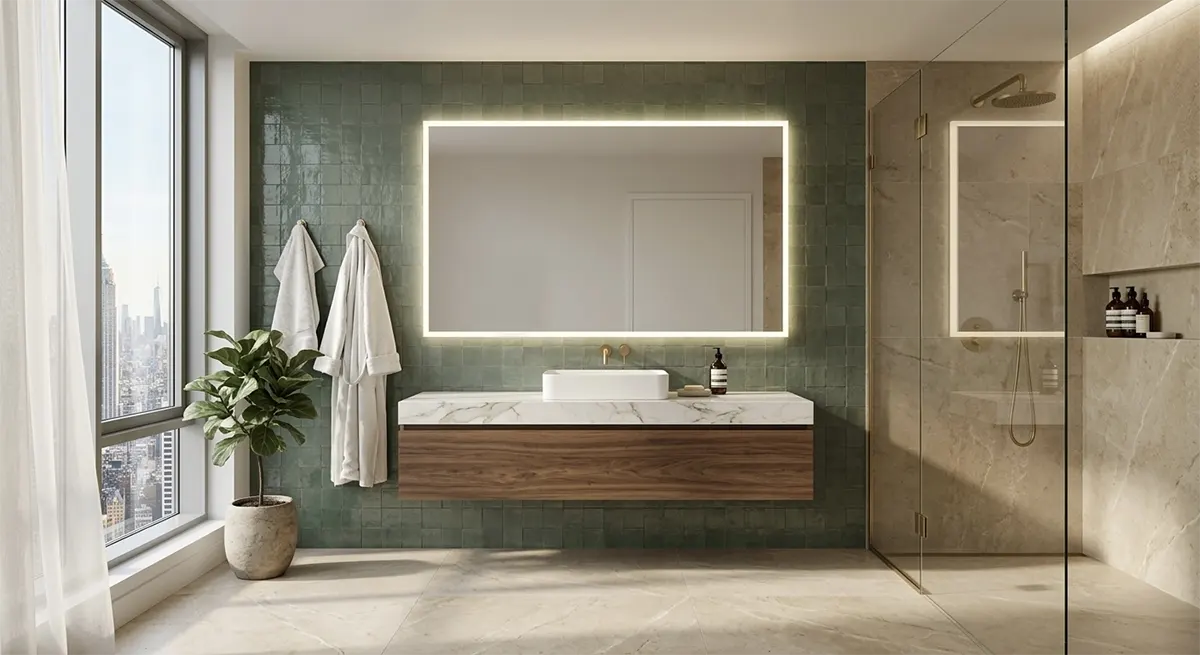
Sage and softer greens work particularly well in small bathrooms because they read warmer than pale grey while staying restrained, and they pair beautifully with brushed brass or aged bronze for a spa-like effect. Deeper forest and emerald greens are more dramatic and generally work best as an accent or in a small powder room, where matte-finish tile and some under-cabinet or niche lighting keep the surfaces from disappearing entirely.
Blue offers a wider range. A soft sky blue expands a space and feels gentle, a dusty blue with grey undertones is the most versatile of the family and sits comfortably with both warm and cool metals, and navy anchors a room, working especially well against white tile for crisp contrast. One caution for bathrooms with little natural light: pure cool blues tend to go cold and flat unless you balance them with warm lighting.
Neutrals
Neutral doesn’t have to mean bland. A sophisticated neutral bathroom layers tones and textures rather than repeating one shade, combining warm off-white paint with a honed limestone vanity top, wood veneer cabinets, and a slightly darker grout that ties everything together.

Warm beiges and tans sit well with travertine, soft plaster, and warm oak, though the undertone needs watching since too much yellow reads cheap quickly. Off-white pairs naturally with large-format marble-look porcelain and benefits from cross-illumination, but it can feel sterile without texture somewhere in the room. Warm greige handles matte black or brushed brass hardware beautifully, and its main risk is flatness, which a single textured surface resolves.

Black, grey, and high contrast
A black and white bathroom reads as precise and deliberately designed, and grey functions as the connective tissue between the two extremes, with dove grey walls over a charcoal floor creating depth while keeping the room calm.
Matte black hardware gives a modern look and hides wear well, while polished chrome reflects light and increases perceived brightness. In either case, limiting yourself to two or three material families keeps a high-contrast scheme coherent rather than busy.

Dark palettes depend entirely on lighting that has been layered intentionally. Add an eye-level vanity light and a concealed strip so the eye has reference points to work from, or the drama collapses into gloom.
Making a dark bathroom feel intimate rather than small
Painting the walls and ceiling the same deep color dissolves the corners and produces a surprising sense of depth, which is why the approach works so well in small powder rooms where you want drama without sacrificing perceived space.
A few things make the difference between intimate and cave-like. Choose a dark tone with a warm or neutral undertone rather than pure black. Introduce a mirror or a band of metallic tile to bounce what light there is. Use low-glare warm LED lighting to keep the room from reading cold. And bring in stone with visible veining or a textured tile so the surfaces don’t go flat.

Using accent color with restraint
Accent color works best as punctuation, where a single saturated field creates impact without committing the whole room.
In a powder room, plaster pink, mustard yellow, or teal can carry an entire wall or even the ceiling, since the space is small and you’re not living in it for long stretches. A primary bathroom handles deeper terracotta, olive, or slate blue better when the color is contained to a tiled niche or a painted vanity rather than spread across the room. Guest bathrooms sit comfortably with sage, soft coral, or dusty lilac on a single feature wall or on the cabinetry.

The principle underneath all of it is that bold color should read as a personality detail rather than an architectural commitment, which means keeping the surrounding surfaces neutral and tactile.
The technical realities that limit color choices
Color has to survive moisture, cleaning, and time, and a paint chosen for a living room will often fail in a bathroom.
Use moisture-resistant paint in satin or semi-gloss on walls in wet zones and avoid flat finishes entirely. For showers and genuinely wet walls, tile or cementitious finishes are the right answer rather than paint of any kind.
Light Reflectance Value is worth understanding as you choose. It is a number from 0 to 100 printed on the back of most paint chips, measuring how much light a color returns rather than absorbs. A lower LRV looks richer but demands more artificial light, while a higher LRV reflects light and makes a small room feel larger. Maintenance deserves a thought too: medium-value neutrals hide water spots and limescale better than stark white, and deep colors conceal staining well but show soap scum readily on glossy finishes.
Ventilation and how it affects your finishes
Ventilation may not seem directly related to color, but it determines how your finishes look and perform over time. This is especially relevant in Manhattan bathrooms, where many spaces have no operable window and rely entirely on mechanical exhaust.
Persistent humidity contributes to peeling paint, discoloration, and mildew, meaning a carefully chosen color may never look its best if the underlying conditions are wrong.
There is a number to hold your contractor to rather than a vague standard. The NYC Mechanical Code sets the ventilation rate for bathrooms in private dwelling units at 25 CFM continuous or 50 CFM intermittent (Table 403.3.1.1), and exhaust air has to be discharged to the outside rather than into a shaft shared with supply air. For a windowless bathroom, confirm the fan is sized to meet that and is actually ducted correctly before you finalize finishes. Moisture-resistant paint and grout matter, but air movement is what keeps them looking new.
Choosing a palette

The most reliable starting point is the fixture finish, since the metal tends to define the direction everything else follows.
| Metal Finish | Pairs Best With |
|---|---|
| Brushed brass | Warm greens, beiges, terracotta |
| Matte black | Grey, charcoal, off-white |
| Polished nickel | Cool blues, rich chamois, soft whites |
| Aged bronze | Deep greens, warm browns, stone tones |
From there, work backward from how you want the room to feel and pair the color with lighting that supports it, since either one alone will not produce the effect.
| Desired Mood | Color Direction | Lighting to Match |
|---|---|---|
| Morning clarity | High-LRV neutral, crisp white | Bright task lighting, CRI 90 or above |
| Evening relaxation | Muted green, warm beige | Warm ambient, dimmable |
| Drama and impact | Deep charcoal, navy, forest green | Layered: vanity fixtures plus accent strips |
| Personality without risk | Neutral walls plus saturated accent niche | Highlight lighting on the accent area |
Whatever direction you choose, test it on site. Apply a large paint swatch directly to the wall and look at it in both morning and evening light, and place your tile samples right next to the painted swatch, since tile reflections genuinely alter how the paint color reads.
Practical finishing notes
Select tile and grout together as a system, because grout color changes both the perceived warmth and the pattern density of a tiled surface more than most people expect.
Invest in mid-range moisture-resistant paint rather than the cheapest option, since higher pigment loading and better coverage mean fewer coats and a more even result.
Where you’re planning underfloor heating, wood-look porcelain is a good choice because it reads warm and won’t delaminate with heat. Worth knowing before you plan around it: installing radiant floor heating in a Manhattan co-op or condo requires board approval, since the system builds up the floor assembly and the electrical work needs to be permitted. In pre-war buildings the added height can also conflict with door clearances. Confirm what your building allows before the heated floor becomes central to your design.
Use bulbs rated CRI 90 or above at the vanity so skin tones render accurately, and add dimmable layers so the same palette can read differently in the morning and the evening.

The Rise of Sustainable Renovation: A Guide to Eco-Friendly Upgrades
Something has shifted in how Manhattan homeowners think about renovation. Environmental responsibili
Elevating the Daily Routine: Shower Design That Actually Works
A shower is one of the most intensively used areas in any bathroom, which means its design has to so
Your Bedroom Has the Wrong Energy
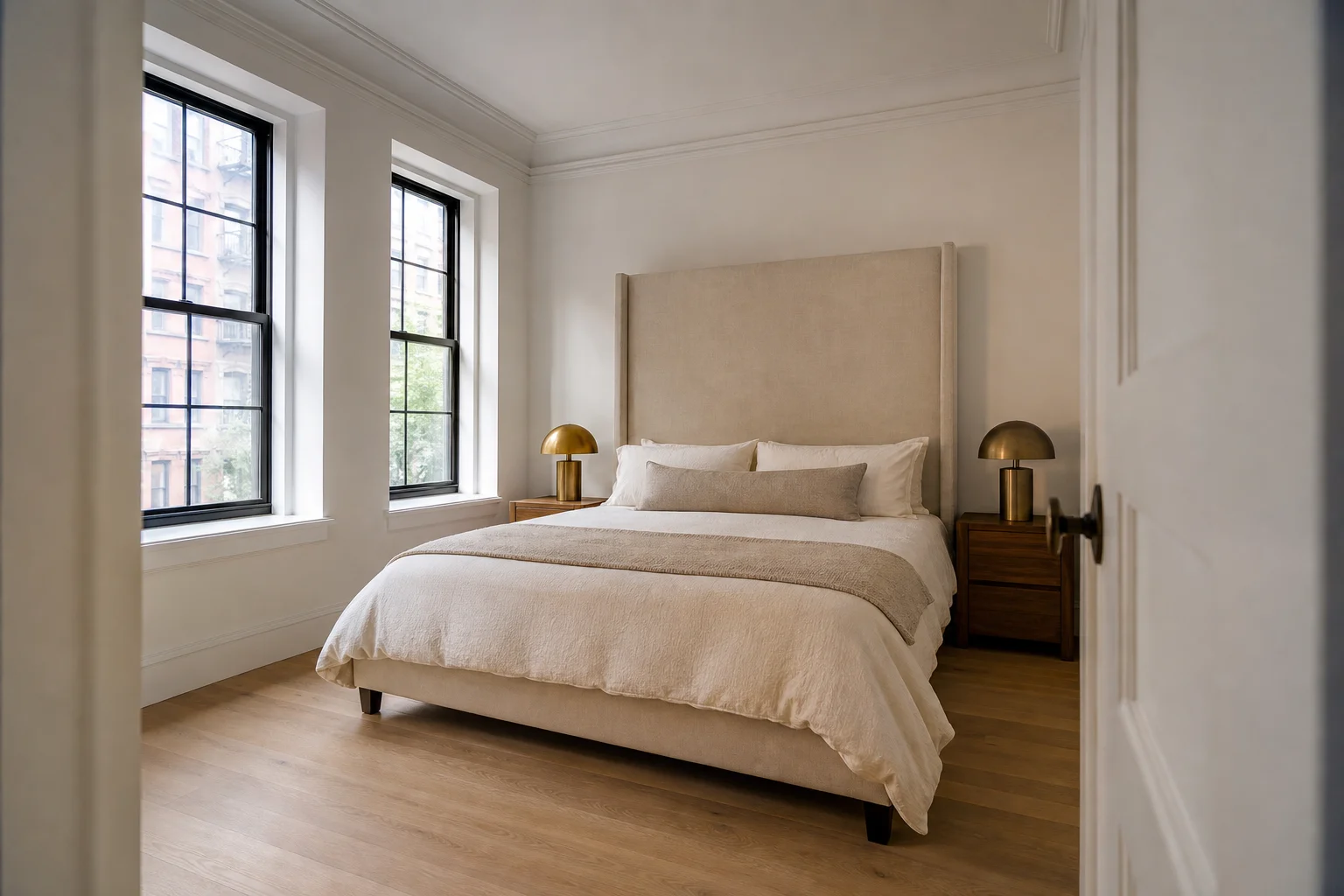
On a gut renovation in Yorkville, the couple kept the bed under a window and both said they woke up