
Water Damage Behind a Pre-War Wall
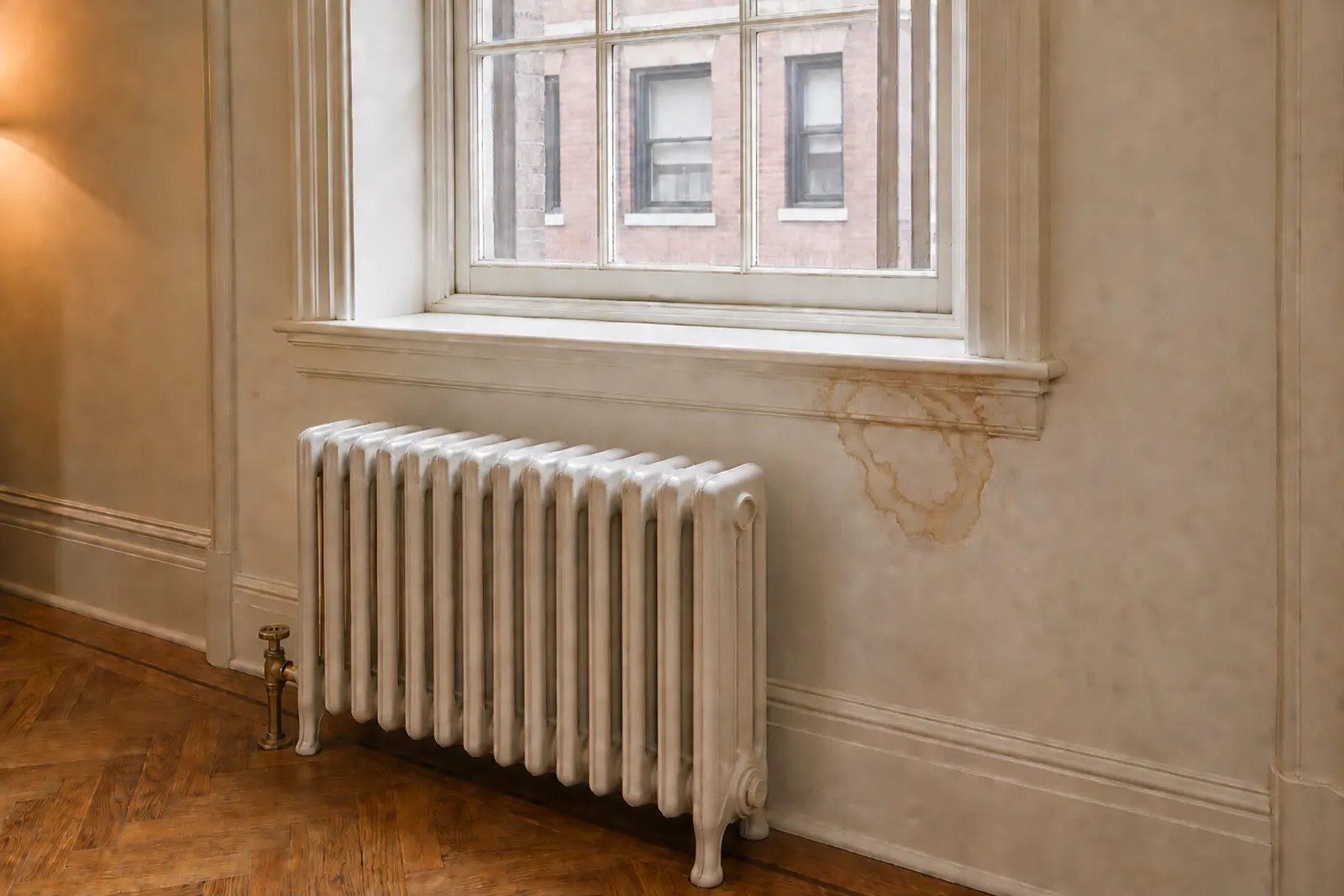
It usually starts small. A faint brown ring on the plaster under a window after a stormy week. A closet that smells like a basement every time the heat comes on. Paint that bubbles in one spot near the radiator and nowhere else. In a pre-war apartment these are easy to live with for years: the stain gets painted over, the closet gets a bag of cedar, and nothing seems to get worse.
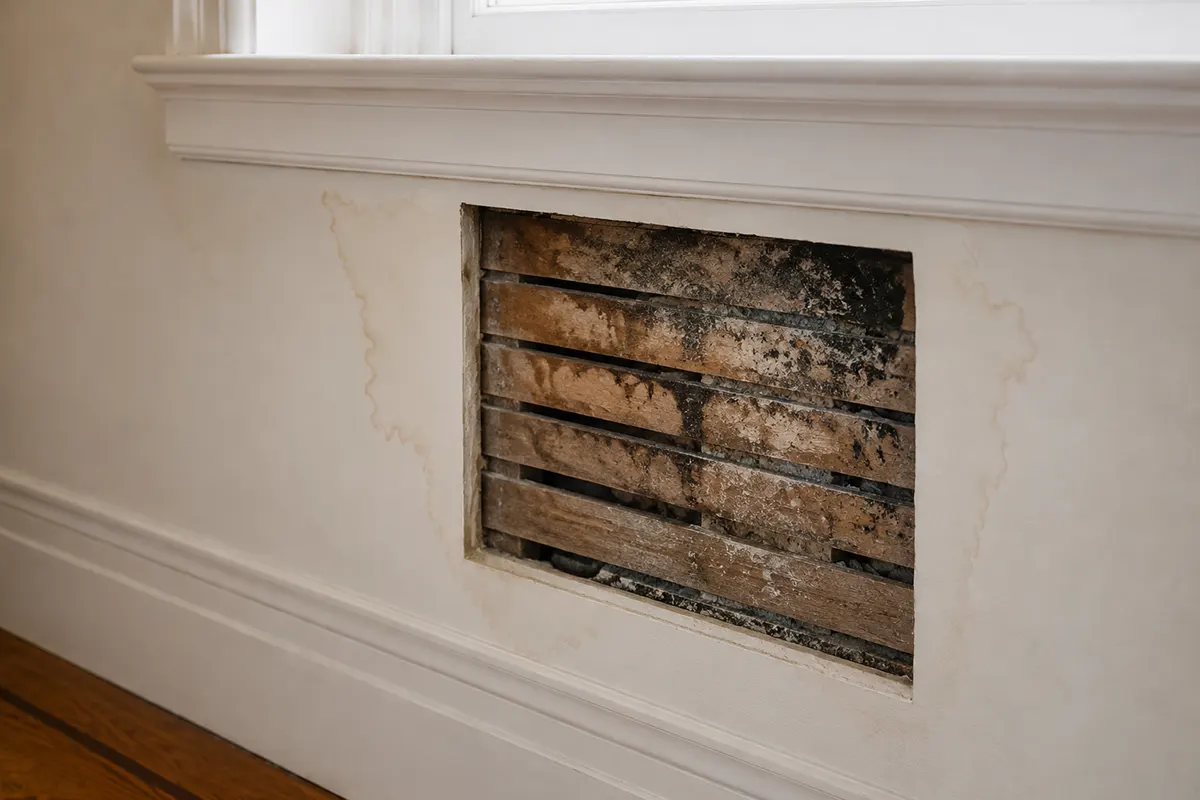
Then the wall is opened for a renovation, and the back of the plaster is dark and spotted, the wood behind it is soft, and the smell is suddenly strong. What looked like a cosmetic stain was water that had been getting into the wall for a long time, and mold that had been growing where nobody could see it.
Here is where that water usually comes from in an old building, when New York’s mold rules apply, who pays in a co-op or condo, and what to do the day you notice the first stain.
Where the water comes from in an old building
Mold needs water that stays. In a pre-war building, a few sources come up again and again, and knowing them tells you where to look.
The first is heat. Most pre-war buildings are heated by steam, and every radiator has a valve and a pipe that runs up through the floors, called a riser. Valves weep, joints sweat, and a slow drip at a radiator can soak the floor and the wall behind it for a whole heating season without ever making a puddle anyone notices.
The second is the outside wall. Old windows, the masonry around them, and the low wall at the edge of a flat roof, called a parapet, let in rain that is driven sideways by wind. That water travels through brick and shows up as a stain under a window sill, sometimes months after the storm and sometimes a floor below where it entered.
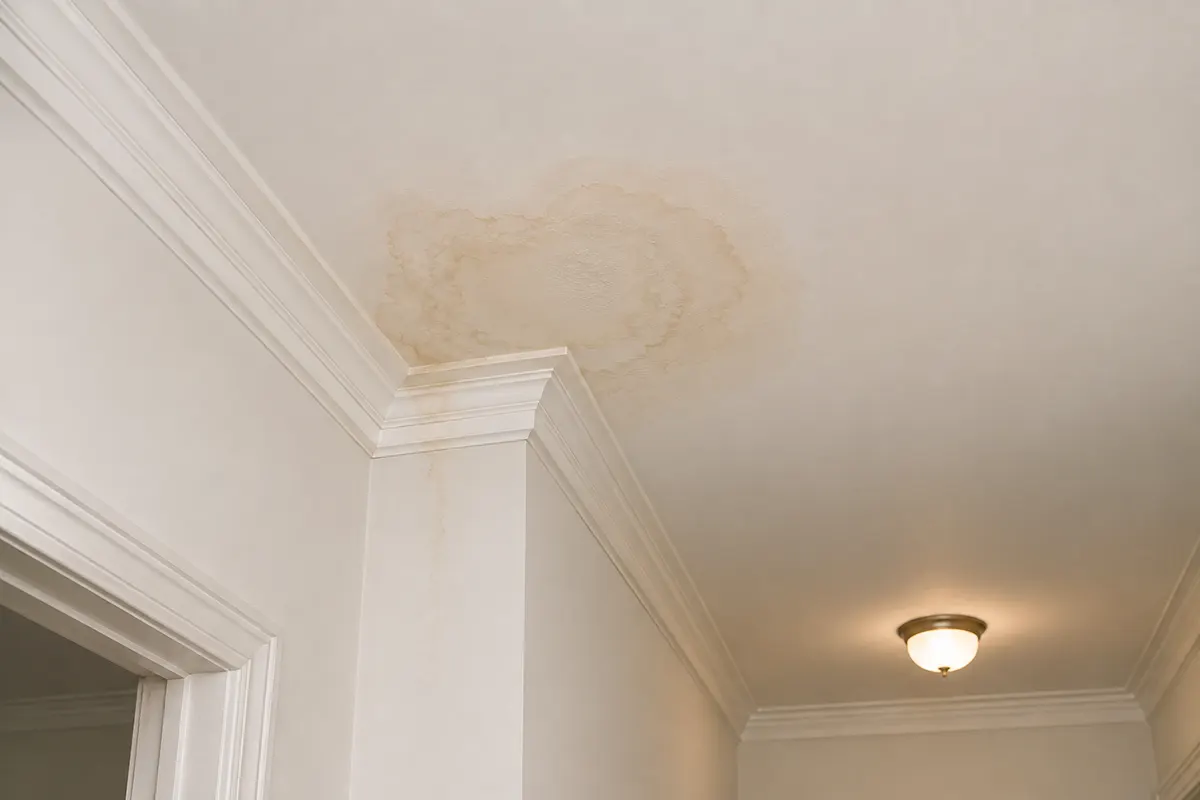
The third is the apartment upstairs. A bathroom or kitchen above yours can leak slowly through its floor for a long time before anything shows on your ceiling or down the inside of your wall.
The fourth is the apartment itself. A bathroom without a working exhaust fan, clothes dried indoors, a closet packed tight against a cold outside wall: moisture that has nowhere to go ends up in the coldest, stillest corner, which is often behind furniture or inside a closet.
Why painting over it never works
A stain is evidence. Painting over it hides the evidence and leaves the water where it was. As long as the wall keeps getting wet, whatever grows inside it keeps growing, and the stain comes back through the new paint.
That is also why fixing mold is really two jobs done by different people. New York State’s mold law is explicit about this: cleaning up mold does not include fixing the source of the moisture. The leak is a job for a plumber, a roofer or the building’s facade contractor. Only once the water has stopped does it make sense to deal with what it left behind. Remediate the mold first and fix the leak later, and the mold is likely to come back, along with the bill.
When the state and the city step in
A small patch of mold on a hard surface is something most owners can clean themselves. The federal Environmental Protection Agency puts the line at about 10 square feet, a patch roughly 3 feet by 3 feet. Beyond that, New York has rules, and they change who does the work.
Under the state law, a mold job larger than 10 square feet has to be handled by licensed professionals, and not by just one. A licensed mold assessor inspects the area and writes the plan that says what has to be removed and how. A separately licensed remediation contractor does the work. The law does not allow the same company to do both on the same property, and it does not allow one owner to hold both companies. When the work is finished, the assessor comes back and checks it: no visible mold left, the plan followed, and the cause dealt with. If it passes, the assessor issues a written clearance report. Keep it. It is the document a buyer, a board or an insurer will ask for later.
In a building with 10 or more apartments, which covers most Manhattan co-ops and condos, the city adds its own layer. Under Local Law 61 of 2018, the remediation contractor files the work plan with the city’s Department of Environmental Protection before the job starts, and the assessor files the post-remediation assessment when it ends. The Department can fine people who skip these steps, from $800 up to $10,000.
For an owner, the practical effect is that a mold problem larger than a small patch is a small project with its own paperwork, two separate firms and a sign-off at the end. It helps to know that before the work is scheduled, so the assessment, the cleanup and the paperwork are planned in from the start.
Who pays in a co-op or condo
The answer almost always depends on where the water came from. As a general pattern, the owner of an apartment deals with damage inside it, while the building deals with its common parts: the roof, the facade, the risers. If the source was a neighbor’s leak, the neighbor, or their insurer, is usually the one responsible. In a co-op, the details are in the proprietary lease, the contract between the corporation and each shareholder. In a condo, they are in the bylaws. Read the relevant clause before anyone starts arguing.
That is why the order of events matters. Report the leak to the managing agent in writing as soon as you see it, photograph the stain and anything wet, and let the super or the managing agent see the source before it is repaired. Call your insurer at the same time. Many apartment policies cover the cleanup after a sudden, covered leak but treat mold that developed slowly over time differently, and many set a separate, lower limit for mold. Knowing your policy before the wall is opened is far better than finding out afterward.
What to do when you see the first stain
Do not paint it. Take a photograph with the date, note when it appeared and what the weather was, and check whether it grows. Look at what is on the other side of that wall or above that ceiling: a radiator, a bathroom, a window, the roof. Tell the building in writing, because in most cases the source is something the building has to fix or at least has to know about.
If the stain is still damp, the water is still coming. If it smells musty, something is already growing. And if you are about to renovate anyway, have the suspect wall looked at before the design is final, so that whatever is behind it is found while there is still time and budget to fix the cause. Finding it after the new cabinets are hanging on that wall means taking them down again.
The stain is the cheap part
A water stain on old plaster costs nothing to notice and very little to report. What it points to is the expensive part: water that has been moving through the building, sometimes for years. In a pre-war apartment, the owners who come out of this well are the ones who treated the first brown ring as a question about where the water was coming from.

Small Spaces, Big Style: Clever Design Hacks for Compact Homes
Living in a compact Manhattan home doesn’t mean sacrificing style or functionality. It simply
Why ‘Cheap Renovation’ Doesn’t Exist in Manhattan
Every few months, someone buys an apartment in Manhattan with a renovation budget that sounds reason
Reviving History: Preserving Character in Historic Home Renovations
There is a quality to pre-war Manhattan apartments that no new construction can manufacture. The par