
The Wiring You Inherited With the Apartment
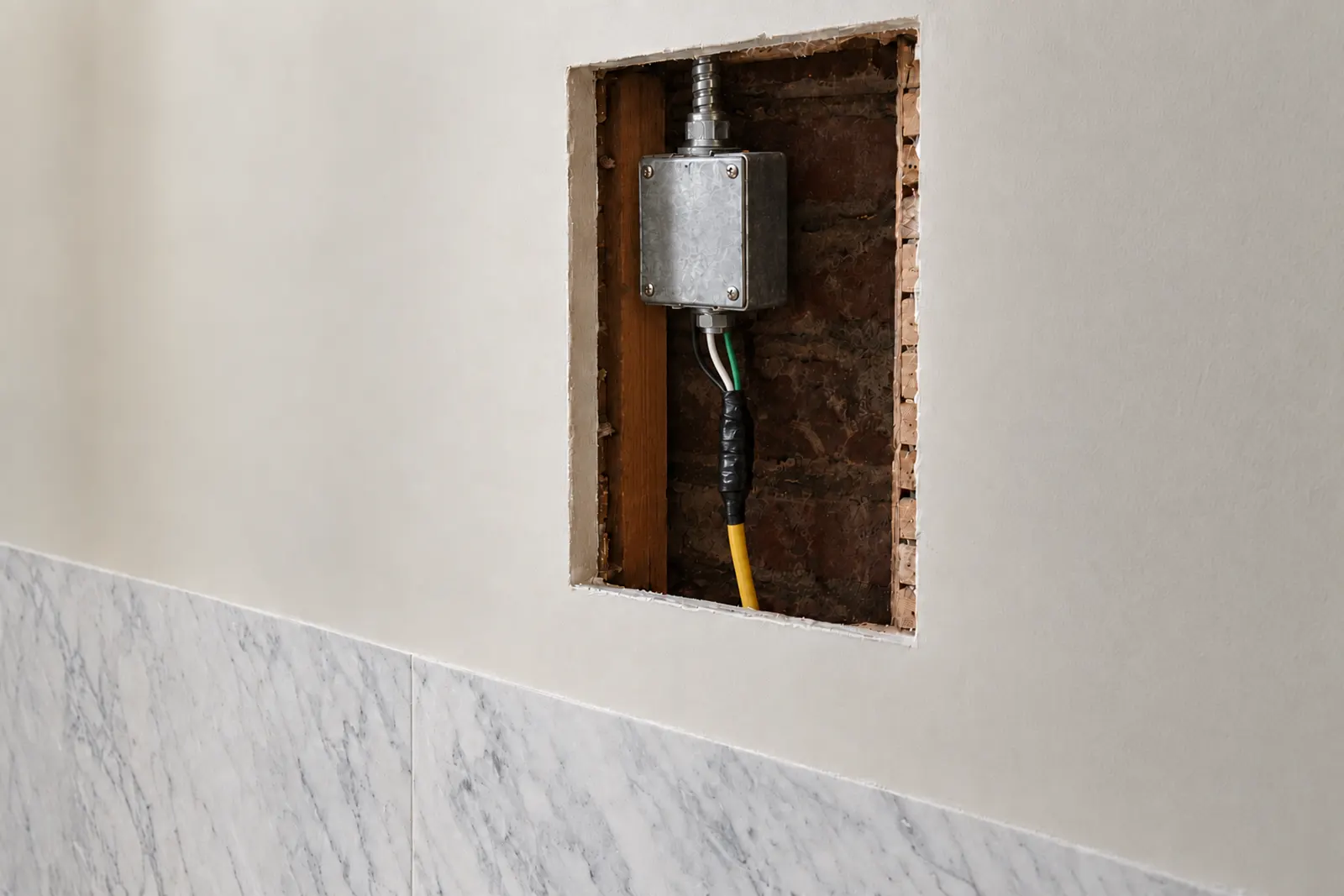
You bought the apartment with a finished kitchen, extra outlets along the counter and a row of recessed lights in the living room. Two years later you decide to redo the bathroom, and the electrician you hired opens the wall behind the vanity. Inside is wiring that does not match the rest of the apartment. Some wire connections are wrapped in tape instead of sitting inside a junction box, and one junction box is buried behind the plaster where nobody can reach it. Then the electrician asks the question that changes the job: did anyone ever pull a permit for this?
In many cases nobody knows. The work was done before you owned the place, by a previous owner or by someone that owner paid in cash. It looked finished, it worked, and nothing came up about it during the sale. Now it is your wiring, in your apartment, and it has to be dealt with before anything new can be connected to it.
How it usually comes to light
Electrical work done without a permit rarely surfaces on its own. It comes out when someone with a reason to look finally looks. In a Manhattan apartment that tends to happen in four ways.
The most common is your own renovation. A licensed electrician who is about to apply for a permit for your new work has to connect to what is already there, and will not put a city license behind wiring nobody can vouch for. The second is the building. Co-op and condo boards review renovation plans, and a managing agent who sees new circuits in the drawings may ask where the permits for the existing ones are. The third is a claim: after a fire, a leak that reaches a panel, or any damage near the wiring, an insurance adjuster will want to know what was installed and whether it was inspected. The fourth is a sale, when the buyer’s attorney and engineer go through the apartment and its records more carefully than you did.
None of these is a city inspector knocking on the door. That is also why the problem can sit unnoticed for years and then arrive at the worst possible moment, in the middle of a project or a closing.
There is one sign an owner can recognize without being an electrician. In New York City, apartment buildings more than three stories tall are not allowed to use the flat plastic-covered cable, usually yellow or white, that is standard in houses across the rest of the country. Wiring in these buildings runs in metal: a cable wrapped in a flexible silver spiral of metal armor, or wires pulled through metal pipe. If you open a cabinet back or an access panel in a Manhattan apartment and see a flat yellow or white cable, someone installed it without following the city’s code, and almost certainly without a permit.
In New York City, almost all electrical work needs a licensed electrician
In many parts of the country, a homeowner can take out a permit in their own name and do their own wiring, then have it inspected. New York City does not allow that. The Department of Buildings, the city agency that issues construction permits, says it directly: no electrical installation or modification can be performed without a permit and a Licensed Master Electrician. That is an electrician licensed by the city, and only that license can file electrical work with the Department.
The rule reaches further than most owners expect: even swapping a few light fixtures on existing boxes, without adding power, needs a Licensed Master Electrician and a permit. The city calls this minor work, and the only step minor work skips is the inspection. Adding an outlet, running a new circuit for a dishwasher or an induction range, or moving a switch to the other side of a doorway is regular electrical work, with a permit and an inspection before the walls close.
So if you are wondering whether you can remodel your own apartment without a permit, the answer for anything electrical is no, and it does not depend on how small the job looks. Painting and new cabinet hardware are a different matter. Wiring is not.
Whose problem it is now
The person who did the work is gone, and so is the owner who hired them. The wiring stays with the apartment. When the Department of Buildings finds electrical work done without a permit, it can issue violations and summonses, and the city names both the owner of the building and the person who did the work as the ones who can face them. A new owner does not get a clean slate because the work is older than the purchase.
Whether you have a claim against the seller is a legal question that depends on your contract and what was said during the sale, and it is one for your attorney. The practical question comes first: the wiring has to be made legal, or taken out and redone, before an electrician will build anything new on top of it.
If you are weighing what the city can charge, we have gone through the fines and legal risks of renovating without a permit in NYC in a separate article. This one stays with the wiring itself.

How unpermitted wiring gets legalized
Legalizing means getting, after the fact, the permit and the inspection that should have happened in the first place. The city has a filing type for exactly this, legalization of completed work, and it comes with a price the original permit did not have: when the Department has not already issued a violation, the filing requires a flat civil penalty of $6,000 for any building other than a one- or two-family house, which covers almost every Manhattan co-op and condo. Otherwise it follows the same path as new work.
First, a Licensed Master Electrician looks at what is there: where the unpermitted circuits run, what they feed, which breaker in the panel shuts each one off if it overloads, and whether any of it is unsafe right now. Some of this can be read from the panel and the outlets. Much of it cannot, because the wiring is inside finished walls and ceilings.
Second, the electrician files a permit that covers the existing work. The city’s Electrical Code requires the filing to say plainly that the work was installed by someone unlicensed. Nobody is pretending it is new.
Third, the inspector may need to see wiring that is now inside finished walls. The permit holder is responsible for keeping the work accessible for inspection, and the city says outright that it does not pay for removing or putting back anything to allow an inspection. How much gets opened is the inspector’s call and depends on what can be checked from the outlets, the boxes and the panel. Whatever is opened has to be patched, smoothed with a thin coat of plaster and painted again, and in a pre-war apartment with plaster walls and detailed moldings that repair is careful work.
Fourth, anything that does not meet the code is corrected. That can be a wire too thin for the breaker that protects it, so it can overheat before the breaker trips; a missing ground wire (the safety path that carries a fault away from you); a splice (a joint where wires are connected, like the taped ones behind the vanity) with no box around it; or a box sealed behind a finished wall where nobody can reach it. The code wants every splice inside a box that can still be opened. Then the Department inspects, and the work gets its sign-off, the record that it was inspected and approved.
How long all this takes often depends less on the paperwork than on what the inspector needs to see. A few new outlets in an accessible spot can be a short job. A kitchen where every circuit was rerun behind new tile is a different project.
What to ask before you buy, or before you build
The cheapest time to find unpermitted electrical work is before it is yours. If the listing mentions a renovated kitchen or bathroom, ask the seller for the electrical permit and the sign-off for that work. A seller who renovated legally will have both, or the electrician who did the job will. An answer like “it was done years ago” or “the contractor handled it” is worth taking to your attorney and your engineer before you sign the contract.
If you already own the apartment and are planning a renovation, raise it early. Tell your electrician about any work you know was done before you bought, and let them look before the design is final. An electrician who finds a problem during planning can price the fix into the job and schedule the openings with the rest of the demolition. One who finds it with the new kitchen half installed has to stop, and so does everyone else.
The wiring is the one part you cannot see
An owner can judge a kitchen by looking at it: the cabinets, the stone, the way the drawers close. Wiring is the part of a renovation nobody sees once the walls are closed, and the permit and inspection are the only record that someone qualified checked it. When that record is missing, the apartment still works and the lights still turn on. What you lose is the proof, and in New York City getting it back means opening the walls.

Custom Cabinet Design: Kitchen Layouts and Corner Plans
A cabinet run in a Manhattan apartment is designed against three fixed things: where the stack sits,

Texture Talk: Adding Depth and Warmth to Your Interiors
Color gets all the credit. Furniture gets all the attention. But texture is what makes a room feel a

Veneer, Laminate or Wood: Cabinet Refacing Materials Compared
When you reface cabinets, you keep the boxes and replace the doors, drawer fronts, and trim. The sur