
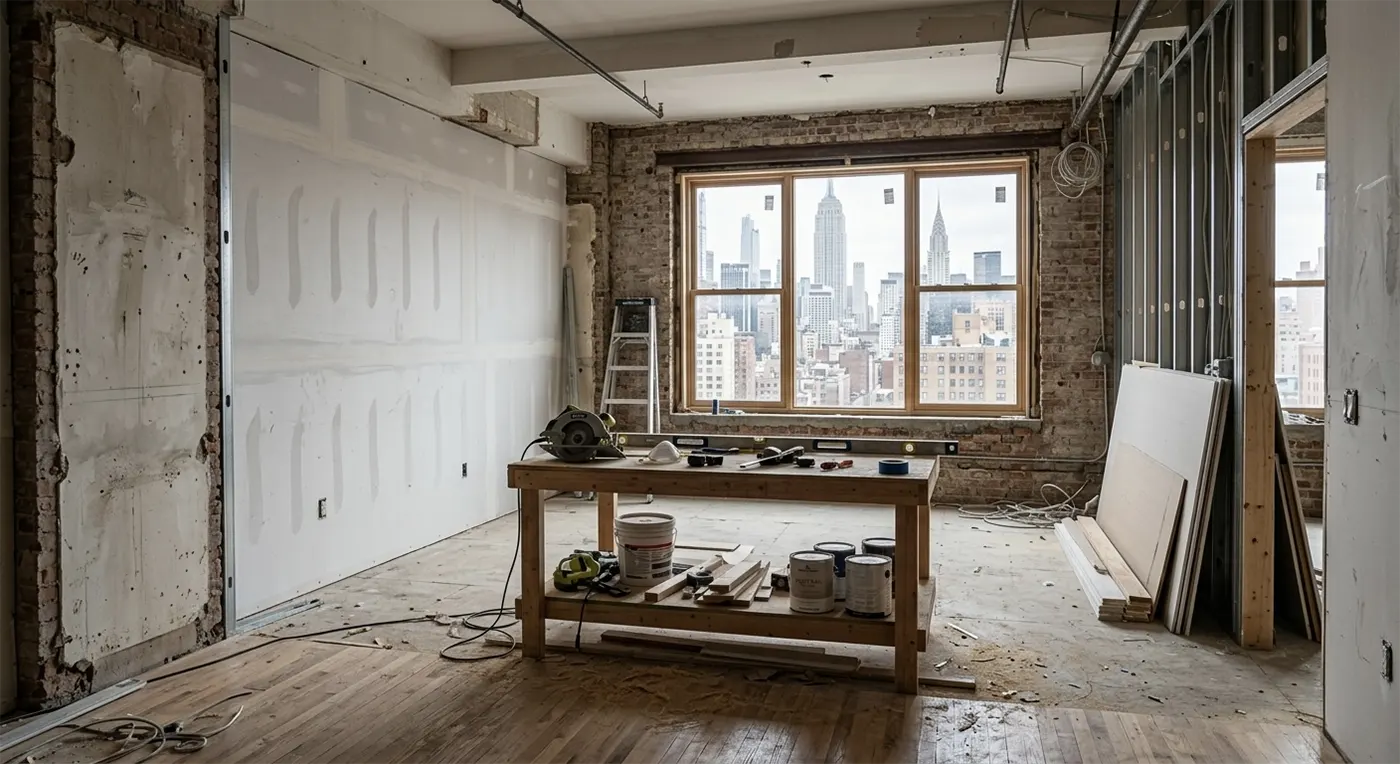
Renovating Without a Permit in NYC: Fines and Legal Risks
Unpermitted renovation work is more common in New York City than most owners want to admit, and the consequences are more serious than most of them expect. The logic behind unpermitted work is usually cost and time: permits take weeks, professional fees add up, and a contractor who says he can handle it quietly without filing seems like a practical shortcut. That logic collapses quickly when the DOB shows up, a neighbor files a complaint, or a buyer’s attorney flags open violations during due diligence.
The NYC Department of Buildings has enforcement authority that does not depend on catching work in progress. Unpermitted work can be discovered months or years after it’s completed, and when it is, the owner is the responsible party regardless of who did the work or when.
What Counts as Work Without a Permit
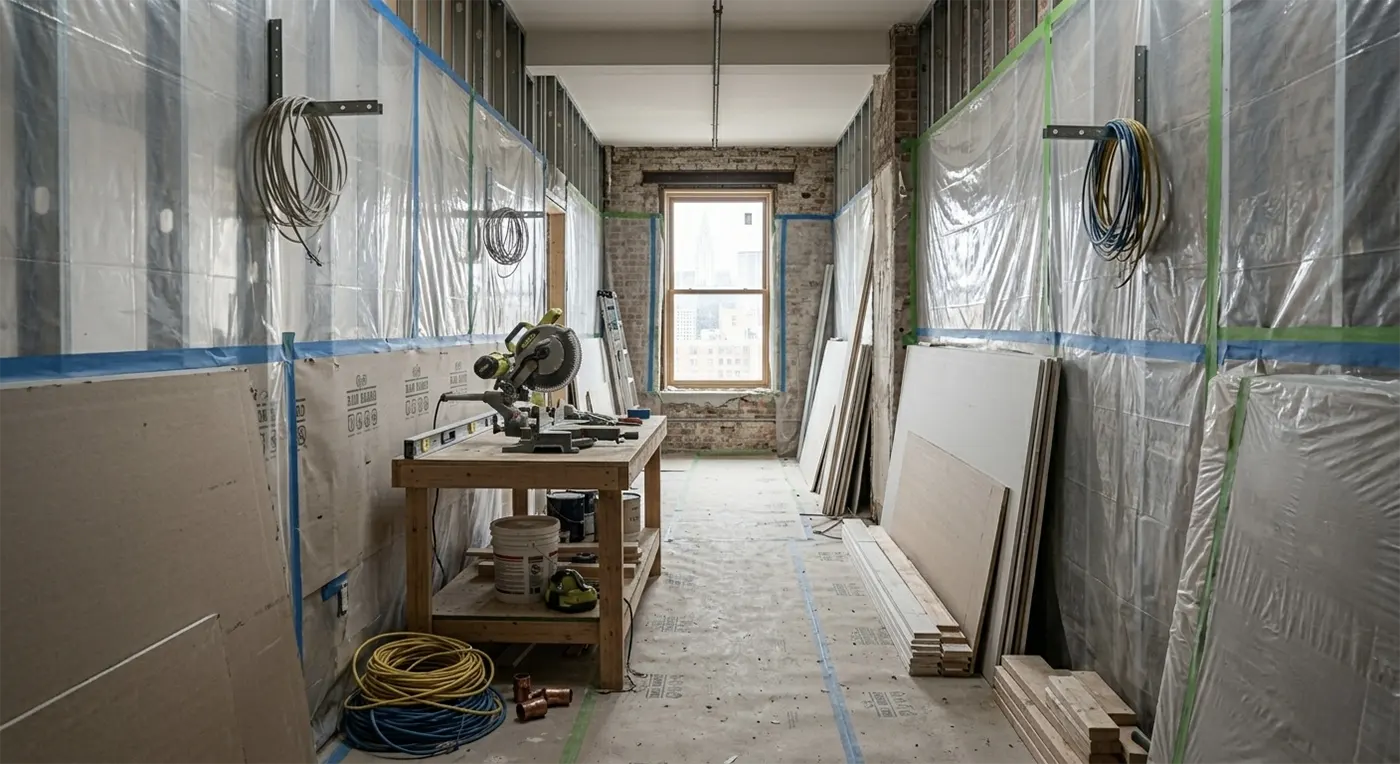
New York City requires a permit for any work that goes beyond ordinary repairs and cosmetic changes. The line is clearer than most owners assume. Replacing a fixture in kind, painting, and like-for-like replacement of finish materials generally don’t require permits. Everything beyond that typically does.
- Plumbing — adding, relocating, or modifying it within an apartment requires a plumbing permit.
- Electrical — new circuits, panel upgrades, and changes to the electrical rough-in require an electrical permit.
- Walls — removing or adding them, including non-load-bearing partitions, requires a building permit.
- Structural work of any kind requires a permit.
- Multiple trades working together on one scope require an alteration filing with the DOB.
The most common misconception is that work described as “minor” is automatically exempt. It isn’t. A contractor who adds a bathroom to a space that didn’t have one, removes a wall to open up a floor plan, or upgrades an electrical panel without filing with the DOB has performed unpermitted work, regardless of how minor it seemed relative to the overall project. The permit requirement is determined by the nature of the work, not by its apparent scale.
How Unpermitted Work Is Discovered
The DOB conducts inspections in response to complaints, and complaints come from predictable sources. A neighbor who hears sustained construction activity and doesn’t believe it’s permitted can file a complaint through the city’s online portal in minutes. A building superintendent who notices contractors in the elevator without a posted permit can call the managing agent immediately. Either event can trigger a DOB inspection within days.
Building management in co-ops and condos monitors construction activity closely. Alteration agreements require prior board approval and a posted permit. A superintendent who doesn’t see a permit on file, or who observes work that doesn’t match the approved scope, is both entitled and in most buildings obligated to report it. The building’s management has financial incentive to enforce this: if unpermitted work damages the building or a neighboring unit, the building wants the documentation to demonstrate it acted correctly.
Resale and refinancing expose unpermitted work with particular reliability. When a property is sold, the buyer’s attorney orders a DOB report that includes all open violations and building history. A permit that was never closed out, a violation on record, or a project that shows no permit activity for a period when neighbors remember construction is a red flag that requires explanation. Lenders conducting a refinancing appraisal encounter the same documentation. Unpermitted work that survived for years without detection routinely surfaces at exactly the moment when the owner needs the transaction to close cleanly.
Fines and Penalties
The DOB issues violations for unpermitted work under 1 RCNY §102-04, and the penalty scales with the type of building rather than starting from one flat number. For a one- or two-family dwelling, the civil penalty is the greater of six times the current permit fee or $600, capped at $10,000. For any other building — which covers virtually every Manhattan co-op and condo — the penalty is the greater of twenty-one times the current permit fee or $6,000, capped at $15,000. A single unpermitted-work violation in a typical Manhattan apartment building starts at $6,000 before anything else is factored in.
Multiple trades performed without separate permits generate multiple violations. Unpermitted general construction, unpermitted plumbing, and unpermitted electrical work are cited independently when they apply, and each one carries its own $6,000-to-$15,000 exposure. Violations are adjudicated at OATH’s Environmental Control Board (ECB) Tribunal, and appearing there with no permit, no architect, and no plan to legalize the work is not a position from which owners negotiate favorable outcomes.
Continuing work in defiance of a posted stop-work order is a separate, more serious violation, with its own civil penalty on top of the underlying work-without-permit fine and, under the Administrative Code, potential criminal exposure for knowingly continuing covered work. When the underlying violation involves hazardous conditions — structural work performed without engineering oversight, or electrical work that creates a fire risk — the penalty moves into a higher bracket than the base civil penalty for unpermitted work alone.
Beyond DOB fines, the cost of legalizing unpermitted work adds real cost on top of them. Hiring an architect to document the existing conditions, prepare legalization drawings, and file a permit after the fact is more expensive than filing correctly from the beginning. The DOB may require destructive investigation to verify conditions behind finished walls. If the work doesn’t meet current code requirements, corrections are required before the permit can be closed, and those corrections involve reopening finishes that were recently completed.
Stop Work Orders and Project Shutdowns
When a DOB inspector finds work in progress without a permit, the result is typically a stop-work order issued on the spot. This order covers all construction activity at the location, not just the unpermitted scope. Workers leave immediately. The project does not resume until the violation is cured and the DOB formally lifts the order.
Lifting a stop-work order is not a quick process. The owner must file a cure application with the DOB, which requires documentation of what was done, who did it, and how the violation is being addressed. If no permit exists, the legalization process must be initiated before the cure can be filed. DOB review of cure applications takes time, and the schedule pressure that caused the owner to skip permits in the first place does not accelerate the DOB’s review.
Projects shut down by a stop-work order often lose subcontractors who move to other jobs during the gap. Rescheduling them back into the project means working around their availability rather than the project’s preferred sequence, which compounds the delay. A project that was three weeks from completion when a stop-work order was issued can realistically take three additional months to close out.
Legal and Financial Risks
Unpermitted work creates legal exposure that extends beyond DOB fines. If the unpermitted work causes damage to a neighboring unit, whether through water infiltration from an improperly executed bathroom renovation, structural settlement from work that should have had engineering oversight, or fire damage from substandard electrical work, the owner of the apartment where the unpermitted work occurred is liable for the resulting damages. In a multifamily building, that exposure isn’t limited to the unit directly below or beside it. Structural work performed without engineering oversight can affect load paths running through several floors, and shared risers, HVAC branches, and common venting often connect more than one apartment — unpermitted work that disturbs any of those shared elements can create a claim from units the owner never considered part of the risk.
Standard homeowner’s insurance policies cover damage that occurs during properly permitted renovation work. When damage occurs during unpermitted work, the insurer has grounds to deny the claim. An owner whose unpermitted bathroom renovation causes a flood in the unit below faces the cost of remediating that unit and the denial of their own insurance claim at the same time. Pursuing the contractor afterward is a separate civil case, and it is often complicated by the fact that a contractor willing to skip permits to save money is frequently under-insured or hard to locate once the project has fallen apart.
At resale, unpermitted work affects property value and transaction feasibility. A buyer who discovers unpermitted work during due diligence has leverage to renegotiate the price, require the seller to legalize the work before closing, or walk away from the deal entirely. A seller who discovers the unpermitted work during the listing process faces the choice of disclosing it, legalizing it before listing, or accepting that it will surface in due diligence and affect the transaction.
Co-op and Condo Consequences
In a cooperative or condominium building, unpermitted work violates the alteration agreement independently of any DOB enforcement. The proprietary lease or unit deed gives the co-op or condo corporation the right to require that all renovation work be conducted under a valid permit and within the scope approved by the board. Unpermitted work breaches that agreement, and the consequences the board can impose are separate from and in addition to the DOB’s enforcement.
There is also a direct financial exposure inside the building itself. Most proprietary leases include an indemnification clause that makes the shareholder liable for any cost or claim the co-op corporation incurs because of the shareholder’s unauthorized work, including a claim brought by an affected neighbor. If unpermitted work in one apartment damages another unit, the corporation can pursue the responsible shareholder directly for what it pays out, on top of whatever the neighbor recovers independently.

Boards that discover unpermitted work can require the owner to immediately stop all construction, submit the work for retroactive board review (which may be denied), restore the apartment to its original permitted condition at the owner’s expense, and in co-ops, pursue legal remedies under the proprietary lease for breach of its terms. The requirement to restore the original condition is not hypothetical. Boards enforce it when the unpermitted work creates risk for the building or conflict with neighboring shareholders.
The relationship between the owner and the board is also damaged in ways that affect future projects. A shareholder who has been found to have violated the alteration agreement faces heightened scrutiny on any subsequent renovation application, longer review periods, more stringent approval conditions, and in some boards, denial of future alteration requests on discretionary grounds.
A Real-World Scenario
Consider a typical version of how this plays out. An owner in a postwar co-op on the Upper East Side contracts with a general contractor to renovate the kitchen. The contractor, citing cost and timeline concerns, suggests skipping the permit and “keeping it simple.” The owner agrees. No filing is made with the DOB. No board approval is sought. Work begins.
Three weeks into construction, a neighbor notices sustained noise during building hours and files a DOB complaint. An inspector arrives the following day, reviews the building’s permit records, and finds no active permit for the unit. A stop-work order is issued. The kitchen is partially demolished, with rough plumbing exposed and cabinet boxes stacked in the living room.
The owner is now required to hire an architect to document existing conditions and file a legalization permit. The architect’s review reveals that the contractor relocated a plumbing rough-in without a plumbing permit and installed a new circuit without an electrical permit. The DOB issues three violations: unpermitted construction, unpermitted plumbing work, and unpermitted electrical work. Because the building is not a one- or two-family dwelling, each violation carries a minimum civil penalty of $6,000 — at least $18,000 in fines before the cost of legalizing the work is even addressed.
The legalization process takes months, not weeks. The board, notified by the managing agent of the DOB complaint, conducts a retroactive review and adds conditions to the approval, including a requirement that all work be re-inspected by the building’s engineer at the owner’s expense. The contractor who suggested skipping the permit has moved on to other projects. The owner pays a second contractor to complete the work under the new permit. Between the DOB fines, the architect’s legalization fees, the engineer’s re-inspection, the second contractor’s costs, and the extended time living without a working kitchen, the total overrun stacks well past what a properly permitted project would have cost — and none of it was optional once the complaint was filed.
How to Fix Unpermitted Work After the Fact

The legalization process for unpermitted work begins with hiring an architect who can document the existing conditions and prepare drawings for a retroactive permit filing. The DOB reviews these drawings in the same way it reviews any alteration application, with the additional complication that some of the work may already be concealed and may require destructive investigation to verify.
If the work as built doesn’t comply with the current NYC Building Code, the legalization application cannot proceed until the non-compliant conditions are corrected. That means reopening finishes, modifying work that was already completed, and having those corrections inspected. The process for correcting a significant non-compliance can be as extensive as redoing the original work.
Open DOB violations must be resolved as part of the legalization process. Appearing before OATH’s ECB Tribunal with a filed legalization application and a clear plan for compliance improves the outcome relative to appearing with nothing, but the underlying fines are assessed regardless.
How to Avoid This Entirely

The answer is straightforward. Every renovation scope beyond minor cosmetic work requires a permit, and permits require licensed professionals. An architect who prepares compliant drawings, an expediter who manages the DOB filing, and licensed contractors who perform the work under an active permit is the structure that keeps a project legally protected from start to finish.
Before any contractor begins work on an NYC apartment, the owner should verify that a permit application has been filed with the DOB, that the permit has been issued, and that the posted permit on-site reflects the full scope of work being performed. A contractor who says the work doesn’t need a permit for a scope that clearly requires one isn’t saving the owner money — he’s transferring his own risk onto the owner instead.
Permits Protect the Owner, Not Just the Building
The permit process in New York City exists to verify that construction work is performed to a standard that protects occupants, neighbors, and the building. An owner who skips that process doesn’t get to skip the standard — only the legal protection that comes from meeting it.
Experienced teams who have managed hundreds of NYC apartment renovations file every project correctly, coordinate all permit tracks simultaneously, and manage the DOB’s review process as a core project management function. The permit is not overhead. It is the foundation of a renovation that closes out cleanly, holds up legally, and adds value rather than liability to the property.
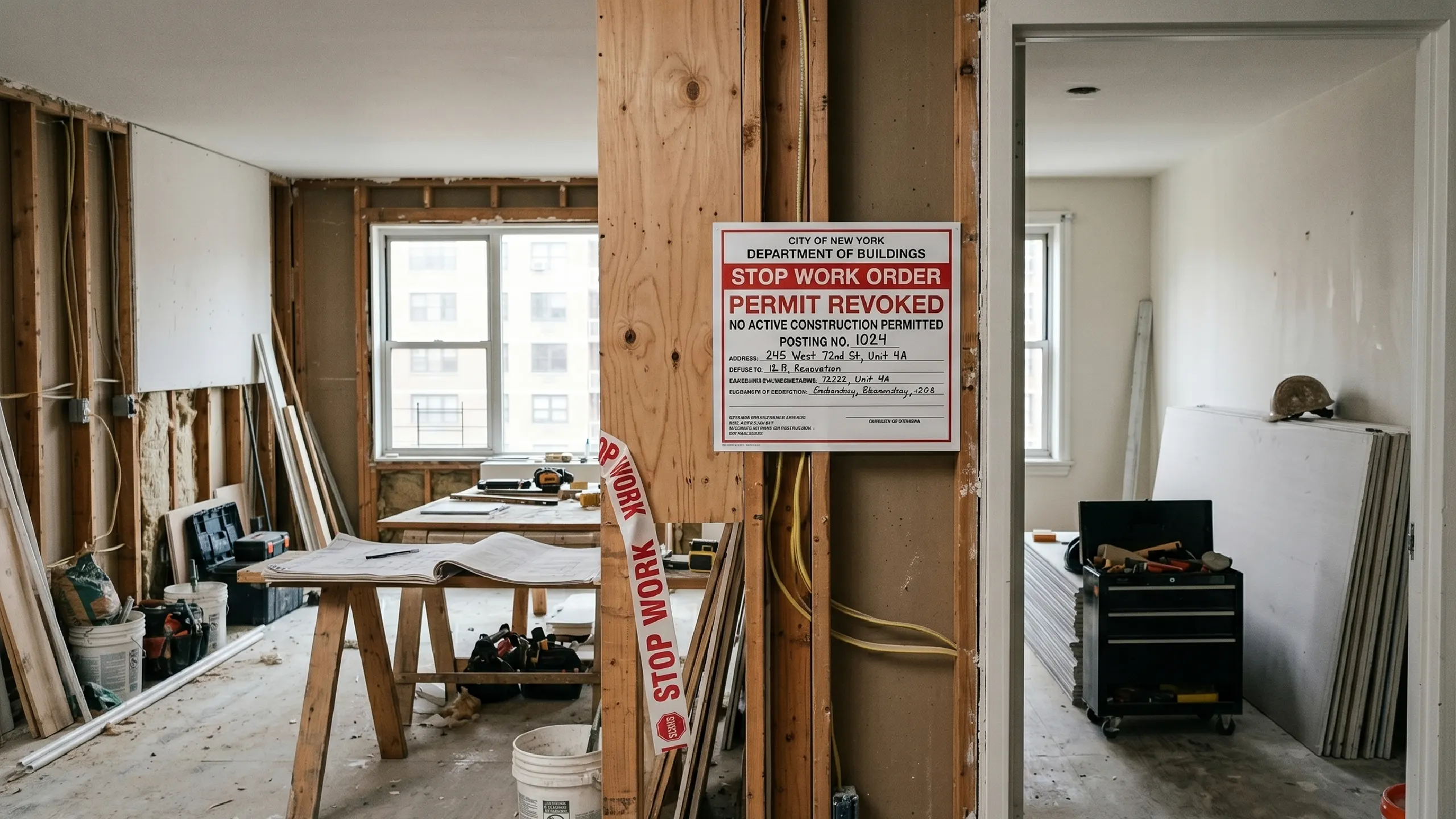
What Happens If Your Contractor Pulls the Wrong Permit
Permit errors are more common on Manhattan renovation projects than most owners realize, and the con
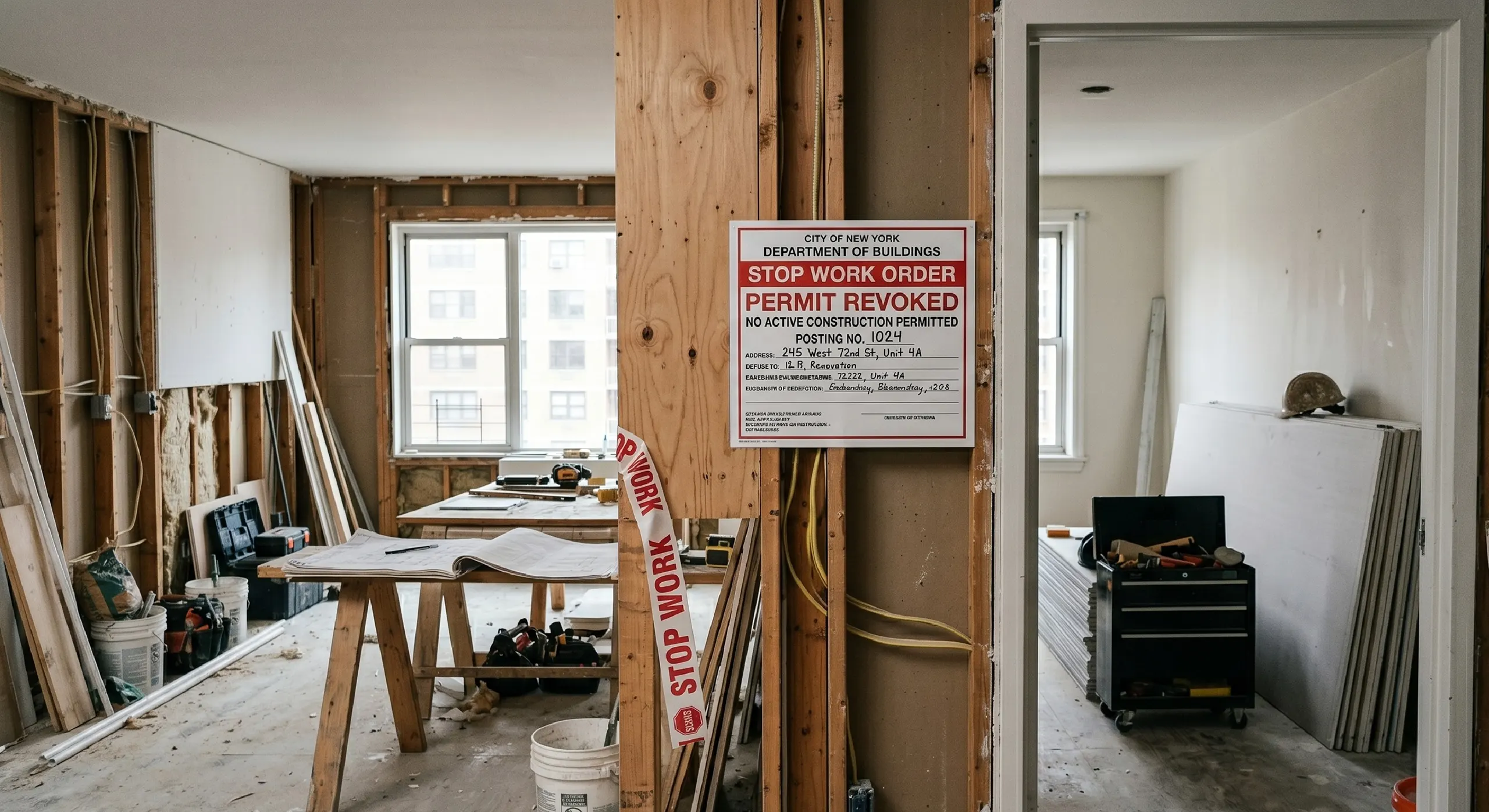
Top 7 Permit Mistakes That Delay NYC Renovations for Months
Most renovation delays in New York City are not caused by contractors, supply chains, or building co

Removing Load-Bearing Walls in Urban Apartments: Risk, Calculations, and Compliance
Taking down a wall to open a kitchen, connect a living and dining room, or improve natural light is