
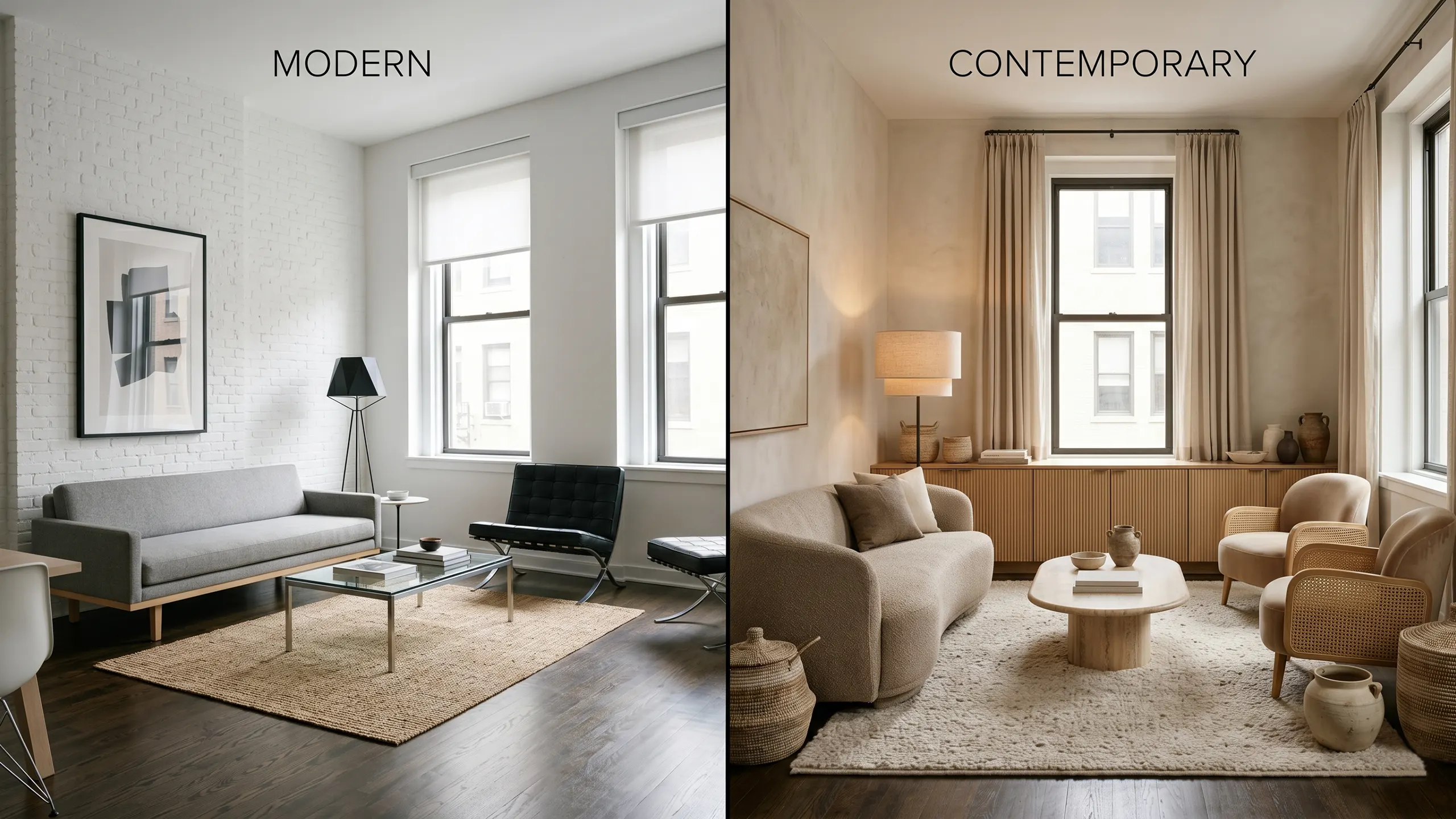
Modern vs. Contemporary Interior Design: What NYC Homeowners Get Wrong
If you have spent any time looking at interior design options for your Manhattan apartment, you have almost certainly come across the terms “modern” and “contemporary” used as though they mean the same thing. Architects use them interchangeably. Real estate listings treat them as synonyms. Even some designers blur the line. But they are not the same, and confusing the two is one of the most common mistakes NYC homeowners make when planning a renovation or redesign.
The confusion costs real money. When a client says “I want something modern” but means they want a warm, layered space with current design trends, and a contractor interprets that as a strict mid-century aesthetic, the resulting apartment can feel cold, dated, or simply wrong. Understanding the actual difference between modern interior design and contemporary interior design in NYC helps you communicate more clearly with designers, make smarter material choices, and end up with a home that reflects what you actually want.
Modern Design Is a Historical Movement, Not a Current Trend
Here is the core issue: “modern” in design has a specific historical meaning. Modernism as a broader design and architectural movement runs roughly from the early 1900s to the 1960s, built on the idea that function should dominate decoration, geometry should stay clean, and industrial materials should be used honestly rather than disguised. Think the Bauhaus school, founded in 1919, Le Corbusier, Mies van der Rohe. Mid-century modern, the era most people actually picture when they say “modern” — the Eames lounge chair, the Saarinen tulip table — is its postwar chapter, running roughly 1945 to 1969. The two get collapsed into one period in casual use, and that collapse is where the confusion starts.
In practice, a truly modern interior has recognizable characteristics: flat or nearly flat surfaces, minimal ornamentation, strong horizontal lines, and materials like steel, concrete, and glass used without trying to disguise what they are. Wood appears, but it is usually smooth, pale, and untextured. Furniture sits low to the ground. There is a certain restraint to it that can feel almost austere.
In New York City, you see this aesthetic in pre-war lofts that have been stripped back to their industrial bones, in certain Upper West Side apartments renovated in the 1970s and never updated, and in intentional mid-century restorations where the owner wants a very specific period look. It is a valid and beautiful aesthetic. But it is a period style, which means it carries certain limitations.
What Modern Design Looks Like in a Manhattan Apartment
In a typical Manhattan apartment, a modern interior tends to feature a neutral palette anchored in white, off-white, and warm grey. Furniture is low-profile and often includes iconic pieces, such as an Eames lounge chair or a Saarinen tulip table, that are immediately recognizable as mid-century references. Cabinetry is handleless or uses recessed pulls. Flooring is often pale hardwood or concrete. Textiles are minimal and unpatterned.
The difficulty in a city apartment is that strict modern design can feel cold, especially in spaces without natural light. Many Manhattan units face courtyards or have narrow windows. A palette of white walls, pale oak, and brushed steel without warm textiles or organic elements can make a room feel clinical rather than refined. This is why it takes real skill to execute a true modern interior in NYC without making it feel uncomfortable to live in.
Contemporary Design Is Always Moving
Contemporary interior design is, by definition, what is happening right now. It is not tied to a single historical period or philosophy. Contemporary style in 2015 looked different from contemporary style in 2010, and both look different from what designers are doing today. It absorbs influences from multiple directions: Scandinavian minimalism, Japanese wabi-sabi, industrial loft aesthetics, biophilic design, maximalism, and so on.
What ties contemporary design together is not a fixed aesthetic but rather an attitude: a preference for clean lines without rigid rules, comfort without clutter, and materials that feel fresh rather than nostalgic. Today’s contemporary apartment in Manhattan might combine warm terrazzo floors, fluted cabinetry fronts, arched doorways, and natural linen upholstery. None of those elements belong to modernism in the historical sense, but together they signal the current moment.
The appeal for NYC apartment owners is flexibility. Contemporary design does not require you to commit to a single era or remove all warmth from your home. It allows for layering, for personal touches, and for evolving the space over time without the whole thing feeling incoherent.
NYC Apartment Design Trends That Are Firmly Contemporary
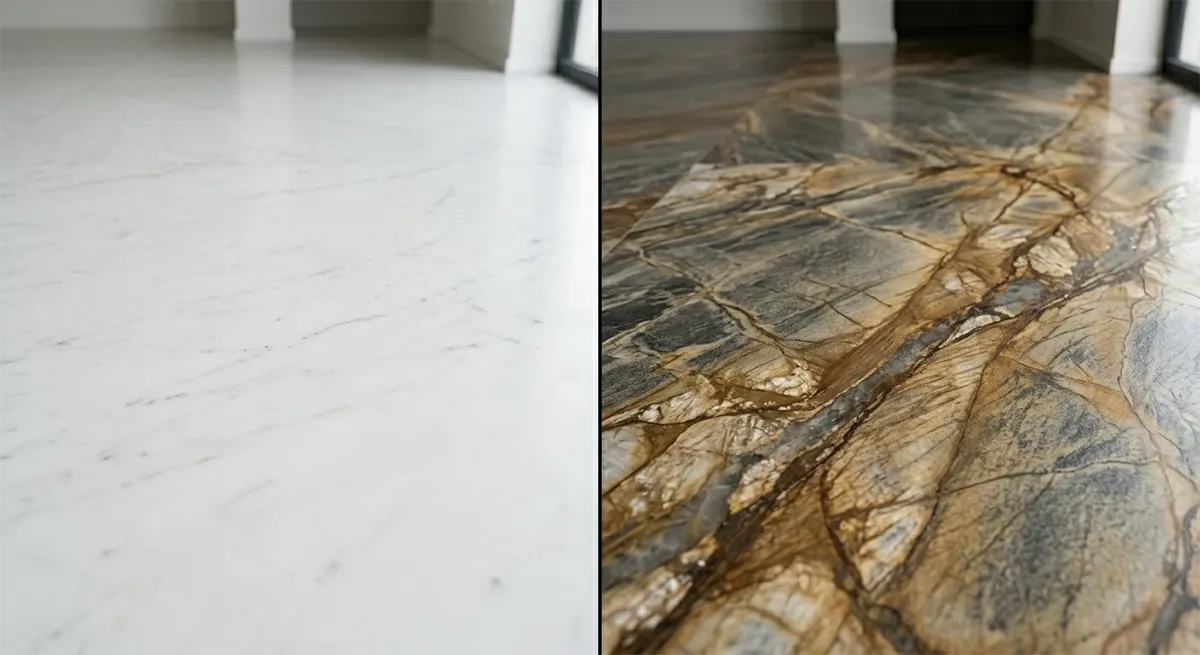
A few elements showing up consistently in Manhattan apartment renovations right now are squarely in the contemporary camp:
- Fluted wood panels on cabinetry, bathroom vanities, and accent walls. This textural detail has no precedent in mid-century modernism and is entirely a current trend.
- Curved and arched forms. Arched doorways, rounded furniture, and oval mirrors are everywhere in current NYC design. They soften the geometry of a box-shaped apartment and add visual rhythm.
- Warm, earthy palettes. Deep terracotta, mushroom beige, warm sage, and muted rust are replacing the cool greys that dominated the previous decade.
- Natural stone used dramatically. Large-format slabs of marble, quartzite, or travertine as feature walls or waterfall countertops. Modern design used stone sparingly; contemporary design makes it a focal point.
- Mixed metal finishes. Combining brushed brass, matte black, and warm nickel in the same space would have been considered a mistake under modernist rules. In contemporary design, it is intentional and nuanced.
Where NYC Homeowners Go Wrong: Mixing Without a Framework
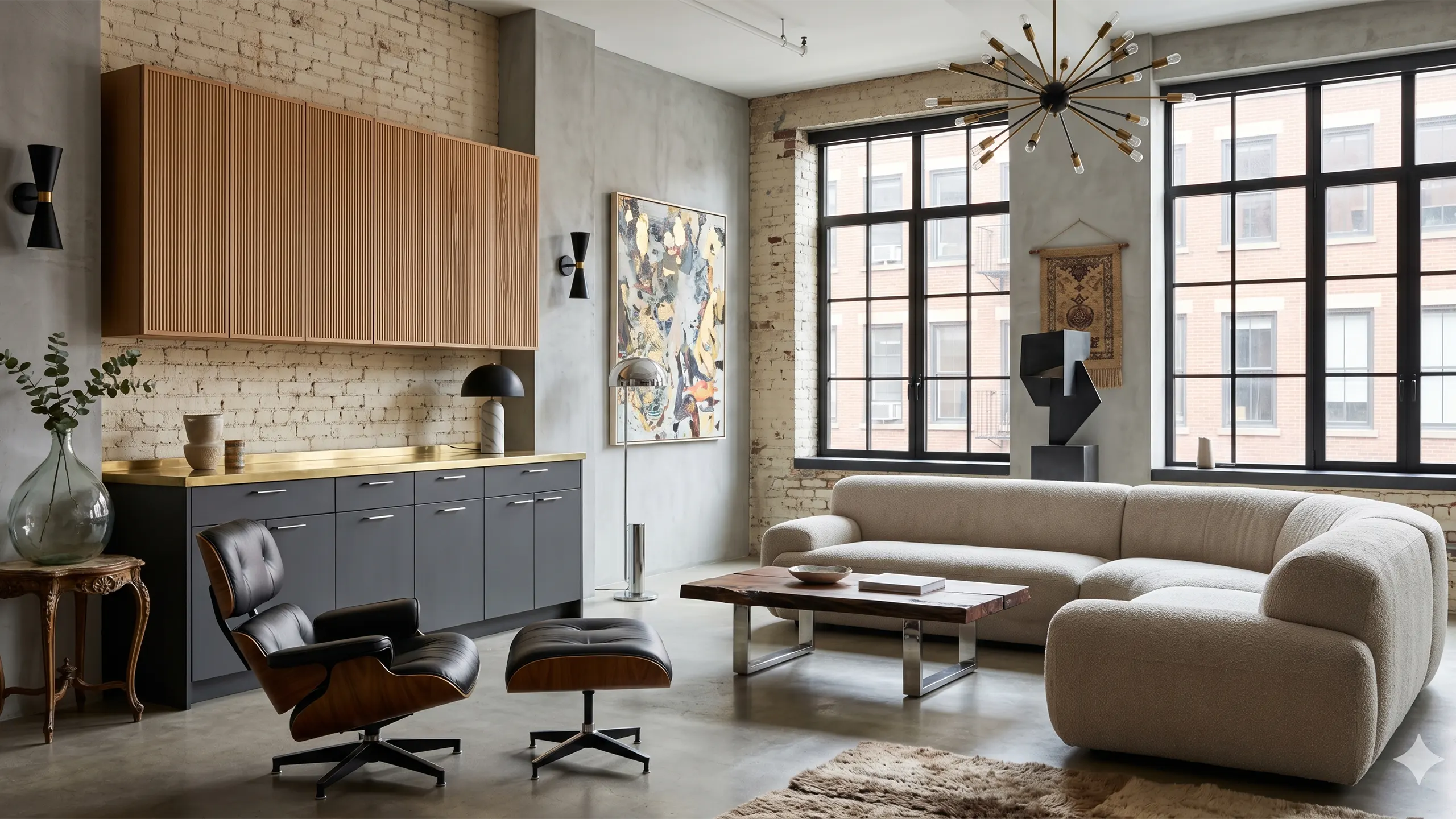
Knowing the difference between the two styles matters most when you are trying to combine them, which most people inevitably do. A client who loves mid-century furniture but wants a kitchen with current finishes needs a designer who understands how to bridge the two without creating a space that looks like it was furnished from three different catalogs in three different decades.
The most common mistake is what we might call inconsistent commitment: spending on a statement piece from one tradition while letting everything else drift. A gorgeous vintage Knoll sofa placed against warm greige walls with brass fixtures, chunky ceramic pendant lights, and a rattan side table is not a modern interior. It is a contemporary space with a modern accent. There is nothing wrong with that, as long as it is a deliberate choice rather than an accident of shopping.
Mistake #1: Applying Mid-Century Logic to a Current Renovation
Some clients walk into a renovation with Pinterest boards full of mid-century interiors and then ask for trendy fixtures that clash with that reference. They want the Eames chair and the fluted oak cabinet at the same time. These things can coexist, but only with a clear tonal anchor — left unanchored, they pull in different directions.
If you are leaning toward a modern interior in NYC, the logic needs to extend to every decision: hardware finishes, lighting profiles, tile grout color, even the style of your door hinges. The coherence is what makes the style look intentional rather than assembled. Break that logic in too many places, and you end up with a contemporary space carrying a few retro pieces.
Mistake #2: Treating “Contemporary” as a Blank Canvas
The flip side is equally common. Because contemporary design is more flexible, some homeowners treat it as permission to do anything. The result is a space without a point of view. Everything is current but nothing coheres — the kitchen might look like a 2024 renovation, the living room like a 2019 one, and the bedroom like a hotel room.
Contemporary design still requires a framework: an anchor, a palette, a material story, a tonal direction that runs through the whole apartment. In a 700-square-foot Manhattan unit, this matters more, not less. With less square footage, every element is more visible, and there is nowhere to hide a decision that does not fit.
How Light, Space, and Building Type Should Guide Your Choice
In Manhattan, the building you live in shapes your options more than almost anything else. A pre-war co-op on the Upper East Side has original moldings, high ceilings, and herringbone floors that push the space toward a particular direction. A glass-curtain-wall condo in Hudson Yards starts from a different baseline entirely. Working with the architecture, rather than against it, is one of the first principles any experienced interior designer applies in NYC.
Pre-War Buildings: Why Modern Feels Forced and Contemporary Feels Right
Pre-war apartments were built with ornament in mind. The moldings, the ceiling medallions, the proportioned rooms all speak a different architectural language from mid-century modernism. Trying to impose a strict modern interior on a pre-war space requires stripping out a lot of original detail, which is expensive and, in co-op buildings, often restricted by the board.
Contemporary design handles pre-war buildings more gracefully. You can keep or restore original moldings and pair them with clean, current cabinetry, warm stone surfaces, and modern lighting. The result respects the building’s context while feeling current — classical bones with a fresh interior skin, a combination high-end Manhattan apartment designers return to for exactly this reason.
Post-War and New Construction: Where Modern Has More Room
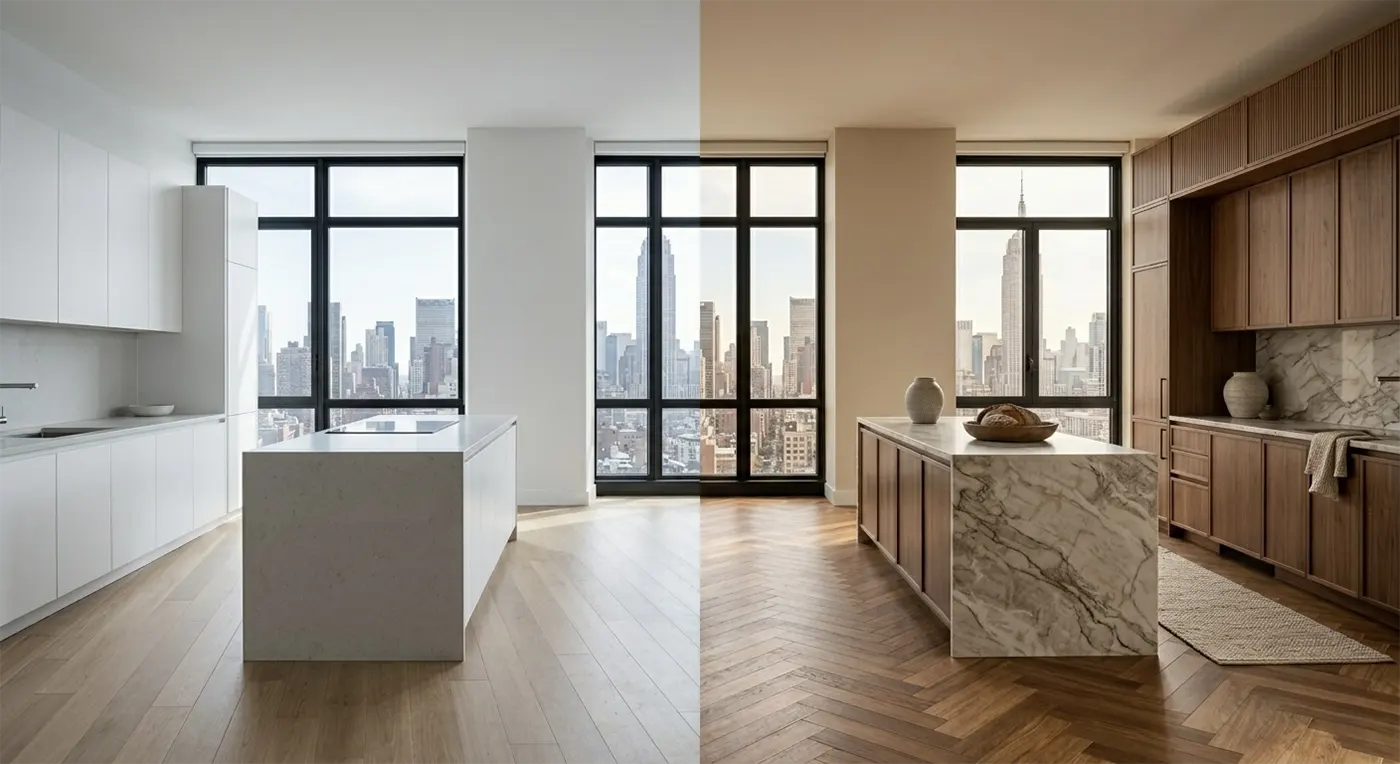
Post-war buildings from the 1950s through the 1980s, and new construction condos built without decorative detail, lend themselves more naturally to a true modern aesthetic. The architecture does not fight you. Open floor plans, low ceilings, and clean wall planes make it easier to commit to the restraint and linearity that modernism requires.
That said, even in a blank-slate new construction unit, the light and orientation of the apartment matters. A north-facing unit with limited daylight will feel very different under a strict modern palette than a south-facing unit with floor-to-ceiling windows. Modern renovations in low-light NYC apartments almost always need to compensate with warmer materials, more layered lighting, and carefully chosen textiles to avoid feeling cold.
Material Choices: Where the Difference Becomes Visible
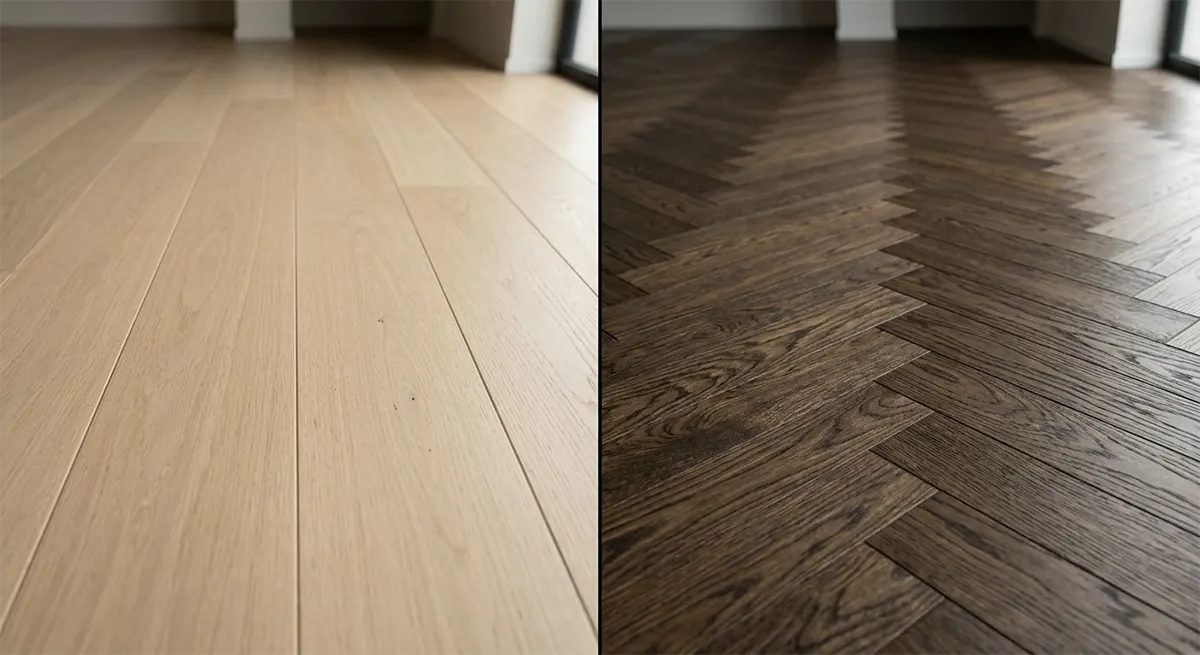
Nothing distinguishes modern from contemporary more clearly than material choices. Here is a practical comparison based on how these styles approach the same decisions:
| Element | Modern | Contemporary |
|---|---|---|
| Flooring | Narrow-plank pale oak or walnut in a simple straight lay, polished concrete, or large-format neutral tile. Grain is minimal and finish is smooth. | Wide-plank wire-brushed oak in warm honey tones, large-format marble-look porcelain, or terrazzo with visible aggregate and color variation. More visual texture and warmth. |
| Kitchen Cabinetry | Handleless flat-front cabinets in white lacquer, matte grey, or pale wood veneer. Clean, unbroken lines. No visible hardware. | Flat-front cabinets with fluted fronts, reeded glass inserts, or integrated pulls. Color palettes extend to deep green, warm putty, or black. Still clean but with more tactile interest. |
| Bathroom | Rectangular fixtures, chrome or brushed steel finishes, white or pale grey tile in a grid or subway pattern, minimal accessory detail. | Zellige tile or fluted stone wall, arched niche, unlacquered brass fixtures that patina over time, freestanding vanity in a deep saturated color. |
Interior designer Tatiana Chechina has watched this shift show up in bathroom requests specifically: clients who once asked for all-white tile and brushed nickel now ask for warm stone and unlacquered brass. That is a contemporary choice, not a modern one, and knowing the difference is what makes certain combinations look intentional and others look accidental.
Practical Advice: Choosing the Right Direction for Your Apartment
So how do you decide which way to go? A few questions help clarify the direction before you commit to anything expensive.
What Does the Architecture Already Say?
Look at the bones of your apartment. Original details, a pre-war ceiling height, original floors, decorative plasterwork, all give you a starting point. A contemporary approach that honors those details looks more considered than a modern one that fights them. If you are in a gutted white-box condo, you have more latitude to choose either direction, though contemporary design still gives you more flexibility.
How Do You Actually Live?
Modern interiors are beautiful but they do not tolerate clutter well. The visual logic of mid-century modernism assumes a certain level of control over the surface. If you have kids, a lot of books, a home office that spills out, or a tendency to layer things on every surface, a strict modern interior will either feel like a losing battle or require significant investment in concealed storage. Contemporary design is more forgiving; it absorbs more life without losing coherence.
The concealed storage that modern interiors depend on is almost always built-in cabinetry and millwork rather than work that touches structural walls. But it still needs a contractor, and hiring a contractor for any built-in work — even non-structural — puts the job under the building’s decoration or minor alteration agreement. Contemporary layouts, which tend to rely more on open shelving and freestanding pieces than on wall-to-wall built-ins, more often stay outside that process altogether. That is a practical, not just aesthetic, reason contemporary can be the easier path in a co-op.
What Is Your Investment Horizon?
Modern design, executed well, tends to hold up visually longer than trend-driven contemporary work, because its logic was set decades ago and does not chase the current material moment. Contemporary design, by contrast, is more exposed to the cycle of trends — the fluted cabinet front that looks current today may look dated in a decade.
For resale specifically, the deciding factor in a Manhattan co-op or condo is rarely modern versus contemporary as a category. It is how neutral and well-executed the finishes are against how niche the reference is: a renovation built around quality materials and a broadly livable palette tends to appeal to more buyers than one built around a strict period recreation, whether that period is mid-century modern or a very specific contemporary moment. If you are renovating a home you plan to keep long-term, that argues for either classic modern choices with staying power or a contemporary approach built on enduring materials rather than trend details.
When the Styles Work Well Together
Done well, the combination of modern and contemporary sensibilities produces some of the most sophisticated interiors in NYC. The key is establishing which style leads and which supports.
A contemporary interior with strong modern influences might use current materials and a warm palette but commit to the same clean geometric lines and restraint that modernism values. The apartment feels current but not trendy. Conversely, a modern-leaning interior that allows a few contemporary accents — a piece of current furniture, a current light fixture — can feel more alive and less like a period room.
The projects that combine both successfully tend to have one thing in common: they were approached with intention from the beginning. The designer knew which style was primary, understood the logic of each, and made deliberate choices about where to stay within that logic and where to depart from it.
Choosing With Intention
Modern and contemporary interior design are not the same thing, and treating them as interchangeable is how renovations lose coherence. Modern is a historical style with a defined logic, rooted in the 20th century. Contemporary is a moving target that reflects what is happening in design right now.
For most Manhattan apartment owners, contemporary design offers more flexibility and a better fit with the realities of city living. That does not make modern design less valid — it means both styles require intentionality. Know which one you are working in, understand the logic behind the choices you are making, and every design decision gets easier to defend.
If you are in the planning stages of a renovation or redesign and want help establishing a clear direction before making any commitments, a design consultation is the most efficient way to work through these fundamentals before construction starts.
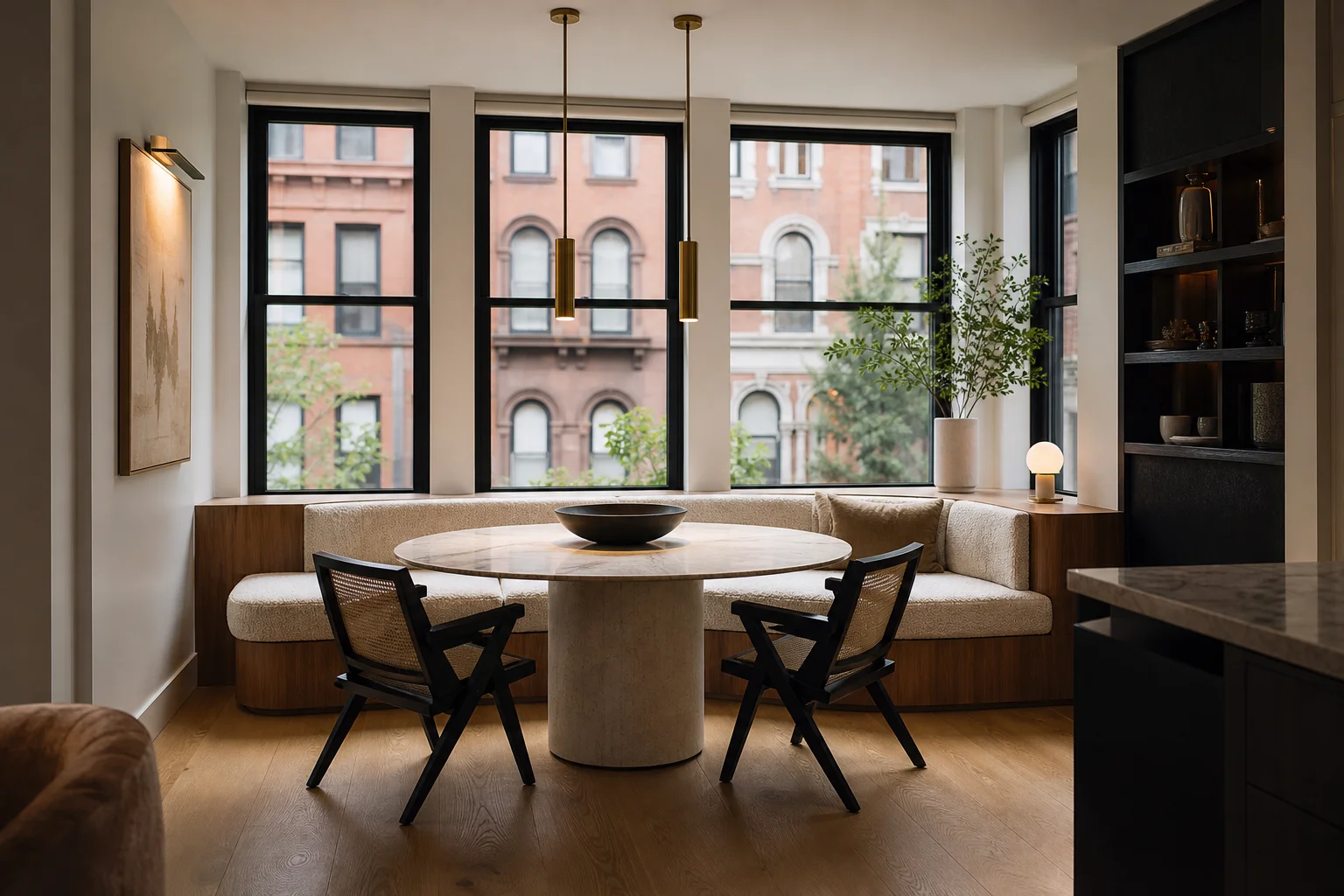
Small Dining Rooms and Breakfast Nooks in NYC Apartments
A small dining room can be comfortable and useful if the layout and the pieces fit the footprint. Th
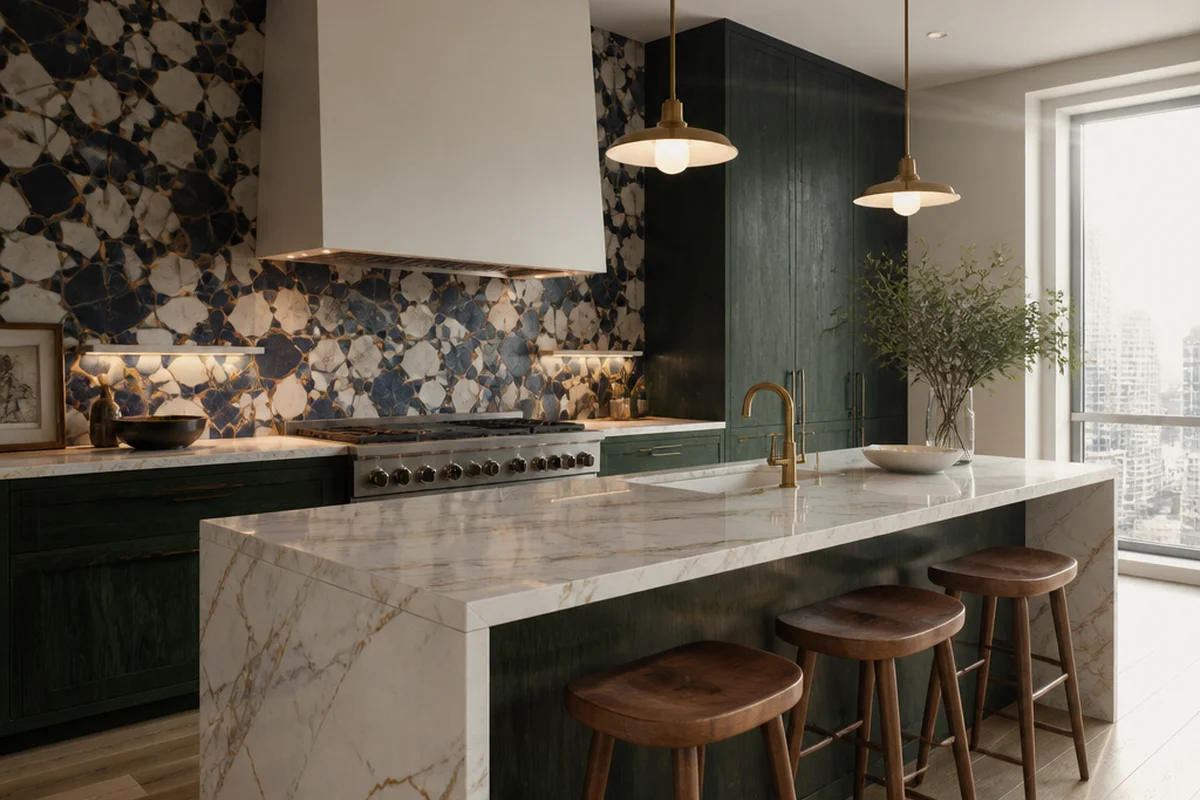
Kitchen Backsplash Design: Materials, Patterns, and What to Skip
Backsplash is one of the last decisions in a kitchen renovation and one of the hardest to reverse. I
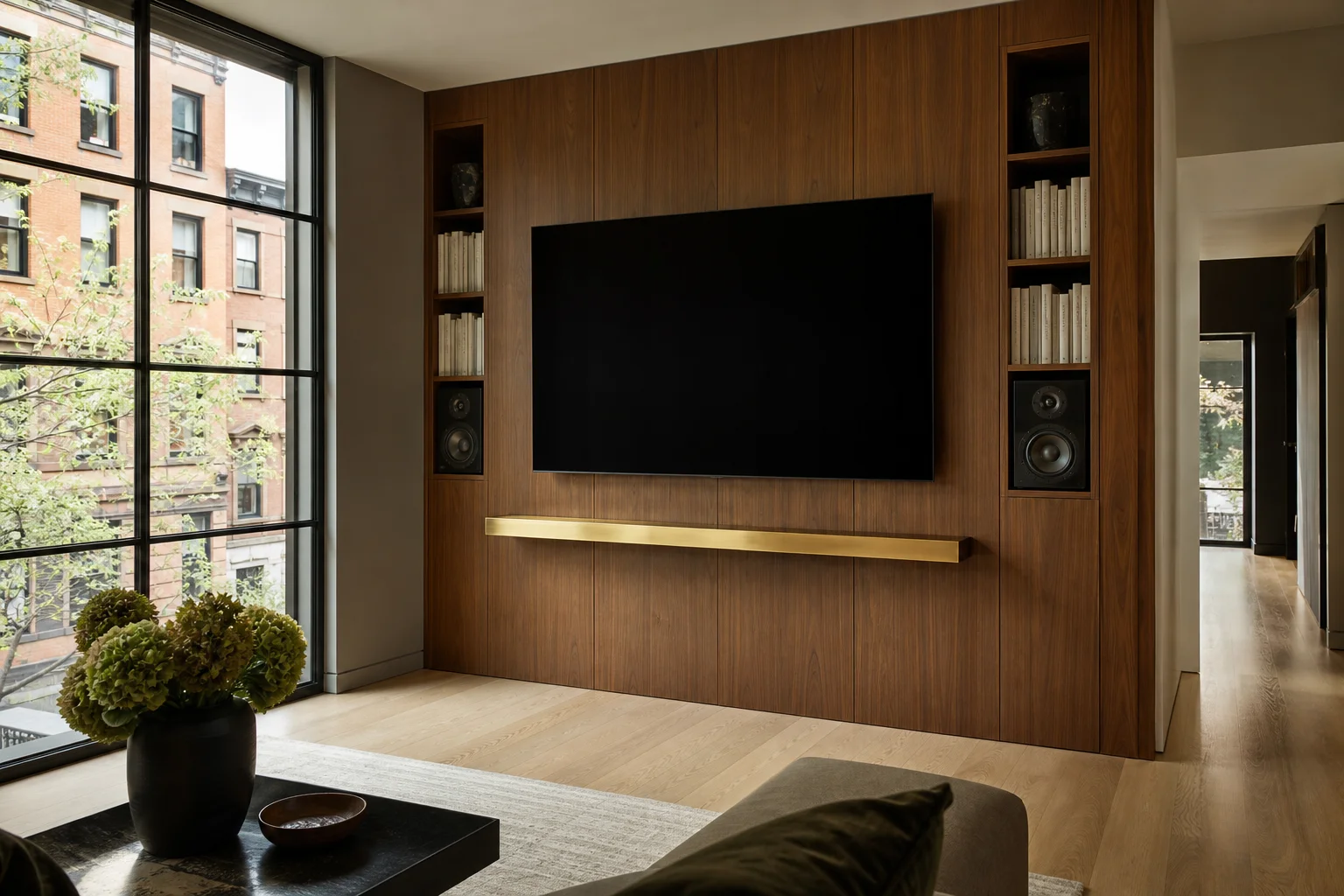
Media Walls and TV Placement in NYC Living Rooms
A good media wall balances sightlines, sound, and storage so the screen looks intentional, not accid