
Feng Shui Apartment Layout: Room-by-Room Principles
Walk into most feng shui consultations and the problems are the same: blocked sightlines, a cluttered entryway, a stove jammed beside the door. They unsettle people whether or not they believe in chi, which is the useful thing about the tradition. Most of what it prescribes is spatial common sense with a long pedigree.
A feng shui apartment starts with a few repeatable moves: clear the entrance, put the major furniture in the command position, balance the five elements, and respect light and airflow. The single highest-impact one is the bed: a solid headboard, a clear sightline to the door, and the foot of the bed not aligned with the doorway.
One caution before any of it. Some of these moves are furniture. Others are licensed work with a permit attached, and the difference is not obvious from the advice itself. This article marks which is which.
What is feng shui and does it work in small apartments?
Feng shui is an approach to arranging space so that energy, or chi, moves through it without obstruction. That is the traditional framing. You do not have to accept it for the rules to be worth following, because the practical prescriptions are the ones that carry the effect: unblocked entries, functional circulation, and deliberate placement of beds, stoves, and desks.
In a compact New York apartment the practice is less about symbolism than about sightlines, storage, and daylight, and those usually do more for how a room feels than any symbolic fix. Treat the tradition as a checklist that happens to be well-tested rather than as a mechanism, and it earns its place.
How do feng shui principles apply to apartment layout?
The principles prioritise the entrance, the command positions, and balance among the five elements: wood, fire, earth, metal, and water.
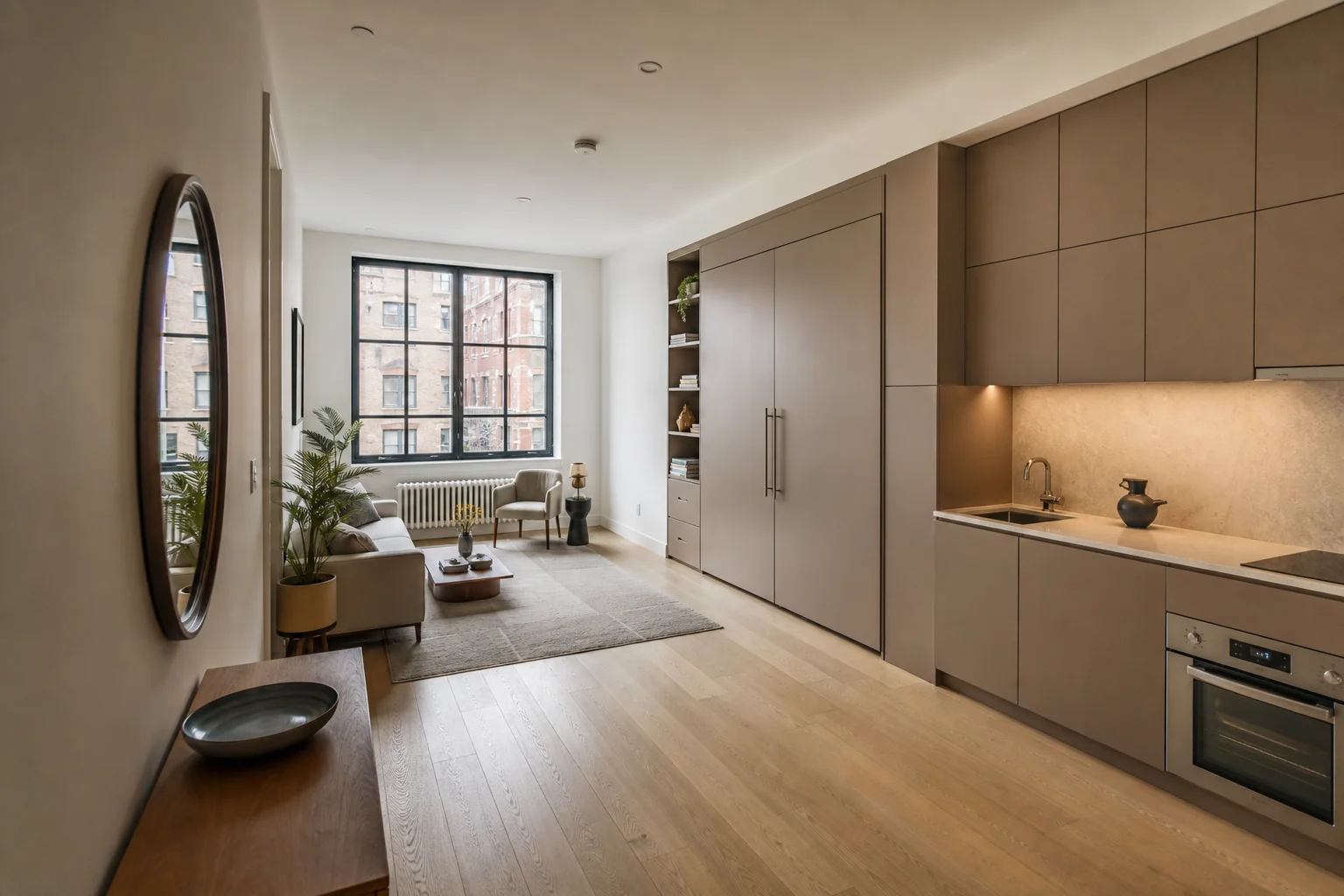
Start at the front door. The stretch of floor immediately inside it should be clear and lit, because it is the first thing you meet coming home and the first thing a guest reads. Keep main walkways unobstructed. Avoid a long sightline that terminates on a blank wall. In an open-plan studio, use rugs and lighting to define zones rather than furniture blocking a route.
One practical note on lighting, because it decides how much paperwork a plan carries. A plug-in floor or table lamp is a furniture decision. Wall sconces are hardwired: adding a junction box, running new wire, or picking up a new circuit requires a New York City Licensed Master Electrician and an electrical permit, while a like-for-like fixture swap on an existing compliant box does not. Decide which you are doing at the planning stage.
Where should I place my bed, sofa, and stove?
The command position rules are simple to apply, and two of the three cost nothing.
The bed. Place it so you can see the door without sitting directly in line with it, and give it a solid headboard. In a pre-war building there is a second constraint that the tradition does not mention but the room enforces: the radiator is almost always under the window, so the wall that looks like the obvious bed wall puts your head over a heat source that clanks and dries the air. Radiators and risers belong to the building, not to you, so plan around them rather than expecting to move them.
The sofa. Orient it so someone sitting can see the entry. The traditional reading is social energy; the practical one is that people are measurably less comfortable with their back to a door they cannot see.
The stove. This is the one that is not furniture. Feng shui puts the stove away from the entrance and out of a direct draft, and both are sensible. But in New York, moving a gas range is licensed work: a Licensed Master Plumber must obtain a permit to install or alter gas appliances or gas piping, filed through DOB NOW. For shifting an existing legal gas line a short distance there is a simplified route, the Limited Alteration Application, which a master plumber can file without an architect or engineer. Nothing about it happens on a weekend with a friend.
The same applies to the range hood above it. Venting to the outside means a penetration through the facade, which is common property in a co-op or condo and needs board approval; where a building will not permit one, a listed ductless recirculating hood is the code-compliant alternative.

How do I apply feng shui room-by-room?
In the bedroom, clear the storage from under the bed, use pairs such as two nightstands and two lamps for balance, and keep electronics away from the headboard.
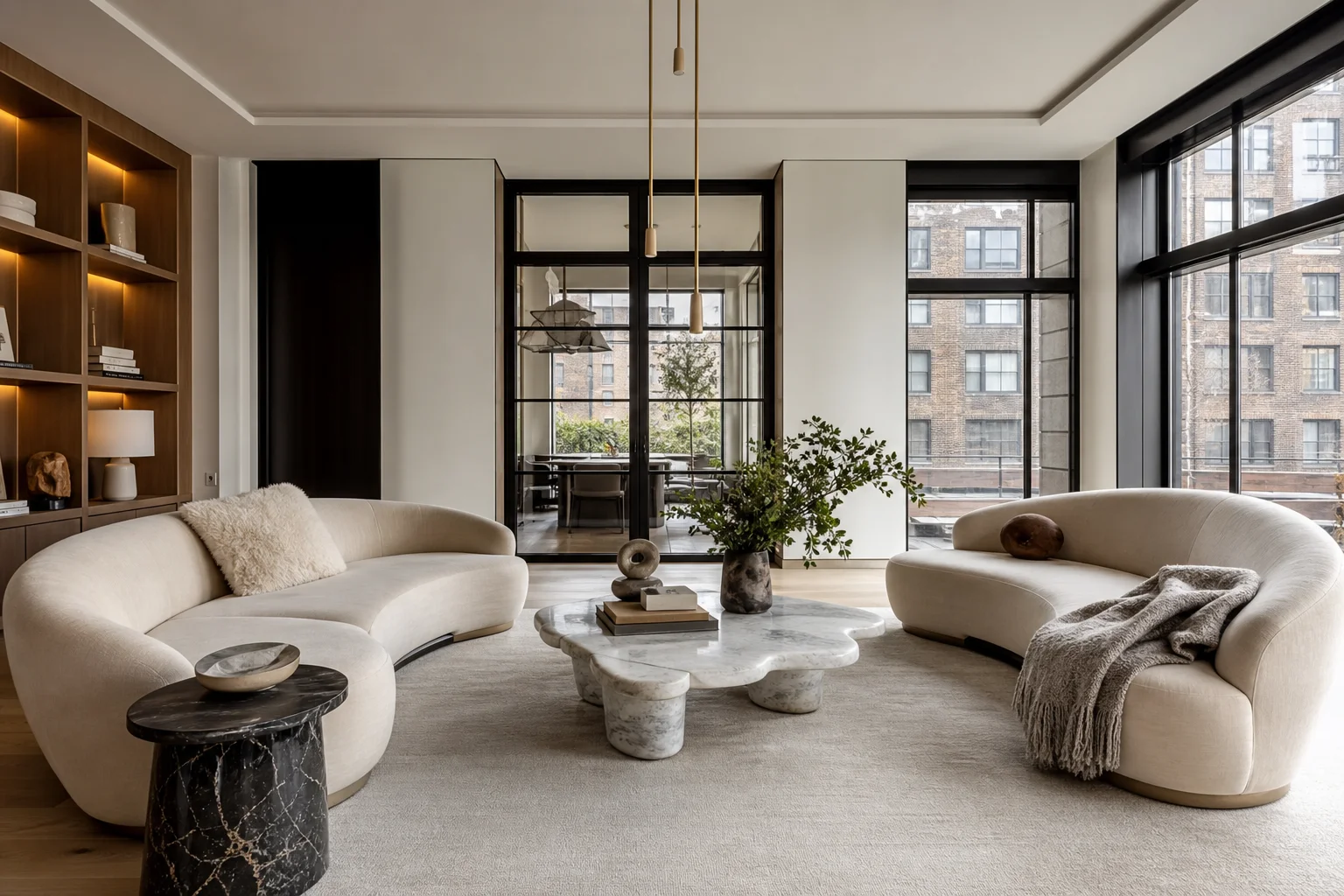
In the living room, set a clear focal point and let seating face both the entry and itself, balancing soft textiles against a metal lamp or a stone table.
In the kitchen, keep the counters working and the controls clean. The tradition adds a plant near the sink to temper water against fire; whatever you make of that, a plant is one of the few kitchen additions that needs no approval from anyone.
In the home office, put the desk in the command position with a wall or a solid bookcase behind it, daylight to the side rather than behind the screen, and cables hidden to cut the visual noise.
The table below sets out the highest-impact move per room, and what it actually changes.
| Room | Key move | What it changes | Furniture or licensed work |
|---|---|---|---|
| Entry | Clear and lit, small console, mirror angled to bounce light | The first thing you read coming home | Furniture, unless the light is hardwired |
| Bedroom | Bed in command position, solid headboard, paired bedside tables | Sightline to the door, symmetry, less clutter in view | Furniture |
| Living room | Seating faces the entry, circulation kept open | Nobody sits with their back to the door | Furniture |
| Kitchen | Stove out of a direct draft, counters kept working | Cooking zone stops fighting the room | Licensed: Master Plumber and a permit |
| Home office | Desk with solid backing, daylight to the side | Fewer interruptions in the field of view | Furniture |
What colors, materials, and decor follow feng shui rules?
Choose materials that echo the five elements: warm wood finishes, stone surfaces, metal fixtures in brushed brass or warm bronze, and a water accent such as a small blue ceramic vessel.
Colours work as tools rather than as rules. Earth tones stabilise a room, reds and oranges belong in accents rather than on walls, blues read calm. In a New York apartment with limited daylight, stark white can read clinical, which is worth knowing before defaulting to it.
Avoid sharp-cornered decor pointed at seating or at the bed. The traditional objection is to the flow of chi; the practical one is that it reads as tension in the corner of your eye, which is the same conclusion arrived at differently.
This is the part of the article where the firm’s designer, Tatiana Chechina, makes the same point about restraint that keeps coming up on projects: a room reads calmer when one material carries it and the rest agrees, rather than when five elements each get equal billing.
Do I need permits to change my NYC apartment for feng shui?
Most of this article needs no approval from anyone. Moving furniture, hanging a mirror, adding a plant, swapping a lamp: none of it is regulated, and none of it involves your building.
The line is crossed the moment a contractor comes through the door, and in a co-op or condo that is the trigger, not the size of the job. Even cosmetic work brings a decoration or minor alteration agreement, a certificate of insurance naming the corporation and the managing agent, scheduled elevator access, and the building’s permitted working hours.
Beyond that:
- Gas — installing or altering gas appliances or gas piping requires a Licensed Master Plumber and a permit filed in DOB NOW
- Plumbing — any change requires a Licensed Master Plumber and a plumbing permit, and moving a wet zone runs into the riser and into the wet-over-dry rule most buildings enforce
- Electrical — new wiring, a new junction box, or a new circuit requires a Licensed Master Electrician and an electrical permit
- Walls — in a co-op, removing any wall needs board approval whether or not it carries load, because the alteration agreement governs the work regardless of the structure
- Pre-war demolition — plaster and tape compound of that era can contain asbestos, so a survey by a New York State licensed asbestos inspector comes first, and where a DOB permit is involved an ACP-5 is filed with the Department of Environmental Protection before that permit will issue
One timing change is worth planning around. Since February 2026, a filing in DOB NOW that lists the owner as a co-op tenant-shareholder or condo unit owner automatically adds the board as a stakeholder, and a board representative must attest in the system before the filing moves. Board sign-off and the DOB filing used to run on parallel tracks; for apartment owners they no longer do.
Read your building’s alteration agreement before you commit to any of it. It carries the insurance limits, the working hours, and often a list of what the building simply will not permit, and it governs your job more tightly than the city does.

Vinyl Plank vs. Microcement: High-End Flooring in 2026
If you’re standing in a flooring aisle trying to work out what the difference is between all t

When Space Tells a Story: Designing Homes with Character, Not Just Style
There’s a specific feeling you get walking into certain homes, an immediate sense that someone

Where Feng Shui Puts Mirrors, Room by Room
Feng shui mirrors are a simple, high-impact element, but placement matters more than size or style.