
Best Color Combinations for a Bathroom Renovation in NYC (2026 Trends)
Color is the cheapest decision in a bathroom renovation and the most expensive one to get wrong. Every surface works as part of a system — tile, paint, grout, vanity finish — and a single miscalculated contrast, or one shade that behaves differently under artificial light than it did on a sample card, flattens the whole result.
What follows is the set of combinations landing well in Manhattan apartments in 2026, the logic underneath them, and the practical constraints of applying colour in the tight, often windowless footprints most New York bathrooms involve.
Where NYC Bathroom Color Design Stands in 2026
The all-white bathroom is not dead, but it has stopped being the default. For most of the 2010s, white tile and white grout with chrome fixtures was the standard New York renovation choice. It looked clean, current, and broadly marketable. By the early 2020s the same combination had started to feel generic.
What has replaced it is a shift toward warmth, depth, and material texture. The palette has warmed considerably, and the materials carrying that palette — limestone, travertine, zellige, textured plaster — have become central to how colour behaves in the space.
The most useful thing to understand about current bathroom colour in New York is that the direction is away from flat colour and toward tonal layering. A bathroom that looks like one cohesive colour from five feet away is usually built from four or five closely related tones at different values, on different surfaces. That layering is what separates an expensive-looking room from a painted one.
The Six Color Combinations Working in Manhattan Right Now
1. Warm Stone White and Raw Travertine
This is among the most frequently specified combinations in higher-end Manhattan bathroom renovations at the moment, and it is the most forgiving on this list.
The palette pairs a warm white — an off-white with a creamy or sandy undertone — with the natural variation of travertine or a travertine-look porcelain. The result is nearly monochromatic but carries real depth, because the texture and vein movement do the work that a second colour would otherwise have to.
Fixtures in unlacquered brass or warm brushed gold complete it. Matte warm metal, pulling out the ochre and amber already present in the stone, rather than gold in the shiny maximalist sense.
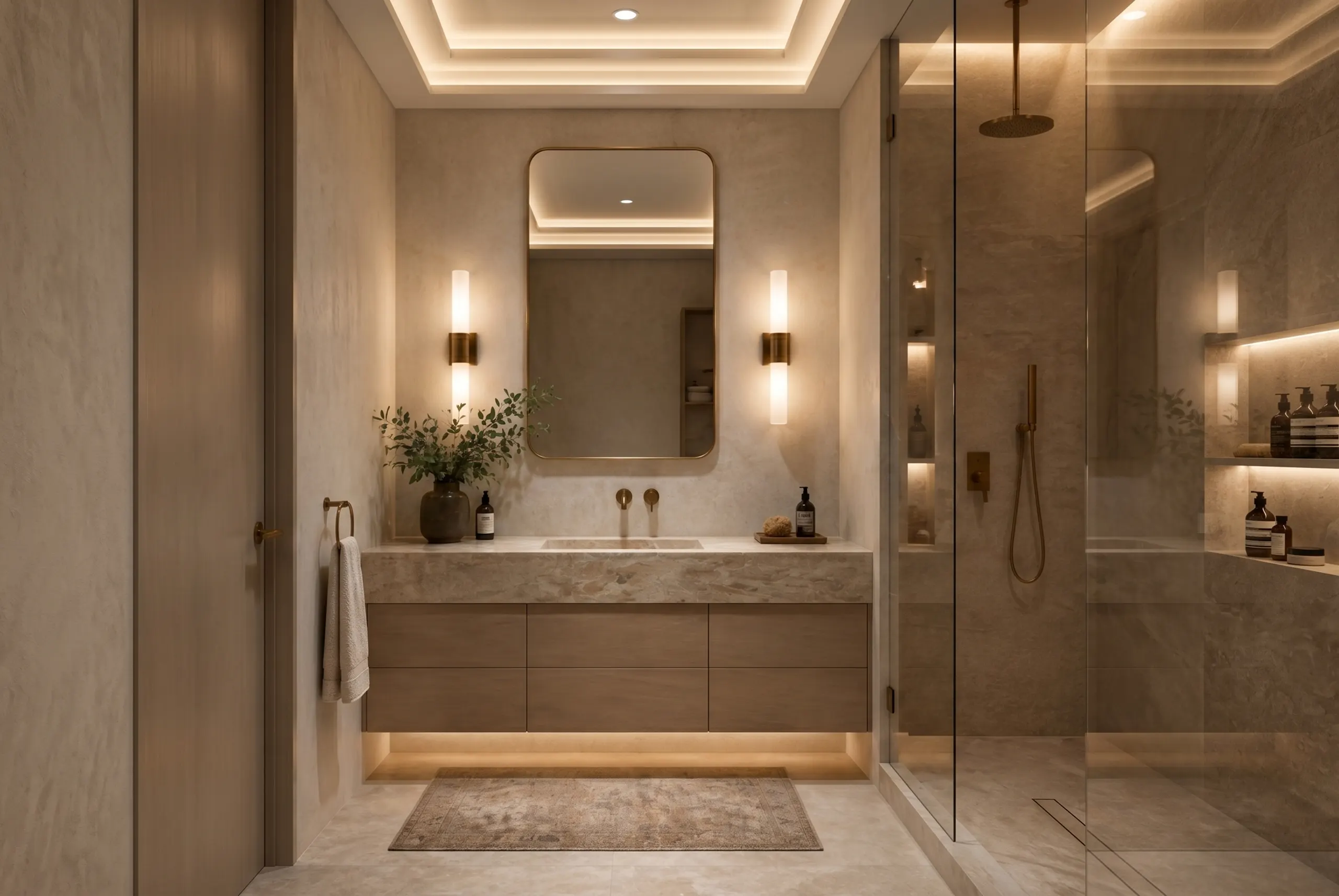
Why it works in NYC apartments: this combination holds up in bathrooms with limited natural light, which describes a great many Manhattan bathrooms. Cool whites under artificial light drift blue or grey. Warm whites stay warm under any source, and travertine’s natural range includes tones that stay light and luminous even in a windowless room.
2. Deep Sage and Warm Cream
Green has been building in bathroom design for several years and has now moved past being a statement colour into something closer to a serious neutral. The version doing the most work is a desaturated, slightly grey-toned sage rather than a bright or obviously green tone.
Against warm cream — on a plaster wall, a painted ceiling, or a cream-toned tile — sage stays quiet. It does not compete with the materials around it. In a pre-war Manhattan apartment where the bathroom is small and enclosed, the pairing creates intimacy without heaviness.
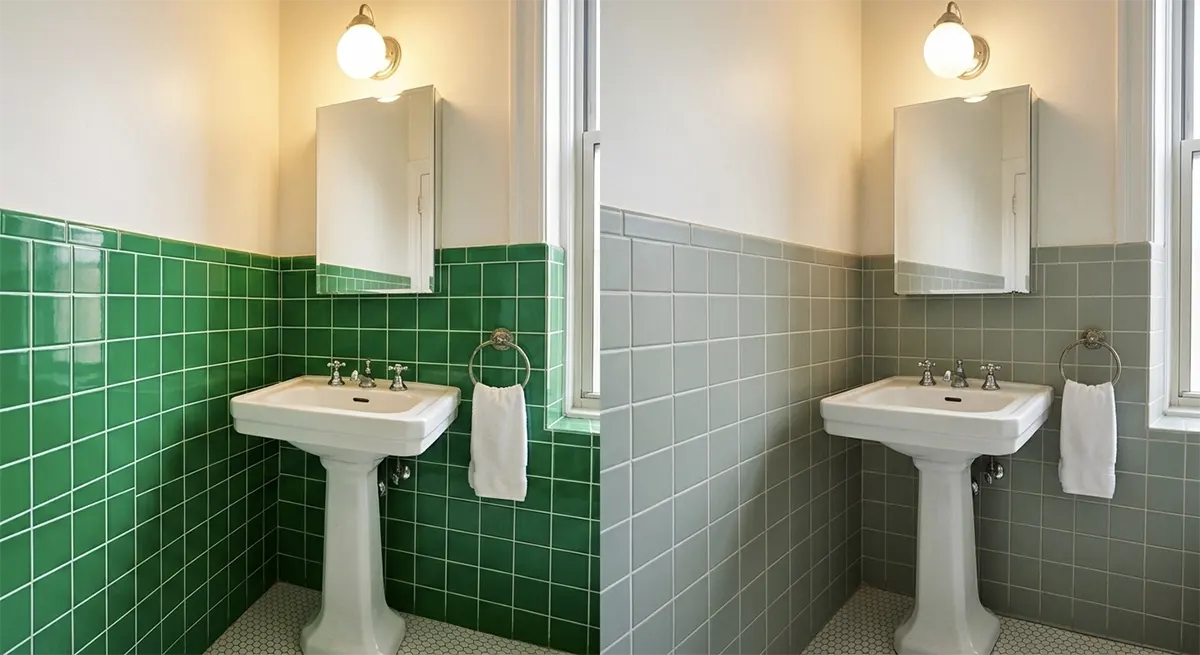
Common mistake: choosing a sage that is too saturated or too obviously green. The versions that hold up in New York bathrooms lean grey-green or grey-blue-green. A pure bright sage in a small bathroom with one window will dominate the room and tire quickly. Err toward the more complex, more desaturated tone.
3. Charcoal and Warm White
For a bathroom that is graphic and grounded without committing to a fully dark room, charcoal against warm white is the reliable high-contrast option. It is more current than black-and-white because charcoal carries warmth, and the warm white keeps the space from turning clinical.
It needs at least one strong source of natural light. A fully enclosed charcoal bathroom without daylight will feel oppressive however well it is executed. With a window, the contrast looks deliberate rather than heavy.
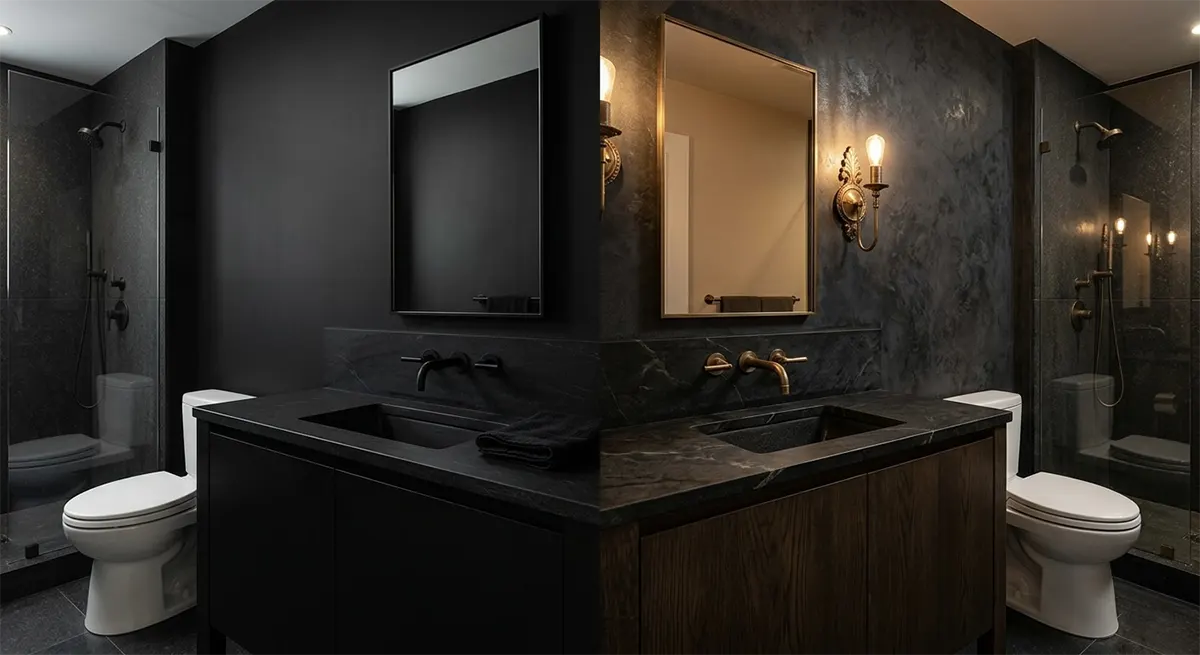
What separates a good dark bathroom from a flat one is material rather than colour. Matte black paint on drywall gives you a dark room. Textured charcoal plaster, a stone with visible movement, and warm bronze rather than black fixtures give you depth in the same colour.
4. Terracotta, Sand, and Warm Plaster
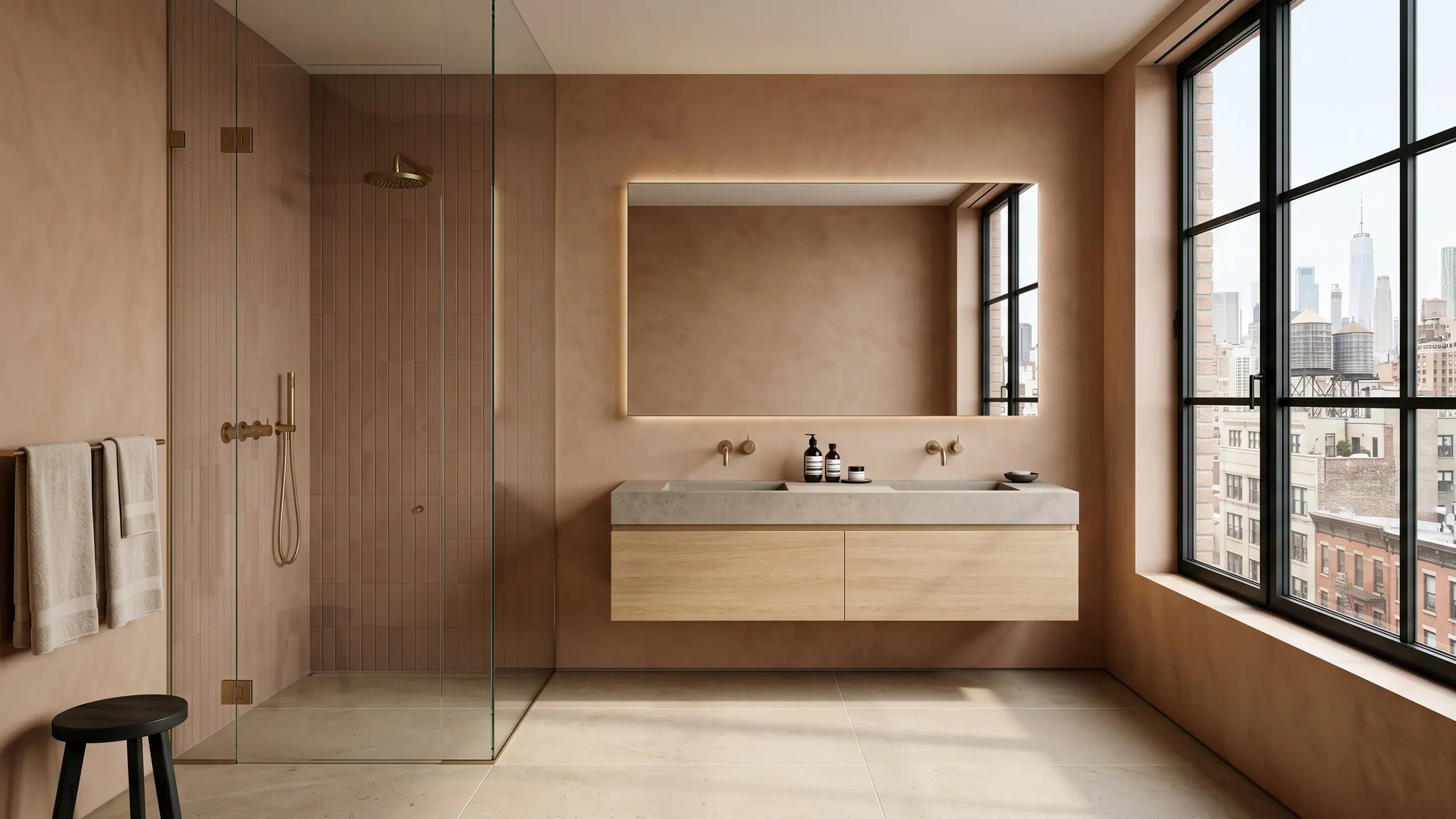
The most tactile and warmest of the current combinations, gaining traction where the client wants a bathroom that feels like a retreat rather than a utility room. The palette draws on Mediterranean and North African references without being theatrical about it.
Terracotta appears here as a warm brownish-red undertone: in handmade or zellige tile, in a limewash treatment, or in a reddish-clay plaster. It anchors the room without dominating it when surrounded by sand and warm plaster tones sharing the same warm-brown base.
Why it suits New York: this combination works particularly well in pre-war bathrooms with lower ceilings and an enclosed feel. Warm plaster adds depth without visual weight, and a terracotta floor grounds the room. It is also relatively forgiving of imperfect lighting, which matters more here than it does almost anywhere else.
Handmade tile carries real installation consequences, and they are worth knowing before you order rather than after delivery. Glazed zellige runs to a water absorption rate around 22.9 percent, which puts it in the non-vitreous class: fine indoors, unsuitable anywhere that freezes. Each tile is roughly 3/8 inch thick with visible variation, and because irregular tiles will not bridge an uneven substrate, the wall behind them has to be brought properly into plane first. Setting them calls for a polymer-modified thin-set, and specifically a white one, since colour will migrate through the porous clay body. The traditional layout is edge to edge with minimal grout spacing rather than a conventional joint, which is part of why the surface reads the way it does.
5. Deep Navy and Bone White
Navy has moved through a full trend cycle and come out the other side as a considered classic. The version appearing in current Manhattan renovations is deeper and more complex than the bright navy of a few years ago, closer to an inky blue-black that looks almost charcoal in some light.
Pairing it with bone white — a white with a slight yellow-cream undertone — is what keeps it from turning cold. This is a neutral palette in the practical sense: it works across a wide range of personal styles and apartment types, graphic enough to have a point of view without narrowing the buyer pool later.
It suits pre-war apartments because it echoes the logic of traditional millwork, dark below and light above, executed in current materials. It also photographs well, which is not a trivial consideration in a market where buyers form their first impression from listing images.
6. Tonal Greige with a Single Material Statement
The most versatile approach on this list is also the most restrained. A tonal greige bathroom, built from warm grey-beige tones at different values across floor, wall and ceiling, is the foundation least likely to date.
The interest comes from one material statement: a bookmatched stone slab behind the vanity, a zellige feature wall in the shower, a fluted stone panel. The greige palette gives that material room to breathe. The whole space is calibrated so one element holds attention.
For anyone uncertain about committing to a strong colour, this delivers a high-end result with the least risk. The investment goes into the feature material rather than the palette, and that material can be changed later without redoing the room.
What Makes a Bathroom Color Combination Look Expensive
The underlying logic matters more than the specific colours, because it is what lets you apply these principles to your own apartment’s light and architecture rather than copying a combination that may not suit either.
Grout Color Matters More Than Tile Color
This is the detail homeowners most often underestimate. Grout lines are visible across every tiled surface and they actively shape how the colour behaves. White grout on grey tile creates a pattern. Grey grout on grey tile creates a surface. The current direction is almost always toward grout that sits flush with the tile or slightly cooler, so the tiled plane behaves like a continuous material rather than a grid.
The exception is deliberate contrast grout, usually dark on a light tile, used as a graphic device. Even then it has to be clearly intentional. Accidental contrast — where the grout was chosen from a small sample and behaves differently applied at scale — is among the most common and most expensive mistakes in bathroom renovation.
One technical constraint sits alongside the colour one. Use unsanded grout with honed or polished travertine, marble and limestone: the silica in sanded grout is abrasive enough to scratch soft stone during grouting and cleanup, and the damage shows under raking light afterwards. Unsanded works up to a joint of about 1/8 inch, and beyond that the joint needs sanded grout or a fine-grit product specifically labelled safe for polished stone.
Warm Light Changes Everything
Colour temperature has an enormous effect on how a palette performs. Cool LED lighting shifts every colour toward blue-grey. Warm white LEDs at 2700K to 3000K bring out the amber, ochre and cream in stone and warm tile.
Test samples under the specific lighting you intend to install, in the room itself. A travertine tile that looks warm and sandy under a warm LED goes flat and slightly grey under a cool one. This matters most in bathrooms without natural light, which is a large share of the New York housing stock.
Tatiana Chechina, interior designer at the firm, makes the same point about sample approval: a colour approved in a showroom has been approved under someone else’s light. In a windowless Manhattan bathroom the only meaningful test is the sample on the actual wall, under the actual fixture, at night.
The Ceiling Is Part of the Palette
In most bathrooms the ceiling is painted a generic flat white and ignored. In current Manhattan work it is often brought into the palette instead: the same colour as the walls for an enveloping effect, one shade lighter, or a plaster or limewash treatment carried from wall to ceiling. This is one of the cheapest ways to change how a combination behaves in the room.
One Warm Metal Tone, Deployed Consistently
Mixing metal finishes is an accepted convention, but the rule is that each metal serves a different purpose rather than competing at the same scale. The dominant fixture finish — faucet, shower head, towel bar — stays consistent throughout. A secondary metal can appear in accessories, a mirror frame, or hardware, but clearly subordinate. When two strong metal tones compete at equal scale in a small bathroom, neither looks intentional.
One product note, because it appears on a lot of specification sheets: there is no such thing as a warm chrome. Chrome is cool by definition. If you want something in that family with warmth, the finish you are looking for is polished nickel, or one of the warm metals proper — unlacquered brass, warm brushed gold, champagne bronze.
NYC-Specific Constraints: Small Rooms, Old Buildings, No Windows
The Room Was Built Around the Stack
A Manhattan bathroom is generally the size the original plan made it, laid out around a plumbing stack that has not moved since the building went up. That has two consequences for colour.
The first is that decisions which would pass as subtle in a larger room become impossible to miss here. The second is that what determines whether a dark scheme works is ceiling height and available light, not floor area. A dark bathroom that succeeds in a West Village townhouse can feel suffocating in a small interior bathroom in a mid-rise with the same square footage.
Light warm neutrals consistently perform best in constrained footprints. They expand the perceived volume without requiring the precision a dark theatrical scheme demands. The travertine-and-warm-white and tonal greige combinations above were both developed with exactly this context in mind.
Ventilation Comes Before Finish Selection
A great many Manhattan bathrooms have no operable window, which makes mechanical ventilation a code requirement rather than an amenity. Under Table 403.3.1.1 of the NYC Mechanical Code, a bathroom or toilet room in a private dwelling unit requires 25 CFM of continuous exhaust, or 50 CFM if the fan runs intermittently. Rooms without adequate natural ventilation have to be mechanically ventilated under Section 403.
This belongs in a colour article because the finishes have to live with the result. A windowless bathroom that is under-ventilated will show it first in the grout and in any porous surface — limewash, unsealed plaster, natural stone, and handmade tile, which at nearly 23 percent water absorption is the most exposed material on this page. Confirm the exhaust rate before specifying anything that depends on drying out between uses.
Old-Building Constraints
Before finalising any scheme that depends on floor-to-ceiling tile, a stone floor, or a wet-room configuration, four things need answers from your building and your contractor rather than assumptions:
- Waterproofing. Under NYC Plumbing Code §417.5.2 the floor under a shower is lined and made watertight, with the liner turned up at least 2 inches above the finished threshold. §312.9 then requires the completed liner to be flood tested: drain plugged, pan filled to at least 2 inches, held 15 minutes with no leakage. Ask to see that test rather than a certificate.
- Wet zones. Most co-op and condo alteration agreements enforce a wet-over-dry rule preventing a sink or shower from moving outside its original footprint over a neighbour’s dry room. This is a building rule rather than a city one, and it constrains reconfiguration more than anything in the code does.
- Floor weight and sound. A stone floor weighs considerably more than the tile or wood it replaces, and replacing a floor at all is governed by the alteration agreement, which typically specifies a minimum impact insulation class for the assembly.
- Demolition. In any building put up before April 1987, stripping a bathroom back to substrate is demolition. Plaster and tape compound of that period can contain asbestos, so a survey by a New York State licensed asbestos inspector comes first, and where a DOB permit is involved an ACP-5 is filed with the Department of Environmental Protection before that permit will issue. Note the date rather than the word: this catches post-war buildings as squarely as pre-war ones.
One scheduling item on top of those: since February 2026, a filing in DOB NOW listing the owner as a co-op tenant-shareholder or condo unit owner adds the board as a stakeholder, and a board representative has to attest in the system before the filing moves.
From a colour standpoint, older bathrooms often have original details worth keeping: hexagonal mosaic floors, subway wainscoting, a cast-iron tub. A scheme that works with them costs less and ends up more distinctive than one that erases them. Painting original subway tile rather than removing it, adding a warm limewash above, and updating fixtures and hardware can change the whole colour story without a renovation — and without triggering any of the four items above.
Orientation
North-facing bathrooms get no direct sun. Colour choices for them should lean warmer than instinct suggests. What looks warm and sandy on a sample card in a showroom can look cool and grey in a north-facing bathroom at seven in the morning. The travertine, terracotta and tonal greige combinations handle that light better than charcoal or deep navy, both of which want stronger daylight to show their contrast.
Colors to Approach with Caution in 2026
Not everything that was interesting three years ago has aged well. Four directions are showing fatigue in the New York market.
Cool grey tile as a primary surface. The cool grey bathroom was the signature of the late 2010s renovation cycle. It looks dated now — not offensively, but not current either. If the point of the renovation is to update the room, this is not the direction.
Bright white subway tile in a standard 3×6 grid. Still perfectly functional, but no longer a design decision. It is a default. If subway tile appeals, consider a larger format, a bevelled profile, or a warm-white variation that connects to the rest of the palette.
High-gloss colour in strong saturated tones. Deep teal, cobalt and emerald in high gloss had their moment in the early 2020s. The current direction is the same hues in matte or a matte-gloss variation, or in more complex, less obviously decorative versions.
All-black bathrooms without warm accents. The all-black bathroom became shorthand for luxury in the mid-2010s and has been replicated widely enough that it no longer signals anything. A predominantly dark bathroom can still work, but it needs a material story — real stone, textured surfaces, warm bronze rather than matte black — to lift it beyond the formula.
Where to Start
Settle the constraints before the palette. Find out whether the bathroom has the ventilation the code requires, what the alteration agreement says about the floor and the wet zones, and whether the room gets any direct light at all. Those three answers eliminate most of the combinations above and leave two or three that will actually work in your apartment.
Then choose the material that carries the room, and build the colour around it rather than the other way round. Colour approved on a sample card is a guess. Colour approved on the wall it will occupy, under the fixture that will light it, at the hour you will use the room, is a decision.
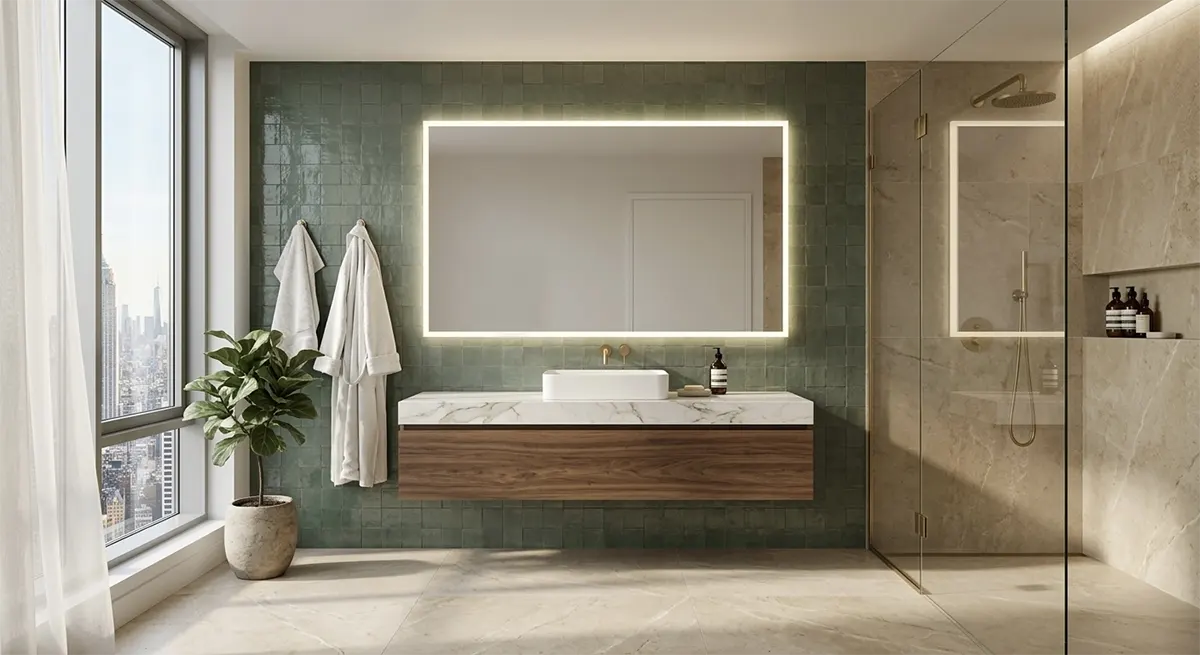
Elevating the Daily Routine: Shower Design That Actually Works
A shower is one of the most intensively used areas in any bathroom, which means its design has to so
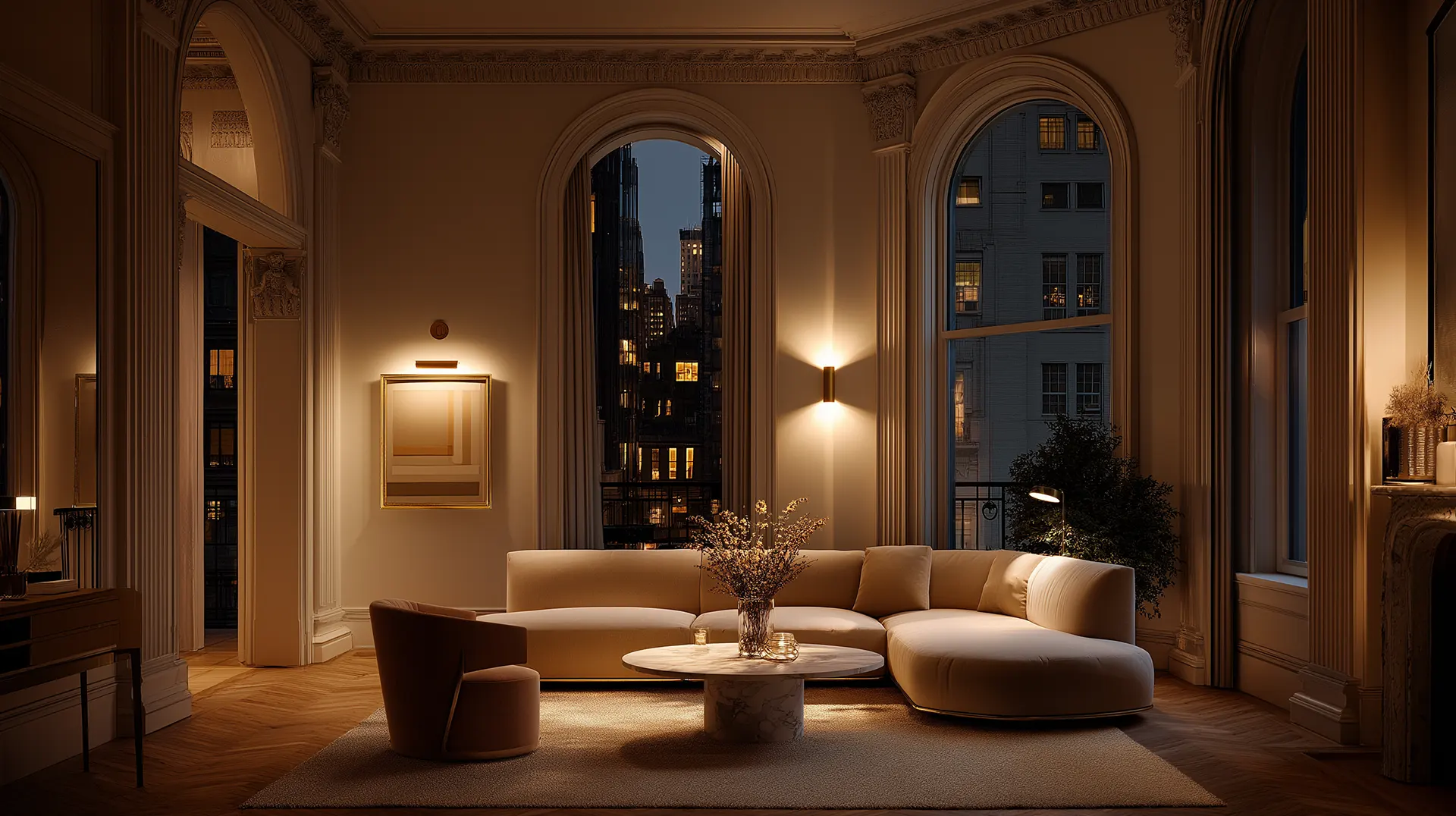
The Secret Life of Light: How Lighting Can Make or Break a Room
There is a particular kind of room that photographs beautifully and feels wrong the moment you step

The Rise of Sustainable Renovation: A Guide to Eco-Friendly Upgrades
Something has shifted in how Manhattan homeowners think about renovation. Environmental responsibili