

Insurance Requirements for Apartment Renovations
Insurance requirements in Manhattan co-ops and condominiums are shaped by how New York buildings are constructed and governed. Apartments are privately owned or leased, but the systems that make them function are shared. Plumbing risers serve multiple units. Electrical infrastructure runs vertically through the building. Structural slabs extend beyond the footprint of a single residence. Ventilation, fire protection, and mechanical systems are interconnected.
Because of this integration, renovation risk is rarely isolated.
A plumbing error in one apartment can damage ceilings and flooring below within minutes. A demolition crew that removes material too aggressively can compromise adjacent finishes or disturb structural elements. Improperly protected electrical work can create fire hazards that extend beyond the renovation footprint. Even a small oversight can quickly become a multi-unit insurance claim.
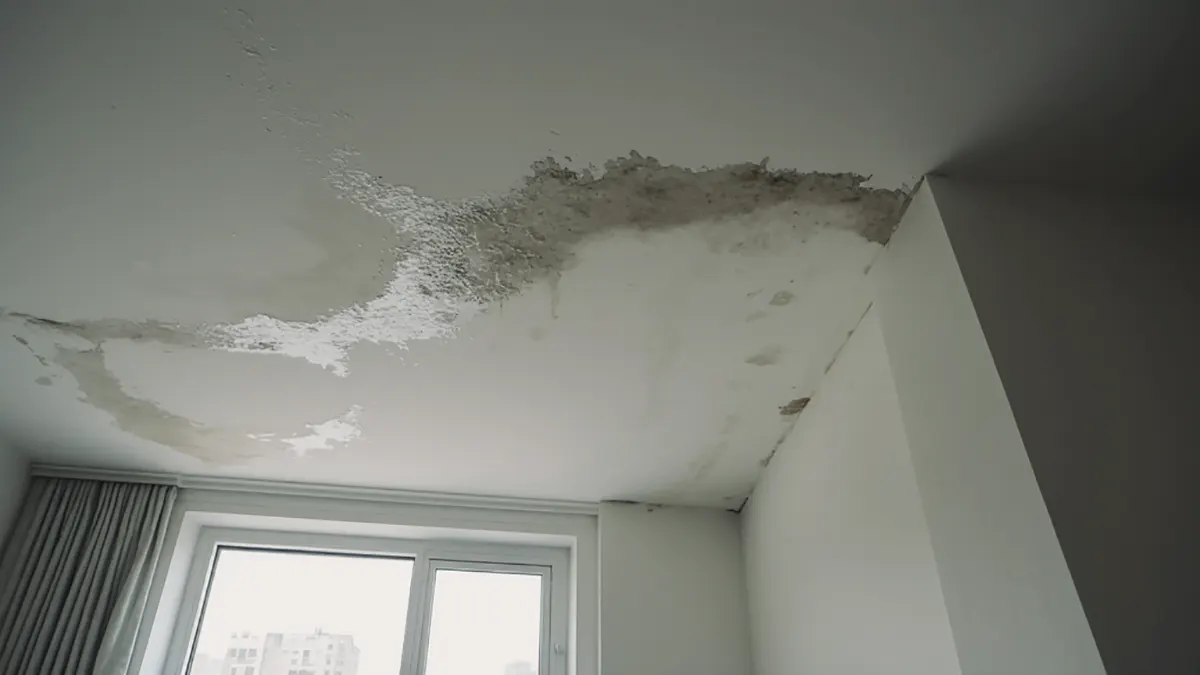
Boards and managing agents evaluate renovation proposals with this reality in mind. Their concern is not whether a contractor is careful, but whether financial responsibility is clearly assigned and adequately insured if something does happen. That is what renovation insurance does in Manhattan: it makes risk follow control.
How Contractor Insurance Allocates Risk
Contractor insurance is designed to respond to third-party claims arising from construction activity. In the context of Manhattan apartment renovations, that typically means bodily injury, property damage, or certain professional errors connected to the work.
If a worker is injured on site, if a neighbor claims water damage, or if a shared building component is affected, the contractor’s insurance should respond first. This protects the apartment owner and prevents the building’s master policy from absorbing avoidable losses.
Without adequate insurance, exposure shifts. An injured worker may pursue claims beyond statutory benefits. A neighboring unit owner may file suit against the building. The building’s insurer may pay a claim and then pursue recovery from the apartment owner. These secondary disputes are exactly what boards seek to prevent through strict insurance requirements. Structured correctly, insurance documentation is a risk transfer mechanism embedded in the renovation approval process rather than a symbolic formality.
The Scaffold Law: Why Manhattan Limits Run High
Owners frequently ask why a board demands coverage that seems disproportionate to a bathroom renovation. The answer is a New York statute that has no equivalent in most other states.
New York Labor Law §240 and §241, together known as the Scaffold Law, impose absolute liability on property owners and general contractors for gravity-related injuries — falls from height and injuries from falling objects. Absolute liability means what it sounds like: the owner’s own care is not a defense, and the injured worker’s own negligence generally does not reduce the claim. If a worker falls from a ladder while installing ceiling work in your apartment, the building and the general contractor face liability regardless of who did what wrong.
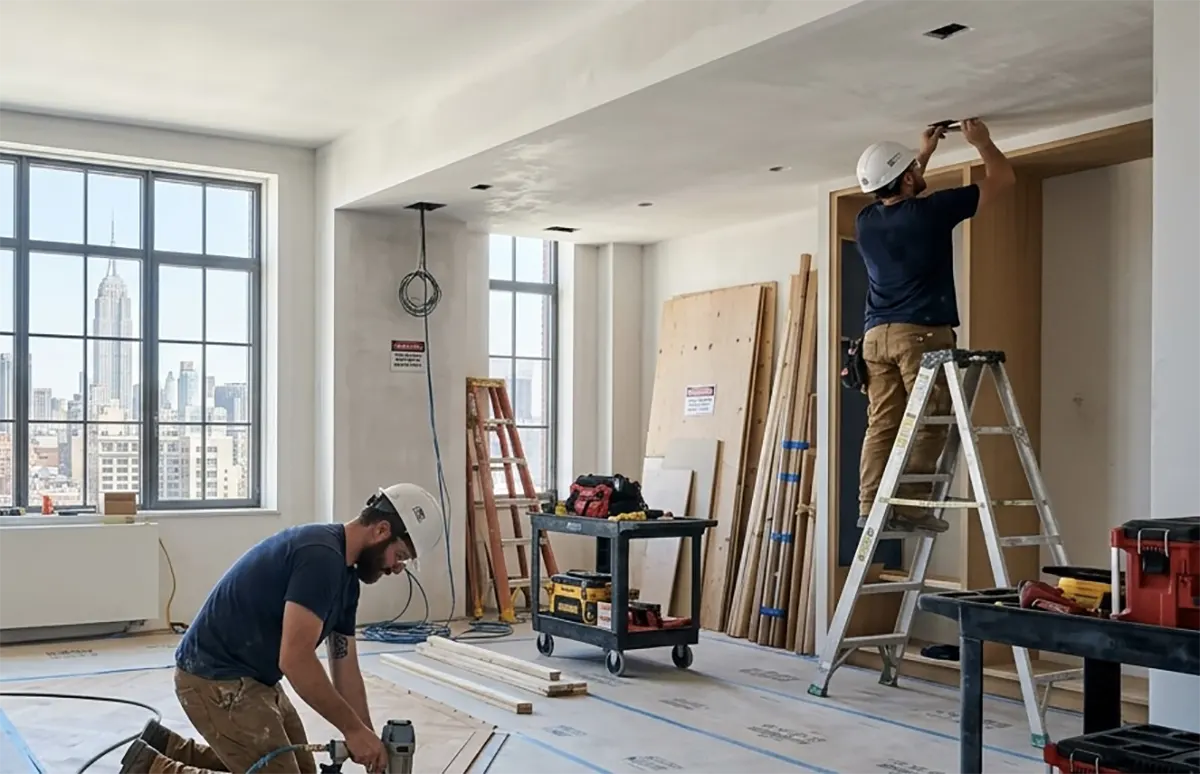
This is the single biggest reason Manhattan buildings set insurance requirements well above what a comparable renovation would need elsewhere. Scaffold Law verdicts and settlements in New York regularly reach into seven figures, and the building sits in the chain of liability whether or not it employed anyone on site. Read in that light, a board’s insistence on specific limits, specific endorsements, and verified subcontractor coverage stops looking like paperwork and starts looking like the only tool the building has to keep that exposure off its own policy.
Core Insurance Policies Required for Manhattan Renovations
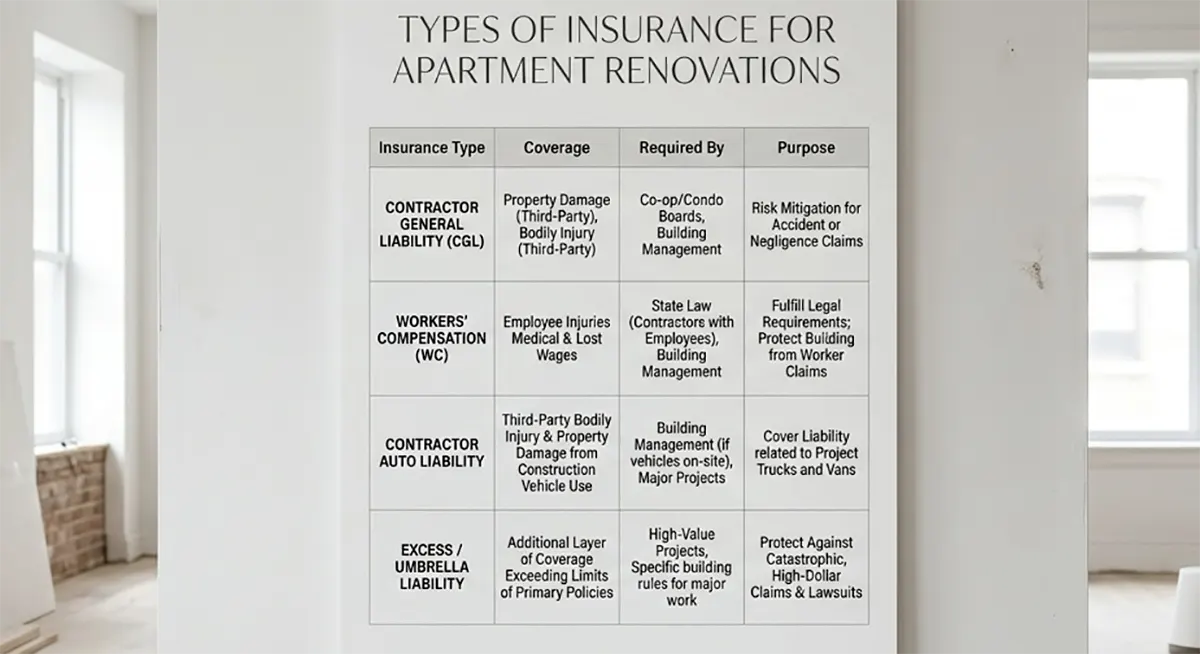
While each building sets its own standards, most Manhattan apartment renovation insurance packages include several consistent components.
Commercial General Liability Insurance
Commercial General Liability, or CGL, is the foundation of any construction insurance program. It provides coverage for third-party bodily injury and property damage arising from the contractor’s operations.
There is no single citywide standard for limits, and it is worth resisting any source that presents one. A common base structure in the market is one million dollars per occurrence with a two million dollar aggregate. Many Manhattan buildings, particularly premium co-ops and any project involving structural work, set their own minimum at two million per occurrence and require umbrella coverage on top of it. Both structures are real and both are in use. The number that governs your project is the one written into your building’s alteration agreement, and that is the document to read before pricing anything.
CGL coverage funds legal defense and settlement costs if claims are brought by neighbors, visitors, building staff, or other affected parties. However, the existence of a CGL policy alone is not sufficient. The policy must be properly endorsed to extend protection to the building and managing agent.
Workers’ Compensation and Employer’s Liability
New York law requires employers to carry Workers’ Compensation insurance. This coverage provides medical benefits and wage replacement for employees injured on the job.
In Manhattan apartment renovations, workers’ compensation compliance is critical. If a contractor lacks proper coverage and a worker is injured, the unit owner and potentially the building may be drawn into litigation under New York Labor Law — including the Scaffold Law provisions described above. Boards therefore review workers’ compensation certificates carefully before granting approval, and they verify coverage for subcontractors, not only the general contractor.
Employer’s Liability coverage complements workers’ compensation by addressing certain claims that fall outside statutory benefits.
Umbrella or Excess Liability Coverage
Umbrella or excess liability policies provide additional limits above the primary CGL policy. Many Manhattan buildings require umbrella limits in the range of two to five million dollars, with premium properties and structurally complex projects setting the requirement higher.
The rationale is straightforward. In a multi-unit environment, property damage claims can escalate quickly. If water affects several apartments, primary limits may be exhausted rapidly. Excess coverage ensures that adequate protection remains available — and in a Scaffold Law jurisdiction, a single injury claim can exhaust a primary policy on its own.
| Coverage Type | What It Covers | Typical Limits | Notes |
|---|---|---|---|
| Contractor’s General Liability (CGL) | Third-party bodily injury and property damage | $1M per occurrence / $2M aggregate as a base structure; many buildings require $2M per occurrence | Required by most NYC buildings, co-ops, and condos. The governing figure is in your alteration agreement. |
| Excess / Umbrella Liability | Additional layer above the CGL limits | $2M to $5M, higher on premium or structurally complex projects | Commonly required in high-rise and high-value buildings. Check building rules. |
| Workers’ Compensation | On-site employee injury, medical costs and wage replacement | Set by New York State statute | Verify that every subcontractor is covered, not just the general contractor. |
| Owner’s Renovation Endorsement | Damage to personal property, finished work, and fixtures | Scaled to project budget | Update the owner’s own policy before work starts. Usually added by endorsement. |
The Owner’s Own Policy
One item on that list is not the contractor’s responsibility at all. Your own homeowner’s or co-op insurance policy was underwritten for an occupied apartment, not an active construction site, and most carriers expect notice before a renovation begins. An endorsement adjusts the policy to cover the changed condition, including damage to finished work and materials already installed. Owners who skip this step sometimes discover after a loss that their own policy has grounds to decline. Notify the carrier at the same time you submit the alteration package, not after demolition starts.
Professional Liability Insurance
If architects, engineers, or design-build contractors are providing professional services, professional liability insurance is required. Commercial General Liability policies exclude coverage for design errors. Professional liability fills that gap.
Projects involving load-bearing wall modifications, structural reconfiguration, or significant MEP redesign typically require proof of active professional liability coverage before boards approve plans.
Builder’s Risk Insurance
For full gut renovations or projects involving substantial material staging, builder’s risk insurance may be required. This policy covers materials and work in progress against events such as fire, theft, or vandalism.
Builder’s risk becomes particularly relevant when construction extends over a long period or when high-value finishes are stored on site prior to installation.
Understanding the Certificate of Insurance in Manhattan Renovations
The Certificate of Insurance, commonly referred to as a COI, is the document most frequently submitted to boards and managing agents. However, it is often misunderstood by apartment owners.
A COI is not the insurance policy itself. It is a summary issued by an insurance broker that lists coverage types, policy numbers, limits, and effective dates. It may also identify additional insured entities and describe the renovation location.
What the COI does not do is create coverage. The enforceable rights are contained in the underlying policy and its endorsements.
This distinction matters. A building may be listed as an additional insured on a certificate, but unless the proper endorsement is attached to the policy, the protection may not exist in practice. Managing agents who review insurance submissions carefully will request copies of endorsements, not just certificates.
For apartment owners, understanding this difference prevents frustration during the approval process. When a managing agent rejects a submission, the reason is usually that required endorsements are missing or incorrectly structured — not that the contractor lacks insurance.
Why Endorsements Matter in Manhattan Renovation Insurance
In most Manhattan apartment renovations, three endorsements are consistently required.
| Endorsement | What It Does |
|---|---|
| Additional Insured | Extends coverage under the contractor’s policy to the building entity and managing agent, allowing them to access defense and indemnification directly if a claim arises |
| Primary and Non-Contributory | Ensures the contractor’s insurance responds before the building’s master policy, preventing the building’s insurer from contributing to a claim that should be covered by the contractor |
| Waiver of Subrogation | Prevents the contractor’s insurer from seeking reimbursement from the building or unit owner after paying a claim |
These three are central to how risk transfer actually functions in a Manhattan renovation. Without them, coverage may exist on paper and still fail when a dispute arises — which, in a building where a single fall can trigger absolute liability, is the outcome every board is trying to avoid.

Timeline of a Manhattan Renovation: From Offer Letter to Move-In
You just signed the offer letter. Champagne is popped. You are already mentally placing the sofa in

When Good Renovations Go Bad: NYC Violations and How to Fix Them
Even carefully planned renovation projects can spiral into legal trouble when violations occur, turn
The Hidden Costs of NYC Compliance: Budgeting for Permits, Inspections, and Fees
Embarking on a renovation project in New York City is exciting. You have a clear vision for your spa