

Countertop Installation in High-Rise Buildings: Technical Considerations
Installing a heavy stone slab in a 30th-floor Manhattan kitchen has very little in common with delivering a prefabricated countertop and setting it on base cabinets. In a high-rise residential building the process combines structural verification, building logistics, precise fabrication, insurance compliance, and strict sequencing. When any one of those is overlooked, the result is rarely cosmetic. Delays, damaged slabs, rejected deliveries, insurance disputes, and building violations are all more common than most clients expect.
The Weight Is What Drives Everything Else
A stone slab looks thin. It isn’t. A typical granite or quartzite at three centimeters runs roughly 16 to 17 pounds per square foot, which puts the top for a 10-foot by 4-foot island somewhere between 640 and 680 pounds before you subtract cutouts.
That single number determines the rest of the project: how many installers are needed, whether specialty lifting frames are required, and — most consequentially — whether the slab can travel up the building’s freight elevator at all. Your fabricator calculates this from the stone supplier’s technical data sheet at the start. Ask for the figure early, because everything downstream depends on it.
The Elevator Question Comes First
Freight elevator or crane hoist is the fork in the road for a high-rise countertop, and it should be settled before fabrication begins rather than discovered on delivery day.
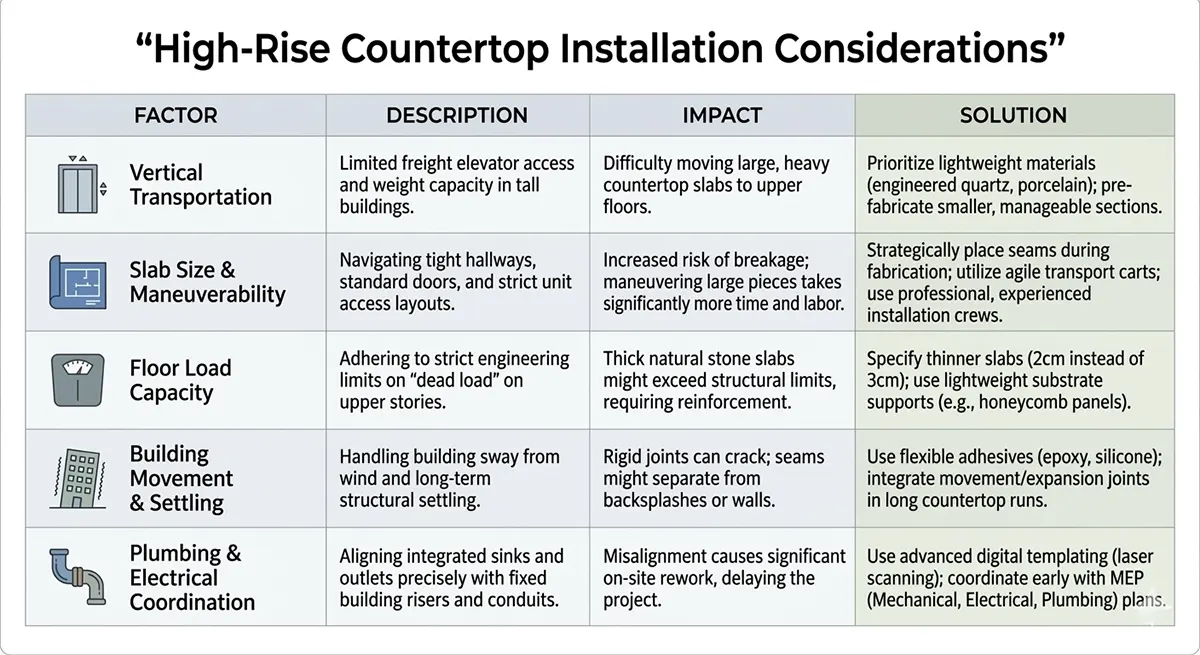
Verify the cab’s interior height, width, and depth, along with the door opening clearance, and check them against both the slab dimensions and the elevator’s load capacity. A half-inch miscalculation here turns a routine delivery into a hoist operation, and the cost difference is not small. Manhattan buildings also restrict freight elevator loads and confine large deliveries to narrow weekday windows, so the reservation itself needs to be booked well in advance through building management, along with any required protective padding and delivery deposit.
When Hoisting Becomes Necessary
Once a slab cannot go up the elevator, the operation expands considerably, and the regulatory layer is where schedules break.
Crane and derrick operations in New York City are governed by the Building Code and DOB rules. Depending on the equipment and the lift, the work may require a certificate of on-site inspection or be performed under the direct supervision of a licensed master rigger. There is also a firm notification window: under 1 RCNY §3319-01, the equipment user must notify the Department through the online crane and derrick notification form at least one day, but no more than two days, before the crane arrives on site, with parallel notice for assembly and disassembly. Cancelling a scheduled operation triggers its own notification obligation, and failing to notify carries penalties.
The practical consequence for you as the owner is simple: a hoist cannot be arranged casually or moved at short notice. Permit processing runs days to weeks depending on equipment type, so the decision to hoist has to be made early enough that the paperwork runs alongside fabrication rather than after it.
Street-level work brings separate approvals. Occupying a street or sidewalk requires a permit from the Department of Transportation, and whether NYPD traffic control is needed depends on the conditions attached to that permit and the specific site, not on the neighborhood. Work within 200 feet of MTA property requires MTA approval as well. Sidewalk protection is frequently required, and hoists are commonly scheduled for early morning to limit traffic disruption.
Building-side requirements stack on top of all of it. A certificate of insurance naming the condominium or cooperative as additional insured is standard. So is union-affiliated rigging labor: in most large Manhattan residential buildings, union riggers for exterior hoisting is the expectation rather than the exception, and it belongs in the budget unless the building specifically says otherwise.
Nothing Gets Templated Until the Cabinets Are Final
This is the single discipline point that saves the most money, and it is the one most often violated under schedule pressure.
Cabinet installation has to be complete, leveled, secured, and fixed in final position before templating. Even minor cabinet movement afterward produces a slab that no longer fits, and refabrication is among the most expensive errors in stone work — a cost that lands entirely on the project.

Where tolerances are tight, digital templating with laser scanning is meaningfully more reliable than manual methods, particularly around walls, columns, and integrated appliances. Whichever method is used, every plumbing stub, gas line, electrical conduit, appliance recess, and wall irregularity gets recorded at this stage. Flush-mounted cooktops and undermount sinks depend on exact cutout placement, and none of it should be left to field improvisation.
Seams and Veining: Your Decision, Made Before Cutting
Seam placement is both a structural and an aesthetic matter, and it is one of the few technical decisions that genuinely belongs to you rather than the fabricator.
Structurally, seams positioned near sink cutouts or in high-stress areas increase cracking risk, so the fabricator will steer placement away from them. Visually, in an open kitchen where the island is a focal point, where the seam falls in the veining pattern is a design choice with a cost attached.

Bookmatching — where adjacent slabs mirror their veining — increases material requirements substantially. Continuous veining across a long run can mean buying additional slabs and accepting longer lead times. Decide this before anything is cut, because it changes both yield and schedule.

What to Ask Your Fabricator
The rest of the technical work belongs to the fabricator, but a few questions confirm you have hired someone who handles it properly:
- How is the substrate built? Heavy stone needs continuous support transferring load into the cabinet system — typically exterior-grade three-quarter-inch plywood fastened to boxes and blocking, with a concealed steel frame for long islands.
- How are overhangs supported? Cantilevers should never rely on adhesive alone. Beyond roughly ten to twelve inches without leg support, engineered brackets or concealed channels do the work, and unusually large islands may warrant a structural engineer’s review.
- How are mitered edges reinforced? A mitered edge creates the look of thicker stone while weakening the corner, so dowels, splines, or internal supports are what make it reliable.
- How is the undermount sink anchored? Large or heavy basins need mechanical anchoring or a steel support frame, not adhesive bonding.
- Are movement joints included at wall transitions? Stone expands and contracts, and bonding it rigidly between immovable surfaces eventually cracks something. A concealed gap with flexible sealant prevents it.
- What seam tolerance do you work to, and how are seams set? Premium work targets visible differences below one thirty-second of an inch, which requires mechanical seam setters and controlled curing conditions rather than speed.

Building Paperwork Before Delivery Day
Administrative coordination is consistently underestimated, and the failure mode is specific: the crew is turned away at the loading dock with a finished slab on the truck, and you pay storage and rescheduling on top of everything else.
Buildings may require an alteration agreement, deposits, insurance certificates, and vendor approvals before anything begins. Some require licensed and bonded contractors, others mandate specific working hours, and delivery windows are usually confined to weekday business hours. Confirm all of it with the managing agent well before the fabricator schedules delivery.
The Sequence That Works
- Confirm the stone’s technical data sheet and calculate slab weight.
- Verify freight elevator dimensions, capacity, and access restrictions.
- Determine whether hoisting is required. If it is, start permitting and notification immediately.
- Complete cabinet installation and confirm levelness.
- Template, with full documentation of plumbing, electrical, and appliance conditions.
- Approve seam layout and veining direction before anything is cut.
- Fabricate to the documented specifications.
- Coordinate delivery with building management.
- Dry fit before final adhesive application.
- Document the completed installation for warranty records.
Handled this way, a high-rise countertop installation stops being risky. The slab is supported correctly, the path into the building is verified early, and field conditions are locked before fabrication — which is why experienced fabricators who understand rigging, insurance, and high-rise constraints are worth what they cost.
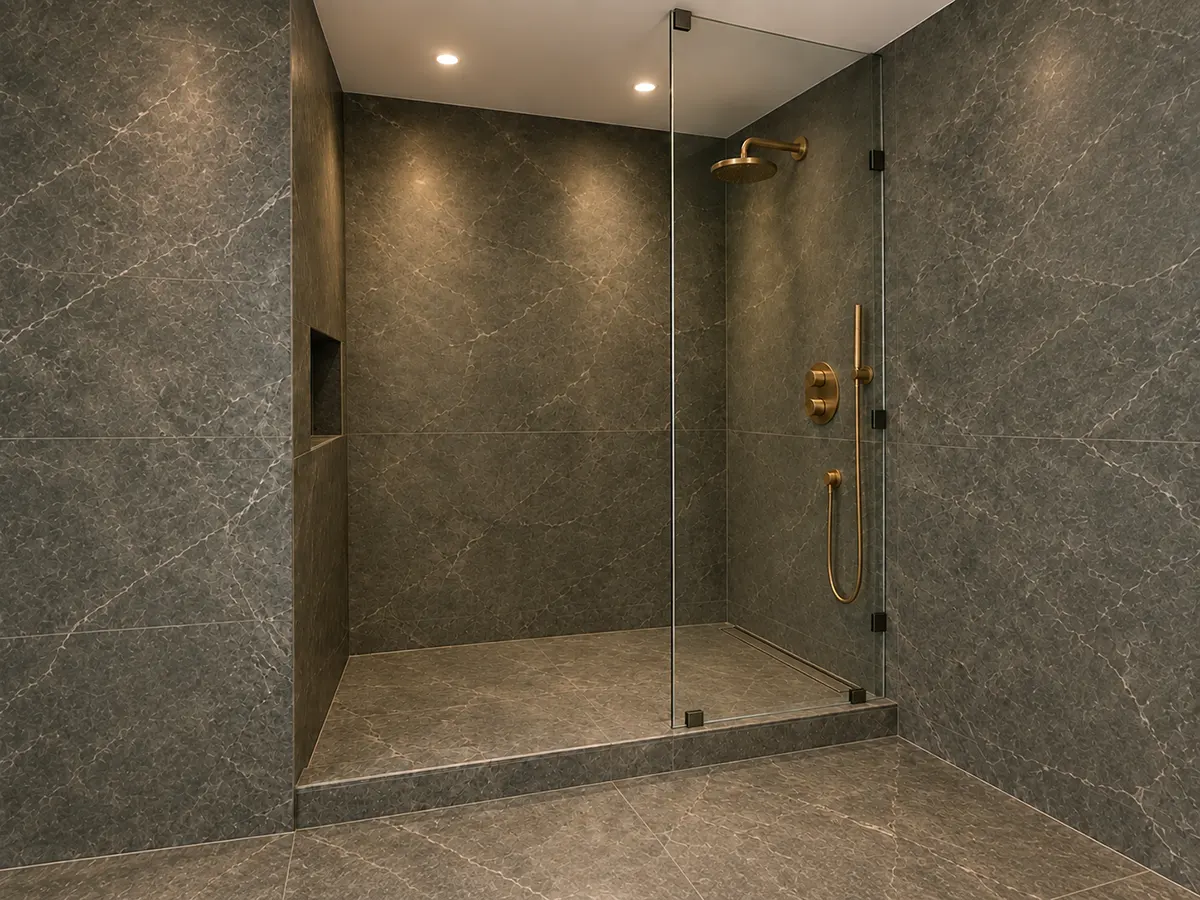
The Quarter Inch That Decides Whether Your Shower Has a Curb
On the drawings a new bathroom usually looks like this: one stone floor runs from the vanity straigh

The Art of Patience: Why Great Renovations Take Time
We live in a culture obsessed with speed, trained by one-click purchases, next-day deliveries, and i

Why the Bathroom Is Always Finished Last
Somewhere near the end of an apartment renovation there is a week when the bathroom looks finished a