
$50K vs $150K Bathroom in NYC: What’s the Real Difference?
The bathroom is the room people most consistently underestimate when budgeting a renovation in New York City. It’s small, the thinking goes, so how expensive can it really be? The answer, consistently, is more than expected. The reasons have everything to do with the specific conditions of renovating in a Manhattan or Brooklyn apartment building. Dense construction, shared plumbing systems, co-op and condo board requirements, DOB permit filings, and the sheer cost of skilled trades in New York make a bathroom one of the most cost-intensive spaces per square foot in any gut renovation.
The two numbers this article compares — $50,000 and $150,000 — are 2026 reference points, and real costs vary with the building, the scope, and what demolition turns up, so treat them as orientation rather than quotes. A $50,000 bathroom renovation in NYC isn’t a budget project; it’s a real investment that produces a genuinely improved space. A $150,000 bathroom isn’t extravagance for its own sake; it reflects a fundamentally different level of design, material quality, and execution. Understanding what separates these two numbers, in concrete, practical terms, is the starting point for any owner trying to decide how much to spend and what they’ll get for it.
What a $50,000 Bathroom in NYC Actually Looks Like
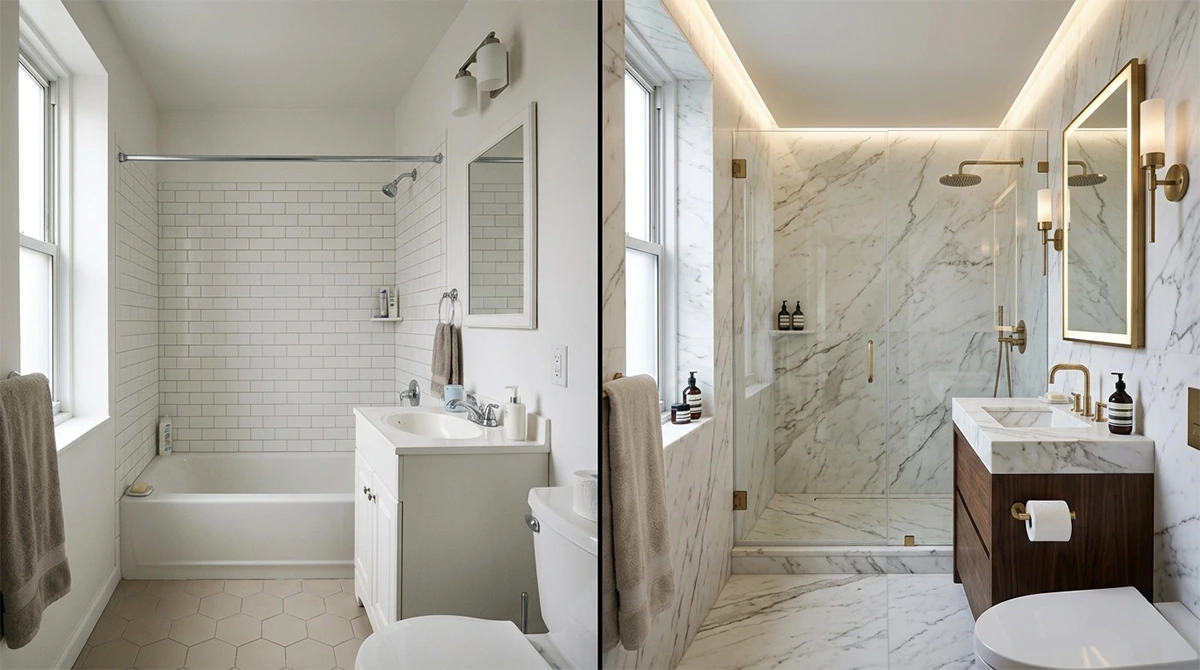
At $50,000, a Manhattan bathroom renovation delivers a complete, professionally executed gut renovation with mid-range finishes, no major layout changes, and a clean, functional result that holds up well and presents well. This is a substantial project, not a cosmetic refresh, and it involves full permitting, licensed contractors, and a real design process. What it doesn’t involve is significant customization, premium material categories, or complex spatial reconfiguration.
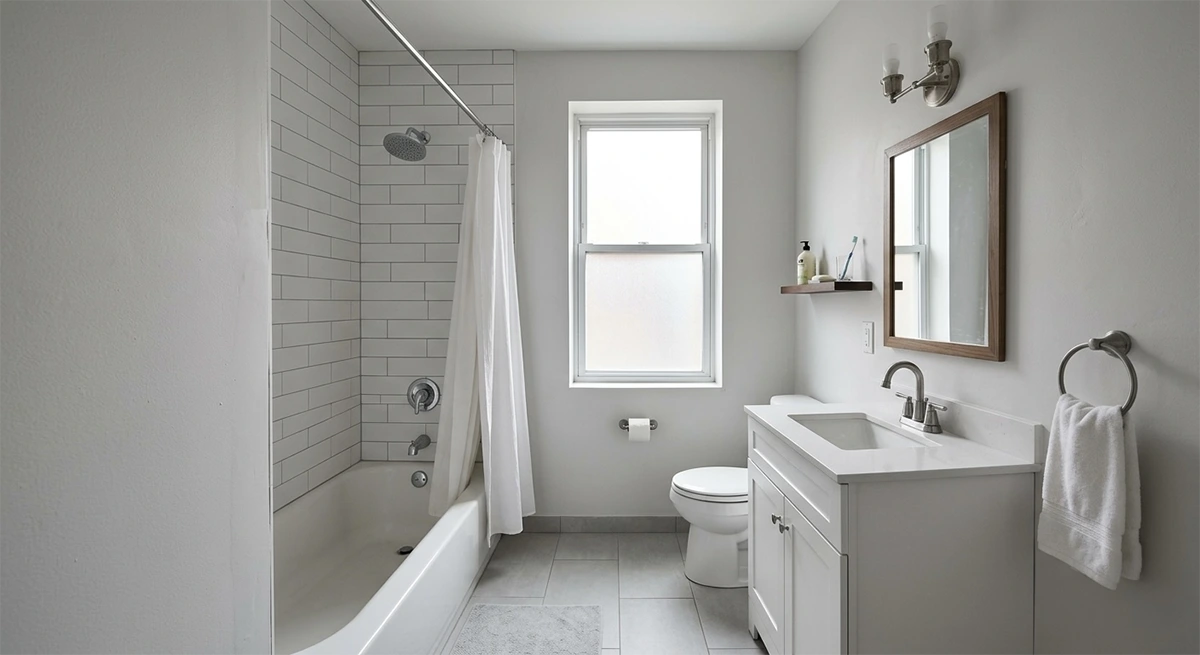
The layout in a $50,000 bathroom almost always stays where it is. Moving the toilet, relocating the shower, or flipping the position of the vanity relative to the plumbing rough-ins each introduces costs that add up quickly: new drain lines, revised plumbing drawings, potential DOB filing amendments, and the labor to trench or reroute in a space where access is constrained. Keeping fixtures in their existing locations, or within a foot or two of them, avoids these costs and keeps the project within range.
Tile at this level is selected from domestic and mid-tier imported lines, typically available through local distributors. The selection is real and includes attractive options, but it doesn’t extend into large-format imported stone, book-matched marble, or artisan handmade tile. A competent designer can produce a beautiful bathroom within these parameters, but the material vocabulary is limited compared to higher budgets. Tile installation is straightforward: field tile on walls, a standard floor tile, a basic border or niche. Elaborate patterns, custom mosaics, or herringbone layouts on walls are technically feasible but consume labor hours that push the budget.
Plumbing fixtures at $50,000 come from mid-range lines: Kohler, American Standard, Toto, and comparable manufacturers. These are quality products with good warranties and a range of aesthetic options. What’s not typically included are fixtures from Waterworks, Lefroy Brooks, Fantini, or similar premium European lines, where a single faucet set can cost as much as a full mid-range fixture package.
The vanity at this level is more likely semi-custom or furniture-grade off-the-shelf than fully custom millwork. A well-selected piece from a quality supplier looks the part and functions well, but the cabinet interior, the hardware choices, the countertop edge profile, and the degree of fit to the specific space are all constrained compared to what’s possible with a custom shop build.
Lighting is functional and considered, but not elaborate. A well-chosen vanity fixture, appropriate ceiling light, and perhaps a dimmer represent a solid lighting scheme at this budget. Integrated architectural lighting, heated floors, and radiant systems are generally not included unless other line items are held deliberately lean.
Where the $50,000 budget makes its compromises is in the margins: the detailing, the quality of the finish materials, the degree to which everything is designed specifically for this space rather than selected from a catalog. The result is a bathroom that looks and performs well. It just won’t photograph like a feature spread or hold up to the kind of close scrutiny a high-budget renovation is built to withstand.
What a $150,000 Bathroom in NYC Actually Looks Like
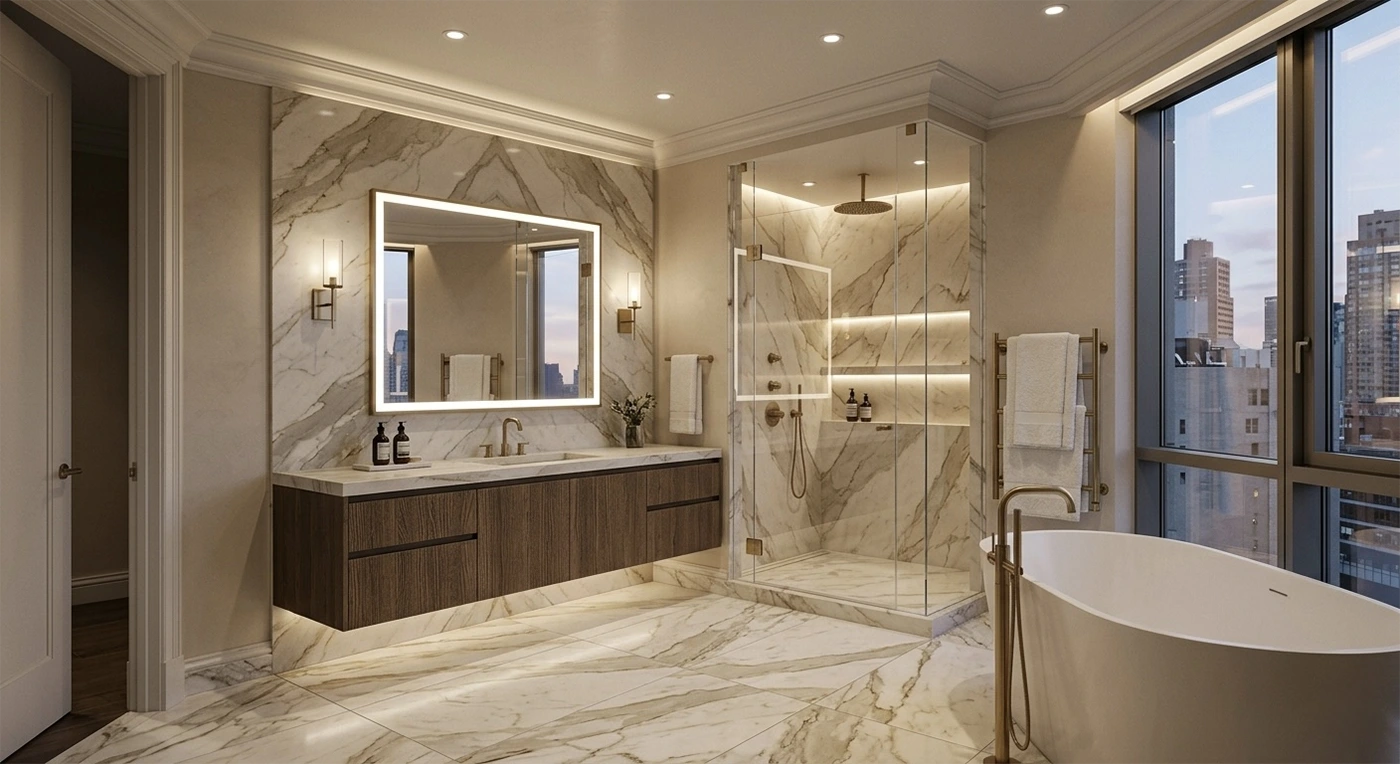
At $150,000, the bathroom is a different project in kind, not just in degree. The additional $100,000 doesn’t go to one or two luxury upgrades; it funds a more refined design process, a wider range of material choices, more complex installation, greater coordination, and a finished product that reflects a level of attention to detail that simply isn’t achievable at lower budgets.
Layout changes are realistic and common at this level. Owners who want to combine two smaller rooms into a single master bath, reconfigure the shower and tub positions, or completely reimagine the spatial organization of the room can absorb those costs within this budget. That means additional plumbing work, possibly revised structural conditions, amended permit filings, and more complex coordination with the building — all of which cost money and take time, but produce a space designed specifically around how the owner wants to live in it rather than around where the pipes happen to be.
Tile at $150,000 extends into materials that have genuine presence: large-format Calacatta marble, book-matched slabs for feature walls, custom cement tile, handmade terracotta, honed basalt, or highly figured natural stone selected for its specific veining rather than from a stock display. The installation is more complex. Book-matching requires careful layout planning. Large-format stone requires a precisely flat substrate. Pattern work requires experienced installers and more time. These materials and the labor to install them correctly represent a significant portion of the budget increase, and the result is a room where the materials themselves are a design element, not a backdrop.
Fixtures at this level come from premium European and American manufacturers. A Waterworks faucet set, a Lefroy Brooks thermostatic shower system, a freestanding tub from Bain Ultra or Victoria + Albert, a Toto Neorest toilet — each of these individually represents a step up that changes the quality of the daily experience and the visual character of the room. The lead times on these products are longer, the installation requirements are more precise, and the cost is substantially higher, but so is the quality.
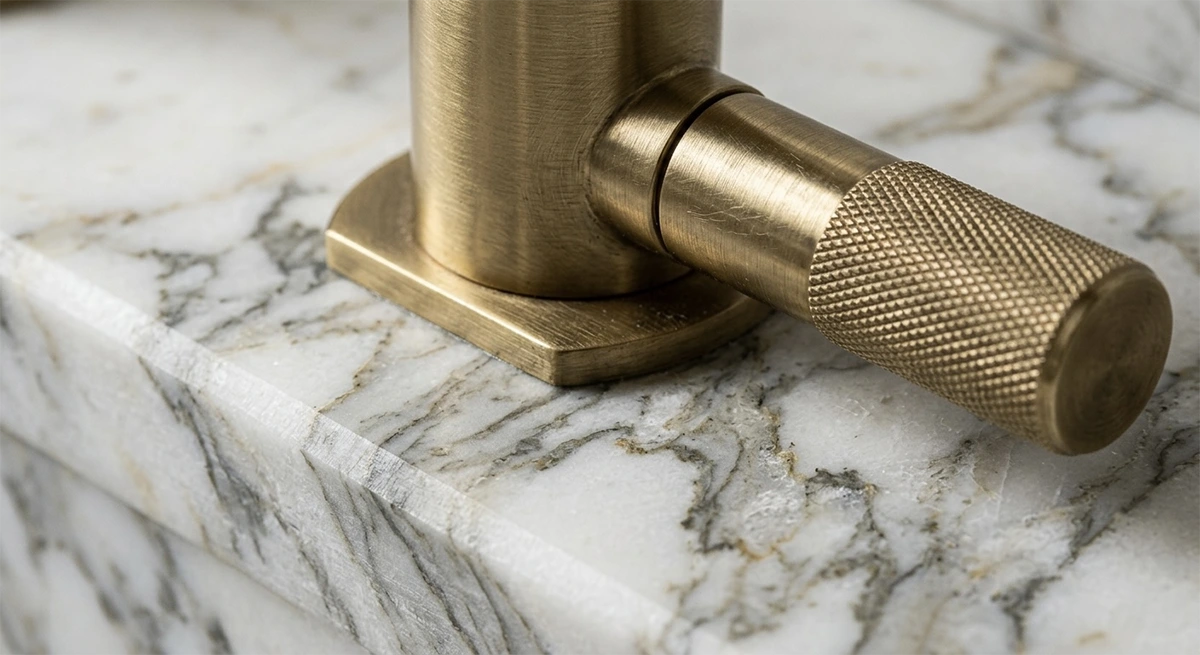
Custom millwork defines this budget in a way it doesn’t at $50,000. The vanity is built by a custom cabinetry shop to the specific dimensions of the space, with the interior configuration designed around how the owner stores and uses the bathroom. The medicine cabinet, if included, is built in and detailed seamlessly. Integrated lighting within millwork, pull-out organizers, custom drawer inserts, soft-close hardware from quality European manufacturers — these are designed components, not afterthoughts.
Lighting design at $150,000 is architectural rather than decorative. Recessed lighting layouts that account for shadows, custom mirror lighting, in-shower niches with waterproof illumination, and heated floors (both radiant floor systems and heated towel rails) are standard inclusions at this level. The electrical work to support these systems is more complex, which adds cost but also adds the infrastructure for a room that functions at a different standard.
Where the Money Actually Goes: A Cost Driver Breakdown
Understanding the price gap between these two budgets means understanding which specific cost categories scale and by how much.
Labor is the largest single cost in any NYC bathroom renovation and the one that scales most directly with project complexity. Tile setters, plumbers, electricians, carpenters, and general laborers in New York City are expensive relative to most other markets, and that baseline applies to both budget levels. What changes is the number of hours required. A complex tile installation with large-format stone, custom mosaic borders, and a book-matched feature wall requires more skilled hours than a straightforward rectangular tile layout. Custom millwork requires a carpenter to spend days fitting and finishing rather than hours installing a prefabricated piece. Intricate lighting systems require more electrical hours than a standard vanity fixture and ceiling light. The labor rate per hour doesn’t change dramatically between a $50,000 and $150,000 bathroom. The number of hours does.
Plumbing and electrical costs are significant at both levels but increase at the higher end when layout changes are involved. Relocating a shower drain in a concrete slab building requires cutting the slab, rerouting the drain line, and patching the concrete — a process that adds cost, generates noise that building management needs to be notified about, and potentially requires additional permit filings or structural documentation. Moving a toilet or adding a second sink doubles the plumbing rough-in work for those fixtures. At $50,000, these relocations are typically avoided. At $150,000, they’re often the point.
Waterproofing is an area where higher budgets allow for more comprehensive systems and higher-quality materials. At the $50,000 level, code-compliant waterproofing membrane systems at the shower floor and walls are included and done correctly. At $150,000, the waterproofing system may extend throughout the entire wet area, use premium sheet membrane products with extended warranties, and include more robust floor preparation and leveling to ensure the substrate is perfectly flat for large-format materials. In older buildings where subfloor conditions are unpredictable, the scope of floor preparation alone can be a meaningful cost item.
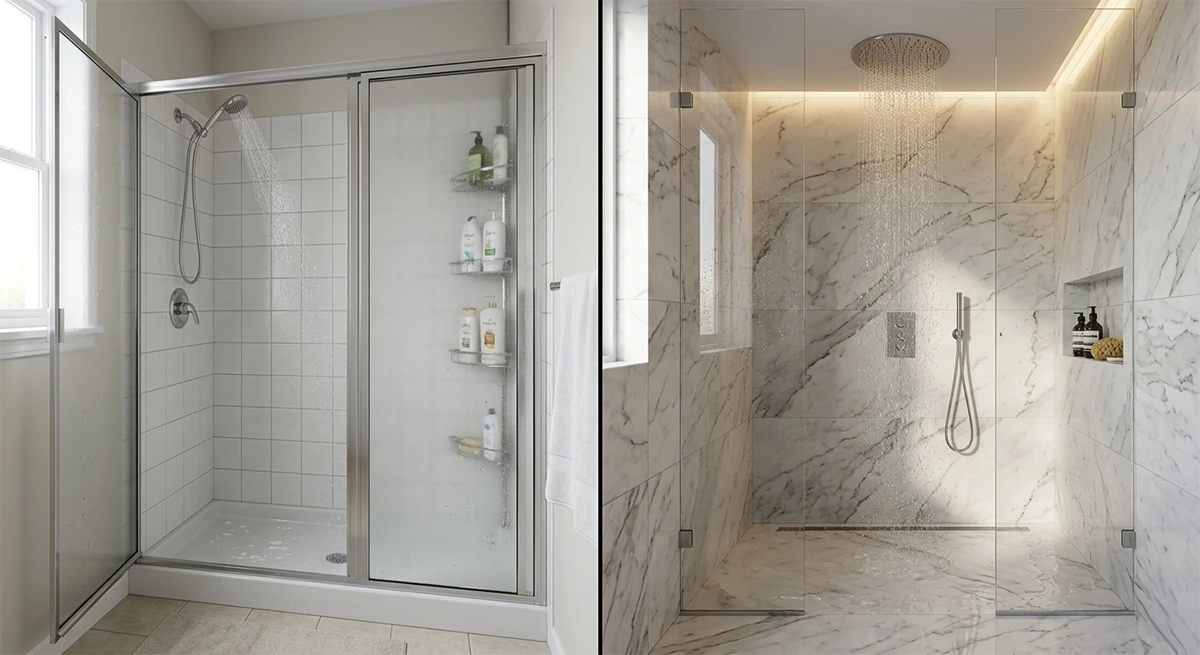
Materials is the category where the gap is most visible and most expected. The difference between mid-range tile and premium stone, between a quality semi-custom vanity and fully custom millwork, between a Kohler shower system and a Waterworks thermostatic panel, is real and reflected in the price. What owners sometimes underestimate is that premium materials don’t just cost more to purchase; they often cost more to install. Large-format stone requires more substrate preparation and more skilled installation. Thermostatic shower systems have more components and more precise installation requirements than standard pressure-balance valves. Custom millwork requires more time on-site to fit and finish than a factory-built piece.
Permits and filings apply to both budget levels, but the administrative costs and complexity are generally higher on more complex projects. A layout-changing renovation that requires amended drawings, additional engineering documentation, or revised filings involves more of the architect’s and expediter’s time, which adds professional fees. These costs are real but not the primary driver of the price difference.
Design, Customization, and Spatial Planning
The experience of designing a $50,000 bathroom and a $150,000 bathroom is different from the first conversation. At $50,000, the design process is largely constrained by the existing conditions: where the plumbing is, what materials are available within the budget, and what can be accomplished within the schedule. Good design within these constraints produces a thoughtful, functional result, but the designer is working around limits rather than defining the space from first principles.
At $150,000, the design begins with what the owner wants and works backward to how to achieve it. The plumbing can move. The layout can be reconceived. Storage can be integrated into the design rather than added as furniture. The shower can be sized and configured around how the owner actually uses it. The vanity can be designed around the owner’s specific storage needs. This level of customization requires more time from the architect or designer, more back-and-forth on details, and more coordination with fabricators and trades — all of which has a cost, but produces a space that feels like it was built for a specific person rather than for an imaginary resident.

Custom vanities illustrate this well. A semi-custom vanity from a quality supplier is a good product. A fully custom vanity built by a cabinet shop is a different thing: the dimensions are exact, the interior is configured specifically for how the owner stores their belongings, the finish is selected from a wider range of options, and the integration with the room’s other elements (mirror, medicine cabinet, lighting) is designed rather than coordinated after the fact. The difference in cost is real. The difference in the finished result is also real.
Building and Regulatory Considerations in NYC
Both a $50,000 and a $150,000 bathroom renovation in a Manhattan apartment building involve permits, board approvals, licensed contractors, and insurance compliance. Neither is exempt from the regulatory environment that governs construction in New York City.
What changes at higher budgets is the complexity and the stakes of that regulatory process. A renovation with significant layout changes, structural implications, or scope that pushes against building-specific restrictions involves more coordination between the architect, the managing agent, and sometimes the building’s engineer. A layout change that triggers a wet-over-dry review, a slab penetration that requires prior building approval, or a design that involves building systems requires more documentation, more professional time, and occasionally more back-and-forth before the alteration agreement is executed.
Insurance requirements and contractor qualification requirements from the building apply at both levels. But higher-end projects often involve more specialized subcontractors, custom fabricators, and third-party vendors whose insurance credentials need to be verified and whose coordination with the general contractor requires more oversight. The managing agent tracks these credentials, and getting everything in order before work starts is a pre-construction process that takes time regardless of project cost.
Hidden Costs That Catch Owners Off Guard
In both budget ranges, there are costs that don’t appear in the initial estimate and that catch owners off guard when they materialize. Being aware of them doesn’t eliminate them, but it allows for contingency planning.
Asbestos testing is the first of these, and it’s mandatory rather than a surprise. Any building constructed before April 1, 1987 requires an ACP-5 certification from a DEP-certified Asbestos Investigator before the DOB will issue a permit and before demolition can begin. The investigator’s survey and filing typically run on the order of $1,500 to $3,000 depending on scope, and the step adds a couple of weeks to the pre-construction timeline. On a $150,000 project it’s a rounding error; on a $50,000 project it’s a real slice of the budget that owners routinely forget to account for.
Subfloor and floor leveling is one of the most consistent surprises. In older Manhattan buildings, bathroom floors are often not flat, not level, or not in the condition the tile setter needs them in. Floor leveling compound, sister boards to stabilize deflecting subfloors, or in concrete buildings the discovery that the slab is lower than expected at one side — all of these require remediation before tile can go down. At the $50,000 level, where the contingency is tighter, these discoveries can force tradeoffs elsewhere. At $150,000, the contingency budget is larger, but the costs are also higher because the materials going over that floor are less forgiving.
Old plumbing conditions are common in pre-war buildings and buildings that haven’t been fully updated. When walls come down and the plumbing system is exposed, corroded supply lines, deteriorated drain pipes, or non-code-compliant configurations may require remediation beyond what was budgeted. A licensed plumber who discovers cast iron drain lines in poor condition doesn’t have the option of leaving them in place and closing the walls; addressing them is both a code requirement and a practical necessity.
Structural conditions occasionally complicate bathroom renovations in ways that weren’t anticipated. In concrete frame buildings, reinforcing bar in the slab can prevent drain lines from being routed where the plans show them. There’s a more serious version of this specific to many post-war Manhattan high-rises: post-tensioned concrete slabs, where steel tendons run through the slab under enormous tension. Cutting or drilling one of those slabs without first scanning to locate the tendons isn’t a technical inconvenience — it’s a code violation and a genuine safety hazard, because striking a tendon can cause a building-level structural failure. Scanning before any slab penetration is mandatory, not optional, and it’s a step and a cost that belongs in the plan from the start. In wood frame buildings, joists in poor condition, blocked by mechanical systems, or running in directions that conflict with the drain slope can require structural remediation. These discoveries happen after demolition, and they require fast decisions that have cost implications.
Building-specific restrictions, such as limits on the hours during which slab cutting or jackhammering is permitted, requirements that a building representative be present during certain phases of work, or rules about how debris is removed from the building, all add time and sometimes cost. These aren’t surprises in the sense of being unknown — they’re in the alteration agreement — but owners who don’t read that document carefully often find themselves absorbing costs they could have planned for.
Timeline Differences Between the Two Budgets
A well-run $50,000 bathroom renovation in New York City, from the start of construction through final inspection and punch list, typically runs eight to fourteen weeks of construction time — with eight weeks being an optimistic floor that assumes permits and board approval are already secured and all materials are on hand before demolition begins. The design and approval phase before construction adds time: typically eight to sixteen weeks for design, four to twelve weeks for board approval — and longer, sixteen to twenty weeks or more, in buildings with monthly board meetings, mandatory engineer review, or a summer gap in the meeting calendar — and four to eight weeks for DOB permitting. So the full project timeline from inception to move-in is commonly six to nine months, and longer where the approval phase runs long.
A $150,000 bathroom renovation runs longer, and the reasons are distributed throughout the process rather than concentrated in one phase. Custom millwork fabrication adds eight to twelve weeks from order to delivery. Premium plumbing fixtures from European manufacturers often have lead times of ten to sixteen weeks. Large-format natural stone may need to be sourced, reviewed in person, and approved before it’s ordered, a process that takes time and that can’t be rushed without risking a material the owner won’t be satisfied with. Layout changes that require amended permit filings extend the approval phase. And the installation itself takes more time: complex tile work, custom millwork fitting, and precise thermostatic system installation require more skilled hours than a straightforward renovation.
Total project timelines for $150,000 bathrooms, from initial design conversations to final sign-off, commonly run ten to fourteen months, and sometimes longer for particularly complex scopes or buildings with demanding approval processes. Owners who plan for this duration experience the project as a managed process. Owners who expect it to move at the speed of a simpler renovation experience the same timeline as a series of delays.

Bathroom Renovation in Manhattan and New York City: What Actually Matters
Bathroom renovation in Manhattan is rarely simple, and it involves far more than choosing tile and s

Manhattan Apartment Renovation Cost: Real Numbers, Hidden Factors, and How to Budget Correctly
Renovating an apartment in Manhattan involves considerably more than construction. It’s a coor
Change Orders Explained: Why Your Final Price Is Always Higher
Almost everyone who has renovated an apartment in New York City has had the same conversation: the c