

How to Pass NYC Inspections the First Time
Inspections are the part of a New York City renovation that most owners think about last and feel most blindsided by. The prevailing assumption is that inspections are a formality, a box to check after the real work is done. That assumption is wrong, and it costs projects weeks.
A failed inspection in NYC doesn’t just mean a second visit. It means the work that was inspected cannot be covered, closed, or built upon until the deficiency is resolved and a follow-up inspection passes. If a plumbing rough inspection fails because drain lines don’t match the filed drawings, the contractor can’t close the walls until the issue is corrected and re-inspected. If that correction requires revised drawings and a plan amendment, the delay compounds further. On a project already running against a board-imposed construction deadline or a move-in date, a single failed inspection can cascade into weeks of schedule disruption.
Passing DOB inspections in NYC the first time is not a matter of luck. It’s a matter of preparation, coordination, and understanding what the inspection process actually involves before it starts.
The Role of the DOB and Why Inspections Exist
The New York City Department of Buildings administers the city’s building code and oversees all permitted construction activity in the five boroughs. Inspections are the mechanism by which the DOB verifies that work in progress, and work completed, complies with the approved plans and the applicable provisions of the NYC Building Code.
When a permit is issued for a renovation, it authorizes the work described in the approved drawings. The permit isn’t a statement of trust that the work will be done correctly; it means only that the DOB has reviewed the proposed work and found it acceptable in principle. Inspections are how the DOB confirms that the executed work actually matches what was approved.
This matters because the approved drawings are a legal document. The contractor is required to build what the drawings describe. The DOB inspector’s job is to verify that they did. When work deviates from the approved plans, whether intentionally through a field modification or accidentally through a miscommunication, the inspection is the point at which that deviation gets caught. At that point, the deviation either needs to be corrected to match the drawings, or the drawings need to be revised through a plan amendment before the work can be accepted.
Inspections also serve a genuine safety function. Rough plumbing inspections verify that drain lines are properly sloped and that water supply connections won’t fail under pressure. Electrical inspections verify that circuits are properly protected, grounding is correct, and wiring is installed in a way that won’t create a fire hazard after the walls are closed. These aren’t bureaucratic box-checks — they’re the practical reason the inspection system exists, and inspectors treat them that way.
The Inspections You’ll Actually Face on an Apartment Renovation
Different scopes of work trigger different inspection requirements, and the specific inspections required on a given project depend on the permit filing and the approved drawing set. That said, most meaningful apartment renovations in Manhattan encounter a predictable set of inspection types.
Plumbing inspections cover the rough installation of water supply lines, drain lines, and vent piping before walls are closed. The inspector checks that drain pipes are correctly sloped to promote drainage and prevent standing water, that all connections are properly made and leak-free, that cleanouts are accessible in required locations, and that the installation is consistent with the filed plumbing drawings. If any plumbing is relocated from its original position shown on the existing plans, the new location must match what’s shown on the approved permit drawings, not what seemed convenient in the field.
A pressure test is typically required as part of rough plumbing inspection. The system is pressurized to confirm there are no leaks at connections before the work is covered. This test needs to be set up and ready before the inspector arrives, not after.
Electrical inspections are conducted by the DOB’s Electrical Division and cover rough wiring, panel work, and in some cases final fixture installations. Rough electrical inspections verify that wiring is properly installed in conduit where required, that circuit breaker ratings are appropriate for the loads they serve, that grounding and bonding are correctly executed, and that the work matches the electrical drawings on file. In pre-war buildings where outdated panel configurations are common, electrical inspections can uncover conditions that were unknown before the walls were opened, creating additional remediation work before the inspection can pass.
Construction progress inspections may be required at specific stages defined in the permit, particularly for projects involving structural work. If a load-bearing wall is being removed and replaced with a beam, the inspector may need to verify the beam installation and bearing conditions before the ceiling above is closed. These stage-specific inspections are identified in the permit drawings and need to be coordinated carefully so the right work is exposed and accessible when the inspector arrives.
Sprinkler and fire suppression inspections apply where required, increasingly common in buildings where a renovation triggers compliance with current fire protection requirements. If the project involves new or modified sprinkler heads, the inspector will verify head locations, coverage patterns, and connection to the building’s fire suppression system.
Final inspections occur after all construction work is complete and are required to close out the permit. DOB NOW replaced the old ALT-1/ALT-2/ALT-3 labels in 2021: what used to be an ALT-2 is now filed as an Alteration, and what used to be an ALT-1 is now an Alteration-CO. For an Alteration, the final inspection results in a letter of completion from the DOB. For an Alteration-CO, it results in the issuance of a new Certificate of Occupancy. Final inspections are the most comprehensive, covering all aspects of the completed work against the full set of approved drawings.
Special Inspections: A Separate Track You Hire Yourself
One category of inspection confuses owners because the DOB doesn’t perform it. For certain kinds of work — structural steel, concrete, masonry, post-installed anchors, and some mechanical and energy items — NYC Building Code Chapter 17, §1704 requires Special Inspections performed by an independent special inspection agency rather than by a DOB inspector. The distinction that matters financially: the owner hires and pays that agency directly, not the contractor and not the architect. The agency is designated on a TR1 form filed with the DOB, and its inspections run as a separate track alongside the DOB’s own inspections rather than replacing them.
On a renovation with structural scope — removing a load-bearing wall and installing a beam, for example — this adds a cost the owner carries directly and a coordination task, because the special inspector has to be on-site at the right stage to observe the work before it gets covered. Owners who don’t know this process exists tend to discover it at the worst time: when a permit with structural work won’t close because the required special inspection reports were never filed.
Preparation: What Has to Happen Before You Schedule
The single most common cause of failed inspections in New York City is scheduling an inspection before the work is actually ready. This sounds obvious, but it happens constantly, driven by contractor pressure to keep the schedule moving, owner pressure to reach a milestone, or a miscommunication about what “ready” actually means.
The rule is simple: nothing should be covered, closed, or built upon until the relevant inspection has passed. Rough plumbing should not be concealed within walls until the plumbing inspection has been passed. Rough wiring should not be covered until the electrical inspection has passed. Framing should not be drywalled until any required framing inspection has occurred. Violating this sequencing means the inspector either cannot verify the work or requires it to be exposed again, which is destructive, expensive, and entirely avoidable.
Before scheduling any inspection, the general contractor and the relevant subcontractors should verify that the work is complete for that stage, that it’s accessible, and that it matches the approved drawings. “Accessible” means the inspector can physically see and evaluate what needs to be evaluated. Work that’s been partially covered, hidden behind equipment, or installed in a location the inspector can’t reach without special effort fails on practical grounds before the inspector has formed any opinion about the work itself.

The approved permit drawings need to be on-site and available during every inspection. Inspectors verify work against the approved plans, not against the contractor’s memory of what was approved. If the inspector can’t find a detail in the drawings, or if the field work doesn’t clearly correspond to something shown on the drawings, that creates doubt. Inspectors resolve doubt by flagging the item rather than assuming it’s fine.
The permit itself must be posted on-site in a visible location throughout the construction process. This is a code requirement, not a suggestion. An inspection visit where the permit isn’t posted starts on the wrong foot.
For plumbing inspections, the pressure test needs to be set up and ready before the inspector arrives. For electrical inspections, the panel cover needs to be accessible and all circuits labeled. For structural inspections, temporary shoring or support conditions need to be in place and documented if required. These preparation steps are the contractor’s responsibility, but the project manager or architect should verify them before the inspection is called.
What Inspectors Actually Look for on the Job
Understanding how an inspector approaches a visit changes how you prepare for one. DOB inspectors aren’t hunting for reasons to fail a project; they’re verifying specific compliance conditions, and when those conditions are met, the inspection passes. When they aren’t, it doesn’t.
The first thing an inspector does is consult the approved drawings and compare them to what’s been built. This is the baseline of every inspection. Work that matches the drawings is work the inspector can evaluate on its merits. Work that doesn’t match the drawings creates a fundamental problem regardless of its technical quality. A beautifully executed plumbing installation that puts the bathroom three feet from where it appears on the approved plans is still a violation, because the approved plans are the legal authorization for the work.

For rough trade inspections, inspectors focus on the elements that will be inaccessible after walls are closed. Plumbing inspectors look at pipe material, joint quality, slope, support spacing, and connection points. They look for proper trap configurations, correctly located cleanouts, and appropriate venting. Electrical inspectors look at wire gauge relative to breaker rating, conduit fill, splice box locations, and grounding. These are the items that create safety hazards when done incorrectly and that can’t be examined without opening walls after the fact.
Code compliance is evaluated against the NYC Building Code and, for plumbing, the NYC Plumbing Code. The inspector has these codes in practice and is specifically looking for conditions that violate them. Common targets include improper support spacing for pipe runs, wiring in conduit configurations that the code doesn’t permit for the building type, insufficient clearances around electrical equipment, and drain configurations that won’t drain properly under real conditions.
Safety conditions that are immediately apparent — unstable temporary shoring, exposed electrical connections in accessible locations, missing fire stopping around pipe penetrations in fire-rated walls — will be flagged regardless of whether they’re the primary focus of the inspection. Inspectors are obligated to note hazardous conditions when they encounter them.
Documentation matters during the inspection itself. If the inspector has a question about a specific installation, having the ability to answer it with reference to the drawings or to a letter from the engineer of record is far more useful than having the contractor offer an explanation from memory.
The Most Common Reasons Inspections Fail
Failing an NYC building inspection almost always traces back to one of a small number of causes. They’re worth knowing in advance because most of them are preventable.
Work that deviates from approved plans is the leading cause of inspection problems on apartment renovations. It happens in predictable ways: a contractor in the field makes a practical decision to route a pipe differently than shown, or a subcontractor installs a fixture in a slightly different location because the original location conflicted with something discovered after demolition. These field modifications are sometimes necessary, but they can’t happen informally. Any deviation from the approved drawings needs to either be resolved through a plan amendment filed with the DOB before the work is done, or justified to the inspector with reference to a code provision that permits the variation. When neither of those conditions is met, the inspection fails on that point.
Work that isn’t complete at the time of inspection is the second most common issue. A general contractor who schedules a rough plumbing inspection to keep the schedule moving, knowing that two connections haven’t been made yet, is betting that the inspector won’t notice. Inspectors notice. Incomplete work results in an objection that requires a re-inspection after the work is finished, which adds time the project didn’t need to lose.
Missing or inaccessible documentation creates avoidable friction. When the approved drawings aren’t on-site, the permit isn’t posted, or the inspector can’t locate the relevant drawing detail, some inspectors will work around it. Others will not proceed. Neither outcome is reliable, and neither is acceptable on a well-managed project.
Poor coordination between trades creates physical conflicts that inspectors flag. Plumbing and electrical runs that violate required clearances, framing that interferes with a duct run, or a structural modification executed without the engineer’s specified connection hardware are all products of trades working in isolation. On projects where the general contractor actively coordinates subcontractors against the approved drawing set, these conflicts get resolved in the field before the inspection. On projects where coordination is left to chance, they show up during the inspection instead.
Improper fire stopping around penetrations through fire-rated walls or floor assemblies is a specific and frequently cited deficiency. When pipes, conduits, or ducts pass through a fire-rated assembly, they need to be sealed with listed fire stopping materials. This work is easy to overlook during a self-review, and inspectors look for it specifically because its absence represents a genuine life safety issue.
How to Avoid the Re-Inspection
The most effective tool for passing inspections the first time is a pre-inspection walkthrough conducted by the project team before the inspection is scheduled. This means the general contractor, the relevant subcontractor, and ideally the architect or their representative walk through the space specifically to evaluate inspection readiness.
The walkthrough should be structured around the same criteria the inspector will use: does the work match the approved drawings, is everything complete, is everything accessible, are there any visible code compliance issues? The people conducting the walkthrough need to be looking for problems, not reassuring themselves that everything is fine. The goal is to find and fix issues before the inspector does.
Subcontractor sign-offs before the general contractor calls for inspection add a layer of accountability. When the plumber confirms that rough plumbing is complete, correctly installed, and pressure-tested, and the GC has independently verified this, the probability of a failed inspection drops substantially. This process documentation is also useful if the inspector has questions about a specific installation.
Having the architect available during inspections, or at minimum reachable by phone, is valuable. When an inspector has a question about a drawing detail or about whether a field condition complies with the code, the architect can often answer it directly in a way that resolves the question on the spot. Without that resource, the inspector may flag the item rather than leave it unresolved, even if the underlying work is acceptable.
For projects with multiple inspection stages, maintaining an inspection log that tracks what has been inspected, what passed, what was flagged, and what remediation was performed keeps the entire team oriented and prevents open items from falling through the cracks.
Scheduling: The Part That Quietly Kills Timelines
NYC building inspections are not available on demand. The DOB processes inspection requests and dispatches inspectors based on availability, and that availability fluctuates based on city-wide workload. In high-volume construction periods, waiting times for inspection appointments can run one to two weeks from the date of request, and for some inspection types — electrical in particular — three to four weeks in the busiest stretches. Plan the timeline around the worst case, not the best.
This is a scheduling variable that needs to be built into the project timeline from the outset. If the contractor assumes inspections can be scheduled for any given day and completes rough plumbing on a Thursday expecting an inspection by Monday, they may find the earliest available appointment is a week or more out. That’s schedule time lost that could have been anticipated and planned around.
The practical approach is to request inspections before the work is fully complete, so the inspection appointment arrives roughly when the work will be ready, rather than after. This requires judgment — the work needs to be genuinely ready when the inspector arrives — but experienced project managers develop a sense of how to calibrate this against typical DOB lead times.
Missed inspection appointments are also a real cost. When an inspector arrives and the work isn’t ready, or no one is available to provide access, the appointment is lost and needs to be rescheduled. This reflects poorly on the project in the DOB’s records, and it can affect how subsequent inspection requests are handled.
Final Inspections and Closing Out the Permit
The final inspection is the most comprehensive review a project undergoes, and it’s the one that matters most for the legal completion of the renovation. Everything the DOB approved needs to be present, complete, and consistent with the approved drawings before it can pass.
For an Alteration project, passing the final inspection results in the DOB issuing a letter of completion, which formally closes out the permit and confirms that the work was completed in accordance with the approved drawings and applicable code requirements. This document will matter in any future sale or refinancing of the apartment.

For an Alteration-CO project, the final inspection is the last step before the DOB issues a new Certificate of Occupancy. The new CO reflects the apartment’s legal configuration after the renovation and supersedes the previous CO. It needs to be obtained before the space is occupied. An apartment that completed an Alteration-CO renovation without a new CO is legally non-compliant regardless of the quality of the work.
Final inspection preparation requires that all work is genuinely complete: fixtures installed, finishes done, all equipment operational, all systems tested. Any punchlist items still outstanding on the day of the final inspection become inspection deficiencies. Closing them out after the fact requires additional DOB visits, which extend the timeline and delay the letter of completion or the CO.
The building conducts its own final review in most co-ops and condos, separate from the DOB process. The superintendent or the building’s engineer walks the apartment and common areas to confirm that work was completed within the approved scope, that no damage occurred to shared systems or common spaces, and that the protection measures required by the alteration agreement were maintained throughout construction. The security deposit held by the building at the start of the project is typically released only after this review is satisfactory — and even then, the refund itself commonly takes another 30 to 60 days to process, which owners should build into their cash flow rather than counting on the money the day construction ends.
What Happens If Your Contractor Pulls the Wrong Permit
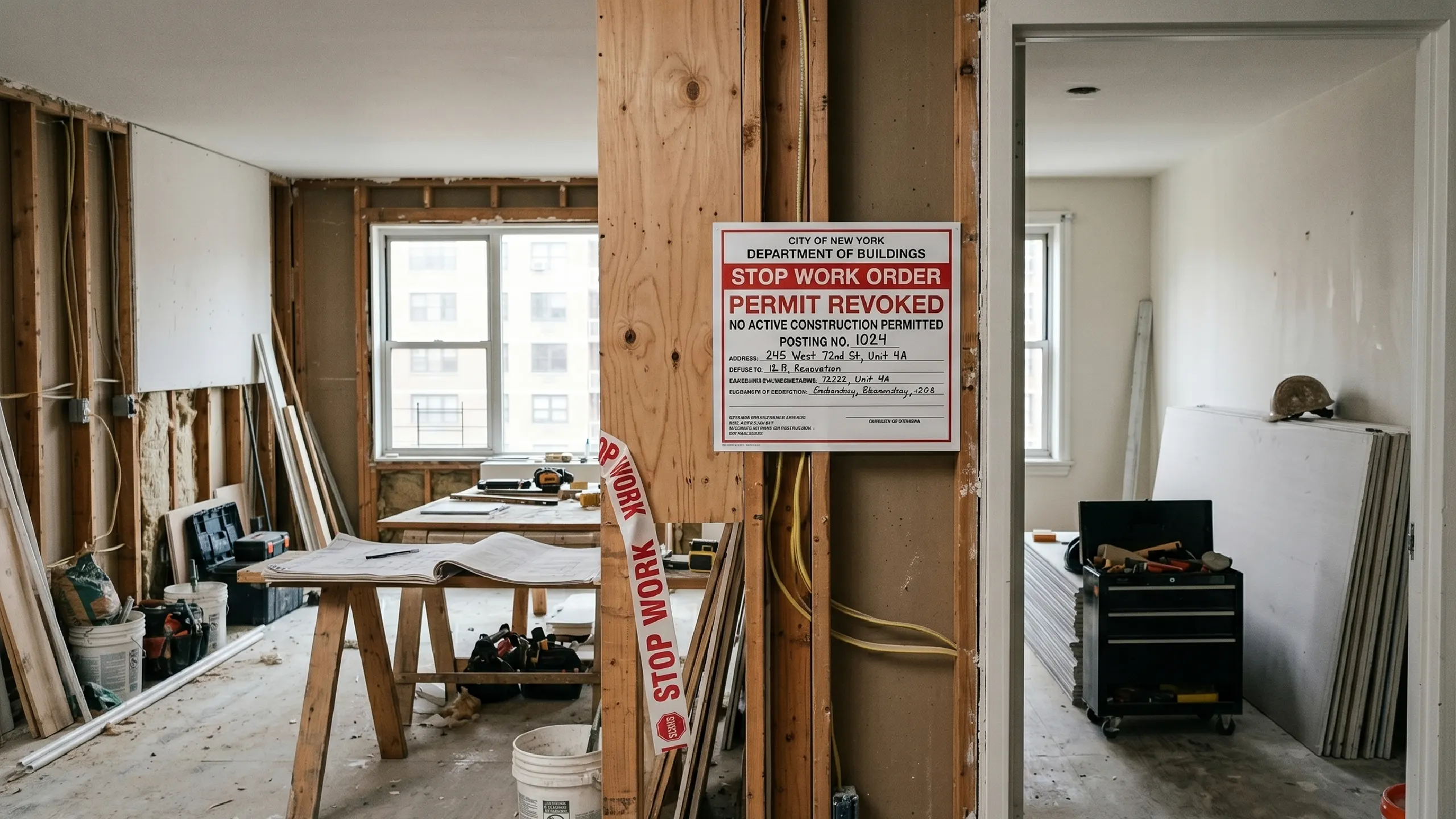
Permit errors are more common on Manhattan renovation projects than most owners realize, and the con

Cracking the NYC Permit Code: Your Step-by-Step Guide to DOB Approvals
Navigating New York City’s Department of Buildings is genuinely complicated, and the consequen
Demolition Rules in NYC Apartments: What Is Allowed
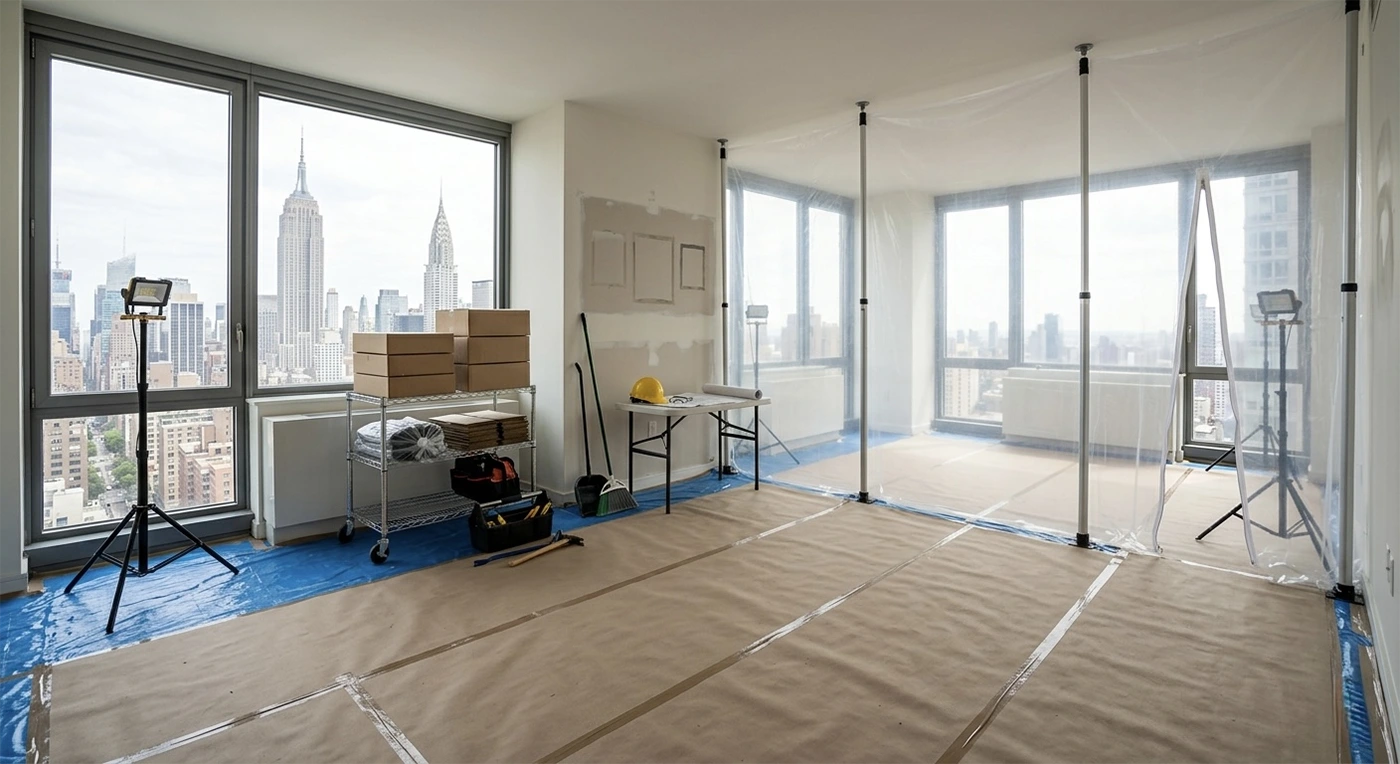
Most people planning a renovation in New York City underestimate how tightly the city controls what