
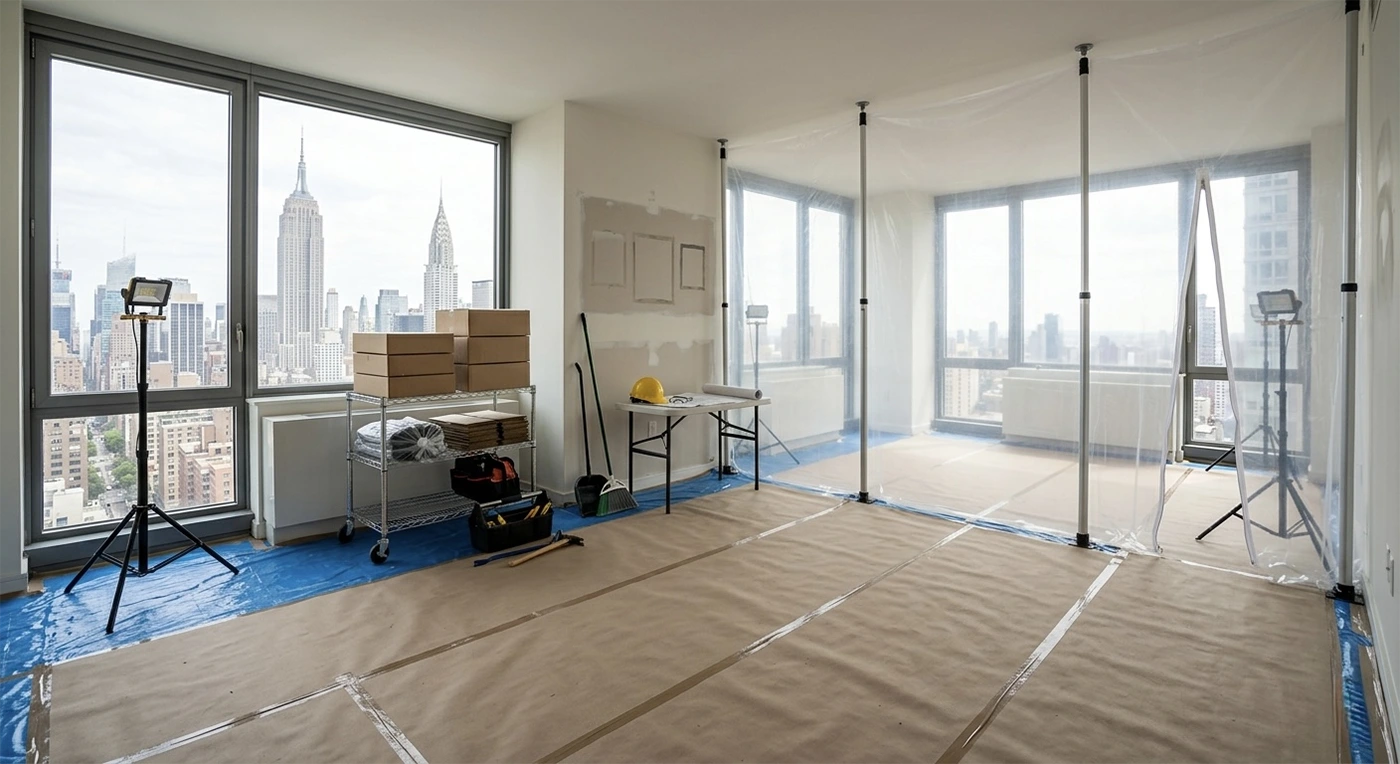
Demolition Rules in NYC Apartments: What Is Allowed
Most people planning a renovation in New York City underestimate how tightly the city controls what you can tear down, and how quickly a misunderstanding can bring a project to a halt. NYC apartment demolition rules aren’t just a matter of building policy or HOA preferences. They’re enforceable city law, backed by the Department of Buildings, and violations can result in stop-work orders, substantial fines, and costly remediation requirements. Before you swing a single sledgehammer, you need to know what’s permitted, what requires approval, and what’s off-limits regardless of who owns the space.
This is especially true in co-ops and condominiums, where the authority to approve renovation work is divided between city agencies and the building’s own board. Getting one to say yes while ignoring the other is a path toward legal exposure that no contractor worth hiring will walk down.
What You Can Generally Demolish — With the Right Approvals
Interior demolition in NYC apartments most often involves removing finishes, non-structural partitions, and outdated materials to make way for a new layout or updated systems. The short answer to what’s allowed is: quite a bit, but almost never without some form of filing or approval first.
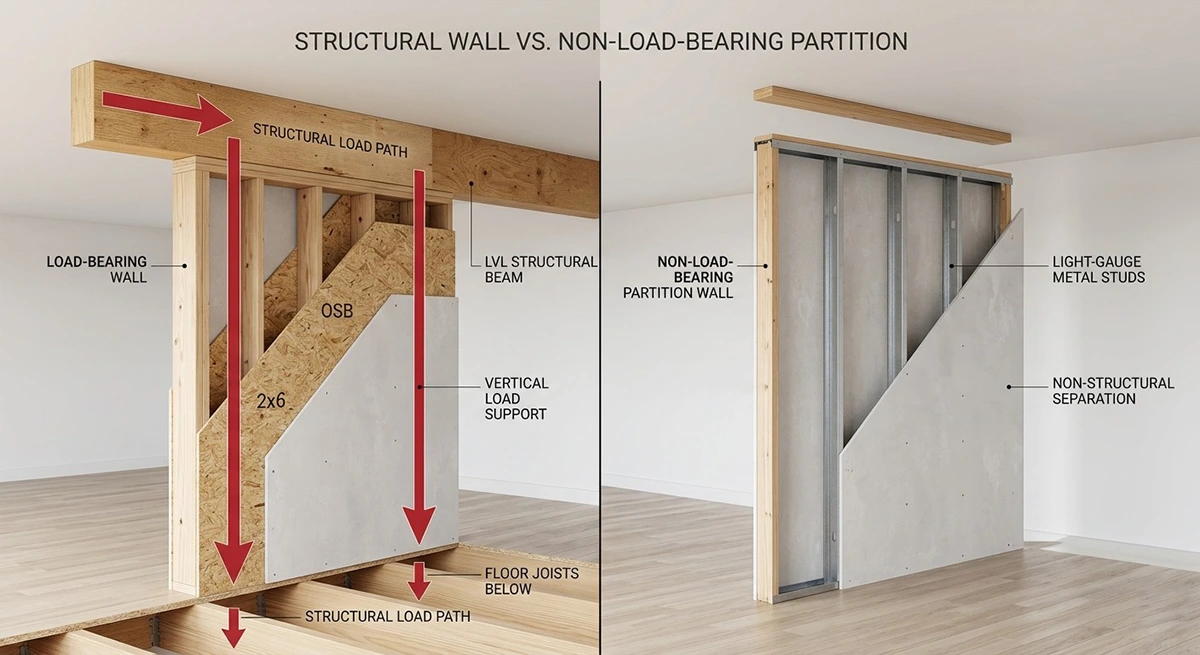
Non-load-bearing partition walls are typically the first things to go in a renovation. These are interior walls that divide rooms but carry no structural load; they’re not supporting the floors above or transmitting force to the foundation below. In theory, they can be removed without compromising the building’s integrity. In practice, even removing a simple partition in most NYC buildings requires a building permit filed with the NYC Department of Buildings, along with drawings prepared and stamped by a licensed architect or engineer.
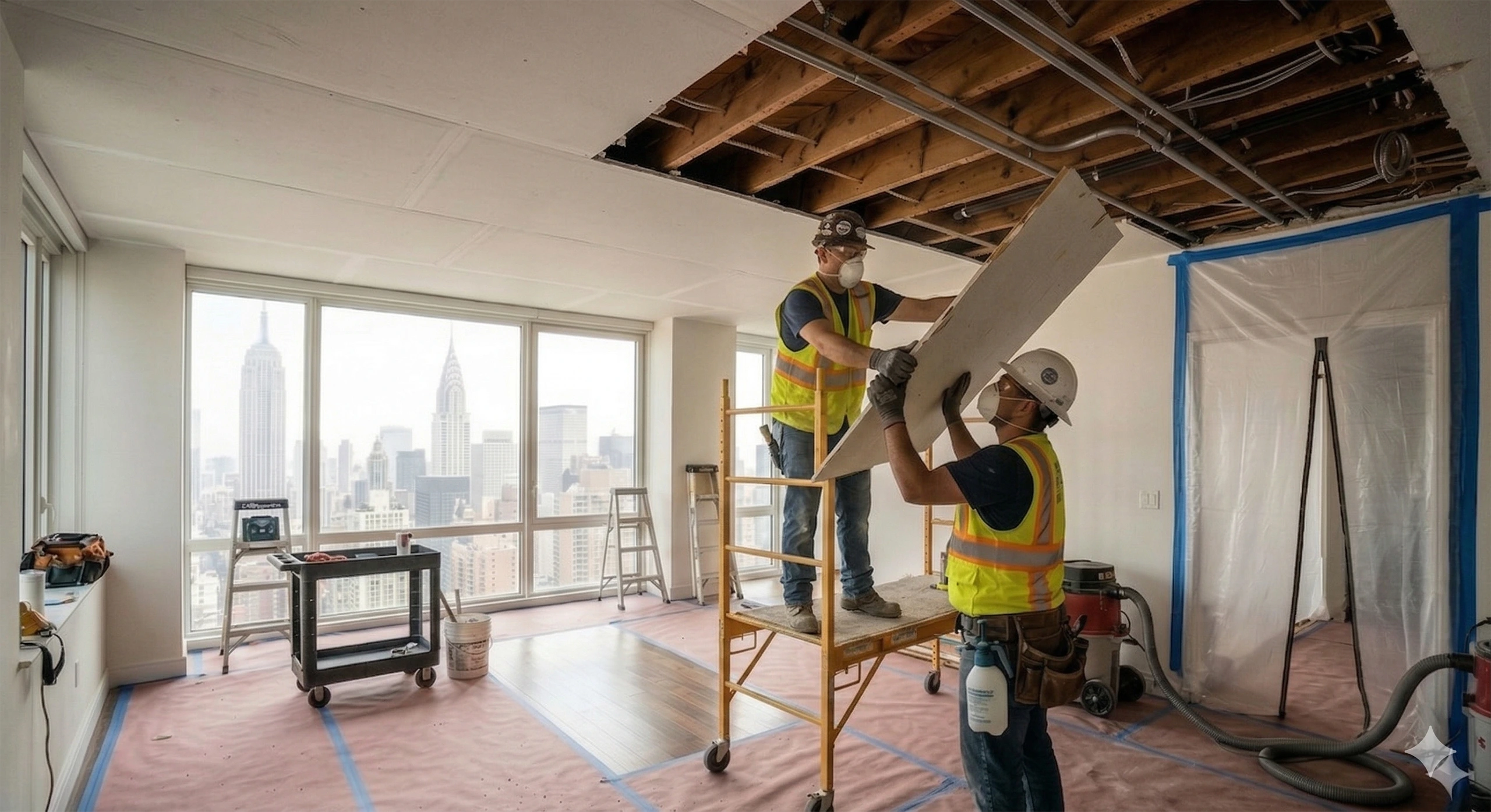
Interior finishes such as plaster, drywall, tile, flooring, drop ceilings, and built-in cabinetry are generally fair game for removal as part of a gut renovation. Removing these elements doesn’t necessarily trigger a full permit filing in every case, but if the work is part of a larger scope that does require permits (and it usually is), the demolition gets folded into the overall filing. Doing any of this work before a permit is issued, or without a registered contractor, creates liability for both the owner and the person swinging the hammer.
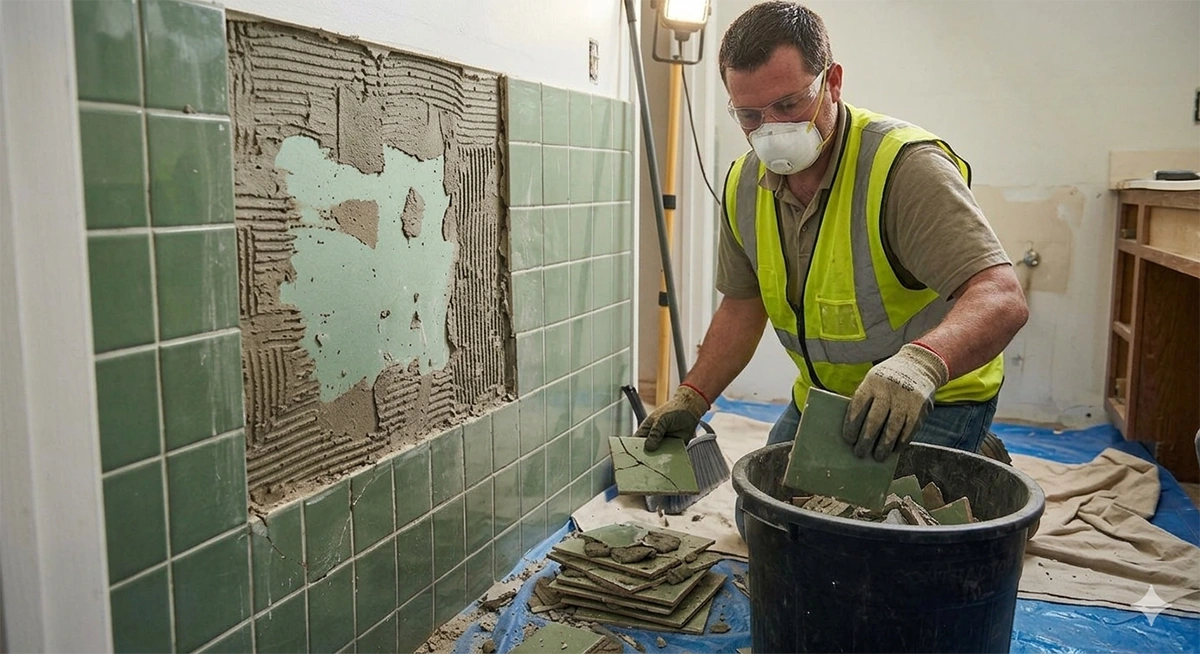
Mechanical and electrical systems, including HVAC ductwork, electrical panels, and individual unit plumbing within the apartment boundary, can be removed and reconfigured with the right permits and licensed tradespeople. The key distinction is whether you’re working within the unit or touching shared building systems. That line matters enormously.
What You Cannot Remove Without Extensive Authorization
Load-bearing walls are the clearest example of what you cannot simply demolish during an NYC renovation, no matter how confident you are in your contractor’s experience. These walls carry the structural load of the building, transferring weight from the floors and roof down through the building’s skeleton to the foundation. Removing or significantly modifying one requires a structural engineering analysis, stamped drawings, a full permit application, and in most buildings, board approval on top of all of that.
Identifying a load-bearing wall isn’t always obvious. Position in the floor plan is one clue. Walls that run perpendicular to the floor joists, that align with walls on floors above and below, or that sit directly above a beam or column are commonly load-bearing. But the only reliable way to confirm it is through a structural analysis by a licensed engineer. A skilled contractor can make an educated guess, but guesses aren’t sufficient when the structural integrity of a multi-story building is involved.
Columns and beams, whether exposed or concealed within walls, are absolutely off-limits without engineering review and DOB approval. The same goes for shear walls, which in many post-war apartment buildings are reinforced concrete elements that provide lateral resistance against wind and seismic forces. Touching these without authorization isn’t just a code violation; it’s a genuine safety hazard.
Shared building systems are another category entirely. Plumbing risers are the vertical pipes that serve multiple apartments above and below yours, and while they run through your unit, they don’t belong to you in any practical sense. Cutting into, capping, or rerouting a riser without coordination with the building’s management and a licensed plumber is the kind of mistake that can affect every tenant on that line. The same principle applies to gas risers, waste stacks, and building HVAC shafts. These are building infrastructure, and they require a different approval process entirely.
Façade elements, structural floor slabs, and anything connected to the building envelope, including exterior walls, window openings, and roof decking, are similarly restricted. Enlarging a window opening, for example, involves the building’s exterior and requires DOB approval, an architect, and often board sign-off. It is not something that gets handled with a handshake and a day laborer.

Permit Requirements: The Framework You’re Working Within
There is no such thing as a permitted gut renovation in New York City that doesn’t involve the Department of Buildings. The DOB oversees all construction permits in the five boroughs, and interior demolition in an apartment building is squarely within its jurisdiction. Understanding the permit framework is essential before any work begins.
The two filing types you’ll encounter most often in apartment renovations are the Alteration-CO and the Alteration. For years these were called ALT-1 and ALT-2 under the old BIS system, and most people in the trade still say it that way, but DOB NOW: Build renamed them in 2021. The classification logic hasn’t changed, only the names on the actual filing.
An Alteration-CO filing is required when the scope of work involves a change in use, occupancy, or egress, meaning the apartment’s fundamental classification or exit configuration is changing. These filings are more complex, require a sign-off from a registered architect or engineer, and often require a new certificate of occupancy before the space can be legally occupied again. Full gut renovations that combine apartments, or any project that significantly alters the unit’s layout relative to its original approved plans in a way that touches use, occupancy, or egress, fall into this category.
An Alteration filing (the old ALT-2) covers most standard apartment renovations that don’t change occupancy or egress. In DOB NOW: Build it’s filed as an Alteration with multiple work types, and this is the more common filing for gut renovations that stay within the existing footprint: new kitchen, new bathrooms, relocated partitions, new mechanical systems.
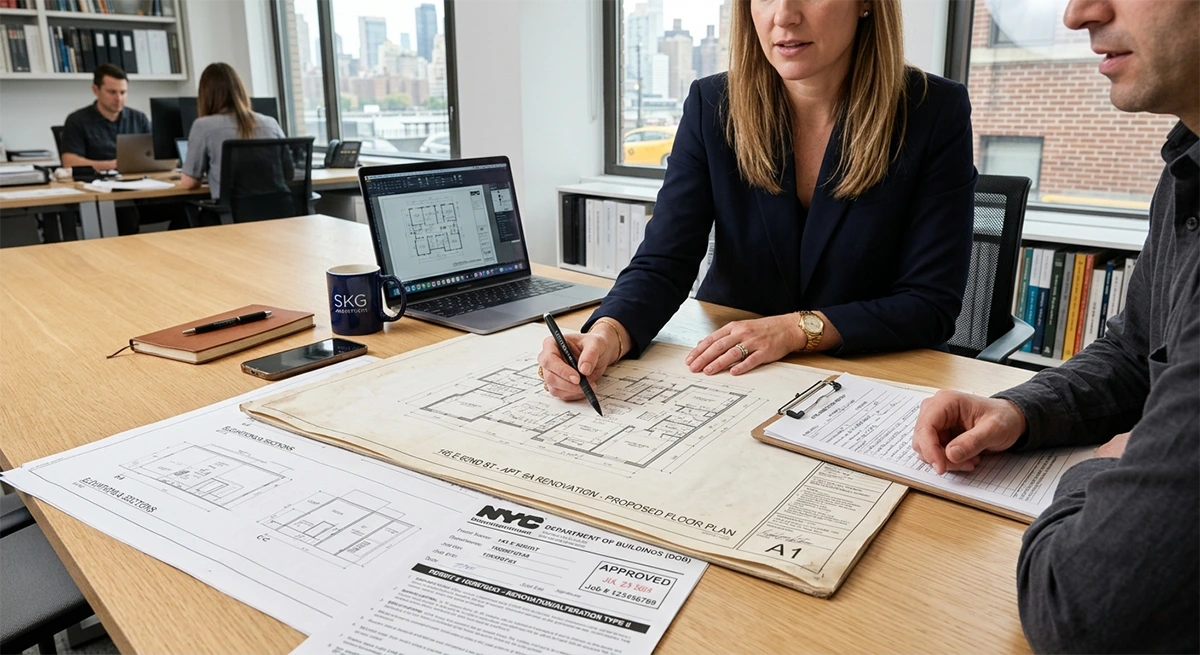
Even this filing requires architectural drawings, DOB review, inspections, and final sign-off.
A demolition permit is required when the scope of work involves more than minor interior removal. If you’re gutting a full apartment, stripping it to the studs, taking out ceilings, and opening up partitions, the DOB expects a demolition permit as part of the overall filing package. Your architect of record will include this in the filing, and it should not be treated as an afterthought.
One thing that catches owners off guard: permits don’t automatically allow you to start work immediately. Once a permit is issued, you or your contractor must post it on-site and comply with its specific conditions throughout the project. Inspections are required at various stages, including rough demolition, rough framing, rough MEP (mechanical, electrical, plumbing), and final, and work must stop between stages until each inspection is passed.
All contractors performing work on a permitted job must be licensed and insured in New York City. General contractors working in a one- to four-family dwelling need a Home Improvement Contractor (HIC) license from the Department of Consumer and Worker Protection. HIC does not cover multiple dwellings, which is what most Manhattan co-ops and condos are. For those, the relevant credential is GC Registration with the DOB (Administrative Code §28-401.18): a $300 fee, a three-year term, and mandatory safety endorsements for construction, concrete, and demolition work in buildings four stories and taller — which covers essentially every co-op and condo in Manhattan. A contractor can hold a valid HIC license and still not be authorized to work in your building if they lack the GC Registration your building actually requires. Plumbers and electricians must hold their own city-issued licenses regardless of building type. Hiring an unlicensed or unregistered contractor isn’t just a risk; it voids any protection you have if something goes wrong, and it can make the permit filing invalid.
Co-op and Condo Board Requirements: A Separate Layer of Authority
Even when you have every DOB permit in hand, you still may not be legally permitted to start work in your apartment. Co-ops and condominiums impose their own layer of approval on top of city regulations, and this approval process is governed by your building’s proprietary lease or house rules, not the Department of Buildings.
Co-op buildings, which make up a substantial portion of NYC’s apartment stock, operate under a proprietary lease that gives the board broad authority to regulate renovation activity. Before any demolition begins, you’ll typically need to submit a formal alteration agreement laying out the scope of work, the contractors you’re using, the insurance requirements for those contractors, and a set of representations about how the work will be performed.
The alteration agreement process can take anywhere from a few weeks to several months, depending on the building and the scope of the project. Boards review architectural drawings, check contractor credentials, and sometimes require approval from the building’s own engineer before signing off. Once executed, the alteration agreement is a binding contract. Deviating from its terms by changing the scope mid-project, switching contractors without notice, or extending the work timeline without approval can result in the board stopping the work entirely or assessing damages.
Condo boards operate under slightly different legal authority. They cannot prohibit you from making alterations in the way a co-op can, but they do have significant power to regulate the process through the building’s bylaws and rules and regulations. Most condo buildings require a similar submission package: drawings, insurance certificates, a construction timeline, and a signed acknowledgment of building rules before work begins.
Work hour restrictions are standard in virtually every NYC co-op and condo. The city’s Noise Code permits construction activity from 7:00 AM to 6:00 PM on weekdays; anything outside that window requires a DOB After-Hours Variance. Most buildings narrow that further through their own alteration agreement, commonly to something like 9:00 AM to 5:00 PM, with the exact hours set by the specific building. Saturdays are sometimes permitted with advance notice; Sundays and holidays are almost universally prohibited. These restrictions exist to protect neighboring residents, and they’re enforced. Violations can result in fines directly from the building, and repeated issues can lead to work being suspended.
Elevator usage, debris removal, and protection of common areas are also typically regulated. You’ll often be required to use service elevators only, pad the elevator cab during demolition, lay protective covering in corridors, and use building-approved waste chutes or dumpster arrangements for debris removal. These logistics need to be coordinated before the first day of work, not after the building super shows up to complain.

One critical mistake owners make is assuming that board approval and city permits are interchangeable, treating getting one as proof the other is a formality. They’re not. You need both, and they don’t always move on the same timeline. It’s not unusual for an owner to receive DOB approval months before the board signs the alteration agreement, or the reverse. Coordinating both tracks in parallel, rather than sequentially, saves significant time.
Overlooked Requirements That Can Stop a Project Cold
Beyond permits and board approvals, there are several regulatory requirements that don’t always make it onto a renovation checklist until something goes wrong.
Asbestos Inspections
Any building constructed before April 1, 1987 is subject to New York City’s own asbestos rules, administered by the Department of Environmental Protection — a separate regime from the federal NESHAP standard, which uses a different framework entirely. Before any interior demolition in an eligible building, an asbestos inspection by a licensed inspector is required. If asbestos-containing materials (ACMs) are identified, and in pre-war and postwar buildings they often are, turning up in floor tiles, pipe insulation, plaster, and ceiling texture, abatement must be completed by a licensed asbestos abatement contractor before demolition can proceed.
This is not optional, and it’s not something to work around. The DEP actively enforces asbestos regulations, and performing demolition without an inspection in an eligible building can result in serious fines, stop-work orders, and potential criminal liability. The cost of an asbestos inspection is minor compared to the cost of a violation. Budget for it upfront.
Lead-Based Paint Considerations
Lead-based paint hazards in NYC renovations are governed by two separate rules that don’t cover quite the same buildings. Federally, the EPA’s Renovation, Repair, and Painting (RRP) Rule applies to any housing built before 1978: demolition that disturbs lead-painted surfaces generates lead dust, which must be controlled under RRP, and the contractor doing that work must be an EPA Lead-Safe Certified Firm. Separately, NYC Local Law 1 of 2004 imposes its own obligations, but on a narrower set of buildings — multiple dwellings built before 1960 (and 1960 to 1978 where lead is documented) — and only where a child under six years old lives in the unit. A pre-1978 renovation can trigger EPA RRP without triggering Local Law 1, or both at once; they’re not the same requirement with two names.
Dust Control
Separate from asbestos and lead rules, NYC Administrative Code §24-146(c) requires that construction and demolition activity be performed so dust doesn’t become airborne, full stop, on every project regardless of building age. In practice that means adequate wetting of surfaces and debris before and during demolition, tarps or enclosures around dust-generating work, covered debris piles and covered transport, and HEPA-filtered vacuuming rather than sweeping or blowing dust around. Using a blower to move deposited dust or dirt is explicitly prohibited. This is a citywide requirement, not a building preference, and it’s the kind of item that gets a stop-work order when an inspector sees it ignored.
Neighbor Protection Measures
The DOB requires that adjoining apartments and structures be protected from damage during construction. This is formalized through the Tenant Protection Plan (TPP), which is required when work is being done while the building is occupied. For gut renovations in occupied buildings, which describes almost every apartment renovation in NYC, the TPP must be filed as part of the permit application, outlining how neighboring units will be protected from dust, noise, vibration, and structural disturbance during the work.
In some cases, a pre-construction survey is required or strongly advisable. This documents the condition of neighboring apartments, including cracks in walls, existing water damage, and squeaky floors, before demolition begins, so there’s a clear baseline if a neighbor later claims the work caused damage.
Landmark and Historic District Rules
If your building is a designated New York City landmark or located within a historic district, the Landmarks Preservation Commission (LPC) has jurisdiction over any work that affects the exterior. Interior work is generally not regulated by the LPC unless the apartment is part of an individually designated interior landmark, but any penetration of the exterior envelope, whether that’s changing a window opening, adding a through-wall HVAC unit, or altering the façade, requires LPC approval before a DOB permit can be issued. Owners in landmark buildings should know this before they sketch out a renovation plan, not after.
Where Successful Renovations Actually Start
Interior demolition in a New York City apartment is never as simple as knocking down a wall and calling it progress. NYC apartment demolition rules exist at every level: city law, building code, co-op and condo governance. They interact with each other in ways that require careful coordination. The owners who navigate these projects smoothly are almost always the ones who invested time upfront in understanding the regulatory landscape, hired experienced professionals, and respected the process rather than looking for shortcuts.
That investment isn’t bureaucratic overhead — it’s the difference between a renovation that finishes on time and one that collects violations, loses contractor relationships, and tests the patience of everyone in the building. In New York City, knowing what you can demolish and exactly how to do it properly is where every successful renovation begins.

Co-op Renovation Agreements: Hidden Clauses That Cost You Money
Most apartment owners who have purchased a co-op in New York City understand, in the abstract, that

Landmark Living: Renovating Historic Buildings in NYC’s Protected Districts
There is a unique romance to living in a pre-war brownstone or a historic loft in one of New York Ci

Removing Load-Bearing Walls in Urban Apartments: Risk, Calculations, and Compliance
Taking down a wall to open a kitchen, connect a living and dining room, or improve natural light is