
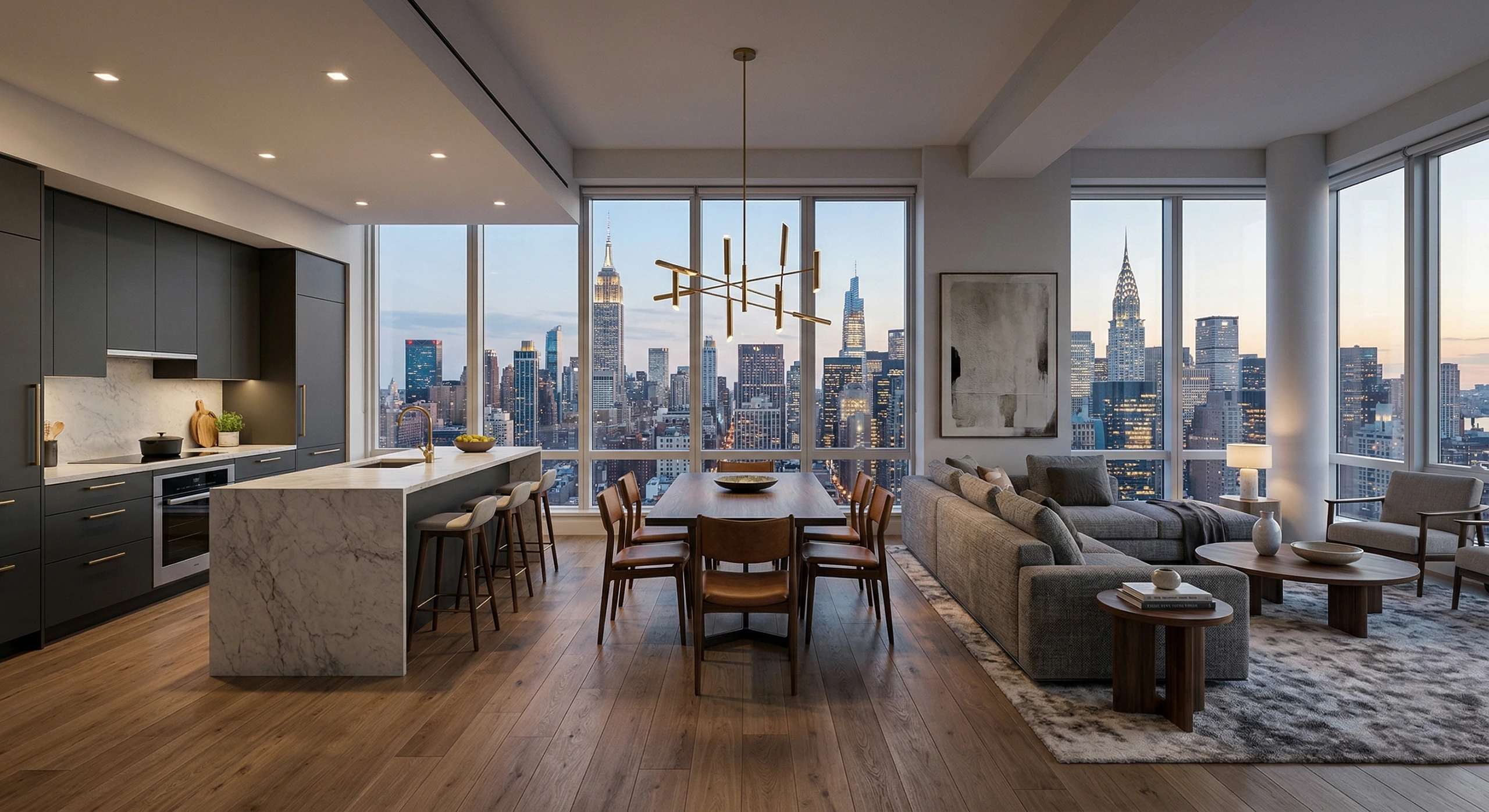
Spatial Zoning in Open-Concept Apartments
Open-concept living has become a defining feature of contemporary urban interiors. It promises light, visual continuity, and flexibility, particularly in compact residences where every square foot must perform multiple roles. Yet openness alone does not guarantee comfort or efficiency. Without deliberate spatial structure, an open plan can feel undefined, acoustically chaotic, and visually unsettled. What makes an open plan succeed is the structure that replaces the walls.
In dense urban environments such as Manhattan, zoning open-concept apartments has evolved into a discipline that combines architecture, interior design, ergonomics, lighting science, acoustics, and real estate pragmatism. Square footage is limited, ceiling heights vary, natural light shifts dramatically between exposures, and building regulations often restrict structural alterations. As a result, designers must rely on layered spatial techniques rather than permanent partitions to create distinct yet cohesive zones.
Understanding the Philosophy of Zoning in Open Concept Design
Zoning is the structure that makes openness livable. In a traditional apartment layout, walls perform multiple roles simultaneously. They provide structural support, acoustic separation, privacy, and psychological orientation. When walls are removed, those roles do not disappear. They must be redistributed across other design elements.
In an open-concept apartment, zoning functions as invisible architecture. It defines where one activity begins and another ends without relying on full-height partitions. It guides movement, establishes visual anchors, regulates sound, and creates atmospheric variation. Most importantly, it supports daily life patterns. A well-zoned apartment feels intuitive. One moves naturally from entry to kitchen, from kitchen to dining, from dining to living, without hesitation or congestion.
Effective zoning requires hierarchy. Every apartment must establish a primary function. In some homes the kitchen is the social center. In others, a generous seating area anchors entertaining. In smaller residences, a home office may be the dominant zone because remote work shapes daily rhythm. Identifying this primary zone early in the design process ensures that supporting zones reinforce rather than compete with it.
Hierarchy also informs scale. The dominant zone typically commands the best light, the strongest focal point, and the most generous proportions, with secondary zones adapting around it. Without that hierarchy, every area competes for attention and the apartment feels scattered.
Circulation as the Structural Framework of an Open Plan
Circulation is the invisible grid upon which zoning is built. In compact urban apartments, circulation cannot be an afterthought. It must be drawn first.
Interior designer Tatiana Chechina starts every open-plan study by drawing the primary circulation path before placing a single piece of furniture: 36 inches of clear width as the working minimum, 42 where the route carries daily traffic. That path should connect the entry door to the principal destination without forcing anyone to weave between furniture pieces. When circulation stays legible and unobstructed, the space feels larger and calmer than its dimensions suggest.
In long, narrow floor plates common to prewar and postwar buildings, the main circulation spine often runs parallel to windows. Designers must carefully balance access to natural light with uninterrupted flow. If the circulation path bisects the best window wall, it diminishes the usability of the perimeter. Instead, placing circulation along an interior edge often preserves the luminous outer zone for living or dining.
Sightlines reinforce circulation. When a person enters the apartment, the eye should land on a focal element such as artwork, a bookshelf composition, or a sculptural light fixture. That visual anchor establishes orientation and depth before anyone takes a second step.
Architectural Strategies That Define Zones Without Walls
Permanent partitions are not the only architectural tools available. Ceiling modulation, floor articulation, built-in millwork, and subtle level changes can create perceptual rooms within a larger volume.
Before any of them get drawn, though, one constraint determines what is even possible: the wet-over-dry rule. Most co-op and condo alteration agreements prohibit placing a wet area (a kitchen, a bathroom, anything with active plumbing) above a dry room in the apartment below. In practice this means the kitchen zone in an open plan usually cannot travel far from its existing plumbing footprint, and many buildings do not permit moving it outside that footprint at all. Since the kitchen is frequently the anchor around which an open plan organizes itself, this is the first question to resolve with the managing agent, not the last. A zoning scheme built around a relocated kitchen that the building will never approve is a scheme that has to start over.
Ceilings are particularly powerful in open-concept apartments because they shape space without consuming floor area. A shallow dropped ceiling above a dining table can create a sense of enclosure even if it descends only 6 to 12 inches. When integrated with concealed lighting, the ceiling plane becomes both a spatial and atmospheric boundary.
Worth knowing before this gets specified: a dropped ceiling counts as a construction alteration. In a co-op or condo it goes through the building’s alteration agreement, and if the design includes cove or concealed lighting, which it usually does since that is most of the point, the new wiring and circuits require a Licensed Master Electrician and an electrical permit. Budget the approval time alongside the fabrication time.
Cove lighting around the perimeter of a living zone establishes a luminous halo that defines territory. The eye interprets the glow as an implied boundary. Similarly, a soffit running above a kitchen run can signal transition from living to culinary space without introducing visual clutter.
Flooring transitions also anchor zones. In high-end renovations, it is common to maintain wide-plank wood throughout the primary living areas while introducing stone or porcelain tile in the kitchen. The change in material underfoot signals a shift in function. The key is maintaining flush transitions to avoid tripping hazards and visual fragmentation.
Flooring is another place where the building has a say. Replacing floor covering in an occupied apartment is governed by the alteration agreement rather than by the city’s code for new floor assemblies, and those agreements are specific: many require a documented impact insulation rating for the underlayment, while others still enforce the older rule requiring soft covering across roughly 80 percent of the floor area outside the kitchen and bathrooms. Either way, the neighbor below is the reason the rule exists, and the specification needs to be confirmed before material is ordered.
In loft-style apartments, a low platform between 4 and 6 inches can elevate a sleeping zone or reading nook. This minimal level change creates psychological separation without obstructing light. When the platform incorporates concealed storage drawers, it adds functionality as well as spatial identity.
One caution that matters more in postwar buildings than in lofts: raising the floor lowers the clear height above it. A sleeping area has to maintain the 8-foot minimum ceiling height that NYC’s housing standards require of a legal bedroom, so a 6-inch platform in an apartment with 8-foot ceilings puts that zone below the threshold. In a prewar apartment with 10-foot ceilings the platform is free; in a postwar unit it may not be available at all. Measure the existing height before the detail gets drawn.
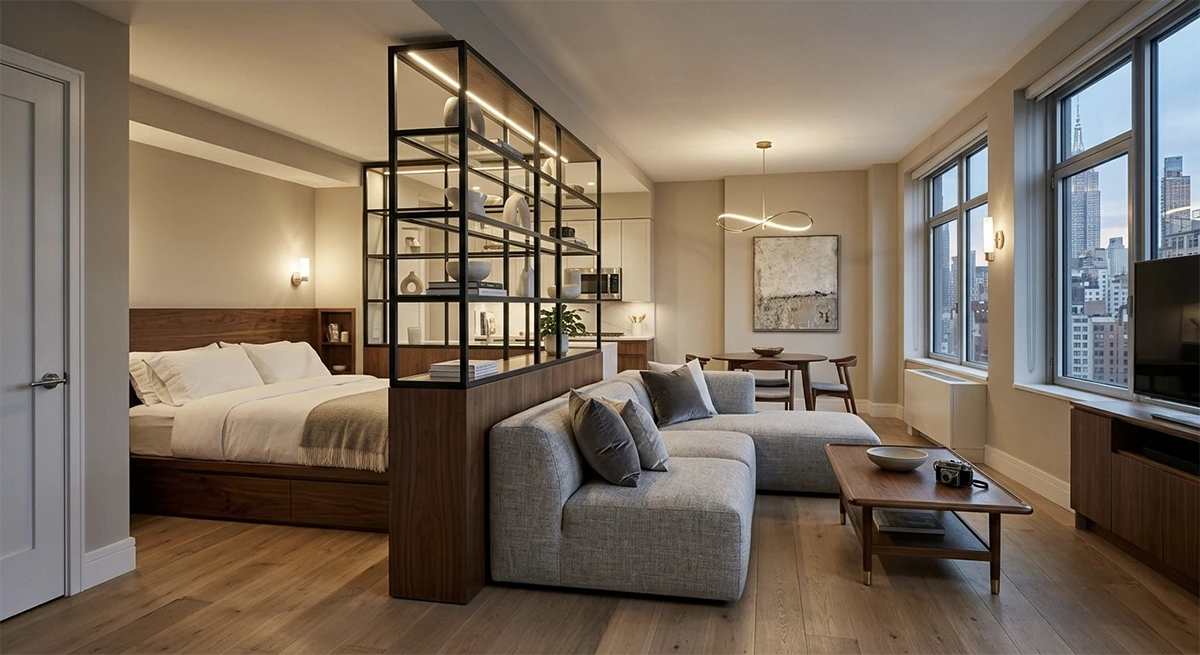
Built-in shelving units positioned perpendicular to a wall can serve as partial dividers. When designed with open sections at eye level, they allow light and views to pass through while screening certain activities. In studio zoning strategies, such millwork solutions often replace traditional bedroom walls, preserving openness while granting privacy.
The Role of Furniture in Defining Open Concept Living
Furniture in an open plan is doing architectural work, whether or not it was chosen that way.
The back of a sofa can operate as a horizontal wall between living and dining zones. A credenza placed behind seating creates a defined edge while offering storage. An L-shaped sectional naturally establishes a corner that functions as a self-contained room.
Scale is critical. An undersized sofa floating in a generous loft looks accidental. A properly proportioned seating arrangement anchored by a substantial rug looks deliberate. Proportion should respond to ceiling height and window scale. In apartments with ceilings above 9 feet, slightly taller furniture silhouettes prevent visual imbalance.
Rugs play a pivotal role in zoning small spaces. A rug large enough for all seating legs to rest upon visually consolidates the living area. If only the front legs touch the rug, the grouping feels temporary and fragmented. In dining zones, the rug should extend at least 24 inches beyond the table edge to accommodate chair movement without catching.
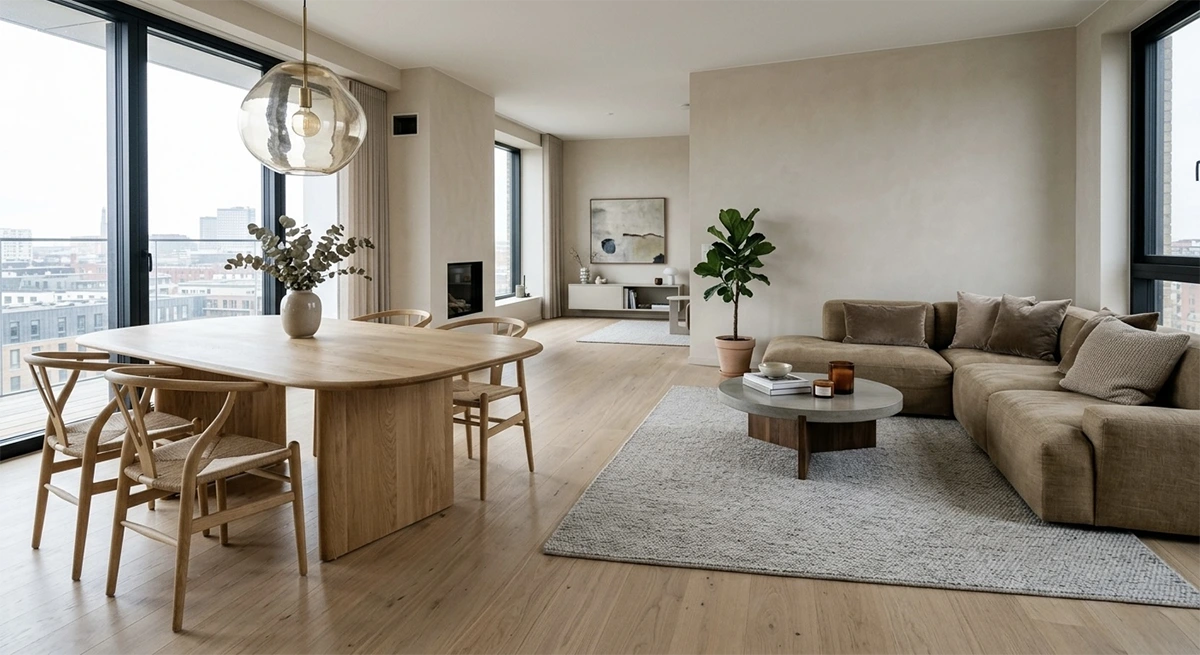
In multi-functional layouts, movable furniture enhances flexibility. Nesting tables, lightweight lounge chairs, and extendable dining tables allow reconfiguration for entertaining or daily use. Flexibility is particularly valuable in apartments where space must adapt to social gatherings, remote work, and quiet evenings.
Lighting as Spatial Choreography
Lighting is one of the most underutilized zoning tools in residential design. It operates in three dimensions and influences both perception and mood.
Pendants suspended above a dining table establish a vertical volume that functions as a distinct room. The light fixture becomes a focal point and defines the table’s territory even without surrounding walls.
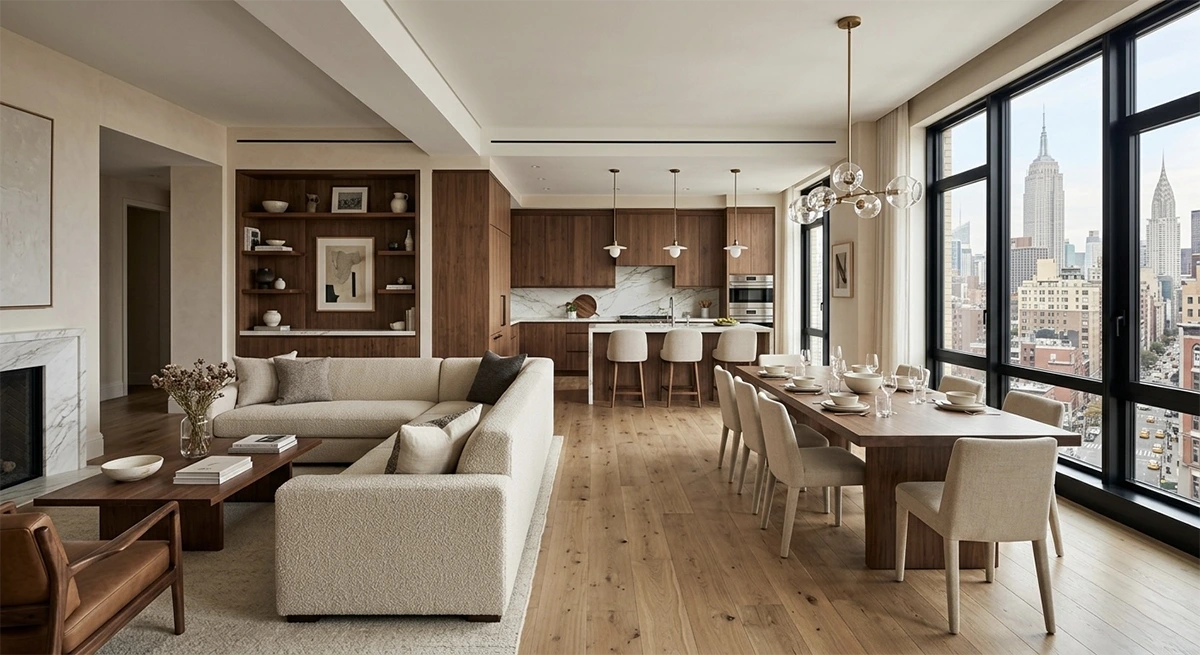
Color temperature subtly differentiates zones. Warmer light around 2700K to 3000K creates intimacy in living and dining areas. Slightly cooler light in the kitchen enhances clarity for task work. When combined with dimming systems, these variations reinforce the identity of each zone without visual barriers.
Layered lighting deepens the zoning strategy. Ambient ceiling fixtures provide general illumination. Task lights focus on specific activities such as reading or cooking. Accent lights highlight artwork or architectural texture. Together they create a layered hierarchy that mirrors the functional hierarchy of the apartment.
In residences with limited natural light due to adjacent buildings, artificial lighting assumes even greater importance. Strategic placement of uplights along walls enhances perceived height, while wall washers expand the visual width of narrow rooms.
Acoustic Zoning in Urban Apartments
Open-concept layouts often struggle with sound control. Hard surfaces common in modern interiors amplify reverberation. In compact apartments, kitchen noise can intrude upon work or relaxation zones.
Acoustic zoning addresses these challenges through material selection and spatial arrangement. Upholstered furniture, heavy drapery, and wool rugs absorb sound reflections. Bookshelves filled with varied objects act as diffusion surfaces, breaking up sound waves.
If the apartment sits above neighbors in a cooperative or condominium, impact noise control becomes critical. Acoustic underlayment beneath wood flooring measurably improves impact insulation performance and reduces transmission. As noted above, most buildings specify what that underlayment has to achieve rather than leaving it to preference.
Appliance selection also contributes to acoustic comfort. Quiet dishwashers, insulated refrigerators, and properly mounted exhaust systems prevent intrusive mechanical noise from dominating the open plan.
Proportion, Clearance, and Ergonomic Precision
Spatial comfort relies on adherence to ergonomic standards. These metrics may seem technical, yet they define the daily experience of an apartment.
| Area | Recommended Clearance |
|---|---|
| Sofa to coffee table | 14–18 inches (20–24 for deep or plush sectionals) |
| Main circulation behind seating | 36 inches minimum, 42 preferred |
| Dining table to obstruction | 42–48 inches |
| Kitchen aisle (single cook) | 42 inches minimum |
| Kitchen aisle (shared) | 48 inches minimum, up to 60 in generous plans |
| Desk depth | 24 inches minimum, 30 inches preferred |
Ignoring these dimensions produces daily friction. When doors collide with furniture or chairs scrape walls, the illusion of spaciousness collapses regardless of how the plan looked on paper.
Material Cohesion and Textural Differentiation
One risk of zoning is visual fragmentation. To avoid this, maintain a cohesive base palette throughout the apartment. Neutral wall tones, consistent trim detailing, and complementary flooring unify the plan.
Within this framework, introduce textural variation to distinguish zones. A fluted wood panel behind the sofa adds depth to the living area. A honed stone backsplash signals the kitchen. A woven wall covering or acoustic panel enriches the workspace. These texture changes register as architectural moves without interrupting openness, creating subtle sensory shifts that reinforce function.
Zoning in Specific Manhattan Contexts
Prewar apartments often feature generous ceiling heights and structural columns that can be integrated into zoning strategies. Columns may anchor shelving units or frame seating areas. Crown moldings and ceiling beams can guide subtle ceiling treatments.
Postwar buildings frequently present lower ceilings and narrower footprints. In these contexts, vertical emphasis becomes essential. Tall millwork consolidates storage along one wall, preserving the remainder of the plan for flexible use. This is also where floor-level changes stop being an option, since there is no headroom to give away.
Studio apartments demand the most strategic zoning. A sleeping area may be separated by open shelving or a partial-height partition. A fold-down desk adjacent to the kitchen can double as dining. Every piece must justify its presence.
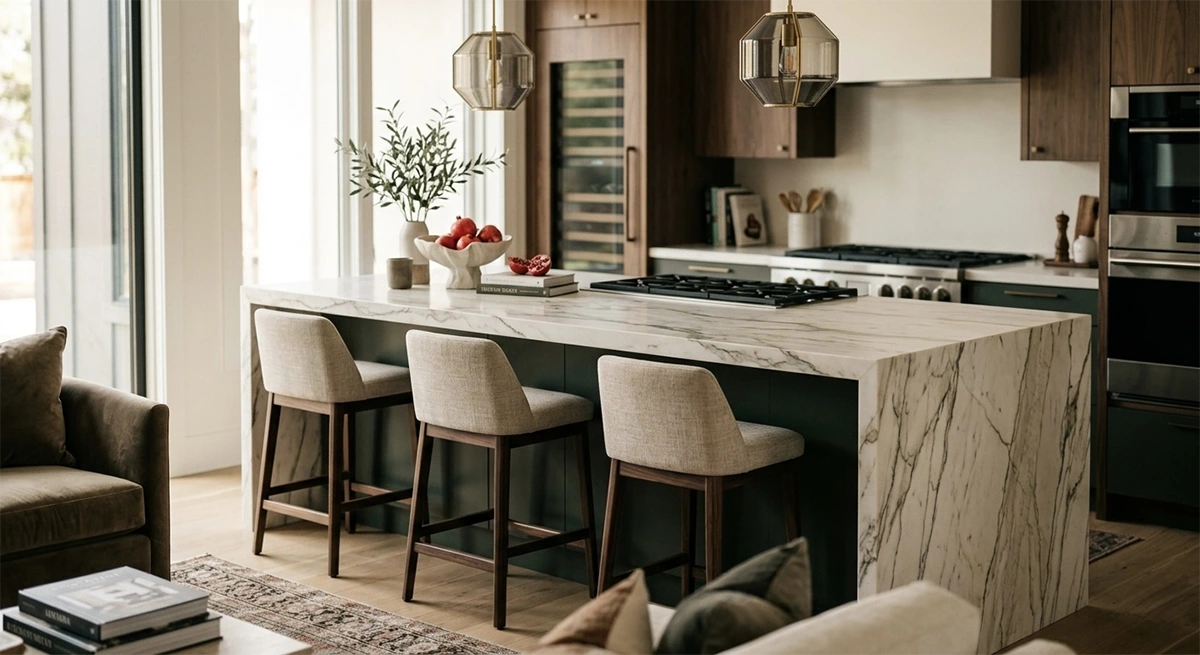
Luxury condominium renovations often prioritize entertaining. Here the kitchen island becomes a social hub, oriented toward the living area. Integrated wine storage or bar niches further define hospitality zones, within, as always, whatever the plumbing footprint allows.
Implementation Strategy for Professional Results
- Begin with program definition and circulation mapping.
- Establish fixed anchors such as kitchen layouts and millwork, confirming the plumbing footprint the building will allow before the kitchen zone is located.
- Confirm structural feasibility and secure building approval. In a co-op or condo this is a scheduled process, not a phone call: an alteration agreement package typically takes 4 to 8 weeks to clear, longer where the board meets monthly or wants its own engineer to review drawings. Ceiling changes, flooring replacement, and any new electrical circuits all belong in that submission. Work backward from this step when setting a completion date, because it cannot be compressed later.
- Finalize ceiling and flooring transitions.
- Install lighting infrastructure before furniture placement.
- Bring in major furniture pieces and adjust positioning physically before committing to smaller accessories.
- Complete the project with textiles, artwork, and acoustic enhancements.
Testing layouts with painter’s tape on the floor lets clients walk the spatial relationships before anything is installed. Mockups at this stage prevent costly errors and settle disagreements that drawings alone tend to leave open.
Real Estate Value and Long-Term Flexibility
Well-zoned open-concept apartments hold their appeal in competitive markets. Buyers respond to clarity and usability. A defined dining area, even within a compact footprint, signals thoughtful design. A discreet workspace adds contemporary relevance.
Flexibility also protects long-term value. Modular shelving, movable partitions, and adaptable lighting systems allow the apartment to evolve as needs change. This adaptability is particularly important in urban environments where residents often remain in place through multiple life stages.
Zoning an open-concept apartment is both art and engineering. It requires understanding circulation, proportion, acoustics, lighting science, and human psychology, and it demands restraint and precision. When executed thoughtfully, one expansive room becomes a sequence of purposeful environments that feel cohesive yet distinct.
Openness works best when it carries structure. Through architectural nuance, furniture intelligence, technical rigor, and early clarity about what the building will actually permit, open-concept living becomes a durable framework for how people live now.

Renovation Contracts in NYC: How to Protect Your Investment Before Work Begins
There’s a specific moment before the hammers swing, before the dust rises, when the renovation
Why “Minimalism” Often Looks Cheap (and How to Do It Right)
Minimalism is one of the most requested design directions in Manhattan apartment renovations, and on
Small Dining Rooms and Breakfast Nooks in NYC Apartments
A small dining room can be comfortable and useful if the layout and the pieces fit the footprint. Th