

Removing Load-Bearing Walls in Urban Apartments: Risk, Calculations, and Compliance
Taking down a wall to open a kitchen, connect a living and dining room, or improve natural light is one of the most common renovation goals in city apartments. On paper, it looks simple. In practice, removing a load-bearing wall is a structural intervention that changes how the building carries weight. The design intent may be visual, but the decision is structural.
In dense urban buildings, especially in Manhattan, load paths are continuous across floors and units. A wall that appears ordinary may be carrying floor loads from above, roof loads, or even transferring forces from other structural elements. Removing it without a clear engineering plan can lead to cracked finishes, sagging floors, misaligned doors, damage to neighboring apartments, and in extreme cases, serious structural instability.
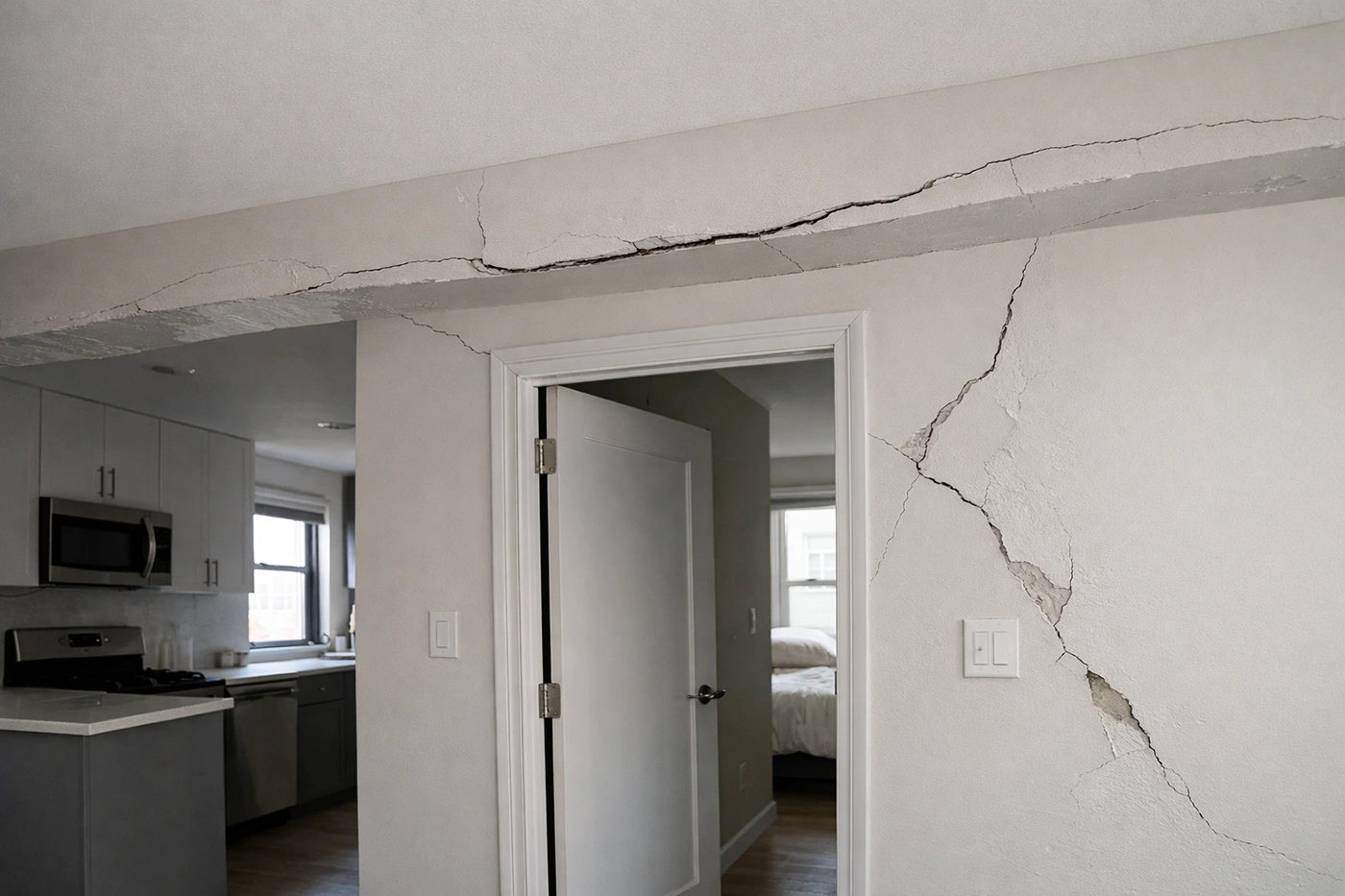
Where it is permitted, this work is entirely routine for an experienced team: disciplined structural engineering, carried out in a specific order, with the design settled before anything is cut. The harder question comes first, and it is not an engineering question. It is whether your building will allow the wall to come out at all.
First Question: Whether the Wall Can Come Out at All
Before any of the engineering described below becomes relevant, two separate gates have to be cleared, and either one can close the project permanently.
The first is physical. Not every load-bearing element can be replaced with a beam. Concrete columns are part of the building’s primary structural system and run from foundation to roof; an individual unit owner cannot remove one. Shear walls in post-war concrete towers provide the building’s lateral resistance against wind, and they are not candidates for removal either. Some walls carry transfer loads from elements above in configurations where there is nowhere inside the apartment to land the reaction forces from a replacement beam. In those cases the answer is no regardless of budget, and a competent structural engineer will say so early.
The second gate is contractual, and it stops more projects than the first. Co-op and condominium boards hold broad authority over alterations through the proprietary lease and the alteration agreement, and structural modification is the category they restrict most heavily. Many alteration agreements prohibit modification of bearing walls, structural slabs, and ceilings outright, regardless of what the city’s building code would permit. Where the work is not banned by the document, it typically requires an explicit board vote rather than administrative sign-off, review by the building’s own engineer, and in some buildings shareholder approval as well. Requests to remove bearing walls are denied often enough that no owner should treat approval as a formality — and a board is generally not obligated to explain its reasoning.
The practical consequence is a sequencing one with real money attached. Read your alteration agreement, and ask the managing agent directly whether the building permits structural work, before commissioning engineering. Owners who reverse that order sometimes pay for a full structural analysis of a wall their building was never going to let them touch.
Why Removing a Load-Bearing Wall Is a Structural Decision
A load-bearing wall is part of the building’s structural system. It supports vertical loads from slabs, joists, beams, partitions, finishes, furniture, and occupants. These loads travel through the wall into lower structural elements and ultimately into the foundation. This continuous route is known as the load path.
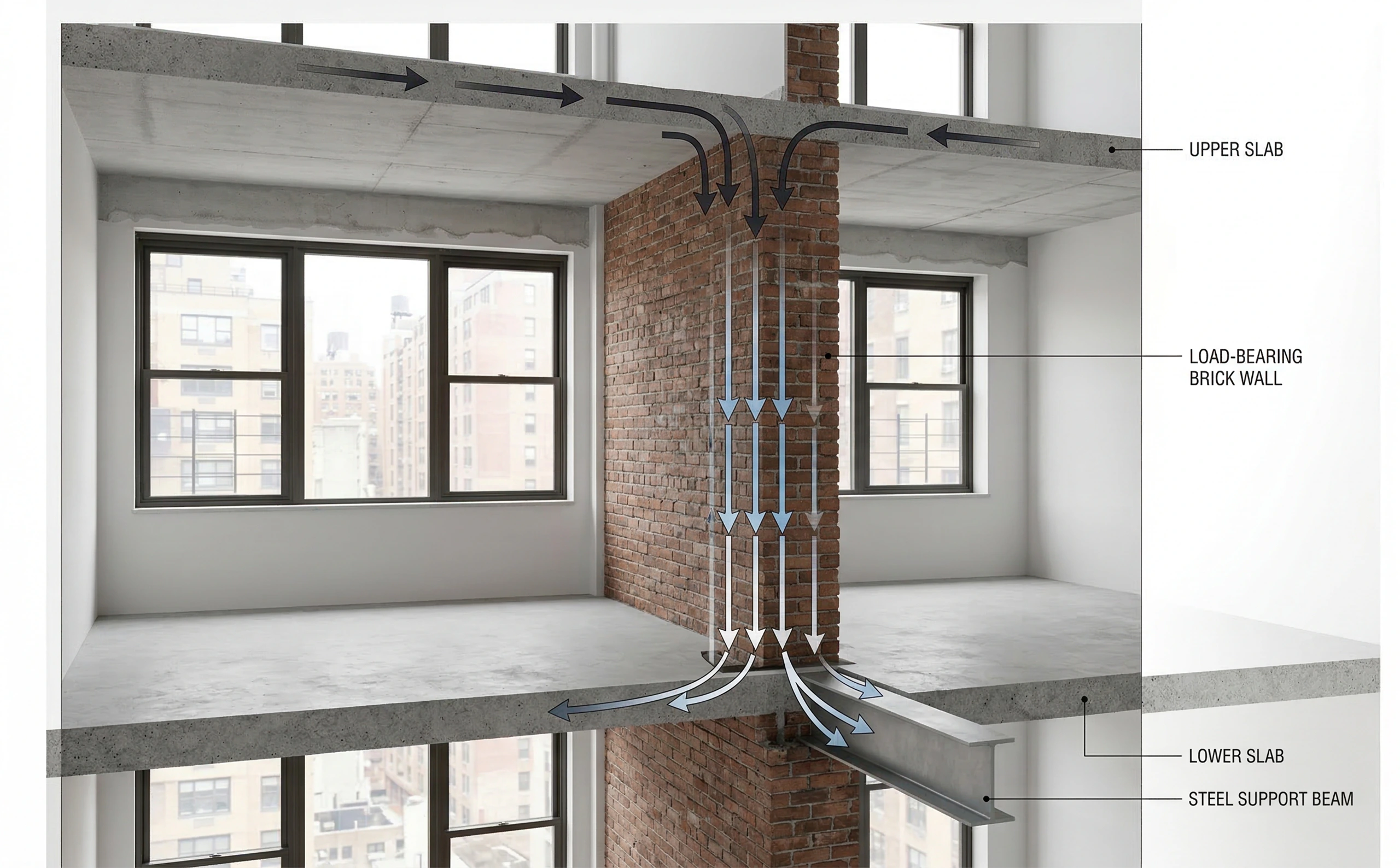
When a bearing wall is removed, that load path is interrupted. The structural engineer’s task is to redirect those forces safely to other elements without overstressing the structure or causing unacceptable movement. The replacement system must carry the same loads with adequate strength and stiffness.
In older masonry buildings, walls often stack vertically from foundation to roof. Removing one segment may affect multiple levels, and in some buildings that alone is grounds for refusal. In modern reinforced concrete towers, interior walls may sit on beams or slabs in ways that are not obvious from visual inspection. Some walls are nonstructural partitions, others are integral to the system, and a subset of the integral ones cannot be substituted with a beam under any design. Assumptions are risky here, and determination has to be based on documentation and investigation rather than appearance.
Identifying Whether a Wall Is Load-Bearing
The process begins with available records. Original construction drawings, if accessible through building management or city archives, are the most reliable source of information. Structural framing plans show beams, columns, slab thicknesses, and load-bearing walls. They provide context that cannot be seen from finished surfaces.
When drawings are unavailable or incomplete, field investigation becomes necessary. Engineers examine wall thickness, alignment with elements above and below, and ceiling framing direction. A wall that aligns vertically with structural elements on multiple floors is more likely to be bearing. A light-framed partition running parallel to floor joists may be nonbearing.
In many cases, small exploratory openings are required. Carefully removing sections of drywall or plaster allows the engineer to observe framing members, beam locations, or slab edges. In reinforced concrete buildings, non-destructive scanning equipment is often used to locate reinforcing bars and post-tension tendons before any cutting begins. Ground penetrating radar and rebar scanners help avoid damaging structural components during investigation.
The purpose of this discovery phase is to understand how loads currently travel through the building. Only with that understanding can a safe replacement be designed — or a conclusion reached that no safe replacement is available within the apartment.
One requirement belongs at the very start of this phase rather than later. In any building constructed before April 1, 1987 — which covers most of Manhattan’s pre-war and early post-war stock — an ACP-5 asbestos certification from a DEP-certified investigator is required before the DOB will issue a permit and before demolition begins. Exploratory openings and wall removal both count as demolition. If asbestos-containing material turns up in plaster, pipe insulation, or floor assemblies, licensed abatement moves onto the critical path ahead of the structural work, so the investigation is worth commissioning early rather than after the engineering is complete.
Understanding the Loads Involved
Structural engineering converts physical conditions into calculated loads. The primary categories considered in residential apartment renovations are dead load and live load.
- Dead load includes the weight of structural slabs, joists, finishes, partitions, and permanently installed components
- Live load represents variable occupancy loads such as people, furniture, and movable items. Building codes specify minimum live loads for residential occupancies, often around forty pounds per square foot
Engineers determine the tributary area supported by the wall — the portion of floor or slab whose weight is transferred to that specific wall. By multiplying the combined dead and live load by the tributary area, the engineer calculates the total vertical load that the wall is carrying.
For example, if a wall supports 120 square feet of floor area and the combined design load is fifty-five pounds per square foot, the total load equals 6,600 pounds. In real projects, load factors and code-required combinations are applied to ensure adequate safety margins. Deflection limits are also checked to ensure that movement under service load remains within acceptable limits.
Selecting and Sizing the Replacement Beam
When a load-bearing wall is removed, the typical structural solution is to install a beam that spans the opening and transfers loads to supports at each end. In Manhattan apartment renovations, structural steel beams are common because of their strength-to-depth efficiency. Engineered wood products such as laminated veneer lumber may be appropriate in certain low-rise conditions. Reinforced concrete or composite systems may also be used depending on the building type.
Beam design must satisfy both strength and serviceability requirements:
- Strength checks ensure the beam can resist bending moments and shear forces without exceeding allowable stresses
- Serviceability checks ensure that deflection under load is limited so that finishes do not crack and floors do not feel uneven
In residential renovations, serviceability often governs. Excessive deflection can produce visible sagging, cracked plaster, or misaligned doors long before structural capacity is reached. For longer spans, camber may be introduced during fabrication so that the beam appears level once loaded. Span length has a major influence on beam size — as span increases, depth and weight increase significantly to maintain stiffness.
Designing Supports and Connections
A beam must deliver its loads safely into supporting elements. The reaction forces at each end of the beam can be substantial and are concentrated over relatively small bearing areas. If these reactions are placed on nonstructural partitions or weak substrates, local failure can occur.
Engineers design bearing conditions carefully. Solutions may include steel bearing plates that distribute load, reinforced masonry pockets, new steel columns, or connections into existing structural walls or columns. The supporting element must be verified to have a continuous load path to the foundation. Where no adequate supporting element exists within the apartment, this is the point at which the project stops.
Connection details include anchor bolts, welded plates, and bearing lengths sized to resist shear, bending, and potential uplift. In existing buildings, conditions are rarely perfectly level or plumb, so field adjustments are anticipated in the design.
Temporary Shoring and Load Transfer
Temporary shoring is one of the most critical phases of removing a load-bearing wall. Before the wall is cut or demolished, temporary supports must be installed to carry the existing loads. The structural engineer prepares a shoring plan that specifies the location, capacity, and sequence of these supports.

Adjustable steel shores or engineered frames are installed on stable bearing surfaces. The sequence of load transfer is controlled carefully. As the new beam is positioned and connected, loads are gradually shifted from the existing wall to the beam. Movement is monitored to ensure it matches expected behavior.
Premature removal of shoring or improper sequencing can overload elements temporarily and cause cracking or settlement. In urban apartment buildings, where adjacent units share structure, that consequence does not stay inside your walls, which is why the shoring sequence is followed as strictly as the beam design itself.
Post-Tensioned Slabs and Concealed Systems
In many high-rise buildings, floor systems are post-tensioned concrete slabs. These slabs contain high-strength steel tendons under tension. Cutting or drilling into a slab without locating these tendons can cause sudden release of force and serious structural consequences.
Before coring or anchoring into a slab, non-destructive scanning is required to locate tendons and reinforcing bars. The same caution applies to embedded mechanical, electrical, and plumbing systems. Walls often conceal risers, conduits, and sleeves that must be identified before demolition. In dense urban renovations, scanning is standard due diligence rather than an optional precaution.
Historic Masonry Buildings
In pre-war or historic buildings, load-bearing walls are often masonry. Masonry performs well in compression but is sensitive to concentrated loads and differential settlement. Removing a masonry bearing wall requires careful design of bearing plates, grout beds, and temporary support.
Engineers may specify larger bearing areas to reduce stress on existing brick or stone. In some cases, additional reinforcement or localized repair is required to ensure that reaction forces are distributed safely. Preservation requirements may also influence how beams are concealed or exposed.

Regulatory and Building Approvals
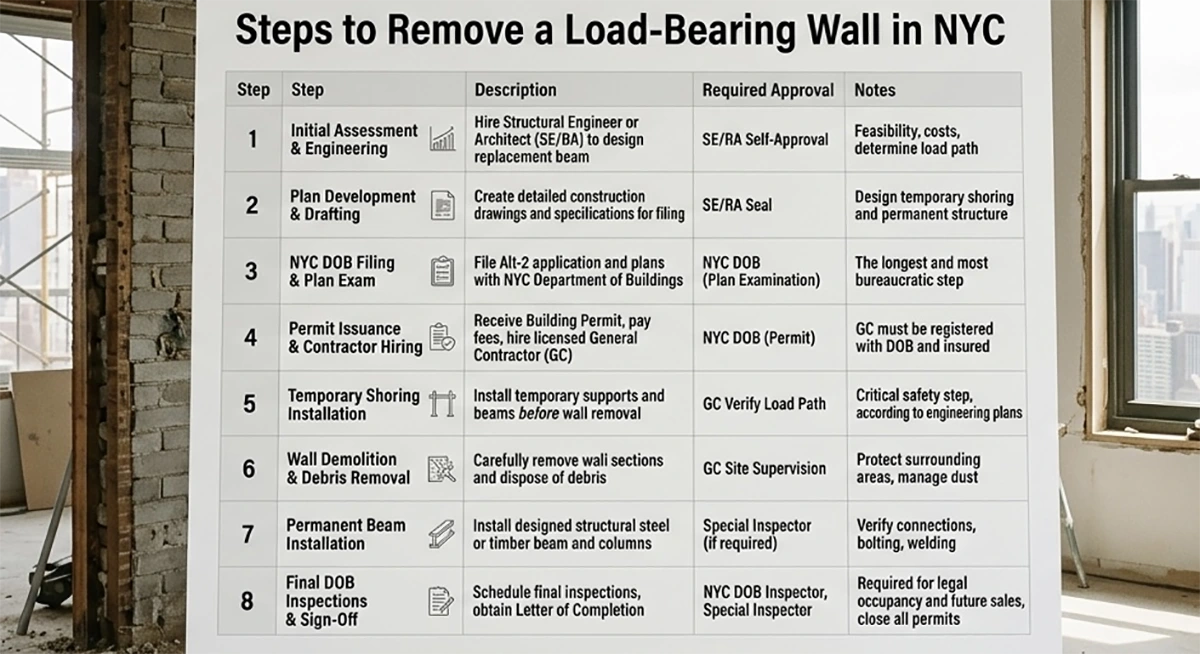
Structural modifications in New York City require formal approval. A licensed structural engineer prepares stamped drawings and calculations demonstrating compliance with the building code. Permit applications include structural notes, connection details, and shoring plans.
Beam work also triggers a requirement that owners routinely leave out of both budget and schedule: Special Inspections. Under NYC Building Code Chapter 17, §1704, structural steel, masonry, and post-installed anchors must be observed by an independent special inspection agency — precisely the elements involved in installing a beam and its bearings. The distinction that matters financially is who engages that agency: the owner hires and pays it directly, not the contractor and not the architect. It is designated on a TR1 form filed with the DOB, and its inspections run as a separate track alongside the DOB’s own. The practical consequence is scheduling: the special inspector has to be present at the right stage to observe the work before it gets covered, and a permit involving structural scope will not close without the required inspection reports on file.
The building’s approval runs on a separate and less predictable track. Cooperative and condominium boards require their own review, typically including structural drawings, contractor insurance documentation, proposed schedules, and protection plans for common areas. For structural scope specifically, expect review by the building’s own engineer and a formal board vote rather than a managing agent’s sign-off. That vote can go against you. A board that concludes the work carries unacceptable risk to the building, or that simply prefers not to set a precedent, can decline — and in a co-op, that decision is generally final and does not come with an explanation. Where approval is granted, it often arrives with conditions attached: additional monitoring, a specified inspection regime, or indemnification language beyond the standard agreement.
Failure to follow approved procedures can result in stop-work orders and costly delays, which is why early coordination among the engineer, contractor, building management, and permit expediter is worth the effort it takes.
Cost and Sequencing Considerations
Removing a load-bearing wall is typically one of the higher cost components of an apartment renovation. Costs include engineering fees, shop drawings, beam fabrication, delivery logistics, shoring equipment, special inspection fees, general inspections, fireproofing if required, and finish restoration. Longer spans and more complex support conditions increase costs. Unexpected conditions discovered during demolition can also require design revisions. For this reason, a contingency allowance is prudent.
The sequence matters as much as the budget, and it starts earlier than most owners expect. Read the alteration agreement and confirm with the managing agent that the building entertains structural work at all. Only then commission the investigation and engineering design, followed by permitting and board approval. Demolition and shoring begin after approvals are secured, never before. Reversing the first two steps is how owners end up paying for engineering on a wall that was never available to them.
Documentation and Long-Term Value
Upon completion, owners should retain stamped drawings, shop drawings, special inspection reports, general inspection records, and as-built documentation. These records demonstrate that the structural modification was engineered and permitted properly. In future sales or renovations, this documentation provides assurance to buyers and boards.
Properly executed structural work is largely invisible once finishes are restored. Its value lies in stability and performance. When engineering is thorough, the open space feels effortless. When it is rushed or improvised, problems appear quickly.
Removing a load-bearing wall in a Manhattan apartment is achievable in the right building, with the right wall, and with the engineering and approvals handled in the right order. It is also, in a meaningful number of buildings, simply not on offer — and finding that out from the alteration agreement costs nothing, while finding it out from a board vote costs a full set of structural drawings. The aesthetic goal may be openness, but the process is structural and contractual from beginning to end.

Cracking the NYC Permit Code: Your Step-by-Step Guide to DOB Approvals
Navigating New York City’s Department of Buildings is genuinely complicated, and the consequen

Inspections, Sign-Offs, and Surprises: What Actually Happens After Construction Ends
Until the Department of Buildings signs off on a project, every permitted wall, wire, and pipe conne

Co-op Renovation Agreements: Hidden Clauses That Cost You Money
Most apartment owners who have purchased a co-op in New York City understand, in the abstract, that