

Co-op Renovation Agreements: Hidden Clauses That Cost You Money
Most apartment owners who have purchased a co-op in New York City understand, in the abstract, that renovating requires board approval. What they often don’t understand until they’re deep into a project is how thoroughly that approval process can dictate the terms of the renovation itself: who builds it, when they can work, how the materials move through the building, what happens if something goes wrong, and how much money sits in escrow while all of it unfolds. The alteration agreement isn’t background paperwork — it’s the governing document of your renovation, and the boards and managing agents who draft these agreements have had years, sometimes decades, to add language that protects the building’s interests very effectively.
Owners who treat the alteration agreement as a formality to sign and file away tend to encounter its terms later, in the form of unexpected costs, delayed timelines, and compliance obligations they didn’t see coming. Understanding what these agreements actually contain, and where the financial exposure is concentrated, is one of the most practical things anyone planning a NYC co-op renovation can do before a single drawing is produced.
What a Co-op Renovation Agreement Is and Why It Exists
A co-op renovation agreement, sometimes called an alteration agreement, is a contract between the shareholder-owner of a co-op apartment and the co-op corporation itself. It is separate from any filing with the NYC Department of Buildings, and it exists because the co-op corporation, acting through its board of directors, has legal authority under the proprietary lease to regulate how and when renovation work is performed within the building.
This authority is broader than most owners appreciate. The proprietary lease in most New York City co-ops gives the board the power to approve or deny renovations, to set the conditions under which approved renovations are performed, and to hold shareholders financially responsible for any damage caused by renovation activity. The alteration agreement is the instrument through which those powers are exercised on a project-by-project basis.
The managing agent plays a critical role in the process. In most buildings, the managing agent is the first point of contact for alteration submissions. They review the package for completeness, communicate with the board, track the status of contractor insurance certificates, and enforce the building’s rules during the construction period. Their involvement adds an administrative layer that affects timeline and, indirectly, cost.
The co-op board’s requirements and the NYC Department of Buildings’ requirements are legally independent of each other. DOB permits authorize work under the city’s building code. The alteration agreement authorizes work under the building’s own rules. A project can have a valid DOB permit and still be in violation of the alteration agreement, and vice versa. Many owners don’t realize this until they encounter a conflict between the two, at which point the project is already in motion.
Financial Requirements: Where Money Leaves Your Account Before Work Begins
The financial obligations in a co-op renovation agreement begin accumulating before the first contractor sets foot in the building, and they can be substantial.

Security deposits are standard in virtually every NYC co-op alteration agreement. The deposit is held by the building against potential damage to common areas, elevators, corridors, neighboring apartments, or building systems caused by renovation activity. The amount varies by building and by project scope; deposits of $5,000 to $20,000 are common for gut renovations in Manhattan co-ops, and premium buildings or especially large gut jobs run higher. There is no market-wide standard figure — the number is whatever the specific alteration agreement sets. Some buildings calculate the deposit as a percentage of the estimated construction cost. Others set it as a flat amount tied to the scale of the work. A few use a tiered system where the deposit increases if the project extends beyond a certain duration.
What owners often don’t anticipate is how long this money sits inaccessible. The deposit isn’t released when construction ends. It’s released after the building conducts its own final inspection, confirms that no damage occurred to common areas or systems, and completes its administrative close-out. On projects with complex final inspections or any disputed damage claim, that process can extend months past the construction completion date. In the meantime, the deposit earns nothing and is unavailable to the owner for any other purpose.
Non-refundable review fees are a separate line item that many owners overlook entirely when budgeting. These fees compensate the managing agent and sometimes the building’s engineer or attorney for the time spent reviewing the alteration submission. They range from a few hundred dollars in smaller buildings to several thousand in larger ones with more rigorous review processes. The critical word is non-refundable: if the board rejects the application, requires substantial revisions, or the project doesn’t move forward for any reason, this money does not come back.
Some buildings also charge administrative fees for each submission round, meaning that if the initial package is returned with comments and must be resubmitted, a second fee is triggered. This creates a financial incentive to get the submission right the first time, which in turn creates pressure to invest in a thorough and complete package before the initial submission — a preparation cost that owners sometimes try to minimize and later regret.
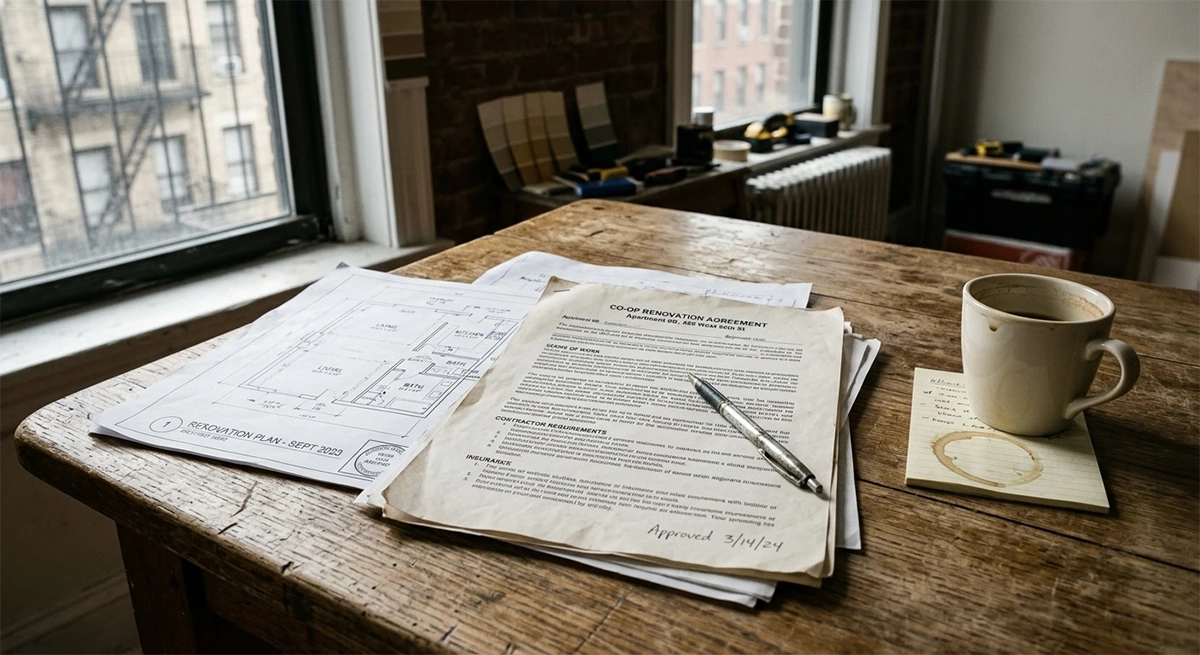
Escrow requirements appear in some alteration agreements, particularly for larger or more complex projects. These differ from security deposits in that they are specifically designated for the cost of remediation if the owner fails to complete the work or abandons the project mid-renovation. The escrow amount is typically tied to an estimate of what it would cost the building to restore the apartment to a habitable condition if left in a partially demolished state. For a full gut renovation, that estimate can be significant.
Contractor Requirements: Why Your Preferred Contractor May Not Qualify
The alteration agreement specifies who is permitted to perform work in the building, and the requirements are more detailed than most owners expect. Getting a contractor to the point where the building approves their credentials is its own process, and the costs associated with meeting the building’s requirements fall on the contractor, who passes them on to the owner.
Licensing requirements in most NYC co-ops track the city’s baseline: general contractors must be licensed, plumbers and electricians must hold their own city-issued licenses, and all work requiring a DOB permit must be filed by a licensed professional. But many buildings layer additional requirements on top of the city’s baseline. Preferred contractor lists, required registration with the building’s management company, and mandatory orientation sessions with the building’s superintendent are common. Some buildings maintain a list of approved contractors and require that all work be performed by someone on that list, effectively limiting competitive bidding and removing the owner’s ability to negotiate on price.
Insurance requirements are where contractor costs escalate in ways that owners don’t anticipate. The alteration agreement specifies minimum insurance coverage amounts for the general contractor and all subcontractors, and these requirements exist to protect the co-op corporation from liability. The coverage types typically required include commercial general liability, workers’ compensation, employer’s liability, and umbrella liability. The minimum coverage limits in many Manhattan co-ops are set at levels that smaller or less established contractors can’t meet without specifically increasing their coverage for the project, which adds cost.
General liability minimums of $1 million per occurrence and $2 million aggregate are common in mid-range co-ops. Premium buildings with more aggressive requirements may require $2 million per occurrence and $4 million aggregate, plus additional umbrella coverage of $5 million or more. Workers’ compensation and employer’s liability coverage is non-negotiable in any building that understands its exposure. The building itself must be named as an additional insured on the contractor’s policy, and certificates reflecting that endorsement must be on file with the managing agent before any work begins.
When a subcontractor’s standard coverage doesn’t meet the building’s minimums, they have two options: purchase additional coverage specifically for this project or decline the job. Either way, the cost differential gets passed to the general contractor and ultimately to the owner. On projects where multiple subcontractors need to increase coverage to meet building requirements, this can add thousands of dollars to the overall project cost — money that doesn’t appear anywhere in the contractor’s initial bid because the requirements weren’t known or weren’t factored in.
Work Hour Restrictions: How Fewer Hours Becomes More Money
Almost every NYC co-op alteration agreement specifies the hours during which construction work is permitted, and these restrictions are narrower than most owners assume when they first plan a renovation.
The city’s Noise Code allows construction from 7:00 AM to 6:00 PM on weekdays, and co-op alteration agreements almost always narrow that further, commonly to something like 9:00 AM to 5:00 PM, Monday through Friday, with the exact window set by your building. Saturday work is permitted in some buildings with advance notice and sometimes an additional fee. Sunday work and work on recognized holidays is prohibited in nearly every building with any formal alteration agreement process. Buildings with large populations of full-time residents, elderly residents, or residents with young children tend to have the most restrictive policies, and some impose additional quiet periods during early morning hours even within the permitted workday.
A number of buildings go further still and impose a summer moratorium — no renovation work at all between roughly Memorial Day and Labor Day — so residents aren’t living next to construction during the season. This one catches owners off guard more than any other scheduling rule, because it isn’t a matter of shorter days; it’s an entire quarter in which nothing can happen. If your building has a summer blackout and you don’t learn about it until you’ve built a schedule around summer construction, the project can slip by months.
The financial impact of these restrictions is indirect but real. Construction crews in Manhattan are priced on daily rates and scheduling assumptions that reflect how many productive hours they can log per day and per week. When a contractor is limited to eight or nine hours of work per day, five days a week, with no ability to recover lost time on weekends, the project simply takes longer. A project that might take twelve weeks with full access takes fourteen or sixteen weeks under restricted hours. That extended duration affects not just the contractor’s billing but also the carrying costs the owner absorbs: mortgage payments, maintenance fees, and in many cases temporary housing costs if the apartment is uninhabitable during construction.
Some buildings require advance notice before each workday, requiring the contractor to notify the superintendent or building staff when workers will be on-site. This creates an administrative obligation that, if missed, can result in workers being turned away at the door and a day of scheduled work lost. The cost of that lost day falls on the project.
Buildings that allow Saturday work often charge a fee for elevator access or superintendent oversight on weekends. These fees are disclosed in the alteration agreement but are easy to overlook during initial review. On a project that uses ten or fifteen Saturdays over its duration, they accumulate.
Alteration Limitations: When the Building’s Rules Override the Design
Beyond the administrative and financial requirements, many co-op alteration agreements contain substantive restrictions on what can actually be done within the apartment. These are the provisions that most directly affect the design itself, and they are often the most consequential for total project cost.
Wet-over-dry rules are among the most common and most impactful restrictions. A wet-over-dry prohibition means that wet areas — kitchens, bathrooms, and any space with plumbing — cannot be relocated to a position directly above a dry room in the unit below. The concern is moisture and leak risk: a bathroom placed above a bedroom in the unit below creates a leak scenario that the dry space below has no tolerance for. When an owner’s preferred layout moves a wet area in a way that triggers this rule, the design must be revised or the building must grant an exception, which typically requires additional waterproofing specifications, engineering review, and sometimes a separate indemnification agreement.
Plumbing relocation restrictions go further in some buildings, prohibiting any movement of plumbing fixtures beyond a certain distance from existing rough-in locations, or requiring that new plumbing locations be pre-approved by the building’s plumber before the alteration agreement is executed. When the design calls for a kitchen relocation or a bathroom reconfiguration that pushes against these limits, the owner faces a choice between revising the design and absorbing the additional engineering and approval costs that a variance requires.
Noise-intensive work restrictions are particularly relevant for projects involving concrete cutting, jackhammering, or similar demolition activities. In buildings with concrete slab construction, any work involving the floor slab — including trenching for new drain lines — requires jackhammering, which is among the most disruptive activities possible in an occupied residential building. Many buildings limit this type of work to specific hours within the permitted workday, require notification of neighboring tenants in advance, or require the work to be phased in short increments. All of these restrictions add time and cost.
Structural work involving common building elements, including columns, beams, and load-bearing walls that are shared with adjacent units or that are part of the building’s structural system, may require review and approval by the building’s own structural engineer in addition to the engineer engaged by the owner. This parallel engineering review adds fees and time, and the building’s engineer’s comments may require revisions to the structural approach even after the owner’s engineer has signed off.
Penalties and Compliance Clauses: What Happens When Something Goes Wrong
The compliance provisions in a co-op alteration agreement are drafted with the building’s protection in mind, and they are enforced. Owners who treat these clauses as theoretical until they become relevant often encounter them at the worst possible moment.
Fines for work hour violations are standard. The amounts vary by building, but $500 to $2,000 per violation is common, and each day of non-compliant work can be treated as a separate violation. A contractor who starts work thirty minutes before the permitted window, or who continues thirty minutes past it, has technically triggered a violation that the building can assess. In buildings where the superintendent is attentive and the board is aggressive about enforcement, these fines are assessed routinely. The contractor may bear some of this cost, but the alteration agreement holds the owner responsible.
Stop-work authority is explicitly reserved by most co-op boards, and the circumstances under which the board or managing agent can stop work are broadly defined. Work that deviates from the approved scope, contractors on-site without approved credentials, noise or debris complaints from neighboring units, damage to common areas, or any violation of the alteration agreement’s terms can trigger a stop-work directive from the building. A building-level stop-work order is different from a DOB stop-work order but equally effective: no work can proceed until the board or managing agent lifts the restriction, which may require a formal resolution of the underlying issue, revised documentation, or in some cases a board vote.
Damage and restoration obligations are among the most financially consequential provisions. If renovation work causes damage to common areas, elevator cabs, corridors, shared mechanical systems, or neighboring apartments, the alteration agreement holds the owner responsible for the full cost of restoration, regardless of whether the damage was caused by the owner’s contractor, a subcontractor, or a third-party delivery. The owner’s recourse is against the contractor, but the building’s recourse is against the owner. In buildings with high-end finishes in common areas or where neighboring apartments have custom work that is expensive to replicate, a single incident of damage can trigger restoration costs that exceed the project’s contingency budget.
Some alteration agreements require the owner to indemnify the co-op corporation against any claims arising from the renovation, including personal injury claims by workers or third parties. This indemnification, combined with the contractor insurance requirements, is designed to ensure the building is never financially exposed by a shareholder’s renovation activity. Understanding the scope of this indemnification before signing is important, because it defines the owner’s legal exposure if something goes seriously wrong.

Approval Timelines and Administrative Delays: The Cost of Waiting
The approval process itself has a cost, and it’s measured in project time. Understanding how board review cycles work, and how administrative delays compound, is essential for realistic timeline planning.
Most co-op boards meet monthly. The managing agent collects alteration submissions, reviews them for completeness, and presents them to the board at the next scheduled meeting. If a submission arrives the week after the monthly board meeting, the first opportunity for review is the following month. If the board has questions or requests revisions at that meeting, the revised submission goes back to the managing agent, is prepared and resubmitted by the owner’s team, reviewed again by the managing agent for completeness, and then presented at the next board meeting. A two-round review process that crosses two monthly meeting cycles easily consumes eight to twelve weeks before the alteration agreement is executed — longer if a summer meeting gap falls in the middle of it.
Boards that require independent engineering review add another layer. In buildings where the board engages their own structural or mechanical engineer to review submitted drawings before approving structural or plumbing work, that review takes time and the engineer’s comments need to be addressed before the board will sign off. The owner pays for revisions to their architect’s drawings in response to these comments, and the timeline extends by however long the review and revision cycle takes.

Legal review by the building’s attorney is required in some co-ops before the alteration agreement is executed. When the proposed scope of work is novel, involves structural modifications the building hasn’t encountered before, or raises questions about the proprietary lease, the board may refer the matter to counsel. Attorney review adds time and, in some cases, language to the alteration agreement that requires the owner’s own attorney to review and negotiate. Legal fees on both sides accumulate, and the timeline extends by weeks.
Coordination Between Co-op Requirements and DOB Filings
One of the most consistently underestimated challenges in a NYC co-op renovation is the coordination required between the building’s approval process and the DOB’s permit process. These two systems run in parallel but operate independently, and conflicts between them create complications that are expensive to resolve mid-project.
The most common conflict involves scope. An owner submits drawings to the co-op board and receives approval for a specific scope of work. The same drawings are submitted to the DOB, which issues comments requiring revisions. If those revisions change the scope materially, the revised drawings may need to go back to the board for approval before the permit can be issued. Meanwhile, the project timeline sits idle. This back-and-forth is most common when the DOB requires code-compliance changes that weren’t anticipated in the original design, such as additional egress provisions, updated fire-resistance requirements, or accessibility modifications.
The reverse happens as well: the DOB approves a permit for work that the board subsequently restricts or denies in the alteration agreement. Having a permit doesn’t authorize work that the board prohibits. The practical result is that owners who obtain a DOB permit before finalizing the alteration agreement may find themselves with an approved permit for work they can’t legally perform under their building’s rules.

Timing the two processes to run in parallel, with each tracking the other, is the correct approach. This requires the architect and any expediter involved to stay in active communication with the managing agent throughout the approval process, flagging any changes in either system that might affect the other before they become binding commitments. It’s a coordination task that falls through the cracks on projects where the owner is managing the process informally.
Some buildings require that the DOB permit be issued before they will execute the alteration agreement. Others execute the alteration agreement first. Knowing which approach a specific building uses affects how the owner sequences the approval process and how the project timeline is structured from the outset.
The Agreement Shapes the Renovation From Beginning to End
A co-op renovation agreement is the legal framework within which the entire renovation operates, not paperwork that gets filed and forgotten, and its provisions have direct financial consequences that accumulate from the day the agreement is executed to the day the security deposit is released.
The owners who navigate these projects with the fewest surprises are the ones who read the agreement carefully, asked questions about the provisions they didn’t understand, had their attorney review it before signing, and built a project budget that accounted for the full range of obligations the agreement creates. The ones who encounter the most expensive surprises are the ones who treated the agreement as a formality and the renovation as a construction project rather than a contractual arrangement with a co-op corporation that has been managing renovation risk for decades.
Reading the agreement closely before signing isn’t pessimism; it’s the same diligence that makes the renovation itself go well.

Timeline of a Manhattan Renovation: From Offer Letter to Move-In
You just signed the offer letter. Champagne is popped. You are already mentally placing the sofa in
Demolition Rules in NYC Apartments: What Is Allowed
Most people planning a renovation in New York City underestimate how tightly the city controls what

Landmark Living: Renovating Historic Buildings in NYC’s Protected Districts
There is a unique romance to living in a pre-war brownstone or a historic loft in one of New York Ci