
The Architecture of Light: How Professional Lighting Design Changes Interior Perception
Before selecting fixtures, it helps to understand how the eye actually reads space.
Human perception is contrast-driven. We do not perceive brightness in isolation; we perceive relationships between bright and dark surfaces. A room with evenly distributed 300 lux can feel dim if there is no vertical illumination. Conversely, a room with moderate horizontal light but bright vertical planes will feel more luminous and expansive.
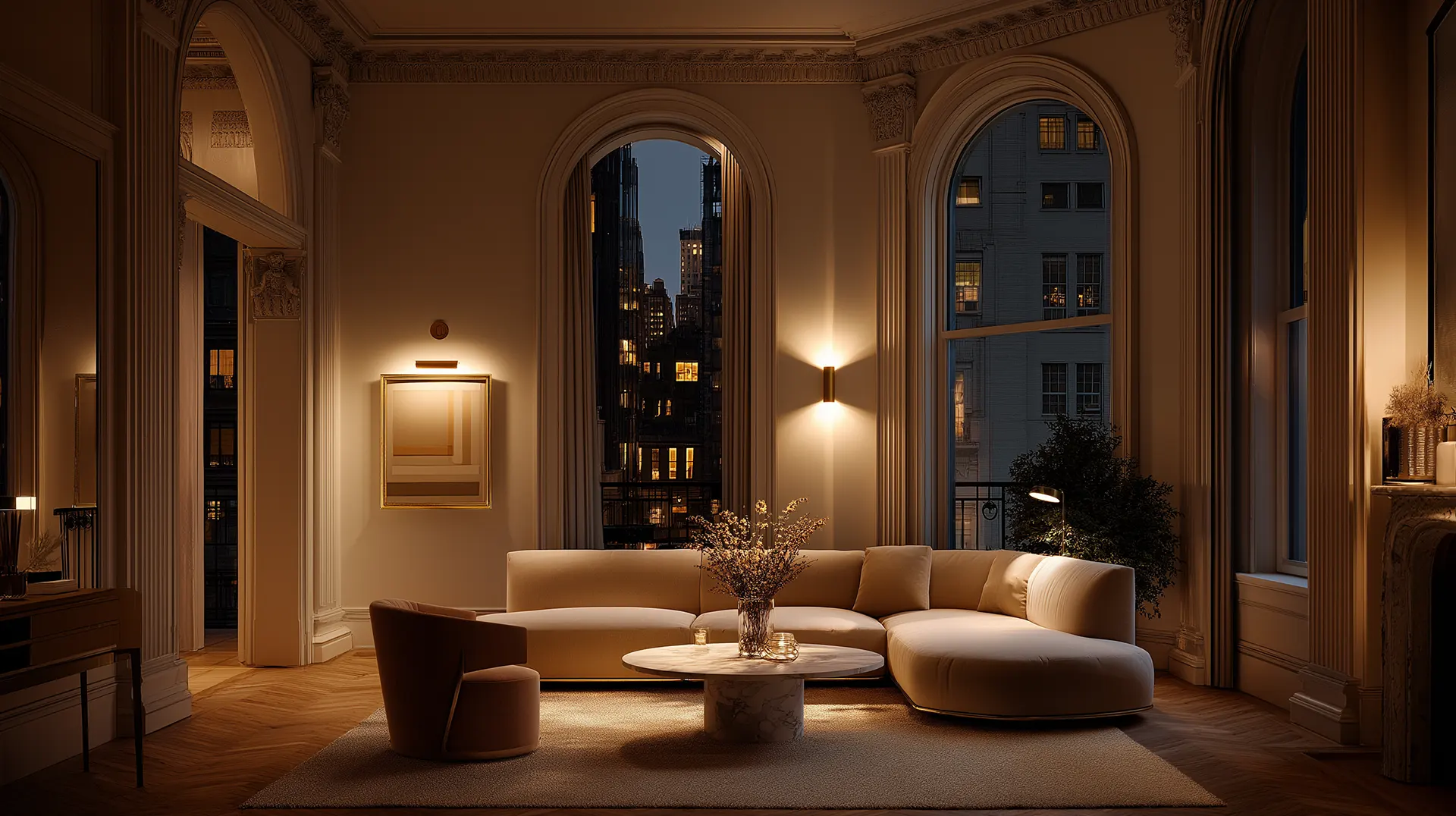
Vertical illuminance is therefore one of the most powerful design tools in compact urban interiors. Illuminated walls increase perceived brightness without dramatically increasing energy load. This is why wall washing, cove uplighting, and concealed perimeter lighting feel more generous than a grid of downlights.
Color perception is equally physiological. The human visual system adapts quickly to color temperature shifts, but inconsistencies between adjacent fixtures are immediately noticeable. Mixing uncontrolled 2700K and 3000K sources in the same field creates visual noise, which is why specification precision matters well beyond aesthetics.
Finally, glare sensitivity increases with age. High-end residential lighting must assume a broad range of visual acuity. Low-glare optics, deeper regress, and controlled beam distribution aren’t luxuries; they are long-term comfort decisions.
Designing With Contrast Ratios, Not Just Lux Targets
While lux establishes baseline function, contrast ratio determines atmosphere.
A common strategy in refined interiors is to maintain a 3:1 to 5:1 contrast ratio between focal elements and ambient field. Artwork, textured walls, or dining tables may sit slightly brighter than the surrounding field, guiding the eye without theatrical exaggeration. Exceeding 10:1 contrast begins to feel dramatic and is appropriate for gallery-style environments but often too sharp for residential calm.
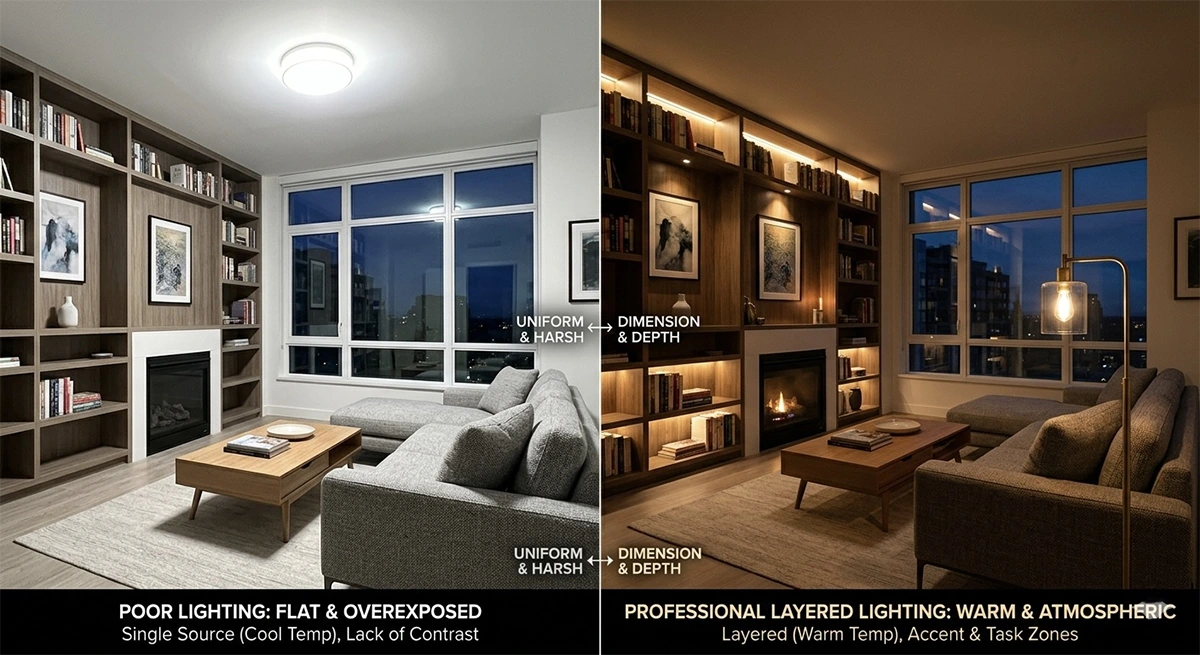
In smaller rooms, restraint is critical. Over-lighting flattens depth while under-lighting compresses volume, and the objective is controlled hierarchy: bright where activity occurs, softer where rest and transition happen. Interior designer Tatiana Chechina treats this as the discipline that separates a well-lit compact apartment from an over-lit one — in a small Manhattan room, adding fixtures is usually easier than knowing which three to leave out.
Beam Geometry as a Spatial Tool
Beam angle is frequently specified generically, yet it directly shapes spatial legibility.
- Narrow beams (10–25°) — create crisp highlights, appropriate for art or pronounced texture
- Medium beams (30–40°) — provide controlled pools for dining tables or seating groups
- Wide beams (60°+) — support ambient fill but must be shielded carefully to prevent glare
Spacing also matters. Downlights spaced too far apart create scalloping and visual patchiness. Spacing too tightly creates over-illumination and ceiling clutter. As a rule of thumb, spacing approximates mounting height for wide beams, and narrows proportionally for tighter optics, but photometric modeling should confirm performance rather than relying on intuition. Precision in beam selection is one of the clearest distinctions between decorative lighting and architectural lighting.
The Ceiling as a Reflector Plane
In many New York apartments, ceiling height is limited. Rather than fighting that constraint, use it.
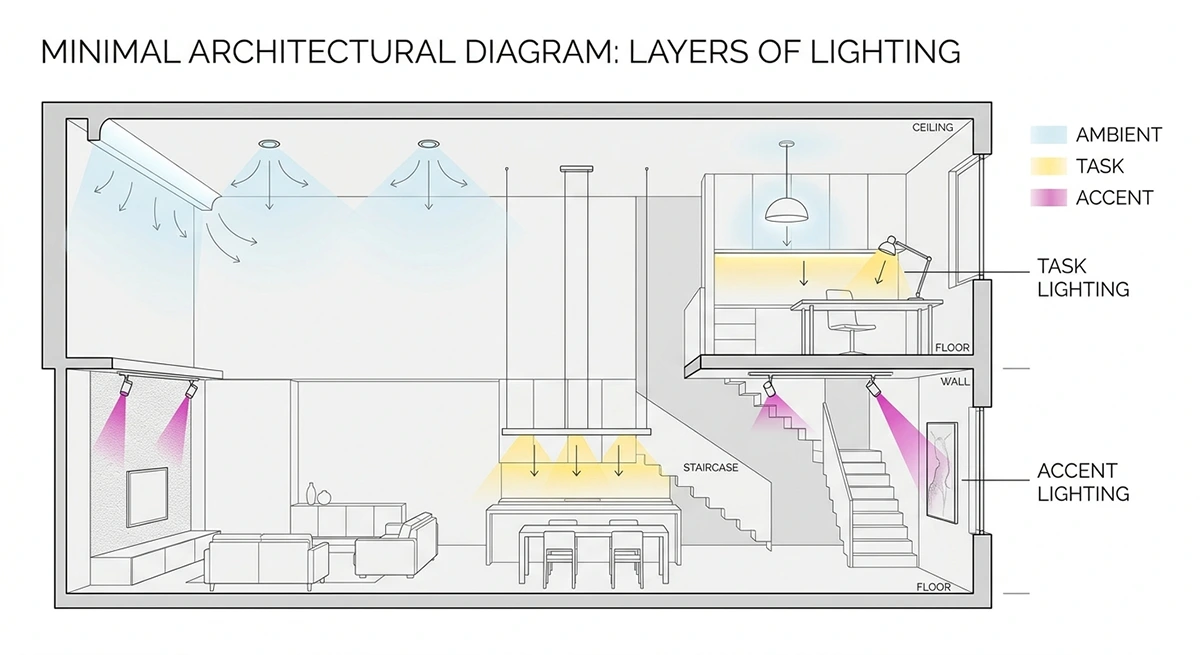
A matte white ceiling with high reflectance becomes a secondary light source when illuminated indirectly. Cove lighting aimed upward allows the ceiling plane to bounce soft light back into the room, reducing shadow contrast and visually lifting the height.
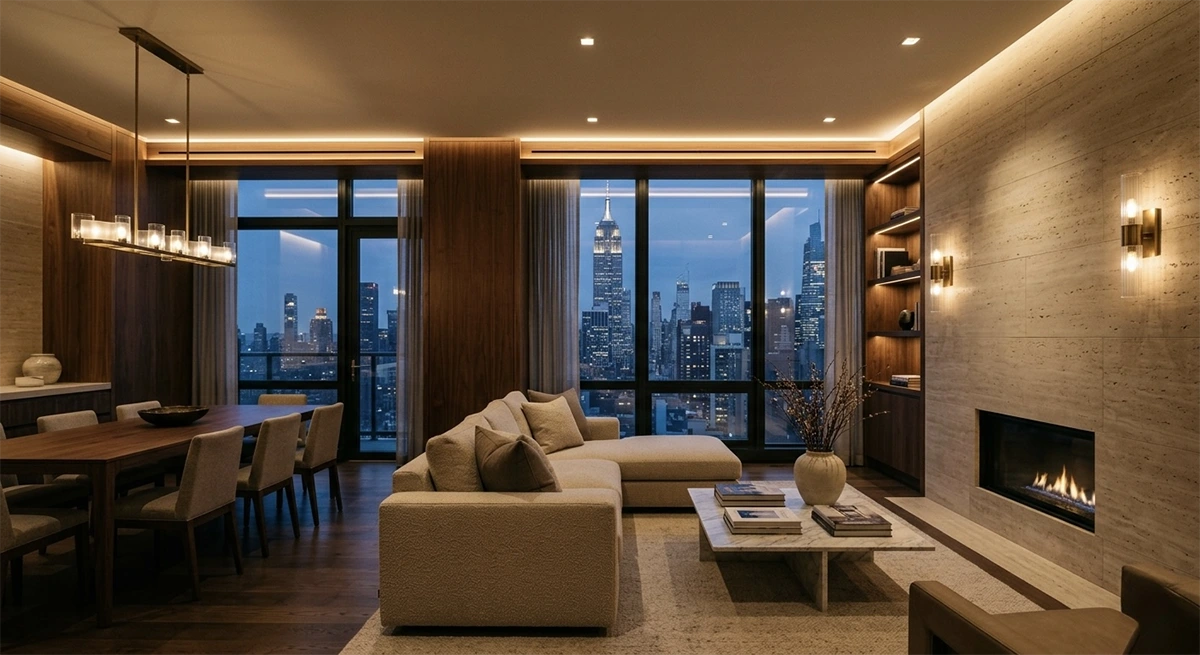
This strategy is particularly effective in pre-war apartments where plaster ceilings can carry subtle texture. Indirect light reveals that texture gently without emphasizing imperfections.
However, ceiling reflectance must be considered during finish selection. Dark ceilings absorb uplight and negate the lifting effect. When a dark ceiling is part of the design language, compensate with vertical wall illumination and carefully controlled perimeter lighting to preserve depth.
Integration With Millwork and Architecture
Lighting that feels intentional is integrated rather than appended.
- Linear LEDs should align precisely with millwork reveals
- Recessed apertures should coordinate with ceiling grid logic
- Cove dimensions must accommodate thermal management and driver access
- Wardrobe interior lighting should be concealed behind vertical partitions or integrated into door frames to avoid visible diode glare
Coordination drawings are not optional at high levels of finish. Lighting locations should be locked before final millwork shop drawings are approved. HVAC diffusers must avoid casting unwanted shadows or disrupting beam patterns. Even sprinkler heads affect visual rhythm. When lighting is designed concurrently with architecture, it disappears into the composition while elevating it.
What Integrated Lighting Requires on Paper
One practical point gets skipped in most discussions of architectural lighting, and it determines the schedule more than any fixture decision. Cove lighting, linear LEDs inside millwork, and integrated wardrobe lighting all mean new circuits and new wiring, not a fixture swap on an existing box. In New York City that requires a Licensed Master Electrician and an electrical permit filed with the DOB, and in a co-op or condo it also belongs in the alteration agreement submission alongside the millwork drawings.
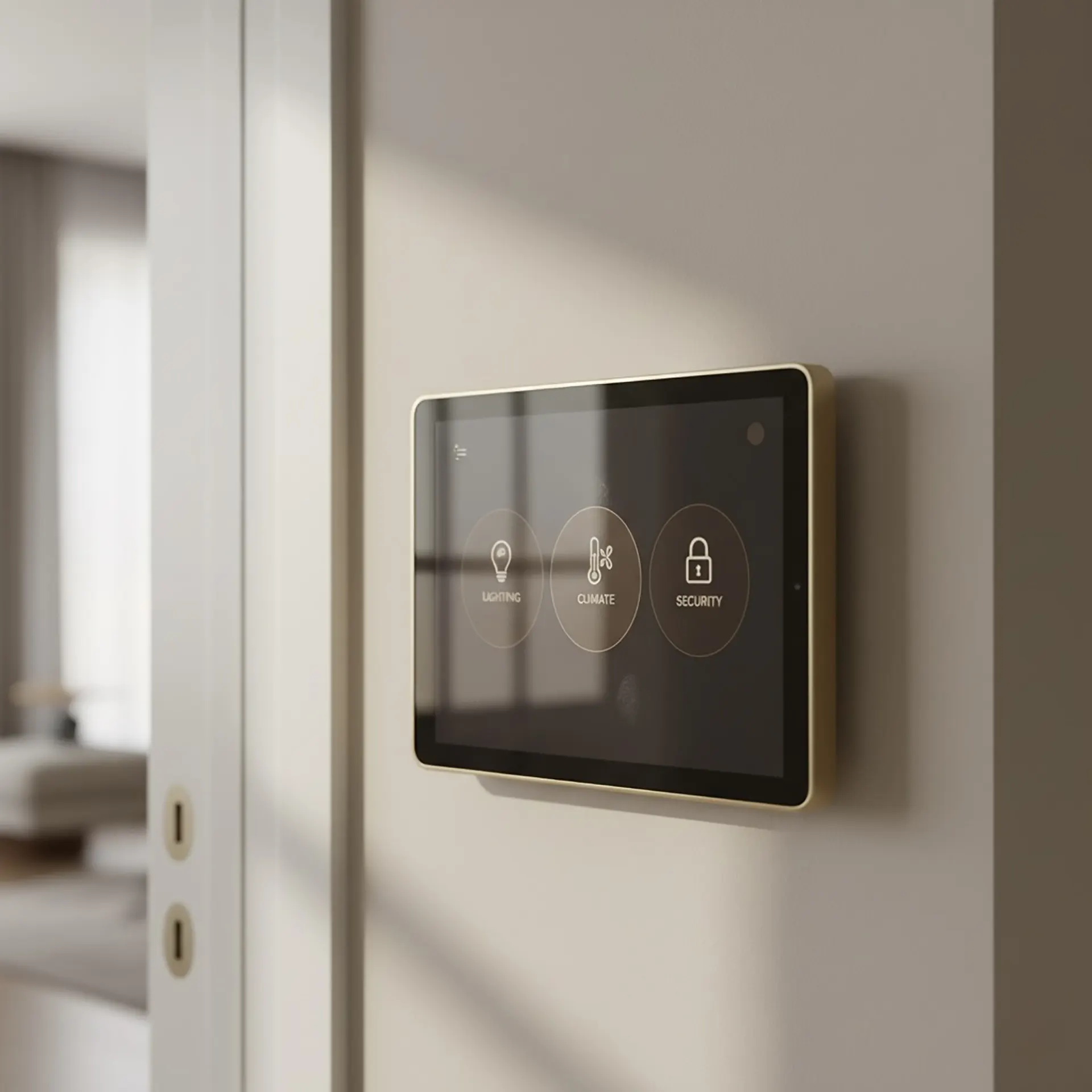
Lighting controls carry the same weight, and this catches people out. Hardwired dimmer systems and smart lighting controls generally need a neutral conductor at the switch box, and older Manhattan wiring frequently doesn’t have one. Adding it is new wiring by definition. The practical rule is straightforward: swapping a fixture or a switch like for like on an existing, compliant box requires no permit, while new circuits, new boxes, and rewiring for a control system require a licensed electrician and a filing. Budget the approval time for this alongside fabrication, because the lighting infrastructure has to go in before finishes close.
Human-Centric Lighting in Residential Context
Tunable white systems, often described as human-centric lighting, are increasingly practical in luxury residential environments.
Morning scenes can shift toward 3500K to encourage alertness and visual clarity. Evening scenes can warm toward 2200 to 2700K to support relaxation. The key is subtlety. Abrupt or extreme shifts feel artificial. Gradual transitions tied to time-of-day automation preserve comfort.
In dense urban environments where daylight exposure may be limited by neighboring buildings, tunable systems help regulate circadian rhythm. However, they require thoughtful control programming. Without scene discipline, tunable systems become underused features.
Energy Codes and Performance Constraints
Lighting design in New York must comply with the NYC Energy Conservation Code, and for a dwelling unit the headline requirement is concrete: at least ninety percent of permanently installed lighting must be high-efficacy. In practice, specifying quality LED sources throughout satisfies this without any design compromise. Control requirements and automatic shutoff provisions apply as well and should be worked into the electrical design early rather than added at rough-in.
Owners sometimes ask whether Local Law 88, the city’s lighting upgrade and sub-metering law, applies to their apartment. It does not. LL88’s lighting upgrade requirement covers non-residential tenant spaces in non-residential and mixed-use buildings; dwelling units in R-2 and R-3 occupancies are exempt, as are lobbies, corridors, and amenity spaces. If your building has ground-floor retail, LL88 may apply to that portion, but it is the building’s obligation and unrelated to your apartment renovation. The Energy Conservation Code is the rule that governs your fixtures.
Meeting these requirements invisibly, without compromising atmosphere, is what separates a well-executed high-end project from one where compliance shows.
Glare: The Most Common Luxury Failure
High-end finishes magnify glare problems.
Polished marble, lacquered millwork, and large-format mirrors amplify poorly shielded light sources. Recessed fixtures should have deep baffles or blackened interiors to reduce high-angle brightness. Linear fixtures must use quality diffusers that eliminate pixelation. Pendant luminance should be evaluated from seated eye level, not standing.
A room can meet every lux target and still feel uncomfortable if glare goes uncontrolled, which is why comfort is more often achieved by reducing peak luminance than by increasing total light.
Mockups and Field Verification
Even with photometric modeling, field verification is essential.
LED binning variations, finish reflectance differences, and real-world geometry can alter perception. Mocking up one representative area before full installation allows calibration of dimming curves, color temperature consistency, and beam direction.
In premium projects, this step prevents costly retrofits and ensures that the lighting supports the material palette as intended.
Light as Narrative
Lighting defines how a space is experienced over time.
Morning light entering through sheer curtains, layered with low-intensity cove illumination, produces calm. Evening scenes with reduced ambient and heightened accent create intimacy. Entertaining scenes emphasize sparkle and focal brightness. Late-night circulation scenes guide movement without disturbing rest. Where architecture holds still, light is the element that moves through the day with the people using the room.
When lighting is treated as a core architectural material, specified with photometric discipline, integrated with millwork and systems, filed and permitted alongside the rest of the electrical scope, and programmed with intentional scenes, it elevates modest square footage into spatial richness.
In dense urban markets where altering structure is costly and regulated, lighting remains the most agile design instrument available.

The Rise of Sustainable Renovation: A Guide to Eco-Friendly Upgrades
Something has shifted in how Manhattan homeowners think about renovation. Environmental responsibili
Smart Homes, Smarter Living: How to Integrate Technology Into a Manhattan Renovation
For a while, smart home technology promised more than it delivered. Voice-controlled lights that wor
The Secret Life of Light: How Lighting Can Make or Break a Room
There is a particular kind of room that photographs beautifully and feels wrong the moment you step