

Vinyl Plank vs. Microcement: High-End Flooring in 2026
If you’re standing in a flooring aisle trying to work out what the difference is between all these products, here’s the single most useful thing to know: nearly all modern vinyl flooring is what’s called a floating floor. That means the planks click together like puzzle pieces and rest on top of your subfloor without being glued or nailed down. The whole floor is essentially one large sheet sitting loose in the room.
That one detail explains most of what follows, especially if you live in an apartment.
Microcement works the opposite way. It’s a thin cement-based coating that gets applied wet, in layers, and bonds permanently to whatever is underneath. No seams, no planks, no joints anywhere.
The vinyl family, translated
You’ll see three sets of initials on the box, and they’re less confusing than they look.
LVP stands for luxury vinyl plank, which is the umbrella term for the whole category. Two numbers tell you most of what you need to know about quality. The first is overall thickness, usually starting around 5mm. The second is the wear layer, which is the clear protective coating on top and gets measured in mils. Think of it as how much abuse the surface can take before it starts showing. A 12-mil wear layer is fine for a bedroom. For a kitchen, a hallway, or anywhere with real foot traffic, look for 20 mil.
WPC means wood plastic composite. It has a foamed core, which makes it softer and quieter to walk on. If you want something comfortable underfoot in a bedroom or living room, this is the one.
SPC means stone plastic composite, and it’s also sold as “rigid core.” It’s denser and holds its shape better when temperatures change, which matters if you have big windows that let in a lot of sun, or heavy furniture that stays put. It’s the more stable choice, at the cost of feeling harder underfoot.
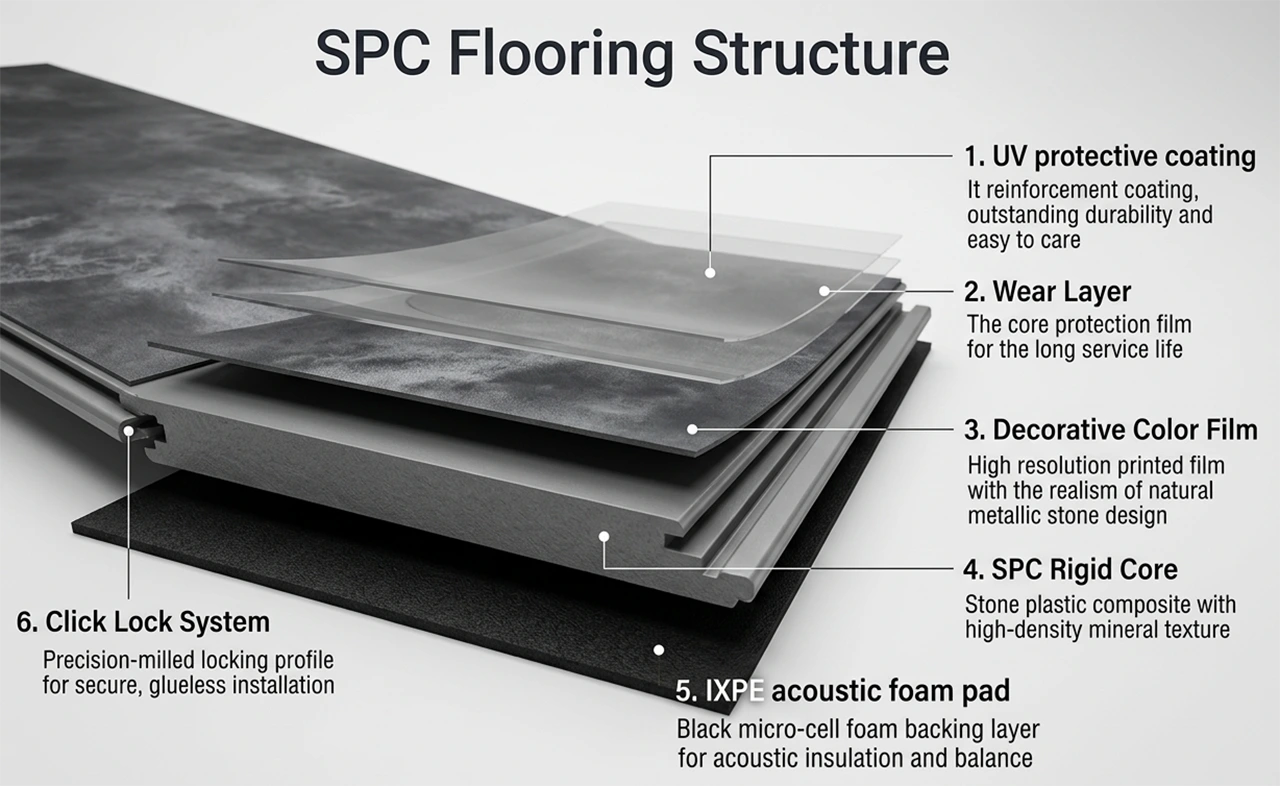
Is vinyl actually safe to have in your home?
There’s a widespread worry that all vinyl flooring gives off harmful fumes. It’s worth taking seriously, and it’s also solvable by reading one label.
Look for a certification called FloorScore or GreenGuard Gold on the product. Both mean the flooring has been independently tested and meets strict standards for what it releases into your indoor air. A certified product doesn’t carry the chemical concerns that gave the category its reputation years ago. If a product doesn’t display one of those certifications, that’s a reasonable reason to pick a different one.
Underlayment, and why apartment dwellers should care most
Underlayment is the thin cushioning layer between your subfloor and your new flooring. It softens the feel underfoot and, more importantly, muffles sound.
Most vinyl planks sold today come with this pad already attached to the bottom. If yours does, don’t add a second layer. It sounds like it would help, but it makes the floor too springy, which puts stress on the clicking joints and eventually causes them to fail. If your planks don’t have an attached pad, choosing a good separate one matters a great deal.
Here’s where a New York apartment is completely different from a house, and it’s the part that catches people out.
Buildings measure how much sound passes through a floor using two ratings. IIC measures impact noise, meaning footsteps, dropped objects, a chair scraping. STC measures airborne sound like voices and music. In a house, nobody checks these. In a co-op or condo, your alteration agreement, which is the contract you sign with the building before renovating, usually sets a minimum. An IIC rating of 50 or higher is a common requirement for hard flooring, and some buildings go further by naming specific underlayment products you must use or asking for paperwork proving your floor assembly was tested.
A smaller number of buildings enforce an older rule instead: at least 80 percent of the floor area outside the kitchen and bathrooms has to be covered by carpet or area rugs. If that’s your building, wall-to-wall hard flooring is off the table entirely, no matter which underlayment you buy. Worth finding out before you fall in love with a plank.
This is not a formality. Installing a floor that doesn’t meet the requirement is a breach of your agreement with the board, and buildings do act on it. It’s not unusual for an owner to be told to pull up a newly installed floor and redo it at their own expense after the neighbor below complains about noise.
So the practical order of operations is: read your building’s alteration agreement first, then shop. The required rating may rule out certain products entirely, and it will usually decide your underlayment for you no matter what the manufacturer suggests.
Moisture: what actually applies to your apartment
Most flooring advice you’ll find online assumes you live in a house with a concrete slab poured directly on the ground. In that situation, moisture from the soil slowly rises through the concrete and can wreck a floor installed on top. That’s the scenario every manufacturer warns about.
It’s also not your situation, if you’re in a typical Manhattan apartment. You’re installing over a concrete floor with another apartment below it, so there’s no ground moisture pushing up.
Moisture can still matter, though, in a handful of specific cases: if the concrete was recently poured or patched, if there’s a lightweight concrete topping (these take far longer to dry than people expect), if self-leveling compound was just applied and hasn’t fully cured, or if there’s a history of leaks from the unit upstairs. Ground-floor and basement-level spaces do face the real ground-moisture problem and should be treated like a house.
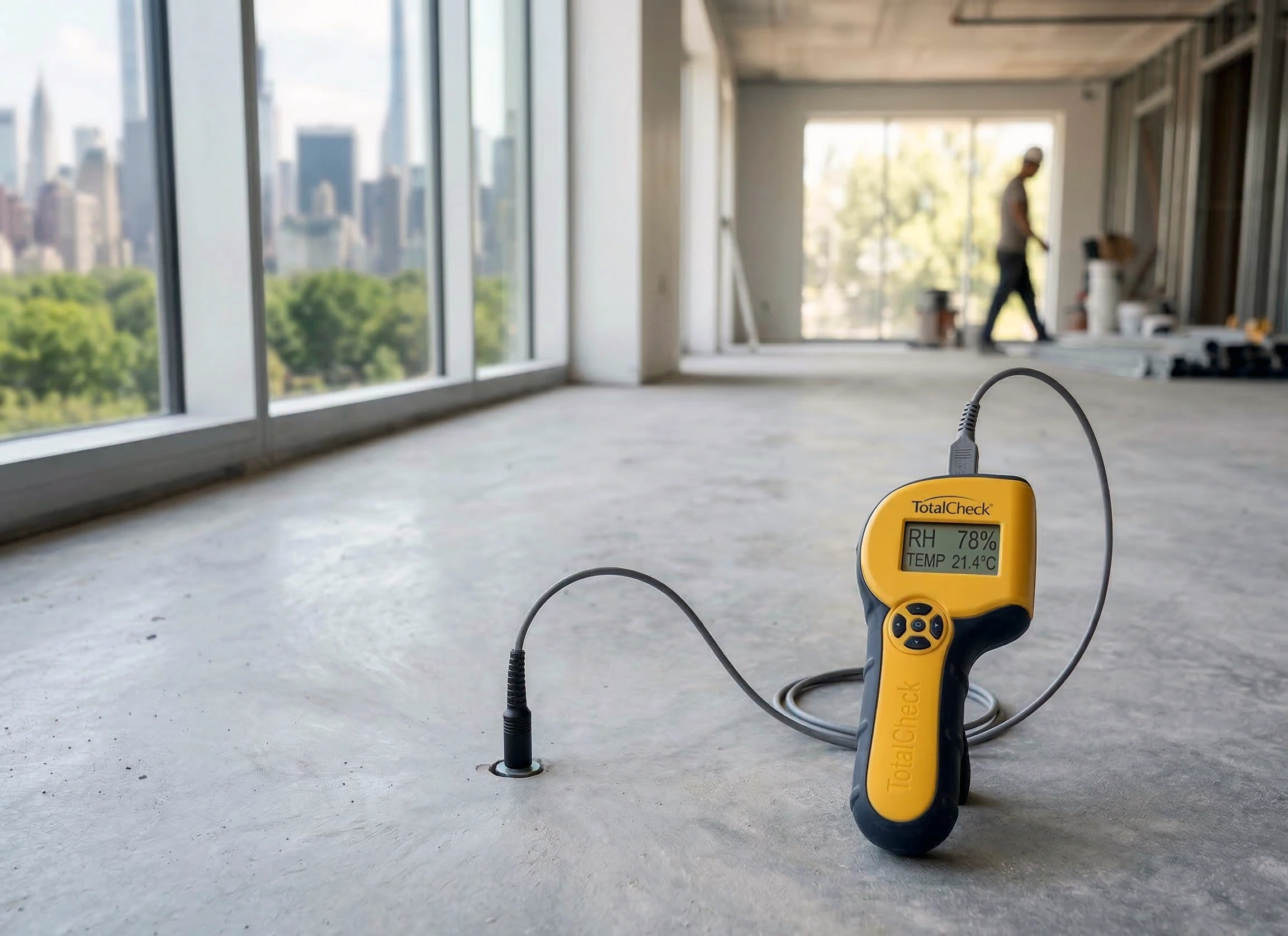
Testing is done one of two ways. A calcium chloride test measures moisture coming off the surface of the slab, and a relative humidity probe measures moisture inside the concrete. Vinyl generally needs the concrete to read below about 80%. Microcement is stricter at around 75%, because once it’s sealed, any trapped moisture underneath has no way to escape and can push the finish loose.
The takeaway: don’t let a contractor skip testing by saying it’s irrelevant on the twentieth floor, especially if there’s been new leveling work or a past leak. Manufacturers will still void your warranty over a missing test. Equally, don’t panic as though you’re fighting groundwater, because you’re not.
Heated floors
If you’re considering radiant floor heating, both materials can work, with caveats.
Vinyl has a temperature ceiling. Most brands cap the floor surface at around 85°F, and going hotter can warp the clicking joints. Microcement conducts heat better and doesn’t have that limit, though it does want a thermostat that heats gradually rather than in sudden bursts, since rapid swings can damage the sealer.
For apartment owners there’s a bigger question first. Installing radiant heat in a co-op or condo requires board approval, because the system raises the height of your floor and adds electrical load to the building. The electrical work also needs a permit. Find out whether your building allows it before you let heated floors influence your flooring choice, since the answer is sometimes no.
Bathrooms and wet areas
Vinyl gets marketed as fully waterproof, which is true of the material itself but misleading about the floor as a whole. Because the planks float and click together rather than sealing to the ground, water that gets through the seams sits underneath with nowhere to evaporate. That’s how you end up with mold in a floor made of a waterproof material, and it’s why vinyl is essentially never used in a shower.
Microcement bonds to the surface underneath and forms one continuous barrier with no seams at all, which is why it’s the standard choice for bathrooms, wet rooms, and anywhere water lands directly.

The seam problem in an open-plan apartment
This is the argument that decides a lot of high-end Manhattan projects, and it rarely comes up until it’s too late.
Because a floating floor expands and contracts, it needs a break roughly every 30 to 40 linear feet, plus a small gap around the perimeter of every room. In an apartment with normal doorways between rooms, those breaks tuck neatly under the metal transition strips in each doorway and you never notice them.
In a large open-plan apartment, they become visible. A single unbroken run from the living area through the dining space into a hallway will exceed the limit, which means a transition strip landing in the middle of an open floor with no doorway or wall to explain why it’s there. In a loft or a combined apartment, you might need several.
Interior designer Tatiana Chechina treats this as a design decision rather than a technical one: when a client has paid to combine two apartments specifically to get one continuous space, a metal strip landing mid-room quietly undoes the thing they bought.
If the whole point of your renovation is uninterrupted flow between spaces, that’s a real compromise. Microcement has no such limit, because it’s bonded rather than floating. It runs continuously across the entire apartment, and it can carry the same finish into a bathroom or across a threshold without a strip anywhere.
Before you decide, measure your longest continuous run in both directions. If it comfortably passes 40 feet, ask your contractor exactly where the transition strips will land and whether you can live with them.
What each one costs
These are national averages for 2026, and Manhattan runs meaningfully higher because of labor rates, insurance requirements, elevator scheduling, and the protective work buildings require in common areas.
Vinyl material costs roughly $3 to $7 per square foot, with installation adding another $3 to $5, or nothing if you do it yourself. Microcement material runs about $5 to $12 per square foot, and installation is considerably more at $10 to $20, since it’s skilled work that can’t reasonably be done DIY.
A few other practical differences:
- Floor height: vinyl adds about a quarter to three-eighths of an inch, microcement only about an eighth. In a pre-war apartment where doors already clear the floor tightly, that difference decides whether you’re also paying someone to trim every door.
- Lifespan: vinyl typically lasts 15 to 20 years. Microcement runs 20 to 30, but its sealer needs refreshing every three to five years.
- Warranty: major vinyl brands often offer a limited lifetime residential warranty. Microcement warranties come from your installer and usually cover one to two years of labor.
Warranties and resale
Brands like Shaw, Mohawk, and COREtec commonly offer a limited lifetime residential warranty, which is genuinely worth something when you’re comparing products. Just know that it’s void if the subfloor wasn’t properly prepared or if the required expansion gaps were left out, which is one more reason installation quality matters as much as the product itself.
On resale value, the two read differently to different buyers. In luxury and custom renovations, microcement is prized for its architectural, seamless quality. In the broader market, good vinyl is often seen as the more practical and familiar option, and buyers recognize it.
So which should you choose?
Go with vinyl if you want a certified, reliable product with a long manufacturer’s warranty, a faster and less disruptive installation, and a lower overall cost.
Go with microcement if you’re working with a larger budget and what matters most is a continuous stone-like surface, no transition strips anywhere in the apartment, and the smallest possible increase in floor height.
One important note about doing it yourself. Click-lock vinyl is genuinely DIY-friendly in a house. In an apartment it usually isn’t allowed to be: most co-op and condo buildings require licensed contractors and certificates of insurance for flooring work regardless of how straightforward the job looks, and many require formal approval before anyone starts. Confirm what your building permits before you buy anything.
Where to go from here
If you’re leaning toward vinyl, look up your specific collection in the FloorScore database to confirm the certification, and check with your building about its sound requirements before ordering.
If you’re leaning toward microcement, find a certified installer through the National Tile Contractors Association, or check the approved applicator lists on manufacturer websites like Ardex or Topciment. This is a material where the installer matters more than the brand.

Feng Shui Apartment Layout: Room-by-Room Principles
Walk into most feng shui consultations and the problems are the same: blocked sightlines, a cluttere

Your Bedroom Has the Wrong Energy
On a gut renovation in Yorkville, the couple kept the bed under a window and both said they woke up

Luxury for Less: Where to Score High-End Materials at Designer Discounts
After fifteen years working on renovations across Manhattan, I’ve come to believe that the dif