

Precision in Millimeters: Why the Details You Never See Define a Luxury Home
Precision in Millimeters: Why the Details You Never See Define a Luxury Home
Stand in a finished luxury apartment and look around, and what registers first is a general sense of rightness: smooth walls, good light, everything where it should be. Look closer, though. Study the gap where the marble slab meets the wood floor, the shadow line where the ceiling meets the wall, the way the screw heads on a switch plate line up. That kind of perfection isn’t luck, it’s labor, a quiet war waged in millimeters. At Hoppler Design and Build, we’re preoccupied with the things you’ll probably never consciously notice but would feel instantly if they were wrong, because those invisible details are the ones that decide how a room actually feels.
The standard of alignment
Most people assume luxury is a function of expensive materials, that buying the Calacatta Gold marble is what makes a renovation high-end. That gets it only half right. The real luxury is alignment. A perfectly cut stone slab meeting a wall in a seamless joint is luxury. A cabinet door that shuts with a soft, confident weight and sits perfectly flush is luxury.
The difference comes down to tolerance. General construction typically works to about a quarter-inch, which produces a standard functional fit and leaves visible gaps as an accepted outcome. We hold to roughly a millimeter, close to museum-grade, so that material transitions read as continuous rather than assembled. That gap between a quarter-inch and a millimeter is the whole distance between a ceiling that feels heavy and one that seems to float.
| Construction category | Acceptable tolerance | Quality impact |
|---|---|---|
| General construction | About 1/4 inch | Standard functional fit – visible gaps are an accepted outcome |
| Hoppler standard | About 1 millimeter | Museum-grade precision – material transitions read as continuous |

The shop drawing phase
Real craftsmanship begins long before anyone picks up a hammer, in the shop drawings. These are exhaustively detailed engineering documents that specify every joint, every material transition, and every lighting cut in advance. We don’t leave a carpenter to work it out on site; we resolve it on paper and in CAD months ahead of construction. Calling that obsessive misses the point. It’s orchestration, because once the work begins you’re no longer just building walls, you’re building the moments a person will live inside.

Why details decide emotion
There’s a well-observed tendency in how people read a space: symmetry and alignment tend to register as signals of order and stability, and when lines connect and patterns repeat cleanly, the eye settles. It’s why you can walk into two apartments that look broadly similar and find that one of them feels subtly off. The culprit is usually the invisible geometry. A crooked outlet or a grout line that drifts out of true introduces a small amount of subconscious visual noise, the kind you don’t name but do absorb. We use laser alignment systems so that every corner reinforces the calm your eyes are looking for rather than quietly undermining it.

The reality of precision in a pre-war building
Holding a millimeter tolerance is demanding anywhere, and in a Manhattan pre-war apartment it becomes its own discipline, because those buildings are almost never square or plumb to begin with. A century of settling leaves walls that lean, floors that slope, and corners that aren’t true, which means precision here isn’t a matter of building to a clean grid. It’s a matter of scribing and shimming each finish element to the actual, irregular contours of a hundred-year-old shell so that the finished surfaces read as straight even when the structure behind them isn’t. That hand-fitting is slow, skilled work, and it’s a large part of why this level of finish costs what it does in older buildings.
It also intersects with the building itself. Much of this work touches walls, floors, and ceilings in ways that require DOB permits and, in a co-op or condo, board approval before anything starts. A serious firm accounts for that from the beginning, since the precision you’re paying for depends on getting the structural groundwork approved and done correctly first.
The paradox of perfection
There’s a saying among master builders that the difference between good and great is what happens when nobody is watching. High-end construction is deliberately slow for exactly that reason. Scribing a baseboard tight to a wall so there’s no gap takes time. Laying out tile so there are no thin slivers at the edges takes time. When clients ask why a renovation costs more, the honest answer is that alignment costs time and time costs money, but that investment tends to repay itself in a kind of daily peace. One of our clients described it well after moving in, saying that she no longer noticed the details at all, she just felt calm. That’s the goal exactly. The best detail is the one executed so well that it disappears.
Underneath the finished result sits a consistent method:
- Resolving every joint through CAD and shop drawings before site work begins
- Holding to millimeter tolerances rather than accepting the industry’s quarter-inch
- Reducing visual noise by keeping outlets, tiles, and fixtures in true alignment
- Hand-scribing each finish element to the real contours of the building
- Validating the whole thing with laser measurement rather than by eye

Why Do Some Homes Just Feel Right? The Science of Flow in Interior Design
Have you ever walked into a home and felt your shoulders drop almost before you’d taken it in?
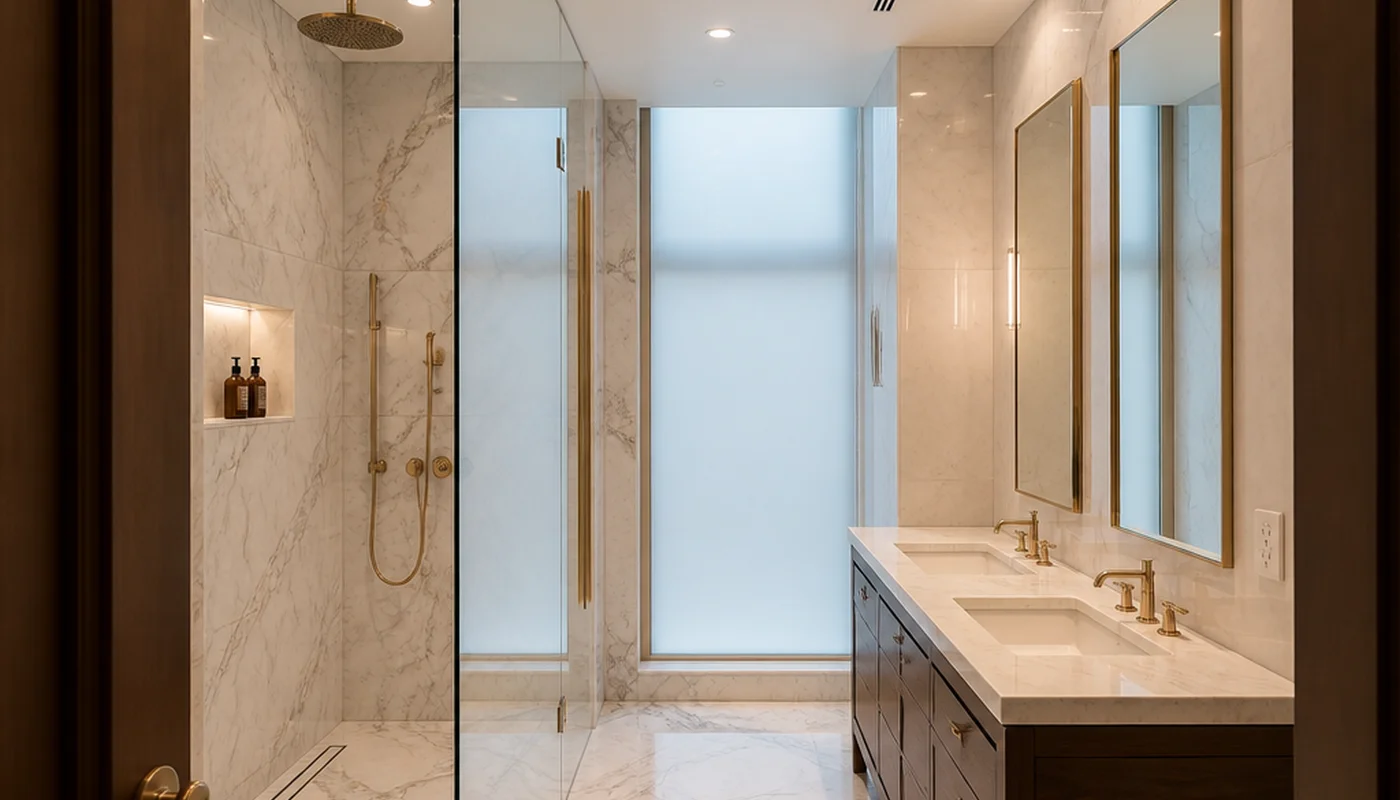
Walk-In Shower Ideas for Small Bathrooms: Layouts, Tile, and What Actually Works
The starting point in a pre-war Manhattan bathroom is usually a 4×7 or 5×8 room built arou

Budget-Friendly Bathroom Upgrades That Actually Make a Difference
A bathroom renovation doesn’t have to mean weeks of construction and an invoice that makes you