

What You’re NOT Allowed to Change in a NYC Apartment
Buying an apartment in New York City is one of the most significant financial decisions a person makes, and it’s natural to assume that ownership translates to control. You paid for the space. You hold the deed or the shares. The rooms are yours to design, configure, and improve as you see fit. That assumption is understandable, and it is only partially correct.
In New York City, apartment ownership comes with a set of restrictions that would surprise owners in most other markets. Some restrictions come from the city through the Department of Buildings, enforced through the permit process and the building code. Others come from the cooperative corporation or condominium association through the proprietary lease, house rules, and alteration agreements. Still others are a function of how buildings are physically constructed, where one owner’s floor is another owner’s ceiling, and where shared systems serve dozens or hundreds of units simultaneously.
Understanding what you cannot change in a NYC apartment, and why, is not a reason to abandon renovation ambitions. It’s the foundation for developing renovation plans that are realistic, approvable, and executable. The projects that go sideways in New York City are almost always the ones that began without this understanding.
Structural Elements: What the Building Needs to Stay Standing
The most absolute restrictions in any NYC apartment renovation are the ones that protect the structural integrity of the building. Load-bearing walls, structural columns, and concrete slabs are not decorative elements that can be removed or modified based on aesthetic preference. They are the components through which the building transfers load from above to the foundation below, and altering them without proper engineering and authorization creates risk that the building’s physical stability cannot absorb.
Load-bearing walls in Manhattan apartment buildings come in several forms depending on the building type. In prewar masonry buildings, thick brick walls that run through multiple floors carry the weight of the structure above. In postwar concrete frame buildings, shear walls and columns perform the same function within a different structural system. In both cases, these walls cannot be removed simply because an owner wants an open floor plan. Any proposal to remove or significantly modify a load-bearing element requires a structural engineering analysis, stamped drawings from a licensed structural engineer, a permit filing with the NYC Department of Buildings, and in buildings with boards, approval from the co-op or condo board that may include independent review by the building’s own engineer.
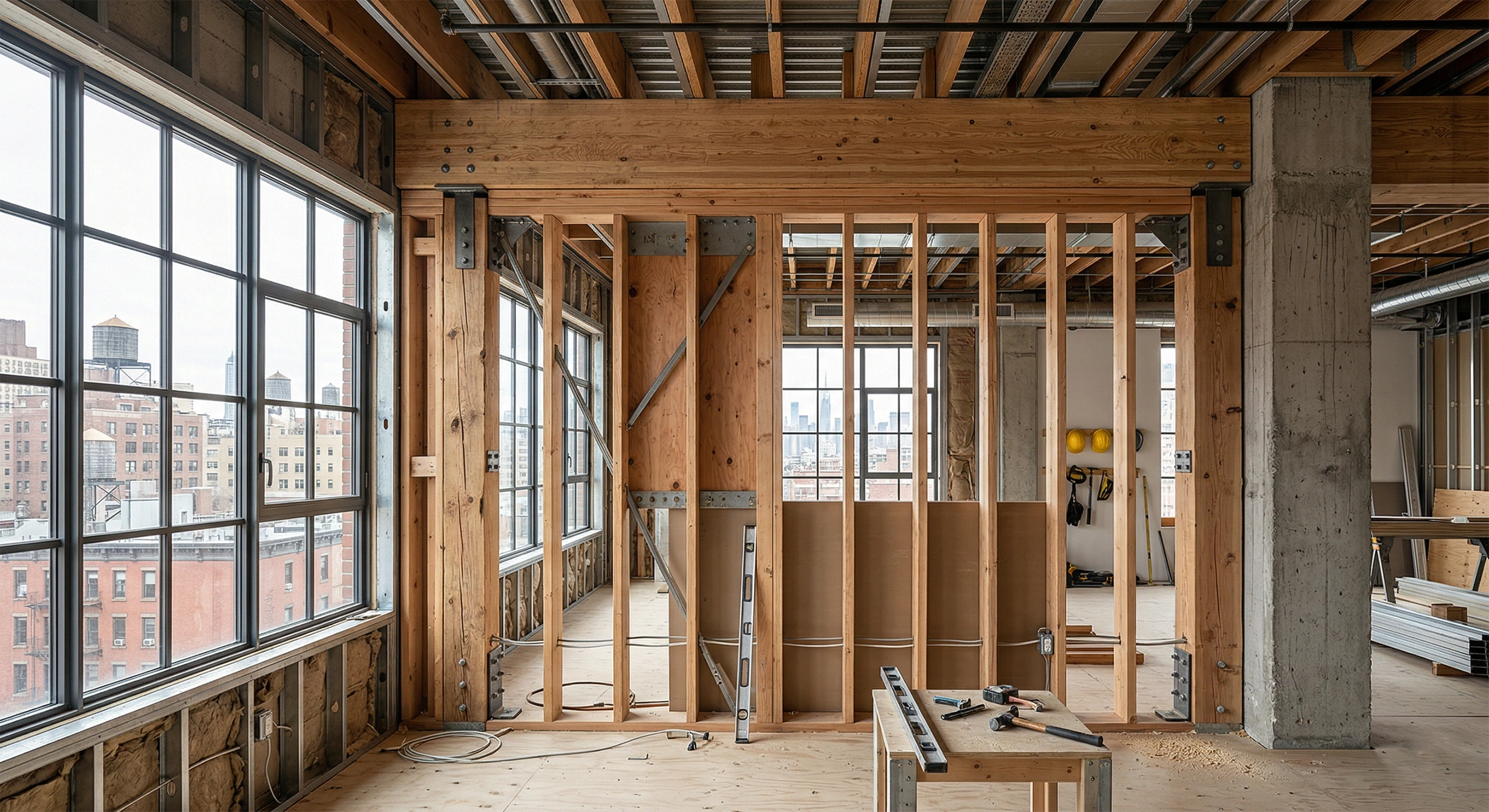
In practice, some load-bearing walls can be removed with proper engineering. The wall comes out and a steel beam, correctly sized and supported at each end by adequate bearing conditions, takes over the load-carrying function. This is a legitimate construction approach with real costs and real approval requirements. What is not an option is removing a load-bearing wall informally, without engineering, without permits, and without verification that the substitute condition is structurally adequate. The DOB’s inspection process exists specifically to prevent this, and the consequences of a structural failure in a building with hundreds of residents are not recoverable.
Concrete columns in apartment buildings are almost never removable by an individual unit owner. These columns are part of the building’s primary structural system, they extend through every floor from foundation to roof, and any modification to them affects every apartment in the column line. Even in cases where a column intrudes awkwardly into an apartment’s living area, the options are limited to concealing it, incorporating it into millwork, or working around it. Removing it is not within the scope of what an individual owner can authorize.
Concrete floor slabs in postwar buildings present their own category of restriction. The slab is simultaneously the structural floor of one apartment and the structural ceiling of the one below. Penetrating it for new drain lines, which is required when plumbing fixtures are relocated to positions that require new drainage paths, involves cutting the slab with a jackhammer. This work is subject to building restrictions on when and how it can be performed, generates significant noise and vibration that affects neighboring units, and requires engineering review to ensure the penetrations don’t compromise the slab’s structural capacity. Most buildings permit it under controlled conditions. Some buildings restrict it more severely. None allow it without authorization.
Building Systems: What Belongs to Everyone
A Manhattan apartment building is a complex mechanical system, and much of the infrastructure that makes individual apartments function runs through spaces shared by the entire building. Plumbing risers, gas lines, steam and hot water heating mains, electrical distribution systems, and HVAC infrastructure are building assets, not unit assets, regardless of where they’re physically located within a specific apartment’s walls.
Plumbing risers are the clearest example. These vertical pipes carry water supply up through the building and drain lines down, serving every unit on the stack. They run through individual apartments, typically inside walls or through utility chases, but they cannot be relocated, capped, or modified by the unit owner without coordination with building management and a licensed master plumber. When a renovation requires connecting new plumbing fixtures to the building’s system, that connection point must be within the range that the building’s infrastructure allows, and any work on or adjacent to the risers requires the building’s authorization and, in most cases, supervision.
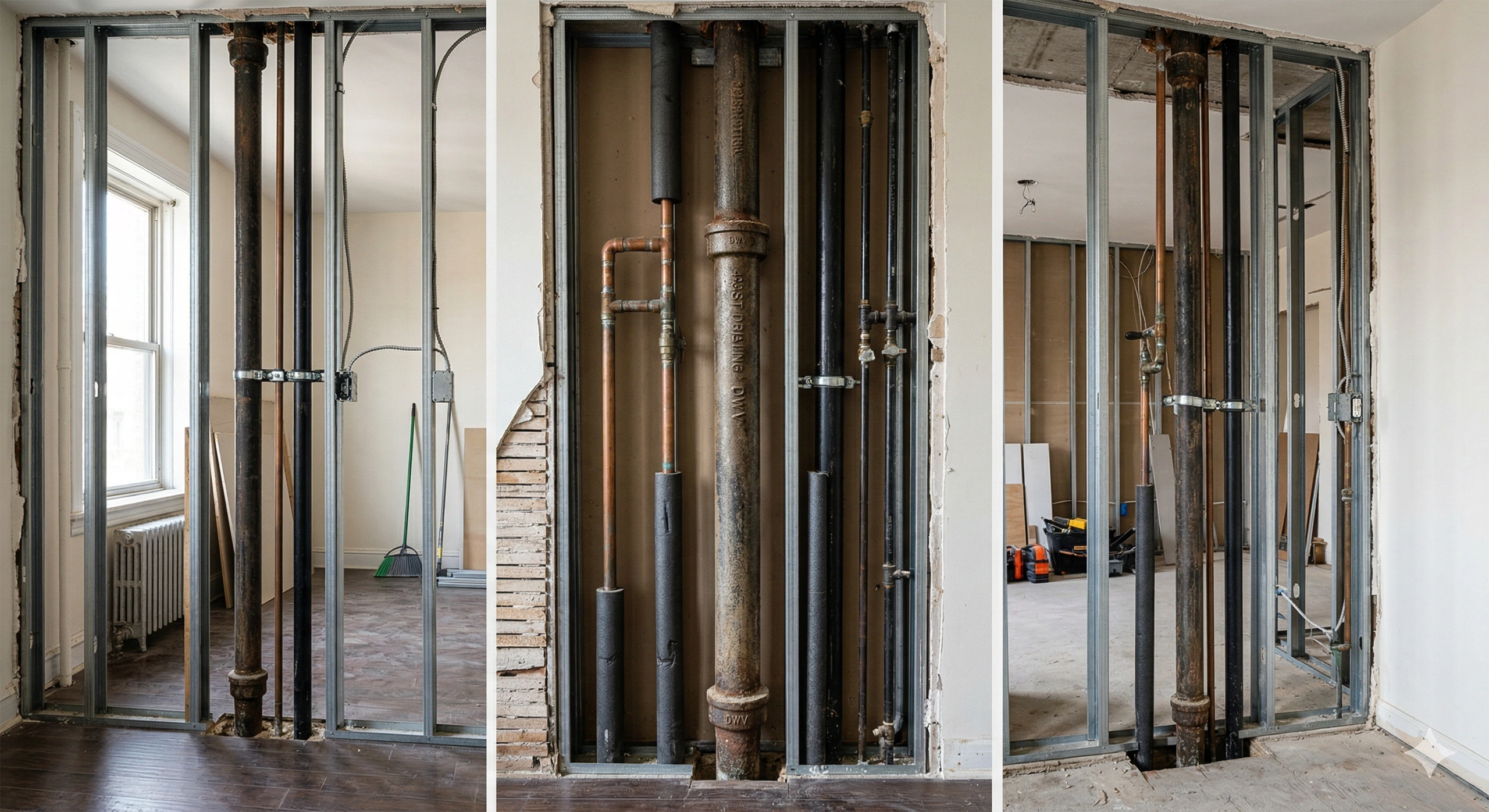
Gas lines that supply kitchen ranges and other gas-fired equipment follow similar rules. The building’s gas infrastructure is a shared system maintained and controlled by the building. Adding a gas connection for a new range location, rerouting a gas line to accommodate a revised kitchen layout, or capping a gas line because a design calls for an induction cooktop rather than a gas range all require licensed plumbing contractors, permits, and coordination with both the building and the utility. These are not tasks that happen informally.
HVAC systems vary by building type, and the restrictions vary with them. In buildings with central steam heating delivered through radiators or convectors, the radiator locations are essentially fixed. Removing a radiator disrupts the building’s heating circuit and requires formal authorization from the building management. Relocating a through-wall air conditioning unit, which penetrates the building’s exterior envelope, requires board approval and in many cases a formal permit filing. In newer buildings with four-pipe fan coil systems that individual units connect to, modifications to the system within the unit are possible but require engineering review and building approval.
Electrical distribution from the building’s main panels to individual apartment sub-panels is another building system that individual owners cannot freely modify. Panel capacity is determined by the building’s electrical infrastructure, and upgrading an apartment’s electrical capacity may require coordination with Con Edison and with the building’s own electrical systems, well beyond what the individual unit’s electrical contractor can accomplish independently.
Wet-Over-Dry Rules: Where Plumbing Can and Cannot Go
One of the most impactful restrictions in co-op and condo renovation agreements, and one of the least understood by owners approaching a first renovation, is the wet-over-dry rule. This restriction prohibits owners from relocating wet areas, specifically kitchens, bathrooms, and any other space with active plumbing, to locations that would place them directly above a dry room in the unit below.
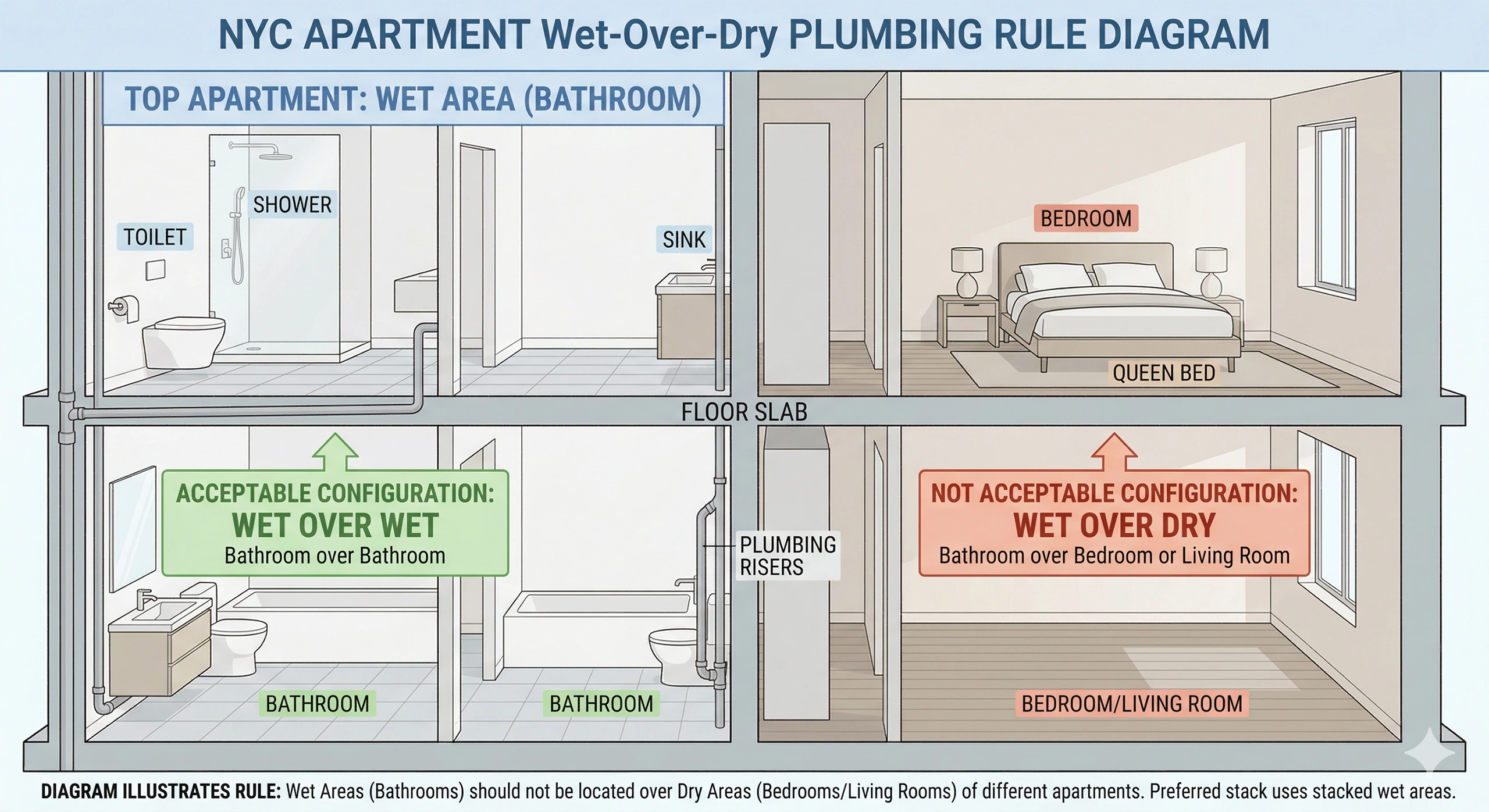
The rationale is straightforward: plumbing leaks. A bathroom placed above a bedroom in the unit below creates a scenario where a plumbing failure, whether from a failed connection, a slow leak, or a gradual failure of waterproofing, causes water damage to a space that has no tolerance for moisture. A bathroom above a bathroom is a different risk profile: some water intrusion is anticipated, the finishes below are designed for moisture exposure, and the structural and finish conditions below are more forgiving.
In practical terms, the wet-over-dry rule constrains kitchen and bathroom locations in ways that can significantly limit an owner’s layout options. An owner who wants to relocate the kitchen to a different room, or who wants to expand a bathroom into adjacent space, must verify that the proposed new wet area locations sit above existing wet areas in the unit below. In a building with a consistent layout from floor to floor, this check is usually straightforward. In a building where layouts vary, or where the floor below has been previously reconfigured, the check requires coordination with the managing agent and sometimes a review of the floors below.
When an owner wants to move a wet area to a location that violates the wet-over-dry rule, the exceptions process is real but demanding. Boards that consider exceptions typically require a comprehensive waterproofing specification from a licensed engineer, a detailed waterproofing installation protocol that the contractor must follow and document, and often an indemnification agreement that holds the owner responsible for any water damage caused by the relocated wet area. The enhanced waterproofing required for an exception approval adds cost and documentation that a standard bathroom renovation wouldn’t require.
Windows, Facades, and the Building Envelope
The exterior of a building is not within the domain of individual unit owners to modify. Windows, exterior walls, the facade materials, balcony railings, window sills, and any other element that contributes to the building’s exterior appearance and weatherproofing is controlled by the building as a whole.
Window replacement is one of the most common points of confusion. An owner who wants to replace deteriorating windows might reasonably assume this is a maintenance improvement they have the right to make. In most Manhattan co-ops and condos, it is not. Window replacement affects the building’s exterior uniformity, its weatherproofing, and in some buildings its compliance with energy code requirements. Most buildings have established specifications for window replacements, including approved manufacturers, glass types, and hardware finishes, and individual owners must use those specifications if window replacement is authorized at all. In many buildings, window replacement is a building-wide capital project, not an individual unit improvement.
Adding or enlarging window openings is a more significant intervention that almost universally requires DOB permits, structural engineering, and board approval, because any change to an exterior opening affects the building’s structural system and its exterior envelope. In landmarked buildings or buildings within historic districts overseen by the Landmarks Preservation Commission, exterior changes including window modifications require LPC approval before DOB permits can be issued. Not every LPC review means months of public hearings — minor, code-required, or like-for-like work can qualify for a faster staff-level review, while a visible change to a landmarked facade typically goes through the full Certificate of Appropriateness process with a hearing. Which track applies is worth confirming with the architect early, since it changes the timeline significantly.
Through-wall penetrations of any kind, whether for HVAC units, exhaust fans, gas meters, or other mechanical equipment, require building authorization and typically DOB permits. The exterior wall is the building’s weather barrier and its thermal envelope. Unauthorized penetrations create weatherproofing vulnerabilities and can affect the building’s compliance with energy codes.
Ceilings, Slabs, and Vertical Space
The vertical dimension of an apartment, from the finished floor to the underside of the ceiling, is governed by the building’s structure in ways that limit what owners can do with it. Raising a ceiling to achieve more height typically means raising it into the mechanical space between the structural slab above and the finished ceiling below. In buildings where that space is occupied by building infrastructure, including ductwork, plumbing lines serving upper floors, or electrical conduit, raising the ceiling can conflict with systems that cannot be moved.
Coffered ceilings, dropped soffits, and other ceiling treatments that reduce the apparent height of a room are generally within an owner’s latitude to install, provided they don’t compromise access to building systems that may require maintenance. Many buildings require that ceiling systems remain accessible to the building’s mechanical infrastructure without requiring destructive access, which means that dropped ceilings in areas above building systems may need to incorporate access panels.
Floor leveling, which is often necessary in older buildings where years of settling have produced uneven subfloor conditions, is generally permissible but subject to practical limits. Self-leveling compound added to raise the finished floor height also raises the finished floor relative to adjacent spaces, which can create a threshold condition at the apartment entry or at the transition between rooms. In buildings where corridor floors are at a fixed height relative to the apartment threshold, raising the finished floor inside the apartment can create a step-up condition that affects fire egress compliance. An architect managing a floor leveling scope in a renovation needs to verify that the proposed finished floor height doesn’t conflict with egress requirements at the apartment door.
Building-Specific Rules: The Alteration Agreement Layer
Beyond the structural and engineering constraints, every co-op and condo building in Manhattan operates under its own set of rules that govern renovation activity. These rules are established through the proprietary lease, the house rules, and the alteration agreement, and they can be more restrictive than the city’s building code in any area the board chooses to regulate.
Work hour restrictions are universal, but the exact window is not — the city permits construction noise from 7:00 AM to 6:00 PM on weekdays under the Noise Code, and most Manhattan alteration agreements narrow that further, commonly to something like 9:00 AM to 5:00 PM. That’s a typical range, not a rule you can rely on. Check your own building’s alteration agreement before assuming your hours. Saturday work is sometimes permitted with advance notice. Sunday and holiday work is almost never permitted in residential buildings with occupied units. These restrictions don’t merely inconvenience contractors; they determine how long a renovation takes, which affects carrying costs, temporary housing costs, and labor scheduling. A project that could run more quickly under unrestricted access takes longer within the building’s permitted windows, and that time has real cost.
Noise-intensive work, including jackhammering, concrete cutting, and heavy demolition, is often restricted to specific hours within the permitted workday, usually mid-morning to mid-afternoon, with buffer periods at the start and end of the day. Buildings sometimes require advance notification to neighboring units before noise-intensive work begins, and some require written acknowledgment from adjacent neighbors.
Material restrictions in some buildings prohibit specific products or installation methods based on building-specific concerns. Some buildings do not permit certain types of flooring installations because of noise transmission concerns for the units below. Others require specific sound attenuation underlayment beneath all hard flooring. A building that experienced moisture problems from a specific type of plumbing fitting may prohibit that fitting type entirely. These restrictions are not standardized and must be read in each building’s specific alteration agreement documents.
Contractor requirements restrict who can perform the work. Most buildings require licensed, insured contractors with minimum coverage levels specified in the alteration agreement. Some buildings maintain lists of approved contractors or require that contractors be registered with the building management before beginning work. These restrictions limit competitive bidding and can affect both contractor selection and project cost.
The Department of Buildings: City Regulations as a Hard Boundary
The NYC Department of Buildings enforces the New York City Building Code, and that code establishes requirements that individual buildings cannot waive and individual owners cannot choose to ignore. These code requirements function as a hard outer boundary on what renovations can accomplish, regardless of what any board or owner might prefer.
Egress requirements protect the path by which residents can exit the building during an emergency. Corridors, exit stair doors, exit passageways, and the configurations that connect them to the building’s exits are regulated by the building code. An apartment renovation that would narrow a corridor, relocate a door in a way that affects egress, or change the configuration of the exit path from an apartment to the stair requires DOB review and approval because it affects life safety. The DOB’s plan examination process specifically evaluates egress compliance, and proposed changes that compromise it are not approvable.
The number of legal dwelling units in an apartment is locked in by the building’s Certificate of Occupancy, and that’s a restriction owners run into more often than they expect. A second kitchen, a separate entrance, or a lockable door dividing a large apartment into what functions as two units is, from the DOB’s perspective, an unauthorized change in occupancy — a second kitchen specifically is what DOB inspectors look for as the clearest sign of an illegal conversion. Legally splitting a unit, if it’s even possible under the building’s zoning and the board’s rules, requires an Alteration-CO filing and an amended Certificate of Occupancy before the additional unit exists on paper, not after the fact. Unauthorized conversions are enforced under Article 210 of the NYC Administrative Code, and both DOB and HPD can issue violations, assess civil penalties that accrue daily, and in hazardous cases order the space vacated.
Fire resistance requirements govern the construction of walls, floors, and ceilings that separate occupancies and that protect egress paths. In most residential apartment buildings, the corridor walls and the walls between apartments have required fire-resistance ratings, meaning they’re constructed to slow the spread of fire for a specified duration. Removing or modifying these assemblies without maintaining the required fire resistance is a code violation that the DOB inspection process will catch and require to be corrected.
Lead and asbestos regulations create mandatory requirements that apply regardless of renovation scope. Buildings constructed before 1978 are subject to lead paint regulations, and renovations that disturb lead-painted surfaces require contractors who are EPA Lead-Safe Certified and who follow the specific work practices required by federal and city regulations. Buildings constructed before April 1, 1987 are subject to the NYC asbestos rules, which require an ACP-5 certification from a DEP-certified Asbestos Investigator before interior demolition can begin. If asbestos-containing materials are identified, abatement by a licensed abatement contractor is required before general demolition proceeds. These requirements are not negotiable.
Approvals: “Allowed” Is Not the Same as “Automatic”
One of the most important nuances in understanding NYC renovation restrictions is that the absence of an absolute prohibition does not mean a proposed change will be approved. Many alterations that are theoretically permitted by the building code and theoretically within the scope of what a co-op or condo building allows are still subject to board approval, and board approval is not guaranteed.
A co-op board operating under the building’s proprietary lease has broad authority to regulate renovation activity. That authority includes the power to approve or deny alterations based on the board’s judgment about the impact on the building, the neighboring units, and the building community. A board that has had bad experiences with a specific type of renovation may be reluctant to approve similar work in the future, even when the proposed work is technically permissible. A board that wants to see an enhanced waterproofing specification before approving a wet area relocation is within its authority to require one.
The approval process itself introduces the possibility of conditions. A board that approves a renovation may approve it subject to specific requirements: a particular waterproofing method, an enhanced sound attenuation specification, a restriction on the hours during which certain work can be performed, or a requirement that the building’s own engineer inspect specific phases of the work. These conditions modify what is effectively permitted even when the underlying work is theoretically allowed.
Condo boards have less legal authority to block alterations than co-op boards, but they still regulate the process through their bylaws and rules, and they can impose conditions on approvals. The process is less restrictive in condos as a matter of law, but it is not without constraints.
Constraints Define the Canvas
Manhattan apartment renovation is a creative exercise conducted within a defined boundary. The structural limitations, the shared system restrictions, the wet-over-dry rules, the exterior envelope controls, the building-specific alteration requirements, and the city’s regulatory framework together describe a canvas that is smaller than most buyers expect when they first imagine renovating their new apartment.
Working successfully within that canvas requires understanding the restrictions before the design begins, not after. An architect who knows the building’s rules, who has reviewed the alteration agreement, and who designs within the constraints from the first sketch produces a project that moves through approvals without fundamental redesigns and that delivers on what the owner wanted. A design that ignores the constraints until they’re enforced by the board or the DOB produces revisions, delays, and costs that the owner didn’t plan for.
The restrictions that govern NYC apartment renovation exist for reasons that, once understood, are almost always defensible. They protect the building’s structure, the shared systems that serve every resident, the quality of life of neighbors, and the life safety systems that make these buildings habitable. Knowing what you cannot change is, counterintuitively, one of the most useful things you can know before deciding what you want to do.

DIY or Hire a Pro? A Guide to Making Smart Renovation Decisions
The appeal of DIY renovation is real. There’s something genuinely satisfying about improving y

Renovating Without a Permit in NYC: Fines and Legal Risks
Unpermitted renovation work is more common in New York City than most owners want to admit, and the

Permits, Plans, and Patience: Navigating NYC’s Department of Buildings Like Someone Who’s Done This Before
A renovation in New York City starts with mood boards and material samples. It continues with paperw