
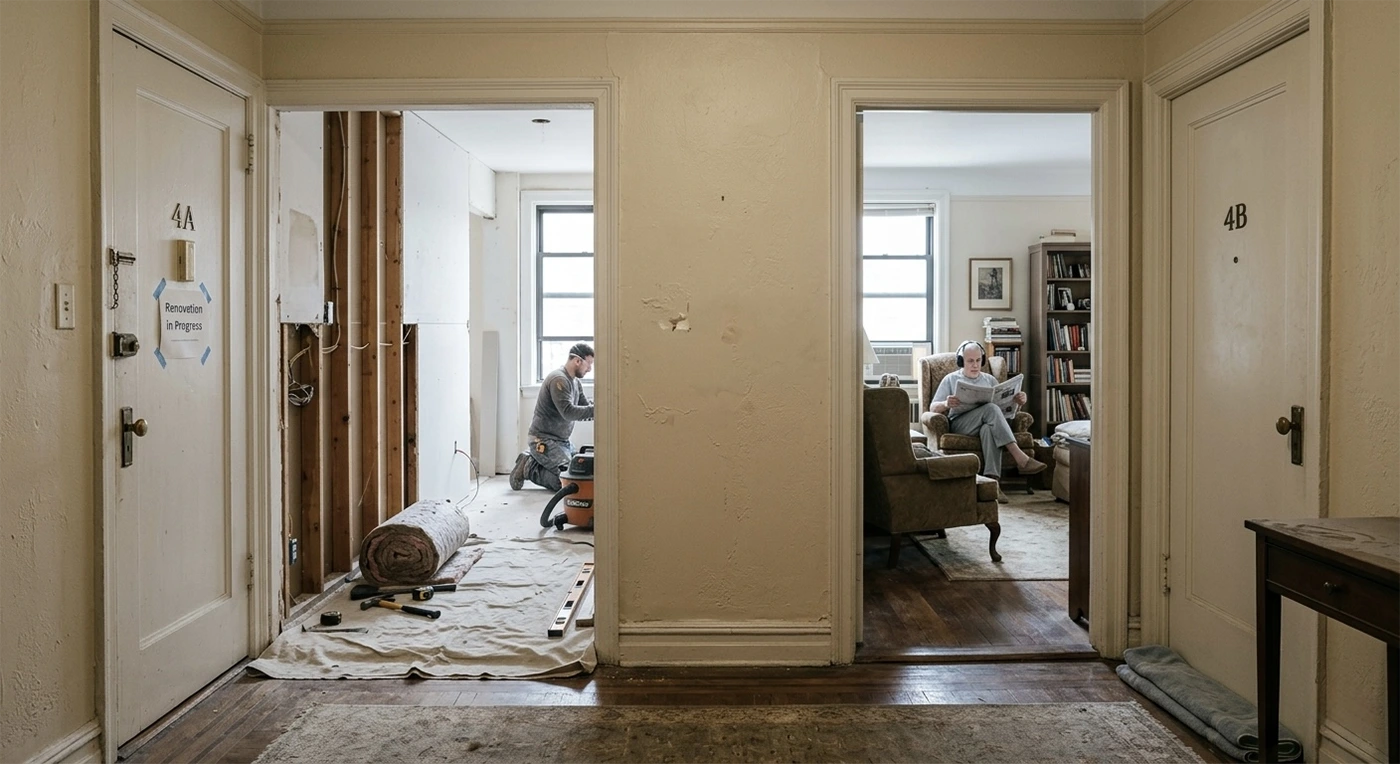
Why Your Neighbor Can Stop Your NYC Renovation – and How to Prevent It
You’ve signed the contract, secured the permits, and finally received board approval. Then your renovation stops because the apartment next door filed a complaint. In Manhattan, this is not a rare edge case. It happens on projects that were planned carefully, filed correctly, and approved by every authority that matters, until a neighbor decides otherwise.
New York City gives residents meaningful tools to intervene in construction activity happening around them. Some of those tools are legitimate protections. Others are leveraged opportunistically. Either way, the practical result is the same: your project stops, your contractor waits, and the clock runs on your carrying costs and temporary housing. Understanding exactly how neighbors can disrupt a renovation, and why buildings allow it to happen, is knowledge that should inform your planning before the first drawing is produced.
Building Management Has More Authority Than You Think
In a co-op or condo, the managing agent and the board hold authority over construction activity that extends well beyond what the city requires. The alteration agreement you signed is a contract with the building, not just a formality, and that contract gives building management the right to stop work for violations that have nothing to do with safety or code compliance.
A neighbor who complains to the managing agent about noise, dust in the corridor, or workers using the passenger elevator triggers an obligation for management to investigate. In many buildings, the superintendent has standing authority to issue a verbal stop-work order immediately while that investigation occurs. Work halts on the spot. The general contractor has no recourse until the managing agent is satisfied. A complaint that takes two days to investigate is two days of idle labor and compounding schedule pressure, even if the complaint turns out to be unfounded.

Noise Complaints Carry Real Consequences
New York City permits construction noise citywide only from 7:00 AM to 6:00 PM on weekdays, under the Noise Code. Most Manhattan co-op and condo alteration agreements narrow that further, commonly to a window around 9:00 AM to 5:00 PM — but the exact hours are set building by building, and yours is the one that governs your project. Violations of the building’s own window are enforceable, but the definition of what constitutes a violation is often left to interpretation.
A neighbor working from home who finds tile installation disruptive can call the managing agent and describe the noise as excessive, regardless of whether your contractor is operating within permitted hours. If the super agrees, your crew may be asked to pause until the issue is resolved. If the neighbor escalates to a formal complaint with the New York City Department of Buildings, an inspector may be dispatched. Even when the inspector finds no violation, the visit creates a record and the delay is real.
More significantly, noise from jackhammering or concrete cutting, which is required any time drain lines are relocated in a concrete slab building, is treated differently in most alteration agreements than standard construction noise. Buildings often restrict slab cutting to limited hours within the permitted workday and require advance notice to adjacent units. A neighbor who wasn’t notified has a legitimate basis to complain, and that complaint can delay the most time-sensitive phase of your rough plumbing work.
Co-op Boards Can Act on Neighbor Concerns Mid-Project
In a cooperative, the board’s authority over renovation activity does not end when the alteration agreement is executed. Boards retain the right to stop work if the project deviates from the approved scope or if neighbor complaints reach a threshold the board takes seriously.
Consider a scenario that plays out more often than owners expect: a unit owner approves a renovation, construction begins, and the neighbor below starts noticing vibration affecting their apartment. They bring it to the board. The board, wanting to avoid a shareholder dispute, requests a temporary pause while an independent engineer reviews the work. Even if that review clears the project entirely, the process takes time. In buildings where boards meet monthly, a complaint that arrives the week after a board meeting may not be formally addressed for another three weeks.
The board’s intervention doesn’t require a code violation or even a credible structural concern. In a co-op, shareholder relations are a legitimate governance matter, and a board that wants to maintain peace among residents has incentive to act cautiously when complaints arise.
DOB Complaints Trigger Mandatory Inspections
Any person can file a complaint with the NYC Department of Buildings through the city’s online portal, and most complaints result in an inspection. A neighbor who believes your renovation is creating a hazard, whether from dust, structural concerns, or noise, can initiate a DOB visit without any prior notice to you.
When an inspector arrives, they review the posted permit, evaluate the work in progress against the approved drawings, and look for safety conditions or code violations. If they find any, they issue violations or a stop-work order that applies immediately and cannot be lifted until the violations are resolved. If they find nothing actionable, they leave, but your project was still paused while the inspection was scheduled and conducted.
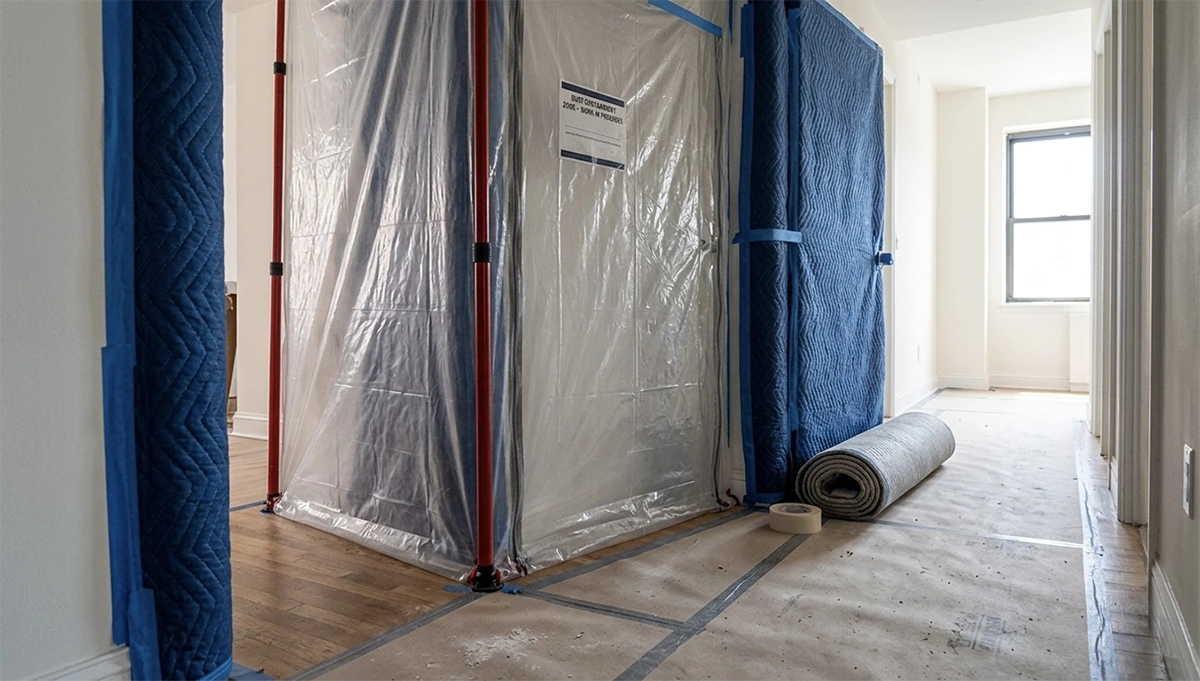
The practical risk here is that a complaint-triggered inspection, even one that results in no violations, creates a record in the DOB’s system. Projects with inspection histories can attract additional scrutiny on subsequent visits. A contractor who knows the DOB has been called once will be less willing to cut scheduling corners in the future, which affects how efficiently the remaining work can proceed.
Water Damage Concerns Can Halt Work Immediately
In an occupied residential building, moisture is everyone’s concern. If a neighbor below your bathroom renovation reports water staining, a damp ceiling, or a visible leak, building management will stop your plumbing work instantly until the source is identified and confirmed to be pre-existing or unrelated to your project.
This scenario is particularly common during rough plumbing phases, when new connections are being made and pressure tests are being conducted. A coincidental pre-existing leak in the building’s riser, or condensation on a cold pipe that a neighbor hasn’t noticed before, can be attributed to your renovation when the timing aligns. Proving that your work is not the cause requires investigation, sometimes a licensed plumber’s inspection on both floors, and a written determination from the building’s plumber or engineer. That process takes days.

The consequence extends beyond the delay. If the investigation concludes that your work contributed to any moisture, even marginally, you are financially responsible for restoration in the unit below under most alteration agreements. That liability doesn’t require negligence on your contractor’s part. It requires only that the damage occurred during your renovation window.
Shared Systems Create Shared Vulnerability
Plumbing risers, electrical panels, and HVAC infrastructure run through your apartment but serve units above and below yours. Any work that touches these systems, even tangentially, creates exposure to neighbor complaints that building management takes seriously.
When a plumber works near a shared riser, the risk of accidentally interrupting service to other units is real. A building that experiences a loss of hot water to three floors because of a connection gone wrong during a unit renovation will hold the renovating owner responsible, and residents who lost hot water for four hours are not a cooperative audience for an apology. Building management will likely require that riser work be performed only during building-wide maintenance windows, which means your plumbing schedule is now tied to the building’s availability rather than your contractor’s.
Electrical work near the building’s distribution infrastructure carries similar exposure. Tripping a shared circuit during rough electrical work affects every unit on that line. The repair is usually quick, but the building’s response is not always proportionate to the actual disruption.
There’s also a specific legal mechanism worth knowing before any work touches a shared wall, floor slab, or foundation: NYC Building Code §3309 makes the renovating owner responsible for protecting adjoining property from damage during that kind of work. If protecting the neighbor’s side requires physical access to their unit, you need a license from them to enter it, under §3309.2. That license is theirs to grant or withhold, and a neighbor who is uneasy about the project has real leverage in that negotiation — it’s worth raising and resolving before the work that needs it is scheduled, not after.
How to Prevent Issues Before They Become Stop-Work Orders
The most effective protection against neighbor-driven delays is pre-construction relationship management, not legal strategy.

Notify adjacent neighbors directly before work begins. A brief note or a conversation explaining the scope, the schedule, and how long the disruptive phases will last does more to prevent complaints than any alteration agreement provision. Neighbors who feel informed are less likely to call the managing agent than neighbors who first learn about the renovation when their walls start vibrating.
Submit a complete, polished alteration package. Board submissions that reflect a well-organized, professionally managed project signal competence to everyone reviewing them, including neighbors who may be watching the process. A thorough submission produces fewer questions, faster approvals, and less opportunity for procedural objections.
Build a real relationship with the building’s superintendent. The super is the first line of response to any neighbor complaint during construction. A super who knows your contractor, trusts that they work cleanly and within building rules, and has a direct line of communication is far more likely to resolve a neighbor complaint informally before it escalates to the board or the DOB.
Schedule the most disruptive work phases, particularly slab cutting and heavy demolition, as early in the project as possible. Disruption at the beginning of a project, when the timeline has buffer, is more manageable than disruption in the middle of construction when subcontractor sequences are compressed.
Managing the Variables You Don’t Control
Neighbors, building management, and city agencies each hold real authority over a Manhattan renovation project, and that authority doesn’t disappear once your permits are issued and your alteration agreement is signed.
Keep a written record of every notification you send and every access agreement you negotiate — the date the neighbor below was told about plumbing work, the date the super signed off on protective barriers, the date a license was granted to protect a shared wall. None of it prevents a complaint from being filed. All of it is what settles the complaint quickly once it is, because it shows the managing agent or the DOB inspector that the project was run in good faith from the start.

Can You Put a Washer and Dryer in a NYC Co-op or Condo?
Few things change daily life in a Manhattan apartment as much as a washer and dryer of your own. No

The Hidden Costs of NYC Compliance: Budgeting for Permits, Inspections, and Fees
Embarking on a renovation project in New York City is exciting. You have a clear vision for your spa
Co-op and Condo Renovation Rules: Navigating Building Board Approvals in NYC
Living in a New York City co-op or condo means your renovation has to clear two separate hurdles. Ci