

Electrical Upgrades in NYC Apartments: When You Need a Full Rewire
Manhattan’s apartment buildings range from prewar classics built in the 1910s to postwar towers from the 1960s, and the electrical systems inside them often haven’t kept pace with how people live and work today. A building’s lobby gets renovated every decade. The electrical infrastructure behind the walls may not have been touched in forty years. When a renovation finally opens those walls, what gets exposed frequently determines the entire scope and cost of what follows.
Ignoring an outdated electrical system during a renovation is not a neutral decision — it’s a choice to close walls around infrastructure that will limit future flexibility, create inspection exposure, and in the worst cases pose fire and safety risks that a modern system would eliminate. Understanding when a partial upgrade is sufficient and when a full rewire is the only real answer is the decision that separates a renovation that holds up from one that generates problems within years of completion.
Signs You Need a Full Rewire
In prewar apartments, the original wiring was installed before World War II, often as knob-and-tube. This system runs unsheathed conductors through porcelain insulators stapled to joists and studs, without a ground conductor, without continuous insulation, and without any of the protection that modern wiring systems provide. If knob-and-tube wiring is still active in any part of the apartment, a full rewire is not optional. Homeowner’s insurance carriers increasingly refuse to cover apartments with active knob-and-tube wiring, and once a renovation opens the walls around it, an inspector working to current code will not sign off on leaving it reconnected.
Cloth-insulated wiring, which replaced knob-and-tube in the 1940s and 1950s, presents a different but equally serious problem. The cloth insulation becomes brittle and friable with age. By the time it’s been in service for sixty or seventy years, the insulation can crack away from the wire with minimal physical disturbance, leaving conductors exposed inside finished walls. This wiring type appears functional right up until it isn’t, and the failure mode tends to be thermal rather than visible.
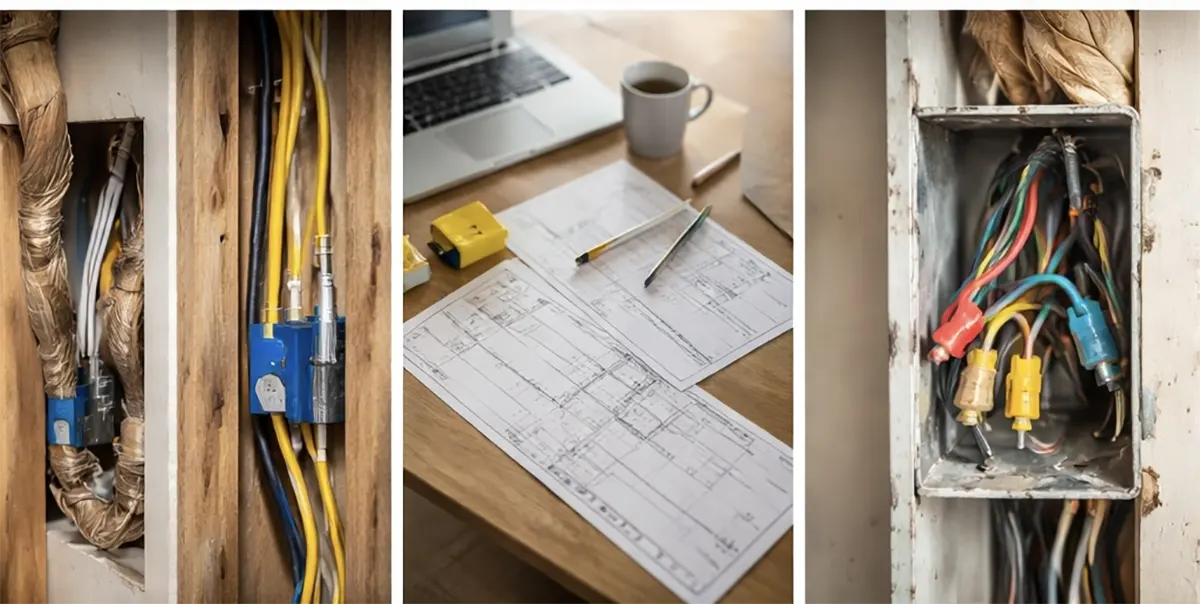
Aluminum wiring was installed in residential buildings during a specific period in the late 1960s and early 1970s when copper prices spiked. Aluminum conductors expand and contract at a different rate than the copper terminals they connect to, which over time creates loose connections at outlets, switches, and panels. Loose connections generate heat. This is a documented fire risk, and while there are mitigation approaches short of full replacement, they require comprehensive remediation at every connection point in the apartment.
Other indicators that a full rewire is warranted regardless of wiring type: a panel with capacity under 100 amps serving a renovated apartment with a modern kitchen, an apartment without any three-prong grounded outlets, or a system where multiple circuits consistently trip under loads that a properly sized modern circuit would handle without event.
When a Panel Upgrade Alone Is Not Enough
The appeal of upgrading just the panel is understandable. It’s faster, less invasive, and less expensive than a full rewire. But a new 200-amp panel connected to sixty-year-old wiring throughout the apartment doesn’t solve the underlying problem. It gives you the capacity to deliver more current through conductors that may not safely handle it.
Patchwork electrical work in NYC apartments produces systems that pass visual inspection but fail in application. A licensed electrician who reviews a partial upgrade job can usually identify the points where old and new systems were spliced together, and those splice points are where failures concentrate. Aluminum-to-copper connections made without the correct anti-oxidant compounds and without listed Al-Cu rated devices are a persistent problem in apartments where previous electricians took the expedient path.
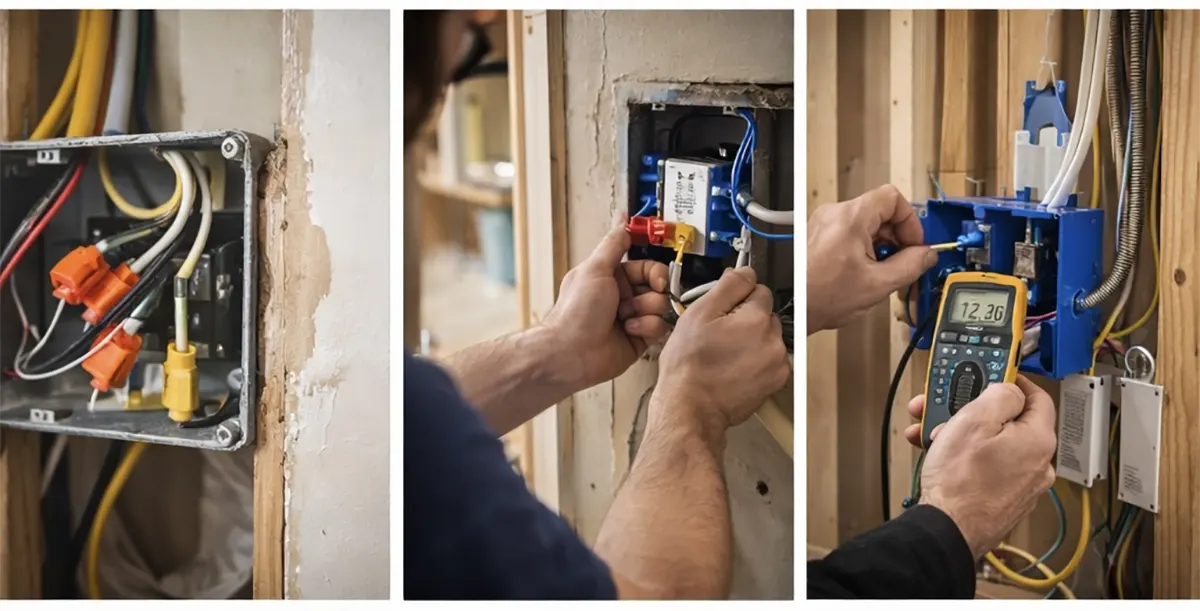
Behind walls that haven’t been opened in decades, conditions are often worse than they appear from the panel. Junction boxes that were buried without access, wire nuts that have loosened over decades of thermal cycling, conductors that were originally run through paths that subsequent renovations partially compromised: these are the conditions that a panel upgrade alone doesn’t address and that a full rewire resolves comprehensively.
The decision point is typically this: if the renovation is opening walls throughout the apartment anyway, the marginal cost of pulling new wire through those open walls is a fraction of what it would cost to do the same work in a finished apartment later. Rewiring during a gut renovation is close to a surgical operation; rewiring a finished apartment afterward means demolition followed by reconstruction just to get back to the same starting point.
NYC Code and Permit Requirements
All electrical work in New York City beyond minor repairs and like-for-like fixture replacement requires a permit from the NYC Department of Buildings. The permit must be filed by a licensed master electrician, and the work must be performed by licensed electrical contractors. For apartment renovations, electrical work is typically included within the broader alteration permit filing, but the electrical scope is evaluated separately by the DOB’s Electrical Division.
A full rewire also brings the apartment under the NYC Electrical Code’s current arc-fault protection requirements. The code adopts the National Electrical Code’s §210.12, which requires AFCI protection on branch circuits serving nearly every room in a dwelling unit, not just bedrooms — kitchens, living rooms, dens, and hallways are all included under the current edition. AFCI breakers cost more than standard breakers and add to the panel budget, which is worth pricing in before the panel is selected rather than after.
Required inspections are not optional checkpoints. The DOB inspects rough electrical work before walls are closed, and a rough electrical inspection that fails, whether for incorrect wire sizing, improper conduit fill, inadequate grounding, or deviations from the approved drawings, means walls stay open until the deficiency is corrected and a re-inspection passes. Closing walls before a required inspection is an unpermitted condition that the DOB can require to be opened again.
In Manhattan apartment buildings, electrical work also requires coordination with building management before and during construction. The building’s electrical infrastructure, including the distribution panels in the basement and the risers that feed individual unit sub-panels, is building property, and accessing or modifying anything beyond the unit’s own sub-panel requires authorization. In some co-ops, electrical upgrades that increase a unit’s service capacity require the building’s electrical engineer to review and confirm that the building’s distribution system can support the additional load.
Challenges Specific to NYC Apartments
The physical constraints of rewiring a Manhattan apartment are unlike anything encountered in a single-family residence. In a house, wire runs through an accessible attic, through a basement, and within stud bays that can be reached by fishing wire through small access holes. In a concrete-frame apartment building, wire runs through conduit embedded in concrete slabs or through walls where access is limited to whatever the renovation has opened.
In prewar buildings with thick masonry walls, running new conduit is labor-intensive work that requires chasing channels into plaster and brick, a process that generates significant debris and that requires skilled execution to avoid damaging the wall structure. In concrete frame postwar buildings, wire is typically run through EMT conduit, which must be secured at specific intervals and routed through paths that accommodate the building’s structure. Every junction box location, every pull point, every transition through a wall or ceiling assembly requires planning against the physical reality of the building’s construction.
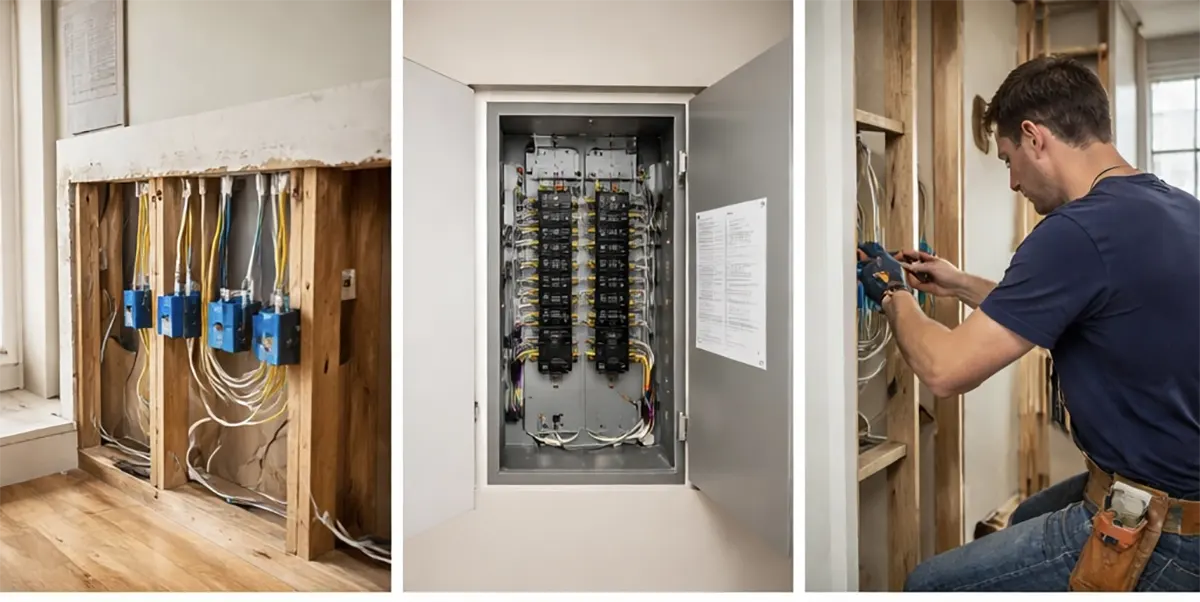
Co-op alteration agreements frequently restrict electrical work to specific hours due to noise, limit the number of workers in the building simultaneously, and require that the building’s electrical systems not be affected during normal residential hours. Coordinating a service upgrade that requires brief interruption of a circuit serving multiple units means working with the building management to schedule the interruption during a window acceptable to residents often on a weekend morning arranged weeks in advance.
Cost and Scope
The cost of rewiring a Manhattan apartment is driven by four variables: apartment size, wall and ceiling access during the renovation, the complexity of the electrical design, and the cost of restoring what was opened.
In a gut renovation where all finishes are being replaced, the rewiring cost reflects primarily labor and materials, and that cost runs lower per circuit than rewiring in a finished space. When walls must be opened specifically for rewiring, the cost of the work includes the electrical labor, the demolition, and the full restoration of finishes, including plastering, painting, and in some cases tile replacement. In a finished apartment, a single circuit addition that would be straightforward in an open renovation can require opening wall sections in multiple rooms to trace a viable path.
In Manhattan, licensed electrical labor rates are among the highest in the country. Industry guidance for 2026 puts a full rewire of a two-bedroom prewar apartment in a gut renovation somewhere in the $25,000 to $70,000 range, with complex prewar apartments — thick masonry walls, extensive chasing, an elaborate lighting or structured-wiring design — regularly landing at $70,000 to $80,000 or more. Treat any single number you’re quoted online as a starting point, not a ceiling, and get an itemized bid for your specific apartment. This is not a line item that can be reduced by using less skilled labor. The DOB inspection process specifically evaluates the quality and compliance of the installed work, and a rough electrical installation that doesn’t pass inspection doesn’t save money regardless of what it cost to install.
What Happens If You Skip It
The consequences of leaving an outdated electrical system in place behind new finishes are not hypothetical. Insurance carriers conduct their own assessments of building systems, and apartments with documented pre-war wiring types that remained in service after a renovation are increasingly difficult to insure at standard rates. When an electrician who did the work under a permit is asked by the DOB to certify the electrical system as code-compliant, they cannot certify a system that includes pre-existing non-compliant wiring they were aware of and didn’t address.
Future renovations become more expensive. An apartment that was gut-renovated with walls closed around original wiring cannot have that wiring upgraded later without reopening finishes that were just installed. Every subsequent renovation that wants to add circuits, relocate outlets, or upgrade the system has to work around the decision that was made to leave the original wiring in place.
For resale, the buyer’s attorney or the buyer’s home inspector will review the electrical system as part of the due diligence process. An apartment with documented electrical deficiencies that survived a recent renovation raises questions about what else was addressed inadequately.
Rewiring Is a Renovation Decision, Not an Afterthought
The moment to address electrical infrastructure is when the walls are already open and the disruption has already been absorbed. Making that decision before construction begins, rather than discovering the need for it after finishes are partially complete, is the difference between adding a line item to a renovation budget and reopening a finished space.

Coordination between the electrical design and the architectural design matters more than owners typically realize. The locations of outlets, the circuit configurations for kitchen appliances, the infrastructure for lighting control, and the capacity for future technology all need to be thought through before the electrician begins rough-in work. Changes to the electrical layout after rough-in has been completed and inspected generate costs and delays that a well-coordinated design phase prevents.
Thorough planning, code-compliant execution, and coordination between licensed professionals and building management are the factors that determine whether a Manhattan renovation’s electrical scope performs correctly for the next thirty years. The apartments that hold up over time, maintain their value, and support whatever future renovation their owners eventually undertake are the ones where this work was done right the first time.
Working with a team experienced in the specific constraints of NYC apartment electrical upgrades, one that understands co-op board requirements, DOB filing procedures, and the physical realities of Manhattan’s building stock, is the most direct path to getting this done without the complications that less experienced teams routinely encounter.

Transforming Manhattan Living: Your Complete Guide to Luxury Apartment Renovation
Picture this: you walk into your outdated Manhattan apartment and envision soaring ceilings, custom

$50K vs $150K Bathroom in NYC: What’s the Real Difference?
The bathroom is the room people most consistently underestimate when budgeting a renovation in New Y
Two Pieces of Paper Decide What Your Renovation Costs
Two owners on the same line of the same building spend $150,000 on the same kitchen. One of them nev