
Top 7 Permit Mistakes That Delay NYC Renovations for Months
Most renovation delays in New York City are not caused by contractors, supply chains, or building complexity. They’re caused by permit errors that could have been avoided with better preparation at the front end of the project. The NYC Department of Buildings processes thousands of alteration filings simultaneously, and it has no obligation to be forgiving of submissions that are incomplete, inconsistent, or filed under the wrong application type. Every error the DOB catches requires a response, and every response cycle adds weeks to a timeline that was already tight.
The owners who experience the smoothest renovation timelines are not the ones who got lucky. They’re the ones who understood the DOB’s requirements before filing, hired professionals with actual experience in the system, and resisted the impulse to move faster than the process allows. The seven mistakes below account for the majority of preventable delays on Manhattan apartment renovations. They appear on projects regularly, and their consequences are real.
Mistake 1: Filing the Wrong Application Type
The difference between an Alteration and an Alteration-CO filing is not a technicality. (DOB NOW replaced the old ALT-1/ALT-2/ALT-3 system in 2021: what used to be filed as ALT-1 is now Alteration-CO, and what used to be ALT-2 or ALT-3 is now filed as Alteration.) Alteration-CO is required when the scope of work changes the apartment’s use, occupancy classification, or egress configuration, and it results in a new or amended Certificate of Occupancy upon completion. Alteration covers work that doesn’t affect those legal conditions. Filing an Alteration for a project that actually requires an Alteration-CO produces an approval that doesn’t match the scope of work, and the DOB will catch the discrepancy either at plan examination or at final inspection.
The typical scenario: an owner combining two apartments into one files under Alteration because the drawings don’t explicitly describe the occupancy change. The DOB’s plan examiner identifies the combination during review and requires the filing to be upgraded to Alteration-CO. The original submission is voided. New drawings are required. The review clock resets. What was a four-to-six-week review becomes a four-to-six-month process.
The reverse error also occurs: filing Alteration-CO when Alteration would have been correct adds compliance requirements, documentation, and review complexity that the project didn’t need.
Mistake 2: Submitting Incomplete or Inconsistent Drawings
The DOB reviews permit applications against two standards: compliance with the NYC Building Code and internal consistency. A drawing set that shows a new bathroom on the floor plan but doesn’t include a plumbing diagram for that bathroom will generate an objection. A drawing set where the electrical panel schedule doesn’t match the circuit layout on the floor plan will generate an objection. A structural note that references a specification not included in the submission will generate an objection.
Each objection requires a written response, revised drawings in most cases, and resubmission for another review cycle. A submission with three separate objections from the DOB’s plan examiner, each requiring revised documentation, can consume two to three months of back-and-forth before the permit issues. In the interim, no work can legally begin.
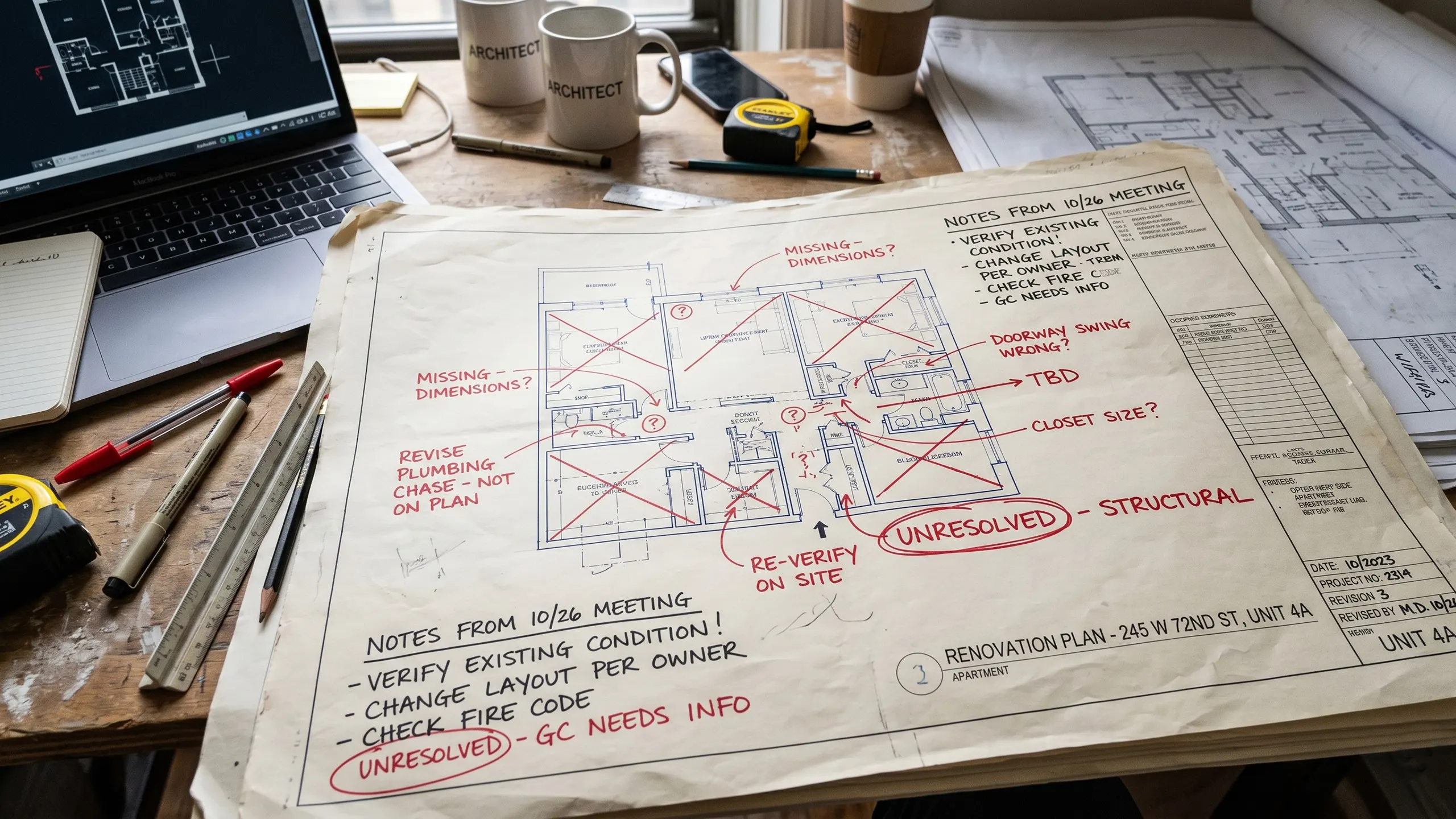
The DOB does not call to discuss errors. They issue objections in writing, and the applicant responds in writing with corrections. The pace of that process reflects the DOB’s workload, not the owner’s schedule.
Mistake 3: Ignoring Co-op or Condo Requirements
The DOB permit and the building’s alteration agreement are independent approvals, and neither substitutes for the other. An owner who sequences the DOB filing before engaging the building’s approval process may receive a permit for work the board subsequently restricts or modifies. When that happens, the permit drawings no longer reflect what the board approved, and the drawings need to be revised and refiled with the DOB before work can proceed under either authorization.
This delay compounds when the board’s required changes are substantive. A building that requires a revised waterproofing specification, a different structural approach, or a modification to the plumbing layout may trigger changes to the permit drawings that require a new plan examination cycle. The owner has now paid for two rounds of architectural revisions, two rounds of DOB review, and lost the time both consumed.
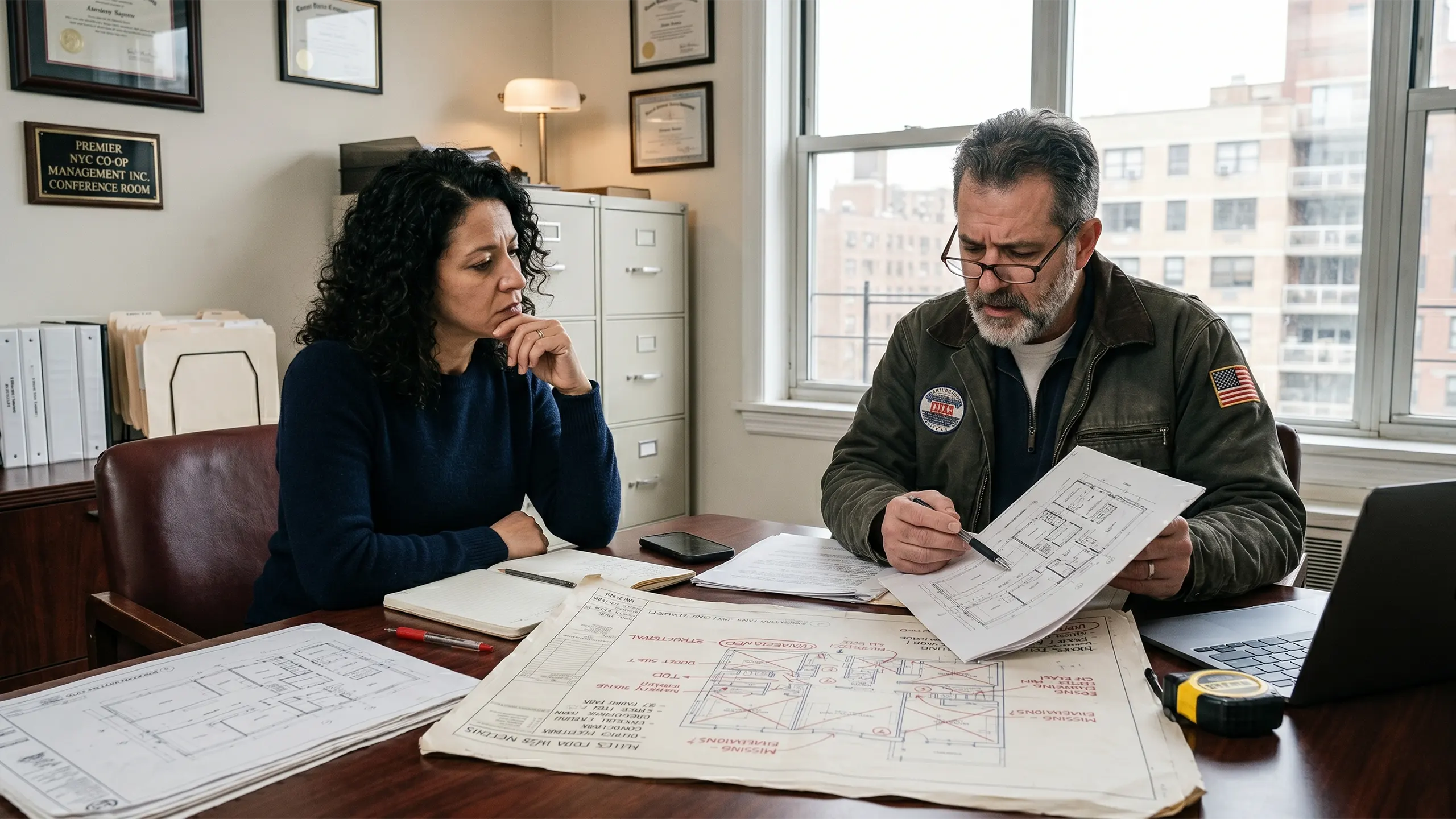
Running both approval processes in parallel, with active coordination between the architect and the managing agent, is the correct approach. It requires more attention during the pre-construction phase but eliminates the sequencing failures that cost months later.
Mistake 4: Hiring Unlicensed or Under-Experienced Filing Professionals
Not every architect who can design a beautiful kitchen has experience filing alteration permits with the NYC DOB. The DOB’s filing system, the objection-response process, the specific documentation requirements for different work types, and the code sections that plan examiners scrutinize most closely are knowledge that comes from doing this work repeatedly, not from passing an architecture licensing exam.
An architect filing their second or third NYC alteration permit will make errors that an experienced practitioner wouldn’t. They’ll miss required notes, format documentation incorrectly, or fail to anticipate the code analysis that a particular scope of work triggers. The DOB’s response is the same regardless: an objection that requires correction and resubmission.
Similarly, expediters vary in their familiarity with the DOB’s current procedures. The DOB’s systems and processes change, and an expediter who hasn’t filed a similar project recently may be working from outdated assumptions. The cost of the delay created by an under-experienced team routinely exceeds the cost savings of hiring them.
Mistake 5: Underestimating Scope Mid-Project
A permit is issued for a specific scope of work as described in the approved drawings. When construction reveals conditions that require changes to that scope, those changes need to be reflected in amended drawings filed with the DOB before the affected work proceeds. This is a standard process with a non-trivial timeline.
The mistake is assuming that small field modifications don’t require formal documentation. A plumber who routes a drain line differently than shown on the approved drawings because field conditions made the approved path impractical has created a discrepancy between the permitted work and the actual installation. When the DOB inspector arrives and the work doesn’t match the drawings, the options are correcting the installation or filing a plan amendment. Neither is fast, and both delay the project.
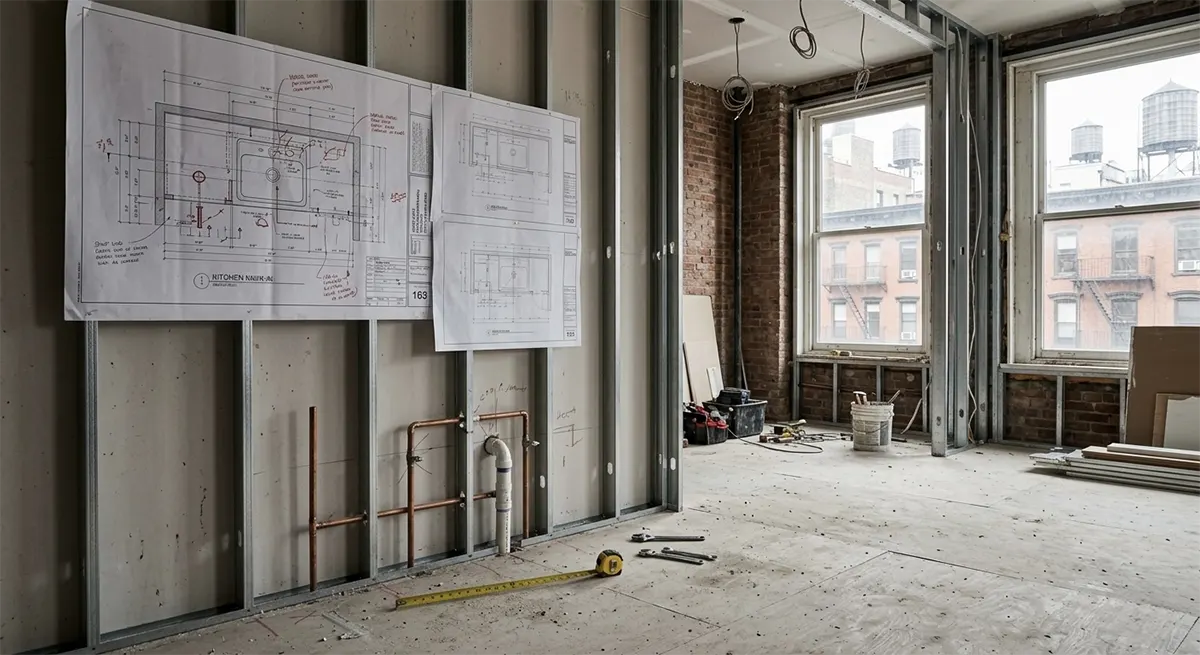
On larger renovations, scope evolution during construction is normal. The projects that manage it cleanly are the ones where the architect is actively engaged throughout construction, field modifications are documented and assessed in real time, and plan amendments are filed promptly rather than accumulated and addressed after the fact.
Mistake 6: Failing to Coordinate Trade Permits
A Manhattan apartment renovation typically involves electrical, plumbing, and general construction permits, all of which must be filed and approved before the corresponding work begins. These permits are related but separate, and they need to be coordinated both in terms of content and timing.
An electrical permit that’s filed two weeks after the general alteration permit, while the project is already in demolition, creates a situation where rough electrical work can’t legally begin when the project is ready for it. The contractor moves on to other phases, the electrical rough-in falls behind the sequence, and the project either waits for the electrical permit to issue or proceeds without one and risks a stop-work order.
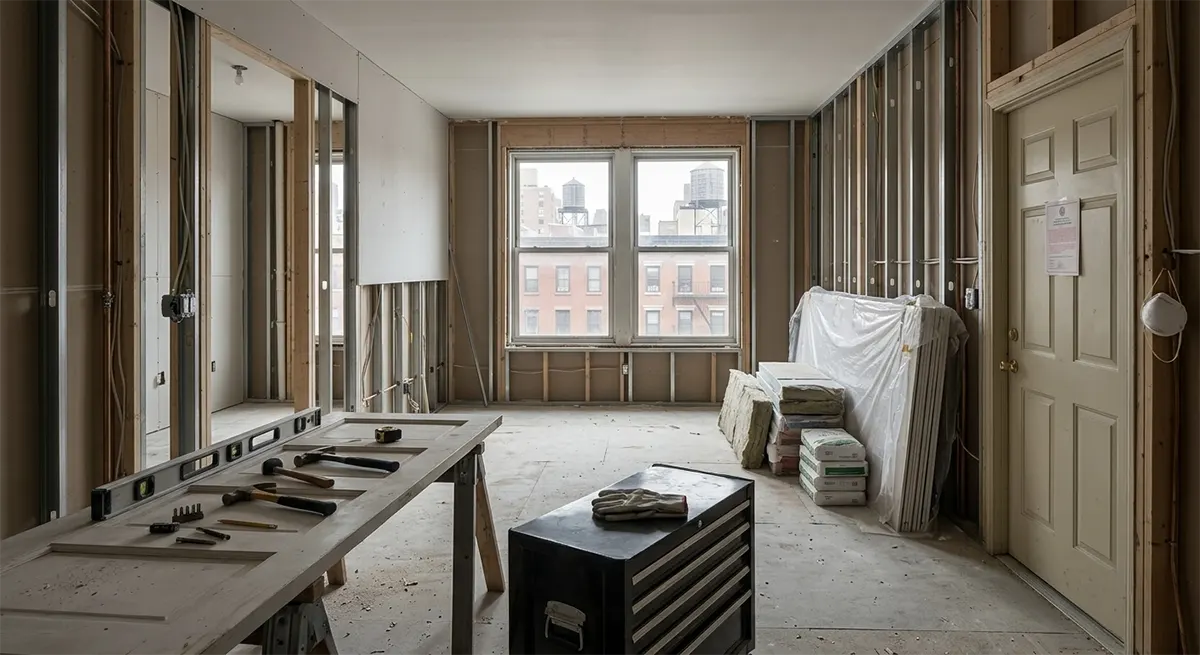
Equally common: a plumbing permit whose drawings show fixture locations that differ from the architectural permit drawings. The DOB’s plumbing reviewer compares the plumbing submission against the filed architectural plans. Discrepancies generate objections on both filings, and both need to be resolved before either permit issues.
Coordinating all permit submissions through a single architect and expediter who are tracking the content and timing of every filing eliminates most of these conflicts before they reach the DOB.
Mistake 7: Starting Work Before Permits Are Issued
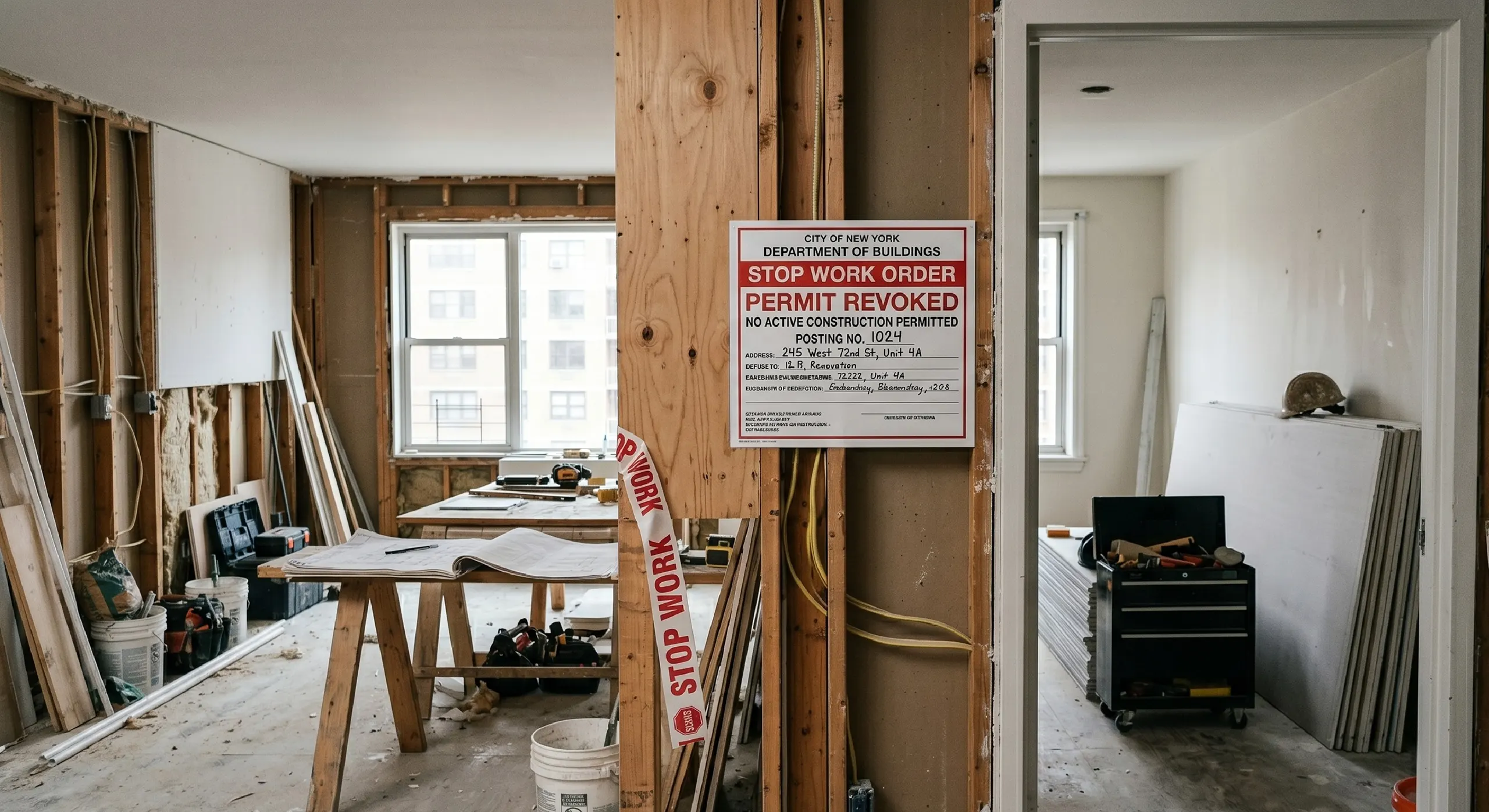
This is the most costly permit mistake, and it remains common despite its consequences. An owner who is anxious to start, or a contractor who wants to show progress, begins demolition or construction before the DOB permit has been issued. The DOB inspects the site, identifies unpermitted work in progress, and issues a stop-work order. That order applies to all work on the project, not just the unpermitted scope.
Clearing a stop-work order requires filing a cure, often with additional documentation, paying associated civil penalties — which start at $6,000 per violation for any building other than a one- or two-family dwelling, under 1 RCNY §102-04 — and in some cases appearing before OATH’s Environmental Control Board (ECB) Tribunal. Clearing it and resuming permitted work is measured in weeks at best, longer when the underlying permit has outstanding objections of its own.
The contractor who started early to save time has cost the project more time than any other single decision could have, plus the fines, the expediter fees to resolve the violation, and any architectural work required to document the work that was done before approval.
Why NYC Permits Take So Long
The DOB processes alteration applications in the order they’re received, with review times that fluctuate based on overall application volume, the complexity of the submission, and how many objection-response cycles the filing requires. A clean, complete, correctly filed submission for a standard apartment renovation can move through plan examination in four to eight weeks under normal conditions. A submission with objections, corrections, and resubmissions can take four months or more to reach permit issuance.
Two requirements outside plan examination itself routinely add time that owners don’t plan for. If the building went up before April 1, 1987, DOB checks for a completed ACP-5 — a DEP-certified Asbestos Investigator’s certification that the work won’t disturb asbestos-containing material — before it will issue the permit at all. That has to be arranged and completed before filing, not during construction. And for projects involving structural work, NYC Building Code Chapter 17, §1704 requires special inspections performed by an agency the owner — not the architect or the contractor — hires directly, filed on a TR1 form. That’s a separate approval track from plan examination, and it’s easy to leave out of an initial schedule built only around the DOB filing itself.
There is one legitimate way to skip plan examination rather than simply survive it: Professional Certification (Pro-Cert), where a PE or RA certifies that the plans meet code and the project moves straight to permit issuance. It’s a real time-saver where it applies, but it isn’t universal — certain scopes, including demolition work in specific Anti-Harassment Districts, are excluded — and a professionally certified filing is still subject to DOB audit after the fact. Ask the architect early in the process whether the project qualifies; it’s not something to discover halfway through design.
The DOB’s plan examiners review every drawing against the building code and against the consistency of the submission itself. A single unclear detail can generate an objection that requires revised drawings across multiple sheets. The agency doesn’t expedite reviews based on project urgency. Applications move through the system at the system’s pace, and the only influence an applicant has is the quality and completeness of what they submit.

How to Avoid These Delays
- File the correct application type from the start. This requires an architect who has assessed the full scope of work against the legal definitions of Alteration and Alteration-CO, not one who defaulted to the simpler filing to avoid complexity.
- Submit complete drawings. Every required note, specification, and code analysis section should be in the submission the first time. A submission reviewed internally against the DOB’s checklist before filing catches most objections before the DOB does.
- Coordinate the co-op or condo approval process in parallel with the DOB filing. Don’t sequence one after the other. Run both simultaneously with active communication between the architect, the managing agent, and the owner.
- Engage trade contractors early enough to coordinate their permit submissions with the architectural permit. All permit drawings should be reviewed for consistency before any submission is made.
- Clear the asbestos investigation (ACP-5) and confirm whether special inspections or Pro-Cert apply before filing, not after — all three affect the schedule in ways that are hard to compress once the project is underway.
- Do not start work before permits are issued. The cost of waiting is always lower than the cost of a stop-work order.
Getting It Right the First Time
The DOB approval process rewards preparation and punishes improvisation. Every error that reaches the DOB’s plan examiner is a delay that was preventable with more thorough work before the submission was filed. The difference between a renovation that begins construction eight weeks after design completion and one that begins six months later is almost always the quality of the permit submissions and the experience of the team that prepared them.
Projects managed by teams who know the NYC permit system, who coordinate all approvals simultaneously, and who prepare submissions the way a plan examiner will review them move through the DOB’s process at the speed the process allows. That’s the practical advantage of hiring professionals who have done this work dozens of times in Manhattan’s specific regulatory environment, and it shows up directly in the project timeline from the first filing to the day construction begins.
The Full NYC Renovation Approval Process: From Concept to Final Sign-Off
One of the most common misconceptions in city renovations is that construction time equals project t

Timeline of a Manhattan Renovation: From Offer Letter to Move-In
You just signed the offer letter. Champagne is popped. You are already mentally placing the sofa in

Landmark Living: Renovating Historic Buildings in NYC’s Protected Districts
There is a unique romance to living in a pre-war brownstone or a historic loft in one of New York Ci