

Change Orders Explained: Why Your Final Price Is Always Higher
Almost everyone who has renovated an apartment in New York City has had the same conversation: the contractor presents a final invoice that is meaningfully higher than the original contract, and the owner is surprised. Sometimes they’re frustrated. Sometimes they feel like they’ve been misled. In most cases, they haven’t been. What they’ve experienced is a change order process that wasn’t explained to them clearly at the start, and a renovation that evolved, as renovations almost always do, in ways that the original contract didn’t anticipate.
The initial quote is a snapshot of a project as it was understood at a specific moment in time, based on the information available, the drawings that existed, and the conditions that were visible before any walls came down. What actually gets built is the result of weeks or months of decisions made under real conditions, by real people, in a space that reveals new information every time something is opened up or removed. That gap between the original quote and the final invoice is where change orders live, and understanding that gap is one of the most useful things any owner can do before a renovation begins.
What a Change Order Is and How It Works
A change order is a formal amendment to an existing construction contract. It modifies the agreement between the owner and the contractor to reflect a change in scope, cost, timeline, or some combination of all three. When both parties sign a change order, it becomes part of the contract, and the original contract price is updated accordingly.
In practice, a change order documents what changed, why it changed, how much the change costs, and how many days, if any, it adds to the schedule. A properly written change order includes a description of the work being added, removed, or modified; the agreed price for that change; any schedule impact; and signatures from both the owner and the contractor. It is not a verbal agreement, an email acknowledgment, or an assumption that the contractor will handle it and the owner will see it on the final invoice.

That last point matters because the disputes that arise over change orders are almost always disputes over documentation, not over whether the work was done. An owner who agreed to an upgraded tile mid-project and then disputes the charge because they don’t remember exactly what they agreed to is in a difficult position if there’s no signed change order to reference. Conversely, a contractor who added work without written authorization can find themselves unable to collect payment for legitimate labor and materials. The change order exists to protect both parties, and the projects that handle it most smoothly are the ones where both the owner and contractor take the documentation seriously from the beginning.
Change orders can add to a contract, but they can also reduce it. If an owner decides mid-project not to renovate a secondary bathroom that was originally in scope, a credit change order reflects that reduction in work and cost. In practice, additive change orders vastly outnumber credit change orders on most renovation projects.
Scope Changes Driven by the Owner
The most straightforward category of change orders is the one most owners are least willing to acknowledge as their own responsibility: decisions they made after the contract was signed that changed what the contractor was asked to build.
An owner who signed a contract for a kitchen renovation with a specific cabinet layout, then decided two weeks into demolition that they wanted the island moved two feet to the left, has generated a change order. The cabinet shop needs to revise shop drawings. The countertop template is no longer accurate. The plumber needs to rough in the sink connection in a different location. The electrician’s panel and outlet layout needs adjustment. Each of these is a real cost, and collectively they can add several thousand dollars to a change that felt minor in the moment.
Material upgrades are among the most frequent owner-driven change orders. An owner selects tile during the design phase, signs the contract, then visits a showroom with the tile setter and falls in love with something significantly more expensive. Swapping that tile after the contract is signed creates a change order that accounts for the price difference in materials and potentially additional labor if the new tile requires more complex installation, different substrate preparation, or a different adhesive system.
Layout adjustments such as moving a wall, adding a doorway, or changing the location of a bathroom fixture are among the most expensive owner-driven changes because they affect multiple trades simultaneously. Moving a toilet involves the plumber, the tile setter, and potentially the drafter if amended permit drawings are required. Widening a doorway involves the carpenter, the drywaller, the painter, and possibly a structural engineer if the opening is near a load-bearing element. These changes feel singular and localized, but the cost reaches every trade the change touches.
Unforeseen Conditions: What Demolition Reveals
The second major category of change orders is the one no one can fully plan for: the conditions that are discovered when walls come down, ceilings are opened, and floors are cut.
In older New York City apartment buildings, which includes most of the pre-war stock that makes up a significant portion of Manhattan’s residential inventory, the conditions behind finished surfaces are genuinely unpredictable. The original drawings, if they exist at all, may not reflect decades of previous renovations. Previous contractors may have done work that was never permitted, never inspected, and never documented. Plumbing that was supposed to be copper is corroded galvanized steel. The subfloor under the bathroom tile is rotted from years of a slow leak no one knew about. The electrical panel that the architect noted as having adequate capacity is found to be fused rather than circuit-breaker protected, or to have handwritten wiring diagrams taped to the inside of the door.
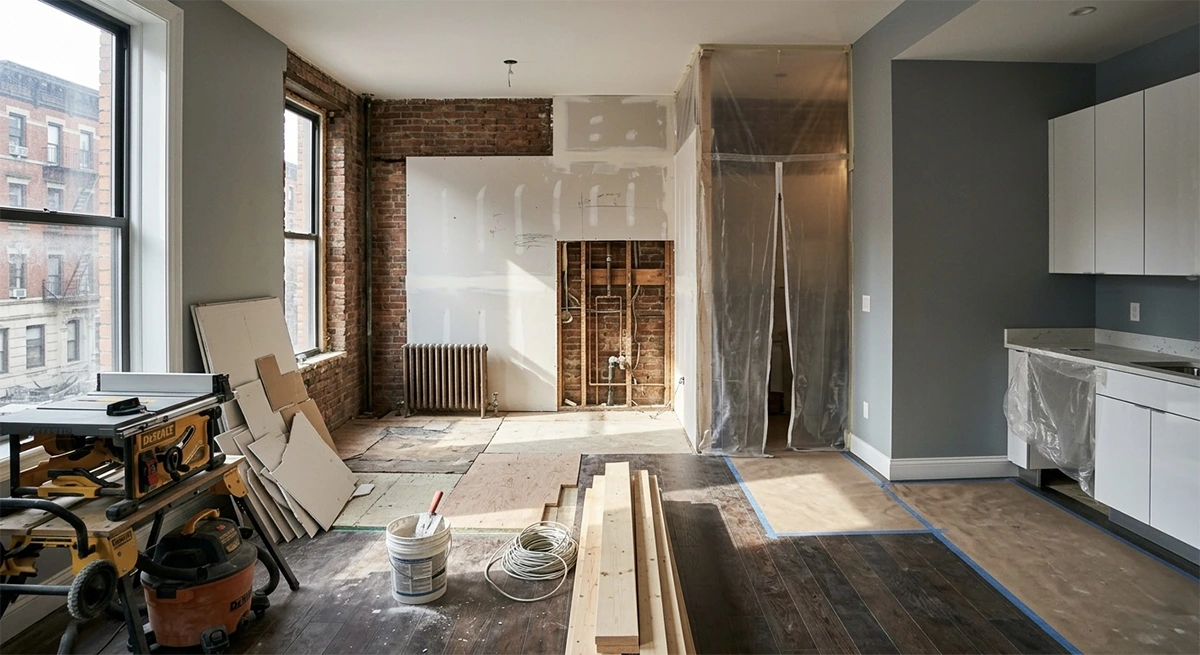
None of these conditions appear on the drawings. None of them are the contractor’s fault. All of them require work that wasn’t in the original contract, and all of them result in change orders.
Structural surprises are a common source of significant unplanned cost. A wall that the architect identified as non-load-bearing turns out, after demolition, to contain a steel beam carrying load from the floor above. Removing it as planned is no longer straightforward: the structural engineer needs to design a replacement condition, the contractor needs to install temporary shoring, and the revised approach may require an amended filing with the DOB before work can continue. That chain of events costs money and takes time, none of which was in the original scope.
Plumbing conditions in pre-war buildings are a reliable source of unforeseen change orders. When old supply lines are exposed, a plumber who finds them in poor condition has two options: flag them and let the owner decide, or close the walls and hope for the best. No licensed plumber takes the second option. When the owner is told that the supply lines need to be replaced, the cost of that replacement is added to the project as a change order, and the alternative of leaving corroded pipes in newly finished walls isn’t realistic.
A contingency budget exists precisely because of unforeseen conditions. Common guidance for NYC apartment renovations is to hold ten to fifteen percent of the construction budget as contingency, but for pre-war Manhattan buildings, where opening a wall routinely reveals non-standard construction, old risers, and asbestos in unexpected places, fifteen to twenty percent is the more realistic reserve. Projects budgeted without any contingency are projects that will be in financial difficulty the first time a wall is opened.
Design Gaps and Incomplete Planning
A third category of change orders is less discussed but equally common: the ones that result from drawings that weren’t complete enough, specifications that weren’t clear enough, or decisions that were deferred rather than made during the design phase.
Construction drawings are supposed to answer every question a contractor might have about what to build. In practice, they often don’t. Details get left for “contractor to coordinate.” Specifications reference a product category without naming a specific product. Wall sections show a condition at one location but don’t address an adjacent location where the contractor has to make a judgment call. When those gaps are reached during construction, someone has to make a decision, and if that decision costs money, it’s a change order.
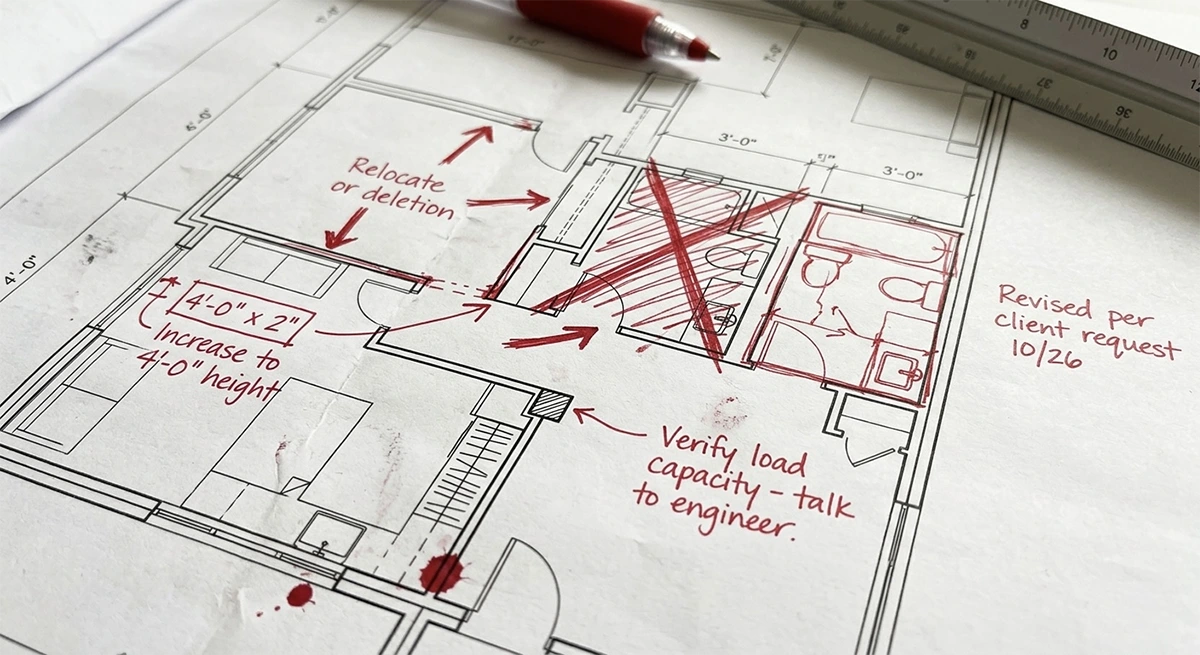
Material specifications are a particularly common source of this type of change order. If the drawings specify “porcelain tile” without naming a product, the contractor bids using an assumed price point. When the owner selects a tile that costs three times the assumed allowance, the difference is a change order. Allowance-based contracts, where specific items are budgeted at an assumed amount with the understanding that the actual cost will be substituted when selections are made, are essentially designed to generate change orders. They’re practical when selections haven’t been made at contract time, but owners should understand that every allowance in a contract is a placeholder for a future change order.
Incomplete coordination between trades is a related problem. When the plumber’s rough-in locations haven’t been coordinated against the cabinetry layout, the moment the cabinets arrive and the plumber’s connections are in the wrong place, someone has to move something. Who pays for that depends on whose drawings were wrong and whether the coordination was the contractor’s responsibility or the architect’s. Either way, the cost of the correction is real, and it typically shows up as a change order.
Building and Regulatory Factors in NYC
New York City’s regulatory environment generates a category of change orders that owners in other markets don’t deal with to the same degree. The combination of DOB permit requirements, co-op and condo board rules, and inspection outcomes creates conditions where scope changes are sometimes driven not by what the owner wants or what demolition revealed, but by what the regulatory process requires.
A DOB plan examiner reviewing a permit filing may require changes to the design as a condition of approval: additional egress provisions, updated fire-resistance ratings, or compliance with current code requirements that the original design didn’t fully address. Implementing those changes after the permit has been submitted, or after construction has started, requires revised drawings, potentially a plan amendment filing, and construction work that wasn’t in the original contract. These are change orders that no one chose; they were mandated by the approval process.
There’s a version of this that catches owners off guard: a change order that alters what the permit actually describes is not just a matter between you and the contractor. If the change touches the scope filed with the DOB — moving a wall shown on the approved drawings, relocating a fixture, altering an egress path — the architect has to file a Post Approval Amendment (PAA) with the DOB, and the affected work cannot legally proceed until that amendment is approved. That adds DOB fees, the architect’s time, and review-queue delay on top of the construction cost of the change itself. A change that feels like a quick decision on site can quietly become a filing.
Inspection outcomes can also generate change orders. If a rough plumbing inspection reveals that a drain configuration doesn’t meet code, whether a slope that’s too shallow or a vent that doesn’t terminate correctly, the plumber needs to correct the installation before the inspection can pass. That correction, if it wasn’t the result of a contractor error but rather a condition created by field conditions that differed from what was expected, may be legitimately billable as a change order depending on how the contract is written.
Co-op board requirements can impose scope changes that owners didn’t anticipate. A board that requires additional waterproofing beyond what was specified, that mandates a specific type of floor protection in corridors, or that requires a pre-construction survey that then generates remediation obligations if damage is found will create costs that appear after the contract is signed and that take the form of change orders.
How Change Orders Are Priced
Understanding how change orders are priced helps owners evaluate whether a change order proposal is reasonable before signing it. This is not a minor consideration. Change orders are where contractor margins can expand, where legitimate costs can be inflated, and where owners who don’t understand the components of the price can end up paying more than the work warrants.
A change order price typically includes the direct cost of materials for the changed work, labor to perform the changed work, any subcontractor costs associated with the change, and a contractor markup on all of the above. That markup, which covers the contractor’s overhead and profit on the additional work, is typically the same percentage as the markup on the original contract. It’s a legitimate component of the change order price, but it means that a $2,000 material upgrade doesn’t cost $2,000; it costs $2,000 plus the contractor’s markup, which might bring the total to $2,400 or $2,600 depending on the contract terms.

Labor costs for change orders can seem high relative to the apparent simplicity of the work, and there are legitimate reasons for this. When a change requires a trade that has already completed their phase of work to return to the site, that return visit has mobilization costs that don’t exist when the work is done as part of the original sequence. An electrician who has finished all their rough work, moved on to another project, and is asked to return to add an outlet needs to schedule the return visit, travel to the site, and do work that takes a fraction of the time of their original engagement. The hourly rate for that return visit is the same as the original rate, but the practical cost per unit of work is higher.
This is why change orders for small scope additions tend to have a higher cost-per-unit than the same work would have cost inside the original contract. It’s a structural feature of how construction pricing works, not a contractor overcharge, and it’s one of the strongest arguments for thorough pre-construction planning: the same outlet that costs $300 as a change order might have cost half that if it had been in the original electrical bid.
The Most Common Types of Change Orders in Apartment Renovations
Across NYC apartment renovations, certain change orders appear so regularly that they can be anticipated and planned for, even if their exact cost can’t be calculated in advance.
Tile upgrades and pattern changes are among the most frequent. A client selects tile during the design phase, signs the contract, then changes their mind. The new tile costs more, installs differently, or requires additional substrate preparation. The delta between the original and revised tile cost, plus any labor adjustment, is a change order.
Lighting additions and changes are consistent generators of change orders, particularly as owners see the space take shape during rough work and realize that the lighting plan doesn’t fully serve how they intend to use certain areas. Adding a recessed fixture requires an electrician to run additional wire, install a box, and coordinate with the drywall and painting sequence. Each addition is relatively modest, but multiple lighting changes across a renovation accumulate.
Custom millwork additions often start as a contractor suggestion or an owner observation mid-project. A built-in bookcase in the living room wasn’t in the original scope. A window seat in the bedroom was mentioned during design but not priced. A mudroom bench emerged from seeing the space with the existing furniture removed. These additions are almost always legitimate improvements to the apartment, but they’re change orders.
Plumbing relocations happen when owners see the rough-in and decide the fixture placement isn’t what they envisioned, or when conditions discovered during demolition make the original location impractical. Moving a toilet, relocating a shower drain, or adding a second sink all involve plumbing and finishing costs that weren’t in the original contract.
Structural discoveries, as noted, are a reliable change order source in older buildings: the beam that wasn’t on the drawings, the joist that needs sistering, the column that occupies space the design assumed was clear.
How to Minimize Change Orders Without Eliminating Them
Change orders cannot be eliminated from a renovation project in New York City. Anyone who promises otherwise is either not being candid or hasn’t managed many actual projects. What can be controlled is the frequency and magnitude of change orders that result from avoidable causes.
Complete drawings are the most effective tool available. When the architect’s construction documents answer every trade’s questions, when the plumbing layout coordinates with the cabinet configuration, when the lighting plan specifies exact products rather than generic categories, when wall sections address every condition in the space rather than just the obvious ones, the number of decisions that get made during construction rather than during design drops significantly. Every decision made during design costs far less than the same decision made during construction.
Early material selection is the second most important factor. Every allowance in a construction contract is a deferred selection that will eventually produce a change order. Moving selections earlier in the process, even when it requires more effort during the design phase, reduces the number of allowances and reduces the number of change orders that result from selections that exceed them.
A realistic contingency budget is not a substitute for thorough planning, but it’s a necessary complement to it. Even the most complete drawings and the most decisive owner will encounter unforeseen conditions in an older building. A contingency of fifteen to twenty percent of the construction budget for pre-war stock, held in reserve and drawn on only for legitimate unforeseen costs, allows the project to absorb those discoveries without creating a financial crisis.
Clear contract language about what constitutes a change order, how change orders are priced, and what markup rate applies to change order work protects both parties and removes ambiguity that leads to disputes later. An owner who signs a contract without understanding these terms is at a disadvantage when the first change order arrives.
Saying no is also a tool. Not every “while we’re here” addition needs to be authorized. Some of them are genuinely worth doing. Others are impulse decisions that add cost without adding proportionate value. An owner who can evaluate each proposed change order on its merits, asking whether it’s an unforeseen condition they have no choice about, a genuine improvement they want to make, or a momentary preference they can live without, is an owner who manages change order exposure rather than simply accumulating it.

Change Orders Are Part of the Process, Not a Failure of It
The final invoice on a renovation project in New York City is almost always higher than the original contract price. That is not evidence that something went wrong. It usually means the project was real: demolition revealed conditions no one could have predicted, the owner made some decisions during the project that improved the final result, and the contract adapted to reflect those changes rather than pretending they didn’t happen.
The projects that end badly usually aren’t the ones with the most change orders. They’re the ones where change orders weren’t documented, where owners didn’t understand what they were signing, where contractors added costs without notice, or where the original contract was so aggressively priced that the contractor needed change order volume to make the job profitable. Those are solvable problems, and they’re solved by understanding the change order process before it starts: what triggers it, how it’s priced, and what the owner’s role is in controlling its scope.
Every dollar added through a change order represents a real decision made during the project. Knowing that going in is what separates a renovation that feels like it got away from you from one you ran with your eyes open.

Electrical Upgrades in NYC Apartments: When You Need a Full Rewire
Manhattan’s apartment buildings range from prewar classics built in the 1910s to postwar tower

The Hidden Cost of Beautiful Spaces: What Instagram Doesn’t Show About Home Design
Have you ever scrolled through Instagram, paused at a stunning apartment photo, and thought that it

Renovation Math: How to Calculate True Cost per Square Foot in NYC
“What’s your price per square foot?” It’s almost always the first question I