
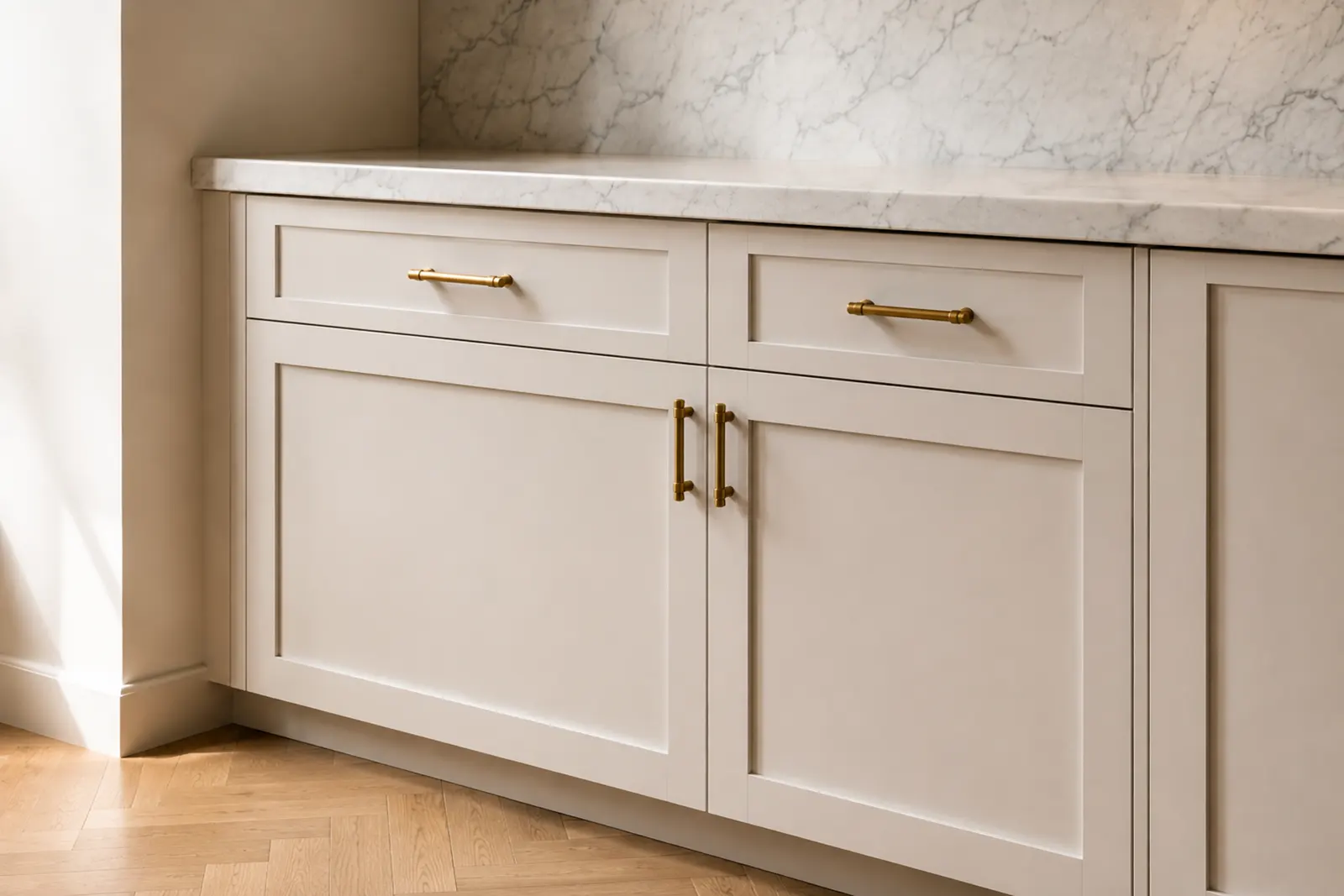
Cabinet Hardware Sizing Starts With the Door
Cabinet hardware is bought last and installed last, usually after the cabinets are hung and everyone is tired. Then the installer holds a pull against a door, and it does not sit flat. The base of the pull is wider than the flat face of the stile, so it runs off the edge where the frame steps down to the panel: on a standard Shaker door that step is a square shoulder into the recess, and on a Shaker door with a profiled inside edge it is a small bevel. Nothing is defective. The hardware was chosen from a photograph, and the door was drawn by someone else.
Hardware sizing has two halves. One is proportion, which is where every article starts. The other is the door itself, which decides what can physically be screwed to it, and which almost nobody checks before ordering 40 pieces.
The two numbers on the box
Pulls are sold by center to center: the distance between the two screw holes. That is the industry measurement, and it is the number that decides whether a pull can reuse existing holes. Common center-to-center sizes are 3 inches, 3 3/4 inches and 5 inches, and some are labeled in millimeters instead, 96 and 128, because those sizes come from European hardware.
The second number is the overall length, tip to tip, which is always longer than center to center and is what your eye actually sees on the drawer front. The gap between the two is where most ordering mistakes live: a 5-inch center-to-center pull can measure 6 or 7 inches overall depending on how its ends are shaped.
One third, and what it is measured from
The proportion rule that runs through every hardware guide is simple: a pull should be about one third the width of the drawer front, and up to about half on a wide front. Measure that against the overall length, not center to center, since tip to tip runs longer and sizing from the smaller number quietly pushes the pull past that one-third limit.
In practice that produces a short list. A drawer 12 to 15 inches wide takes a pull around 4 to 5 inches overall. An 18-inch drawer, the most common width in a kitchen, lands near 6 inches. A wide drawer of 30 to 42 inches takes a single long bar in the 10- to 14-inch range, centered, which reads as one clean horizontal line.
The rule is a convention, and sources disagree at the edges: some stop at one third, some allow up to one half, some size the widest drawers by eye instead. What matters is picking one interpretation and holding it across the whole kitchen, because the eye compares fronts with each other and never with the guide.
The door decides where the hardware lands
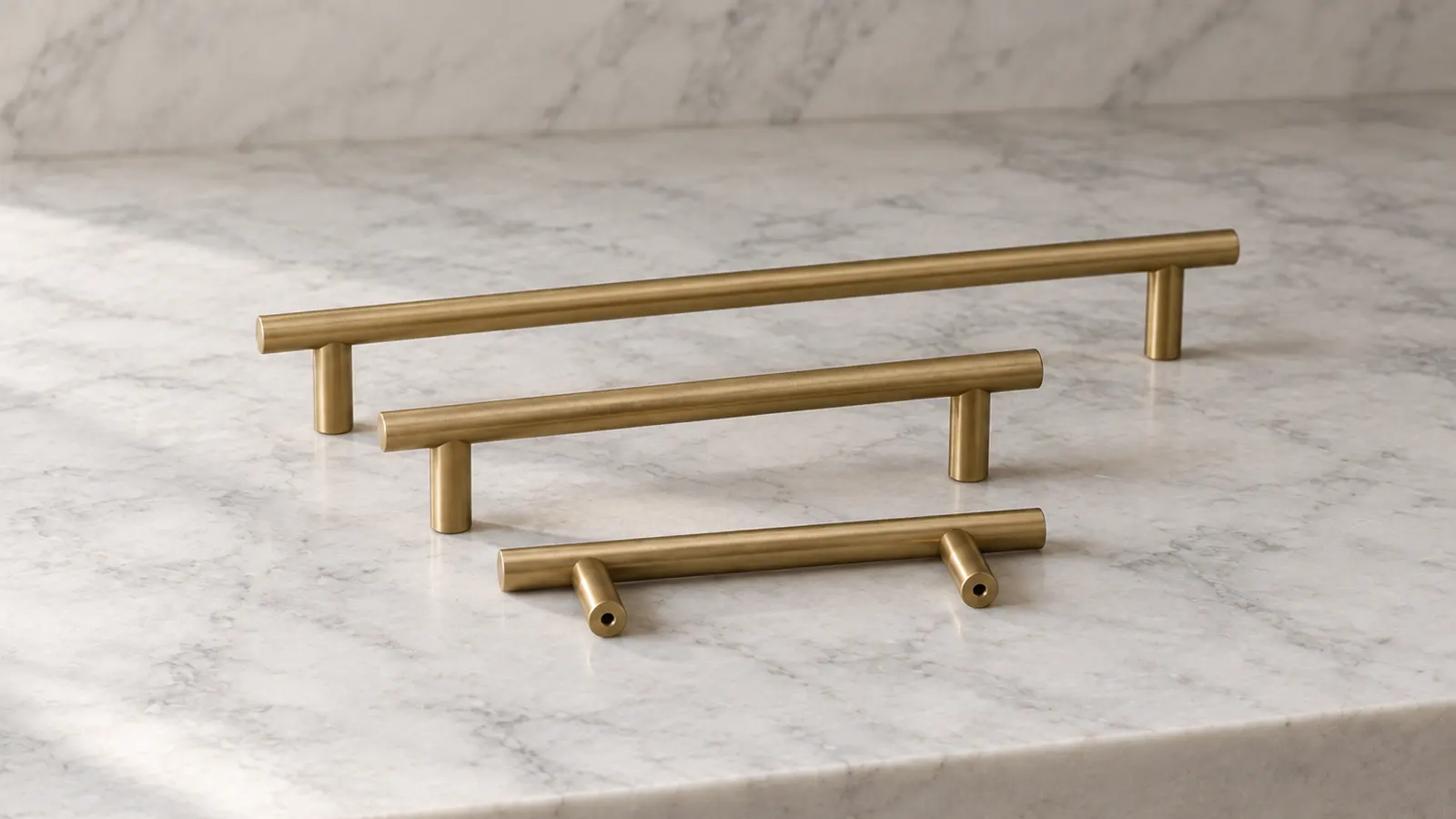
A Shaker door is a frame around a recessed panel, and on a traditional door the frame is wide enough to carry hardware. The placement that door makers publish for those doors is straightforward: knobs and pulls centered horizontally on the stile, 2 1/2 inches up from the bottom on an upper door and 2 1/2 inches down from the top on a base door. On a drawer front, the hole is centered both horizontally and vertically on the front itself.
Thin-framed doors change that answer completely. TaylorCraft builds its Slim Shaker doors with 3/4-inch and 1-inch frames, and its 4S doors can be ordered with those same frames (4S also comes with 2-inch and 2 1/2-inch frames, which behave like a traditional door). The company says plainly that knobs and pulls should not be installed on frames that narrow. The hardware goes on the recessed panel instead, and the screw length is adjusted to the thickness of that panel. Ask the door shop for the screw length when the doors are ordered, not on installation day.
Placement on those doors is also measured differently: from the inside of the frame, not from the outer edge of the door. The maker’s numbers are 1 inch over from the left or right inside of the frame, depending on which way the door swings, and 1 1/2 inches up from the bottom of the frame or down from the top. Hook the tape on the outer edge of the door instead and every hole shifts by the width of the frame; mix the two methods across a run and the hardware ends up on two different lines.
Before 40 pieces are ordered, find out how the doors are built. Ask how wide the frame is and whether the maker expects the hardware on the frame or on the panel. On a wide-frame door, the base of the knob has to sit on the stile with room on both sides, and a sample knob held against a sample door shows in a minute whether it fits. On a 3/4- or 1-inch frame the hardware goes on the panel, and the sample is held against the recessed panel before drilling, to check both how it looks and how it works.
Heavy fronts are a different problem
Trash pull-outs, recycling units and appliance panels weigh several times what a drawer of forks weighs, and they get pulled harder. Pull placement does not change on those fronts. The standard drilling on a five-piece or slab drawer front is dead center, horizontally and vertically. On a five-piece front that lands on the recessed panel. Shifting the pull up or down onto a rail to find solid wood takes it off the center line and off the drawer box behind it. Centered is also the strongest spot, because the subfront of the drawer box sits directly behind that point: the screws pass through the panel and into or through the subfront, so the load goes into the box and not into the face alone. On a heavy front, the fastener changes. Order screws long enough to take both layers, and on a thin veneered panel add a backing washer or a steel plate on the inside face so the clamping force is spread out instead of concentrated in one hole.
The second question on a wide front is one pull or two. Two pulls look symmetrical and they let a person open the drawer from either end, which is exactly the problem: an off-center tug twists the drawer box against its slides. On undermount slides that racking is what wears them out. A single centered pull sends the force straight through the middle of the box, and on a long front it also gives the run its cleanest line.
A kitchen reads as one run
Placement conventions are consistent enough to work from. The knob positions above carry over to pulls: centered horizontally on the stile, which on a standard 2 1/2-inch stile puts the holes roughly 1 to 1 1/2 inches in from the door edge, with the upper hole 2 1/2 inches down from the top on a base door and the lower hole 2 1/2 inches up from the bottom on an upper door. On base cabinets, keeping the hardware 2 to 3 inches below the top is what keeps a hand clear of the countertop above.
The numbers work; what goes wrong is the line you measure from. Drawer pulls stay centered on their own fronts. Door pulls are the ones that drift: if each installer eyeballs a spot on a different-sized door, the run turns visually jumpy. Measure every door pull by one fixed rule, 2 1/2 inches from the top of a base door or the bottom of an upper door, and the door hardware reads as one consistent line across the run. Decide that rule once, write it on the drawing, and give it to whoever drills.
The same logic applies to the sizes themselves. Repeating one center-to-center distance across several widths does more for how a kitchen looks than choosing a perfect size for each front in isolation.
Changing hardware in a kitchen that already exists
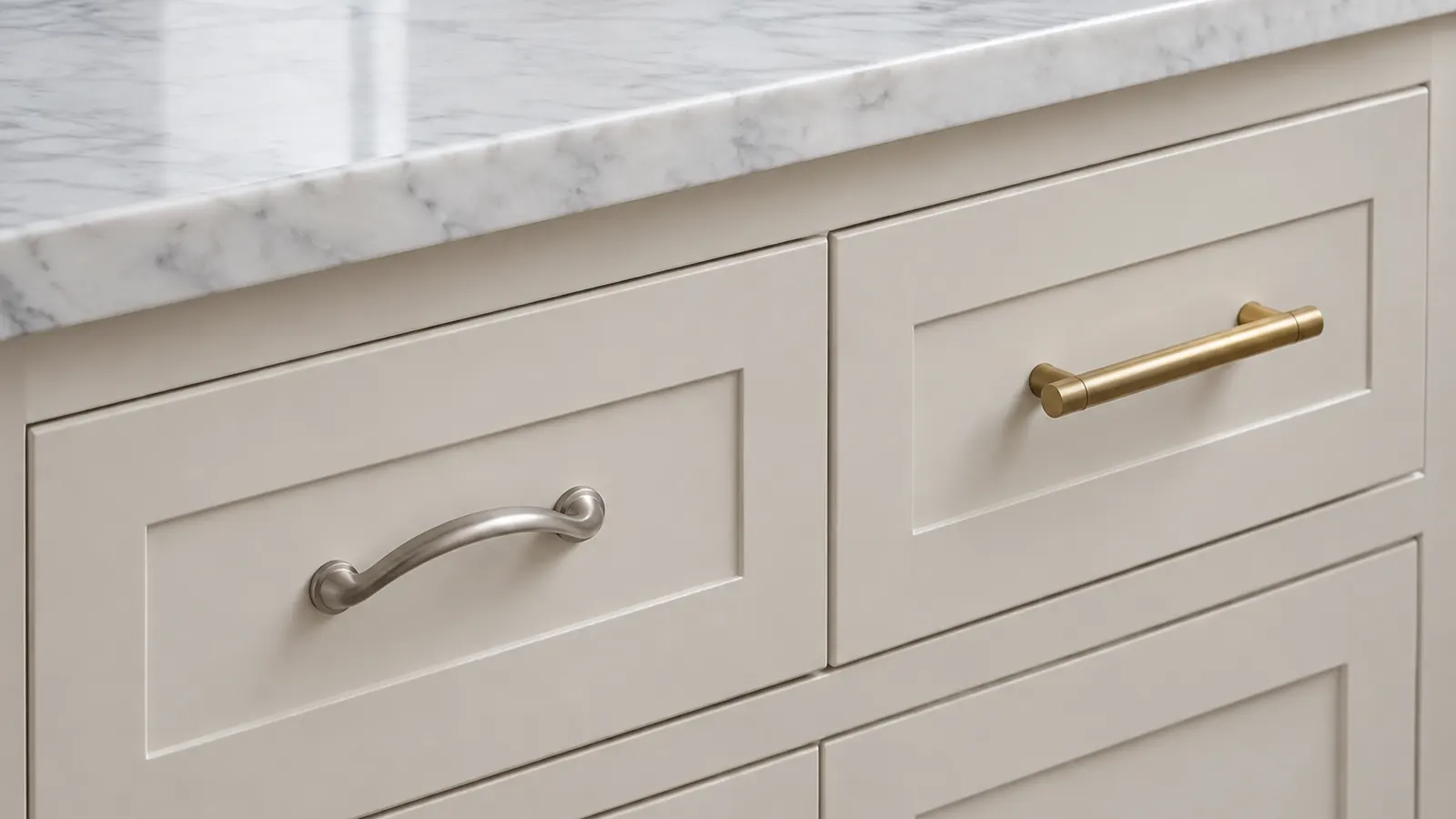
Swapping hardware on existing cabinets is the cheapest change in a kitchen, and it is cheap only while the old holes are usable. A new pull with the same center-to-center distance drops onto the existing holes and the job is an afternoon. A different center to center means new holes, and the old ones have to be plugged, filled and touched up, which on a painted custom front means a finish repair rather than a dab of paint.
So the first measurement in a hardware swap is the distance between the two screws already in the front. If that number can be kept, keep it, and spend the freedom on shape and finish instead. If it cannot, count the fronts and price the refinishing before the hardware.
Either way, buy one piece first and live with it on a door for a day. Hardware is the only part of a kitchen that a hand touches every single day, and weight, edge and temperature are things a photograph cannot tell you.

The New Tile Revolution: Innovative Materials Changing the Game
The tile industry is undergoing a true renaissance, transforming tiles from simple functional surfac
Veneer, Laminate or Wood: Cabinet Refacing Materials Compared
When you reface cabinets, you keep the boxes and replace the doors, drawer fronts, and trim. The sur

Texture Talk: Adding Depth and Warmth to Your Interiors
Color gets all the credit. Furniture gets all the attention. But texture is what makes a room feel a