
Can You Put a Washer and Dryer in a NYC Co-op or Condo?
Few things change daily life in a Manhattan apartment as much as a washer and dryer of your own. No more carrying bags to the basement on a Sunday, no more waiting for a free machine or a trip to the laundromat. It is also one of the most common things owners ask about before a renovation, and the honest answer is: often yes, but the building decides first.
In a co-op or condo, the first question is not what fits in the closet. It is what your building allows, and on what conditions. Here is how to find that out, what boards usually ask for, how to choose a dryer when there is no way to vent to the outside, what the job costs, and what to check when you buy an apartment that already has machines in it.
Your building answers first
Almost every co-op proprietary lease gives the board the right to review a shareholder’s plan to install a washing machine or a dryer. Condos set their rules in the bylaws and house rules. What the rules say varies a lot from building to building. Some buildings ban in-unit machines outright. Some decide case by case. Others allow them as long as the installation meets a list of conditions.
The quickest way to find out where your building stands is to ask the managing agent for the house rules and the alteration agreement, the contract you sign with the building before any work starts. If you are still buying, your attorney can check the house rules and the minutes of recent board meetings, where a washer policy, or a fight over one, usually shows up.
Boards that say no usually have one of four reasons:
- Old drain lines. In older buildings the waste pipes can be narrow or lined with decades of sediment. Soapy water from many machines can back up into the apartments below.
- Leaks. A washer that overflows floods the apartment underneath, and water that comes through a neighbor’s bedroom ceiling does more damage than water that lands in their bathroom.
- The laundry room. Many buildings have a basement laundry room that brings in income, sometimes under a contract with a laundry company that expects a certain amount of use.
- Noise. A spin cycle carries through floors and walls.
A “no” is not always permanent. Museum Tower, a 52-story condo above the Museum of Modern Art, banned new washers in 1994 after soapy water from the first few dozen machines backed up and bubbled into toilets, sinks and tubs on lower floors. Years later, when low-water washers came on the market, the board had its engineer check the pipes, let seven or eight residents try machines as a test, and then lifted the ban with conditions. If your building says no, it is worth asking whether the board would look at the question again, especially if other owners want the same thing.
What a board usually asks for
Buildings that allow machines protect themselves against the same risks they worry about. The conditions differ, but the same items come up again and again:
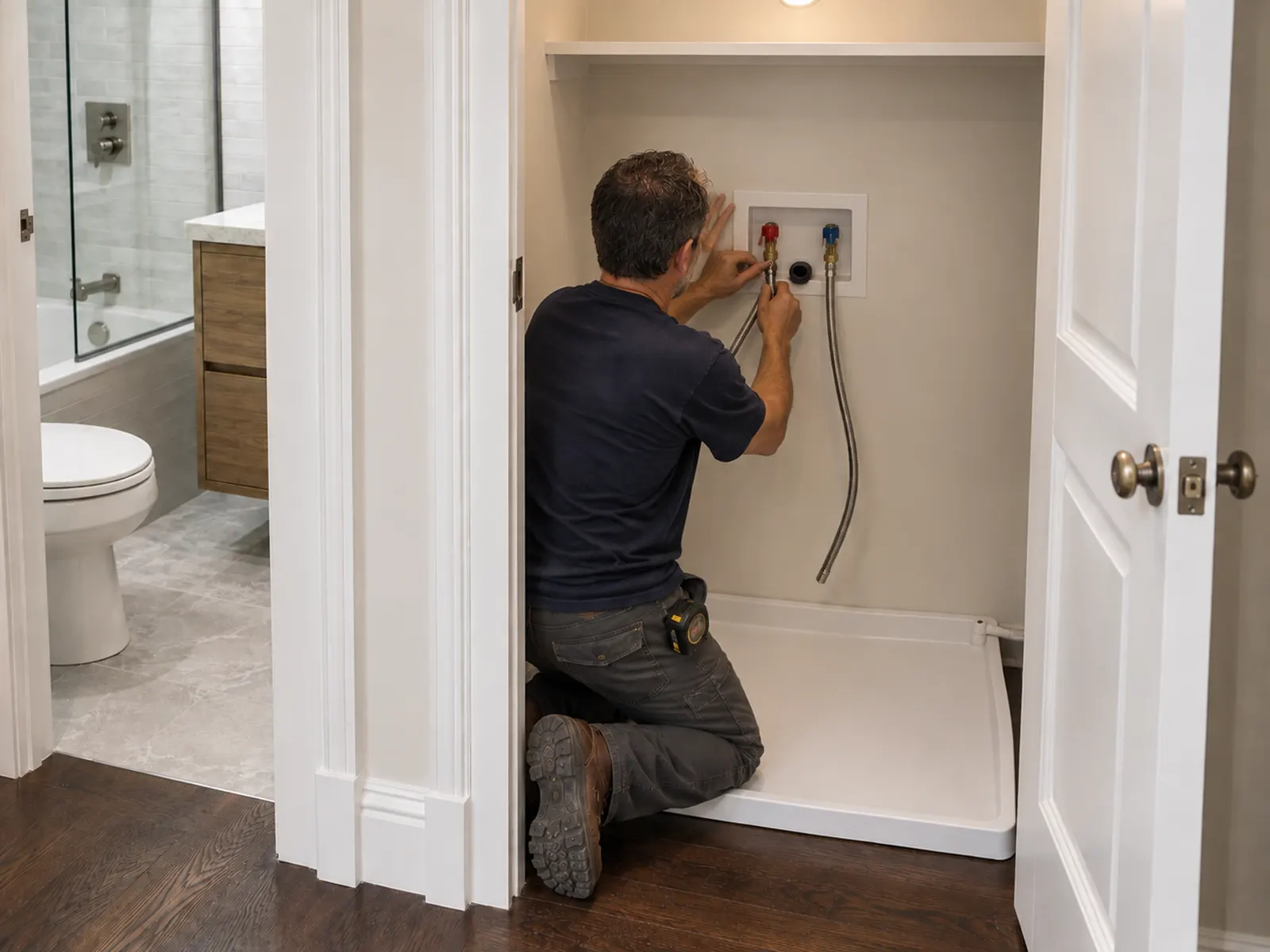
- a drain pan under the washer with a leak sensor that shuts off the water automatically when it gets wet;
- braided stainless steel water hoses in place of rubber ones, which crack with age;
- a high-efficiency washer that uses little water and little soap, sometimes from a list of approved models;
- in some buildings, a waterproof layer under the finished floor that turns up the walls about 6 inches, so a leak stays in the laundry space;
- rubber pads under the machines, or a sound-deadening layer under a new floor, to keep the vibration away from the neighbors;
- installation by licensed tradespeople.
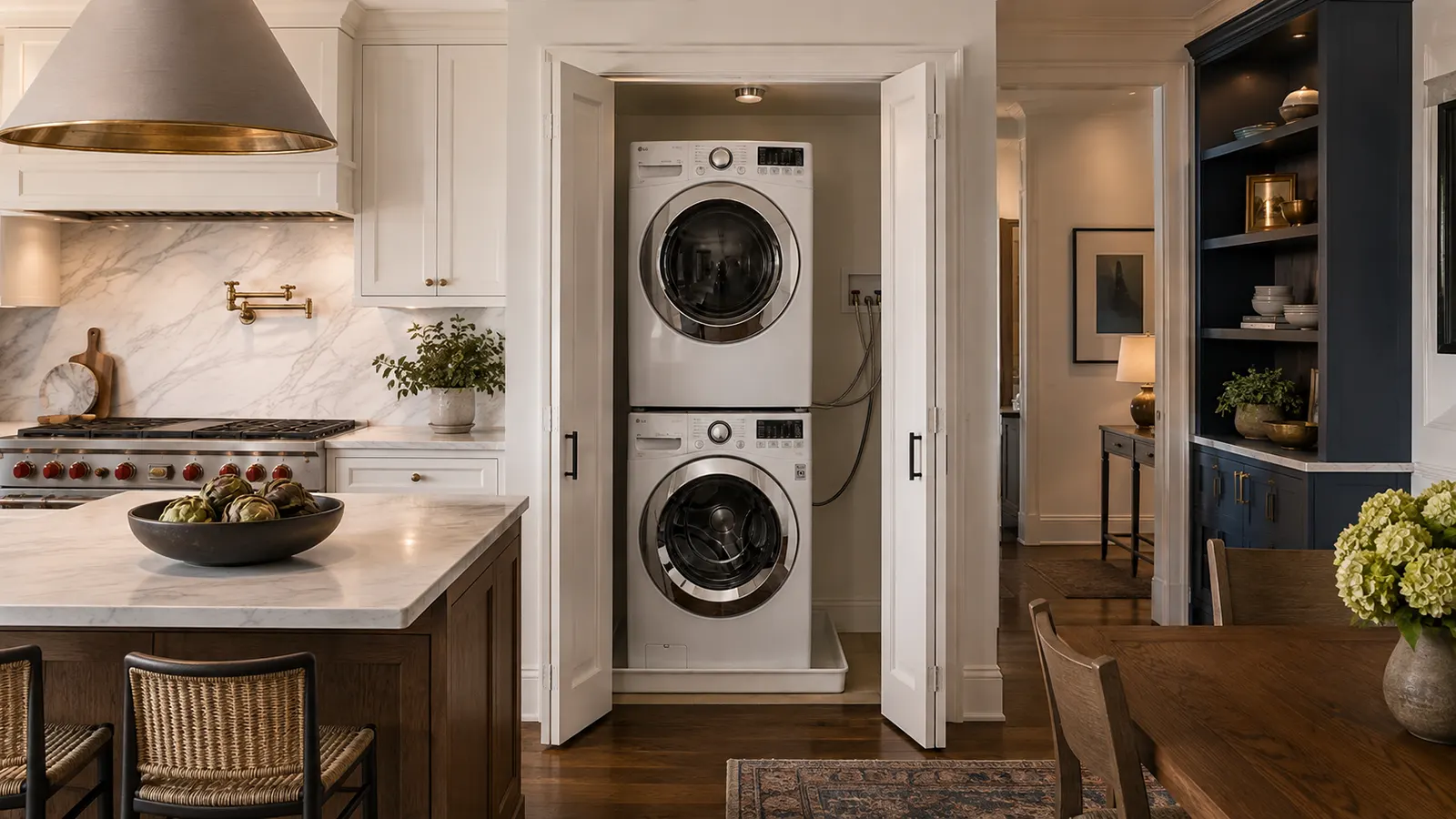
Where the machines go matters just as much. Most buildings follow a “wet over dry” rule: a room with water in it cannot sit above a bedroom or living room in the apartment below. In practice this puts the washer in or next to a kitchen or bathroom, close to the building’s water and drain pipes. A closet beside the bathroom is a common spot. Another is a second bathroom, where the tub is replaced with a shower and the space it frees up takes a stacked pair of machines. If your building’s apartments are stacked the same way floor after floor, it is easy to see what sits under a given closet. If you or the owners below have changed the layout, ask the managing agent before you plan anything.
The approval itself follows the building’s usual alteration process, the same one described in our guide to co-op and condo board approvals in NYC. For a laundry closet, the board will want to see the location, the make and model of each machine, and how the plumbing and wiring will reach it.
The plumbing and the permit
A washer needs a hot and a cold water supply and a drain. Adding one to an apartment in New York City is plumbing work that the Department of Buildings expects a licensed master plumber to do and to file. For a residential washing machine, it is filed as a limited plumbing alteration, and the permit is issued to the plumber, not to you.
The dryer depends on what powers it. A full-size electric dryer usually needs its own 240-volt circuit, which can be hard to add in an older building where the apartment’s electrical service is already stretched. Some compact dryers and some heat pump dryers run on an ordinary 120-volt outlet, which makes them much easier to fit. Gas dryers are the hardest: they need a legal gas line and proper venting, and many buildings will not approve new gas piping in an apartment at all.
None of this is unusual work. But it is plumbing and electrical work, which is why the job goes through the building and through a licensed plumber and electrician. The paperwork you get at the end is also what protects you later, when you sell the apartment.
Choosing a dryer when there is no way to vent outside
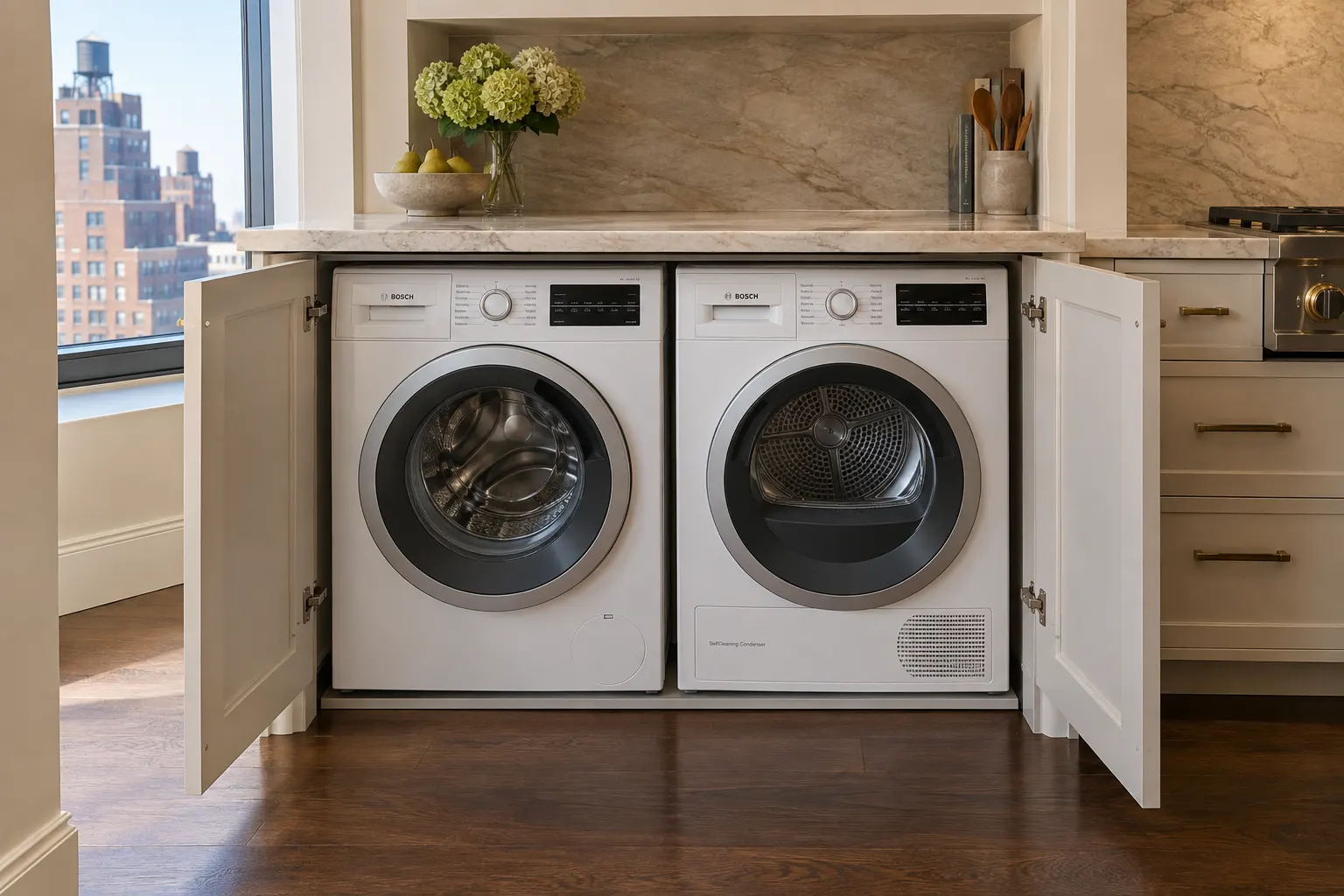
A regular dryer blows hot, damp air out through a duct, and New York City’s mechanical code requires that duct to end outside the building. In most Manhattan apartments there is simply no route for it: the only exterior wall is the facade, and many buildings do not allow new openings in it. The same code makes an exception for condensing, or ductless, electric dryers that a testing lab has certified for that use, and that is why ventless dryers are the usual choice in apartments.
There are two kinds. A condenser dryer cools the damp air inside the machine and turns the moisture into water. A heat pump dryer does the same thing more efficiently, reusing its own heat; the New York State Energy Research and Development Authority says a heat pump dryer uses about 30 percent less energy than a conventional one. With both, the water either runs into a drain or collects in a container that you empty every few loads, so it helps to plan the dryer next to the washer’s drain.
There are also all-in-one machines that wash and dry in the same drum. They need the least space, but drying takes much longer than in a separate dryer, and they suit smaller loads. If you have room for two machines, stacked or side by side, a separate washer and dryer is usually the more comfortable choice for a family.
New York State also helps with the cost of a heat pump dryer. Through its Appliance Upgrade Program, NYSERDA offers rebates of up to $840 on the dryer and separate help with wiring and panel upgrades, depending on household size and income.
What it costs
The machines are the predictable part. BrickUnderground’s 2025 survey of prices puts a stacked washer and dryer from brands like Electrolux at about $2,100 to $2,800 for the pair, and an all-in-one combo at roughly $1,600 to $3,300. Compact European machines from Bosch or Miele run about $1,250 to $2,500 each.
The installation is where the budget moves. By the same estimate, adding a stacked pair to a closet can reach about $7,000 once new water, drain and electrical lines are run to it. Putting the machines where those lines already are, in a kitchen or bathroom, brings that number down. On top of the work, count the building’s own costs: the alteration agreement usually comes with a processing fee and a refundable deposit, and the amounts are set by each building.
Buying an apartment that already has one
A washer in the listing photos does not always mean a washer the building has approved. Before you sign, ask for proof that the installation was approved, and have your attorney put that promise into the contract of sale. What the seller’s broker says has little legal weight; what the contract says does.
Buildings that ban machines often “grandfather” the ones already installed. That protection usually covers the existing machine, not a new one. In a Westchester co-op that banned washers in 2014, a shareholder kept her old machine for years without trouble. When it broke, she installed a new one without asking, it caused a flood, and she refused to remove it. The court sided with the board and upheld the termination of her proprietary lease. If a grandfathered machine needs replacing, ask the building first.
Start with the house rules
The work itself is the easy part: a licensed plumber, the right dryer, a drain pan and a shut-off valve. The part that decides everything is the building’s paperwork. Get the house rules and the alteration agreement before you choose a closet or a model. Once you know what your building allows and asks for, the rest of the laundry closet is a normal, well-understood job.

DIY or Hire a Pro? A Guide to Making Smart Renovation Decisions
The appeal of DIY renovation is real. There’s something genuinely satisfying about improving y

ALT-1 vs ALT-2 Filings in NYC: What Actually Applies to Your Apartment?
Most apartment owners planning a renovation in New York City fall into one of two camps. The first g
What You’re NOT Allowed to Change in a NYC Apartment
Buying an apartment in New York City is one of the most significant financial decisions a person mak