
Will Your Sofa Fit Through the Door?
The sofa you want is 86 inches long and 38 inches deep. Your apartment door is a standard 32-inch door. The showroom salesperson says it will be fine, the delivery company says they will try, and both of them are telling you the truth as they know it. Whether it goes in depends on one measurement of the sofa, its diagonal depth, which is often missing from the spec sheet and which nobody at the store took.
What follows is the measurement that actually decides it, why the door is narrower than the number on it, where a delivery really fails in a pre-war building, and what your options are if the answer comes back no.
The number nobody measures
A sofa does not go through a door lying flat. It gets stood on one end and pivoted, which means the dimension that has to clear the opening is not the length and not the depth. It is the diagonal depth: the distance from the back of the frame, at the bottom, to the highest point at the front of the arm.
Measuring it takes two minutes and a straight edge. Look at the sofa from the side and lay a yardstick or a broom handle across it, from the top of the back to the front edge of the arm. Then measure from the bottom back corner of the frame straight out to the stick: that is the narrowest the sofa gets when it is tipped on its back to go through a door. On a sofa with a low slim arm, that diagonal is often 4 or 5 inches less than the stated depth, which is the difference between a yes and a no. On a deep sofa with a rolled back and a wide arm, it can be as much as the depth or more.
This is the number to ask the retailer for before you buy. Some retailers print it on the spec sheet next to the width and the depth; many do not. If the store cannot give it to you, measure the piece in the showroom yourself.
Your 32-inch door is not 32 inches
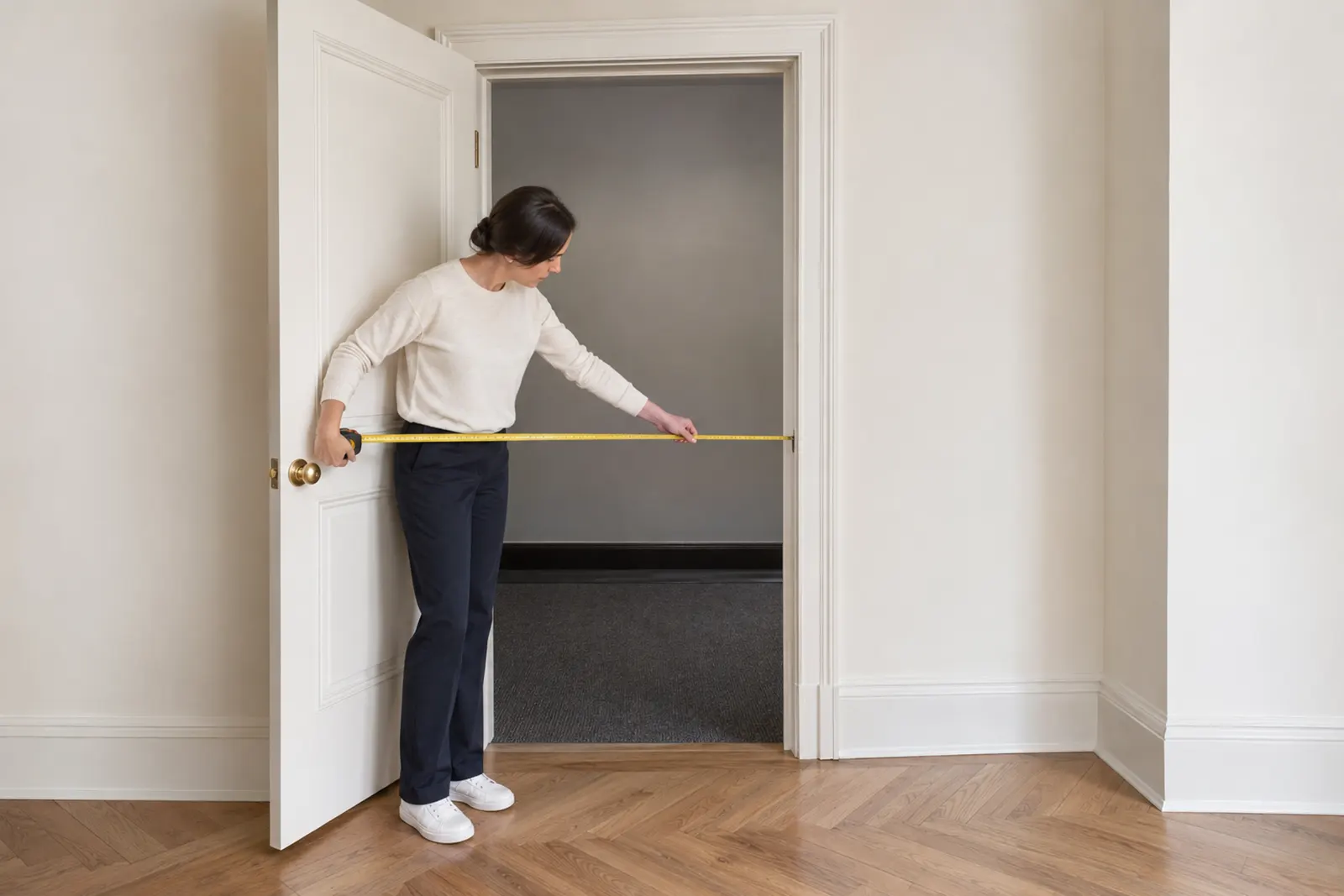
A door’s listed width is the width of the door itself. The opening you carry furniture through is narrower. A 32-inch door hangs in a frame, and the frame has a stop on each side, a thin strip of wood the door closes against. Once the stops are in place, the clear opening of a 32-inch door is usually around 30 inches, and on an older door with layers of paint, it can be less.
The door also has to get out of the way, and in a pre-war apartment it often cannot. If a wall or a radiator stops it at a right angle, the door can’t swing back flat against the wall, so it sits partly inside the opening, and its thickness, roughly an inch and a half, comes off the width you have left. The knob and the lock stick out from it and catch on fabric as the sofa goes past.
So measure the opening, not the door: tape from the face of one stop to the face of the other, with the door standing fully open. Then compare that width with the sofa’s diagonal depth, and give yourself 2 to 3 inches of margin. Movers need room for their hands and for the piece to tilt, and a sofa that fits with no room to spare usually does not fit on delivery day.
Where it really goes wrong is the turn
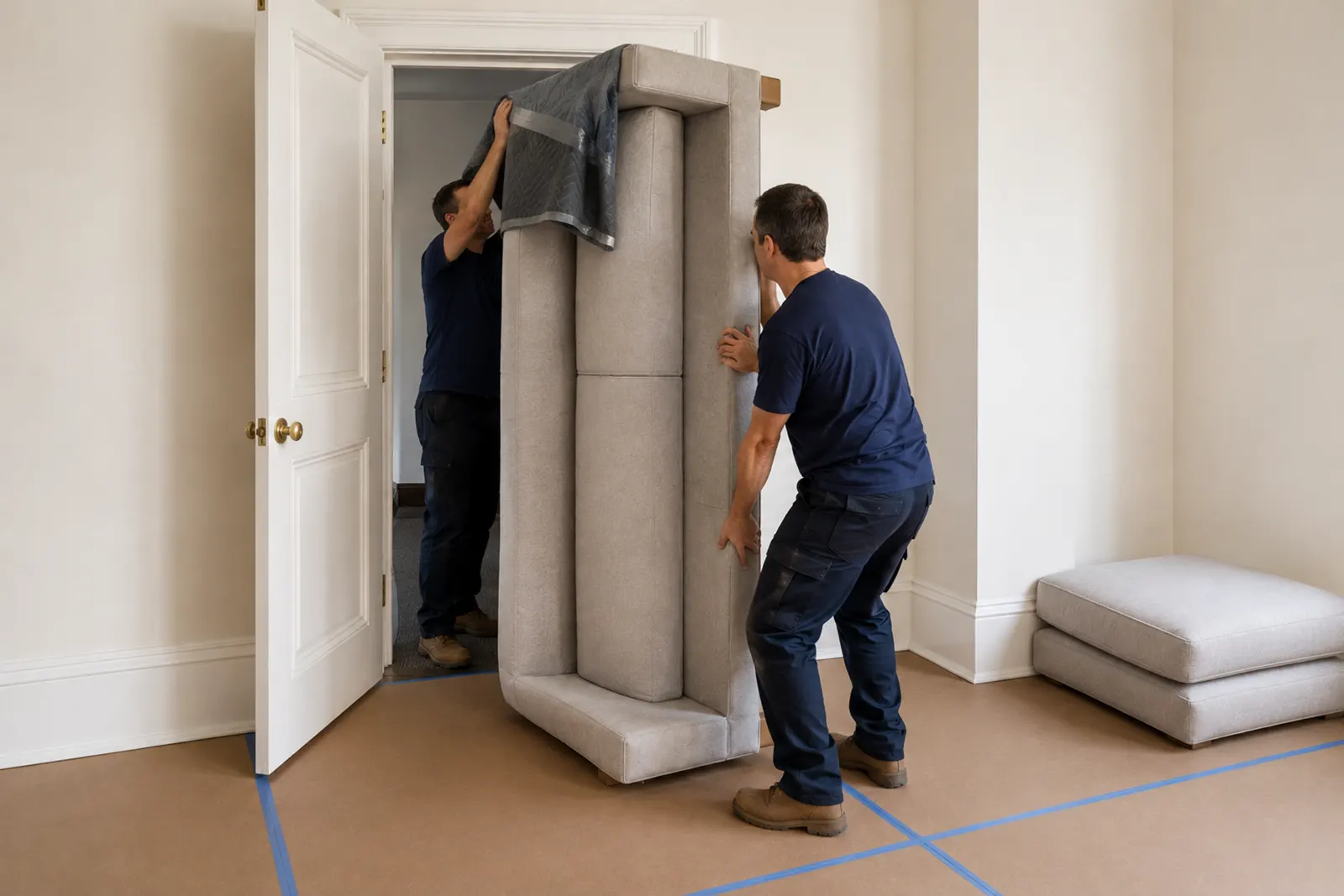
Owners picture the delivery failing at the door. In a pre-war building it usually fails a few feet earlier, at a corner, and for a reason that has nothing to do with width.
To pivot a long piece around a corner you need run-off space: the distance from the corner to the wall behind you. A corridor can be a comfortable 4 feet wide and still defeat an 86-inch sofa if that corridor ends in a right-angle turn with a wall 3 feet opposite. The sofa has nowhere to swing. The same thing happens at an elevator landing, where the car door is wide enough but the lobby in front of it is not deep enough to line the piece up.
So walk the route with the tape out, from the building entrance to the room the sofa is going in, and write the numbers down in order: the entrance door, the elevator car in all three dimensions, height included, the width of every corridor, the distance across every turn, the apartment door, and the doorway of the room itself. Your worst number is your answer, and it is rarely the one you expected. We went through the same walk for construction material in what fits in the elevator decides the kitchen.
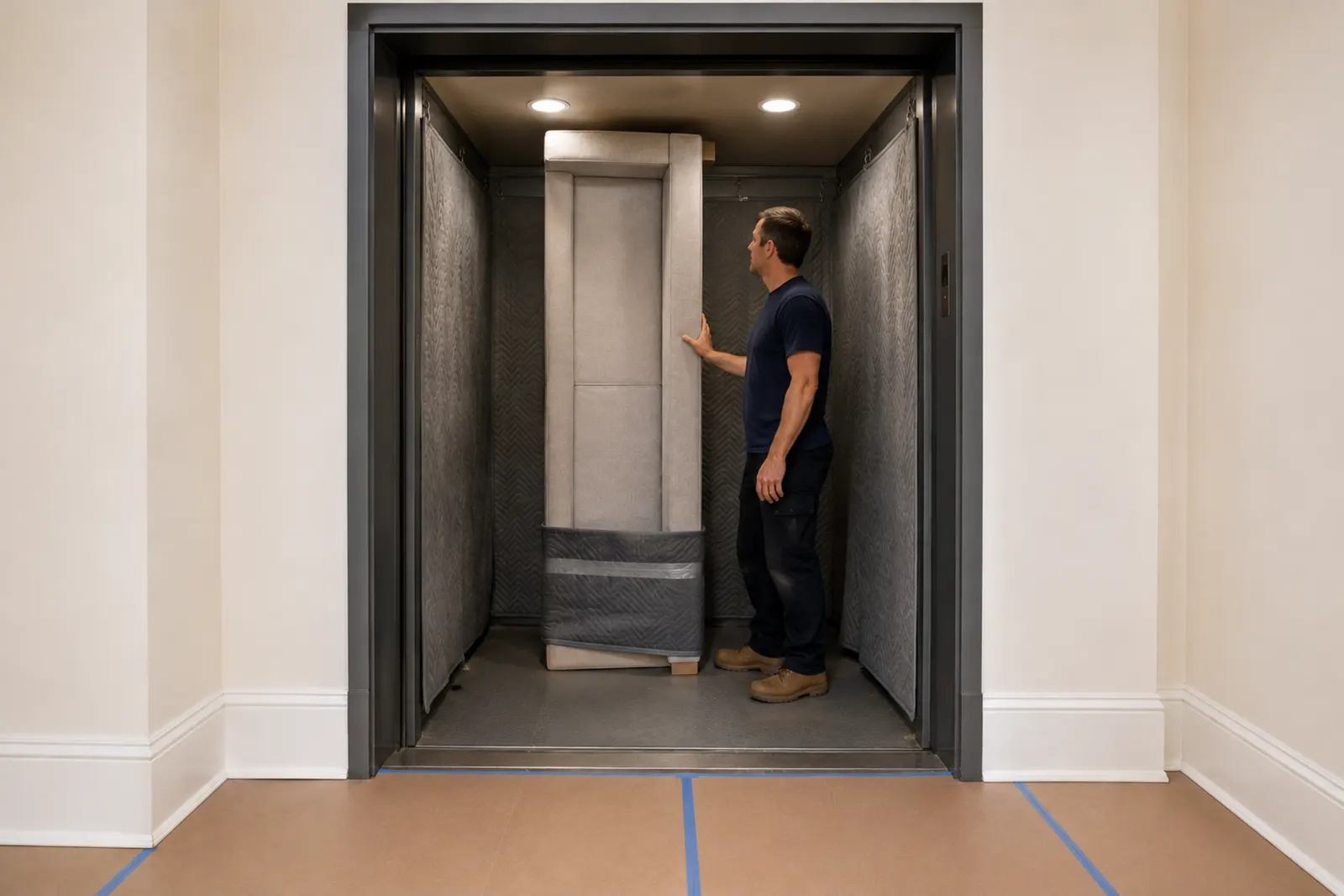
Two building-specific things belong on that list. In a walk-up, the stair is the route, and what stops a delivery there is almost never the flight; it is the landing where the stair turns back on itself, with a handrail narrowing it and a low ceiling over your head. And in a building with a service elevator, the car you measure has to be the one the delivery will actually use, because the freight car and the passenger car are rarely the same size.
If the answer is no
There are four honest ways out, in the order most owners should consider them.
- Take the legs off. Most sofa legs unbolt in a few minutes and buy you 3 to 6 inches. This is the first thing a good delivery crew does and the cheapest fix there is.
- Buy a piece that comes apart. A sectional arrives in sections. A knock-down sofa arrives as a frame, a back and arms, and is bolted together in the room. In a building with a tight stair this is not a compromise; it is the normal choice.
- Buy a smaller piece. Two chairs and a loveseat often live better in a pre-war living room than one long sofa anyway, and they certainly travel better.
- Hoist it through a window. This is real and fairly common in Manhattan, but it is licensed, permitted work with the building’s approval behind it, not a favor from a moving company. For a sofa it is almost never worth what it costs.
What is not on the list is taking the door off its hinges and hoping. Removing a door leaf gains you about an inch and a half of clear width, and it does nothing at all about the turn in the corridor, which is where the piece was going to stop anyway.
Settle it before you pay
Measuring the sofa and the whole route takes about half an hour and costs nothing. Get the diagonal depth from the retailer, walk the route with your list of numbers, and bring that list to the showroom.
Then ask the store one more question before the sale: what happens if it does not fit. Some delivery contracts treat a refused delivery as a return with a restocking fee, and the return trip back down the stairs is not free either. That answer, in writing, is worth more than the salesperson’s confidence.

Bathroom Clearances: The Legal Minimum and What Works
Bathroom dimensions are one of the few parts of a renovation where the code gives you hard numbers r

Can You Live in Your Apartment During a Renovation?
Almost every owner asks this before the contract is signed: can we just stay in the apartment while
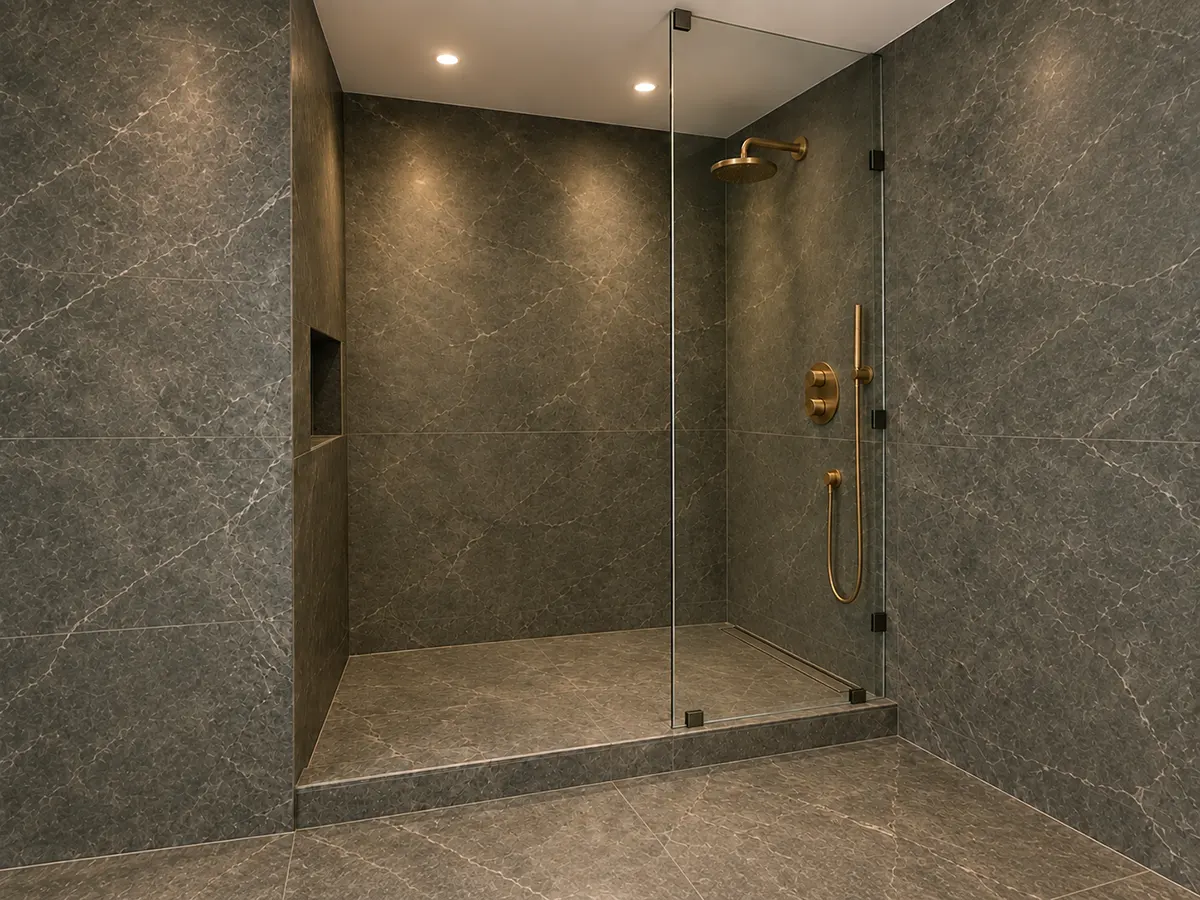
The Quarter Inch That Decides Whether Your Shower Has a Curb
On the drawings a new bathroom usually looks like this: one stone floor runs from the vanity straigh