
Why the Hood Over Your Range Does Nothing
Fish on Thursday, and on Friday morning the hallway still knows about it. The film on the cabinet doors beside the range comes back a week after it is wiped off. Meanwhile the hood cost more than the dishwasher, its spec sheet promised a number nobody could argue with, and on high it sounds like a small aircraft.
In almost every case the hood works exactly as it was built to. It was chosen by its number and installed into conditions nobody checked. Kitchen ventilation fails in four places, and only one of them is the appliance.
A hood works by catching the plume
The mental model most people carry is a vacuum cleaner: more power, more removed. That is not how it works. A cooking plume rises on its own, in a column that spreads as it goes up. The hood is a container held over that column. If the plume is inside the container, a modest fan takes it away. If the plume spreads past the edges before it reaches the hood, no amount of fan brings it back, because by then the smoke is in the room and moving sideways.
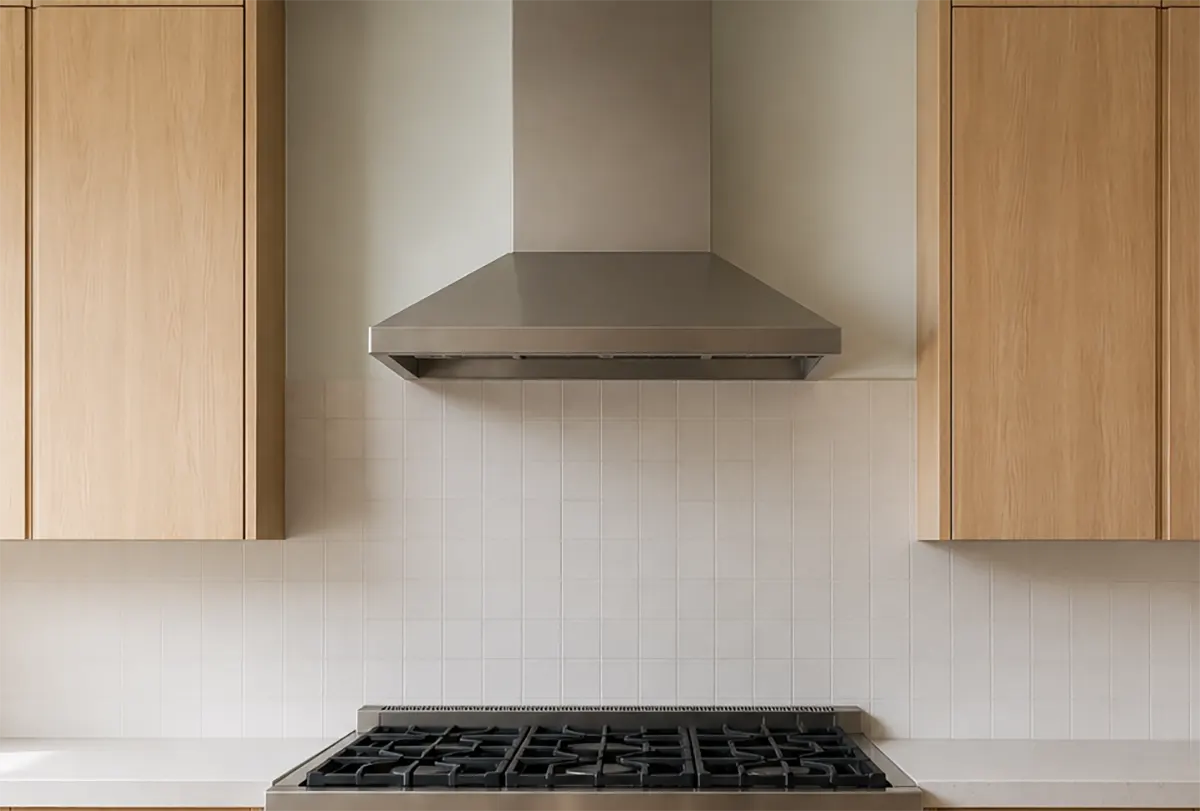
Which is why two boring things decide more than the fan does: how much of the cooking surface the hood covers, and how high it hangs. Coverage starts with width. The hood should be wider than the cooking surface, by about 3 inches on each side, so the plume is still inside it when it arrives. And it should hang at the height the manufacturer specifies, which depends on the type of hood: roughly 24 to 30 inches above the cooking surface for a standard chimney hood, and 30 to 36 inches for a pro-style hood over a pro range. Take the number from the installation guide for the exact model, not from the neighbor’s kitchen. Mounted higher for headroom, and the plume has room to spread. Mounted lower than the installation guide allows, and the listing no longer covers it: those clearances are the ones the appliance was tested with, and they come out of the manufacturer’s own testing. Take both the floor and the ceiling from that guide.
A hood the same width as the range, or narrower, is the single most common installation in a small kitchen, because it is what fits between the cabinets. It also lets the plume spread out past both sides before it ever reaches the filters. Depth is the other half of coverage, and it is the half that decides the front burners: a shallow hood that stops short of them leaves that half of the cooking surface uncovered, so what rises off the front pans goes into the room.
Where the air goes
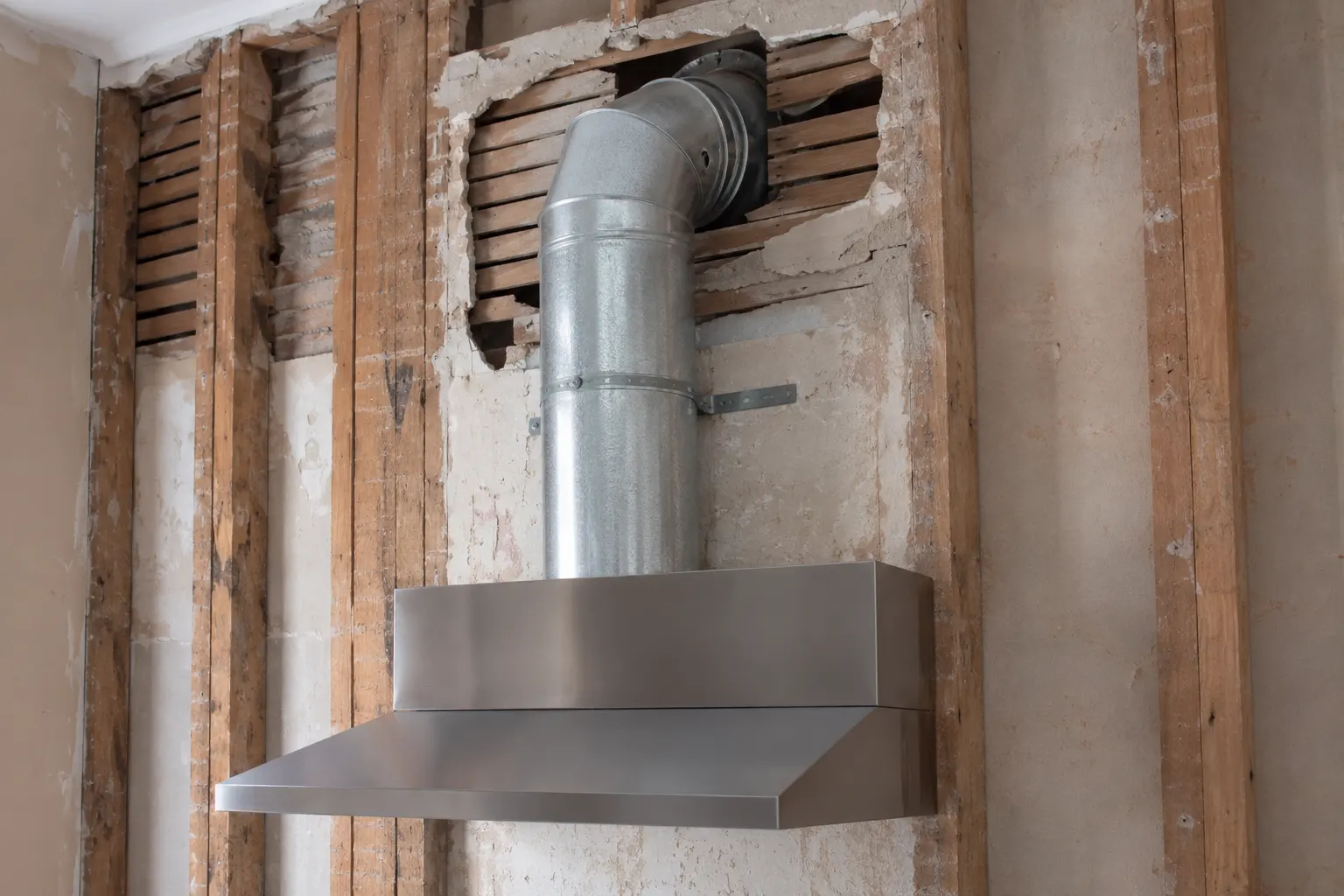
There are two kinds of hood, and they do different jobs. A ducted hood sends the air outside. A recirculating hood pulls the air through a grease filter and a charcoal filter and returns it to the room.
In New York City a ductless hood is allowed on conditions. The city lets a listed and labeled domestic ductless hood skip discharging outdoors only where it is installed to the manufacturer’s instructions and the room has mechanical or natural ventilation provided in its own right. The code treats recirculation as the fallback, and those conditions are what it attaches to the fallback.
Recirculation removes some grease and some smell. It cannot remove heat, it cannot remove water vapor, and it cannot remove combustion products from a gas burner, because all of those come back out of the front of the appliance with the air. A recirculating hood in a kitchen where somebody boils, fries and roasts is a filter with a fan behind it, and its charcoal cartridge stops working long before anyone thinks to change it.
Everyone would rather duct. In a Manhattan apartment that is where the trouble starts. Punching a new hole through the facade is a change to the exterior of the building, and in most co-ops and condos that is not the owner’s decision at all: it goes to the board, and in a landmarked building it goes further than that. An existing shaft is not a connection point you can assume either. The riser that happens to run past the kitchen wall is usually serving something else, a bathroom stack or a dryer line, and that riser is out of the question before anyone is asked. The city mechanical code requires a domestic range hood to discharge to the outdoors through metal duct with smooth inner walls, air tight, fitted with a backdraft damper, and independent of all other exhaust systems. No engineer and no board can sign off on sharing a bathroom or dryer shaft, because the code does not leave that available to sign off on. What the board and the building’s own engineer actually decide is narrower: whether a dedicated route to the outdoors exists at all, and whether you may use it. New ductwork and a new opening in the facade are filed work as well, so the chain runs through DOB: in a multiple dwelling the owner retains a Registered Design Professional to file the plans, and the work is carried out by a contractor holding DOB General Contractor Registration, which is a separate credential from the Home Improvement Contractor license that covers work in private homes rather than apartment buildings and multiple dwellings. A contractor can hold a valid HIC and still have no standing to pull a permit in your building. The DOB filing comes after the building’s own approval. What the building already has is what you get, and finding out which of those situations you are in belongs at the start of a kitchen project.
This is the single biggest difference between planning a kitchen in a house and in an apartment. In a house the duct route is an engineering question. Here it is a permission question, and the answer can make an expensive ducted hood impossible after it has already been ordered.
The duct undoes the fan
Assume the route exists. The number on the box was measured with the blower running against almost nothing. Everything you attach to it takes some of that number away.
Two rules carry most of the outcome. Never reduce the duct below the size on the hood’s own spec plate: a single reducer turns the whole run into that smaller size, permanently. And count the turns. Every fitting is priced in the manufacturer’s equivalent-length table as so many feet of straight duct, and the penalty for a single 90 degree turn runs from a few feet to well over 10 feet depending on the fitting and who published the table. There is no universal number, which is exactly why the run gets added up against the table for the hood you are buying. A route with several turns and a long horizontal leg can consume more than half of what the fan was rated to deliver, and nobody measures it afterward.
Oversizing fails differently and more slowly. Air in an oversized duct moves too slowly to keep grease particles suspended, so instead of leaving the building the grease settles on the inside of the duct. That is a maintenance problem for a few years and a fire risk after that.
So the duct has to be designed before the hood is bought. The route, the size and the number of turns decide which hoods are worth considering. Doing it the other way around is how a 1,200 CFM appliance ends up moving less air than a modest one on a straight run.
Air taken out has to come back in
A fan that throws air out of an apartment does not create a void. The same volume comes back in, through whatever gaps exist, and that much is physics: it works the same in Manhattan, in Chicago and in a farmhouse. In an older, leaky building the air arrives through window frames and around the entry door, and nobody notices. In a tight modern apartment, or an old one that has been carefully sealed during renovation, there are no easy gaps, so the air comes back down whatever else is open: a bathroom exhaust, a dryer vent, sometimes a chimney or a gas appliance flue. That last path is what makes this a safety subject.
The 400 CFM threshold is gone in the city. It stood in the 2014 edition, and the 2022 NYC Mechanical Code dropped it: makeup air is required for domestic kitchen exhaust regardless of the fan size, the supply has to be able to close, and it has to start automatically with the hood.
Practically, that turns a hood into a system, and the number the supply side has to hit is not the small one people quote. The city’s ventilation table puts a dwelling unit kitchen at 25 CFM continuous or 100 CFM intermittent, which is the minimum ventilation rate for the room itself; what the hood throws out is counted separately. The same table carries a footnote for dwelling units in R-2 buildings, which is what an apartment house is: once the sum of the exhaust rates in the unit is designed to go past 75 CFM, outdoor ventilation air has to be supplied by mechanical means, and that supply has to be approximately equal to what is being exhausted, never less than the table rate. A 1,200 CFM hood therefore carries a supply duty of roughly 1,200 CFM, and that is precisely why a large blower is expensive to feed. What is left as a design decision is where outdoors that supply is taken from, and how it is tempered before it reaches the room: the intake needs an opening the building will allow, and January air arriving at that opening is January air. Moving air between rooms of the same apartment replaces nothing, because the fan is discharging past the envelope, not into the hallway. It is also the reason a bigger fan is not free: every extra cubic foot per minute you throw out is one the apartment has to take back in, warm or cool, and find a path for.
Bigger is not the fix
Appliance sellers size hoods by burner output, usually about 100 CFM for every 10,000 BTU, which for a serious gas range arrives at four figures very quickly. It is a tidy formula and it sells large blowers.
The geometry points somewhere else. A fan can only move air that has already arrived under the hood, so airflow does nothing about a plume that left sideways 2 feet earlier. A hood shaped and positioned to cover the burners does the job at a fraction of the airflow those formulas produce, because it is holding the plume rather than chasing it. The variable that matters is capture: whether the hood covers the burners and hangs at the right height, whether the back burners get used for the smelly work, whether the fan gets switched on before the pan gets hot rather than after the smoke alarm.
A very large blower in an apartment brings problems of its own. It is loud enough that people stop using it, it takes more makeup air than the building can comfortably supply, and it can pull hard enough to disturb other exhausts in the same apartment. The kitchen that never smells is the one where the hood covers the pans, the duct is short and straight, and the fan gets turned on early.
How to get this right in the order it actually happens
Ask the building first. Whether a new opening in the facade is possible, and whether anything existing can take kitchen exhaust, decides whether ducting is on the table at all. That answer comes from the managing agent and the building’s engineer, it lives in the alteration agreement, and no city rule sets it. Expect weeks. Work of this kind is also filed work, so a licensed contractor and a design professional get involved on their own schedule. None of that is a formality you can run in parallel with buying appliances.
Then draw the duct. Shortest route, fewest turns, size taken from the hood you are actually considering, and the makeup air path drawn alongside it, because the code here treats them as one system.
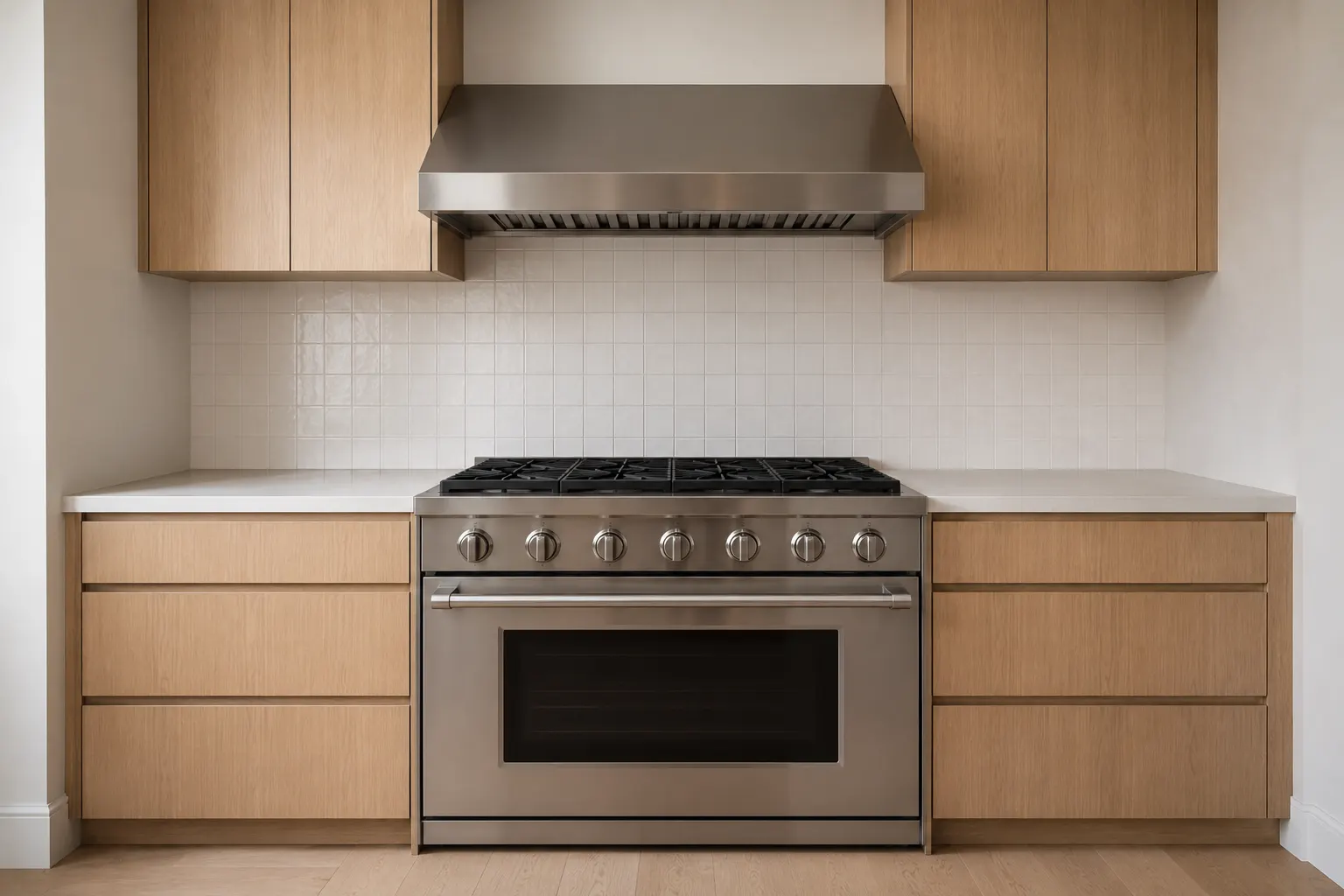
Then choose the hood, and choose it by coverage before airflow: wide enough to overhang the cooking surface, deep enough to sit over the front burners, mounted within the range the manufacturer specifies.
And if the honest answer is that nothing can be ducted, then plan around a recirculating hood instead of pretending: a bigger grease filter, charcoal cartridges changed on a schedule, cooking habits that keep the worst of it on the back burners, and a window that opens. The window is part of the condition the code sets: the exception lets a hood skip discharging to the outdoors only when it is a listed and labeled ductless model installed to the manufacturer’s instructions and the space still gets mechanical or natural ventilation of its own. The kitchen that cannot be ducted is exactly the one that has to show where that ventilation comes from. It is a compromise, and it goes bad when it is discovered after the cabinets are in.
If the hood is already in
Most people read this with a hood already on the wall, which changes the question from what to buy to what is still moveable. More of it is moveable than owners assume, and none of the moveable parts are the expensive ones.
Height is the cheapest fix in the kitchen: a hood hung above the manufacturer’s range comes down in an afternoon, and the plume loses the room it was using to spread. Filters are next, and baffle filters wash in a dishwasher while mesh ones rarely recover. Charcoal has a service life measured in months of cooking, and almost nobody meets it. Habits do the rest, the back burners for anything with a smell, the fan on before the pan is hot and left running 10 minutes after.
What does not move is the duct and the hole in the wall. Widening a hood usually means new cabinets around it, and a new route to the outdoors means the board, the filing and the money. That is the line worth knowing before anybody starts pricing a replacement: everything on the near side of it is a Saturday, and everything on the far side is a project.
Tub to Walk-In Shower: What the Conversion Involves
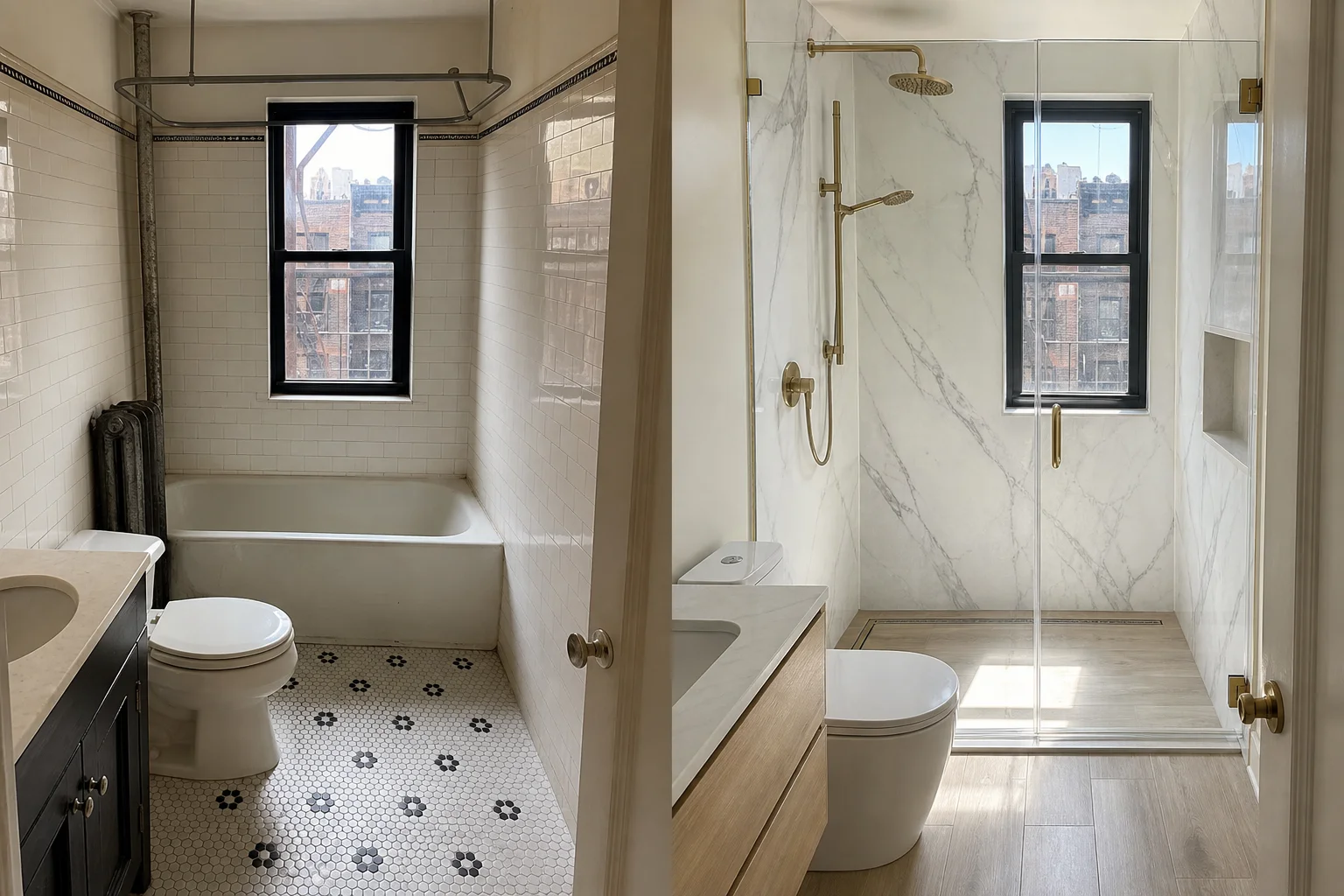
Converting a tub to a walk-in shower is one of the most common bathroom remodels: it frees floor are

Design Decisions That Help Apartments Sell Faster
Selling an apartment quickly and at a premium is rarely accidental. In competitive urban markets suc

Bathroom Clearances: The Legal Minimum and What Works
Bathroom dimensions are one of the few parts of a renovation where the code gives you hard numbers r