

One Renovation, Two Perspectives: How Designers and Builders See the Same Space Differently.
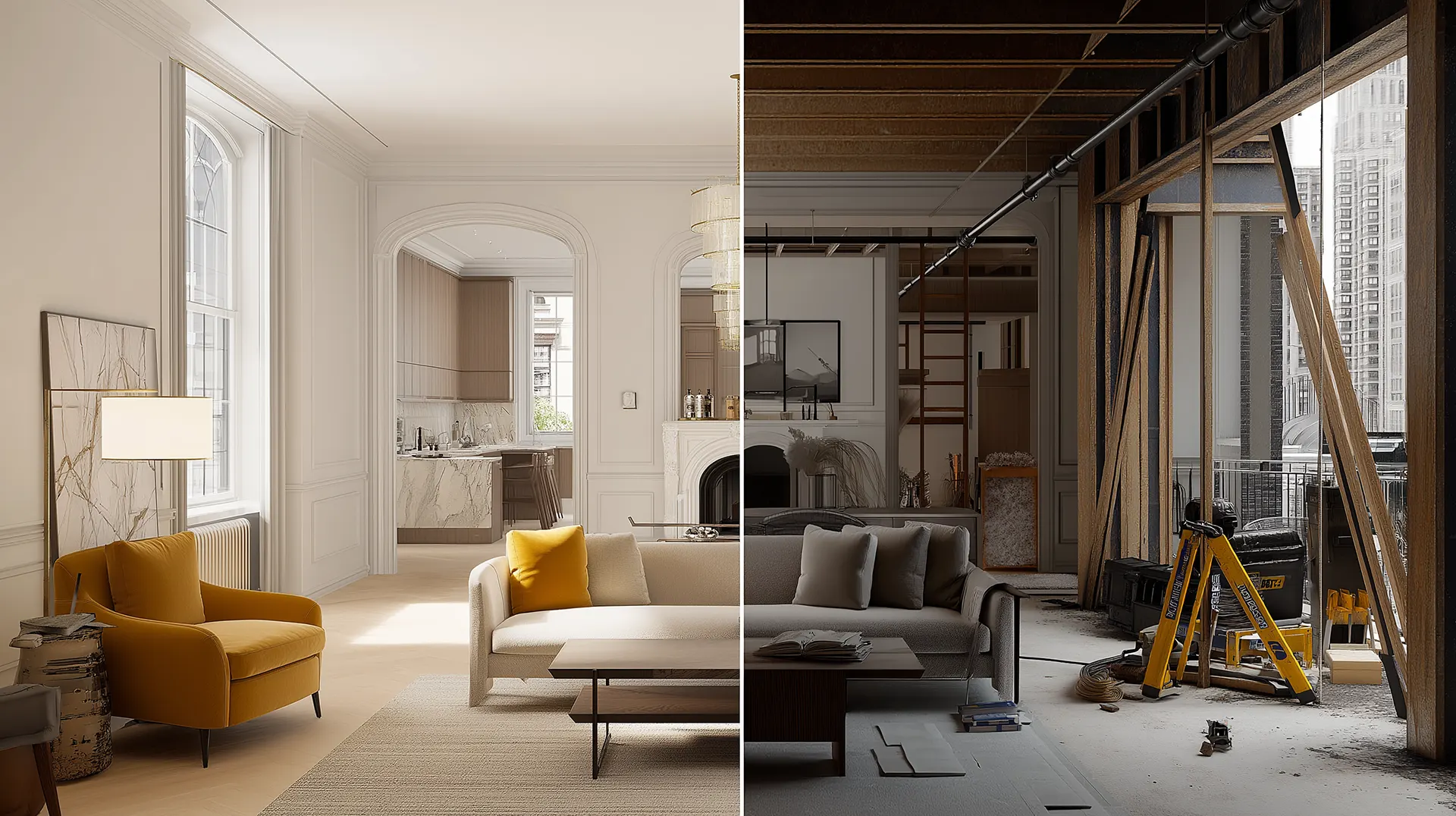
Every renovation begins with a blank page — or rather, a floor plan. Two professionals gather around it: the designer and the builder. They’re looking at the same lines, the same walls, the same light — yet what they see couldn’t be more different.
To the designer, the space is a story waiting to be told. To the builder, it’s a structure waiting to be realized.
Between those two visions lies the heartbeat of every successful renovation: translation. The art of turning imagination into matter, sketches into structure, and emotion into engineering.
1. The designer’s eye: emotion, proportion, and narrative
Designers don’t see measurements first — they see possibility. They imagine how sunlight will hit a wall at 4 PM, how a client might move between kitchen and living room, how color and texture can change mood.
To them, every project is emotional. It’s about the experience of space — the flow, comfort, balance, and story.
“Designers think in feelings before they think in finishes. A great interior is built not just from what’s seen, but what’s sensed.” — Architectural Digest (2024)
Their focus is on proportion, light, and alignment. Will the crown molding feel heavy or elegant? Should that kitchen island encourage conversation or workflow? They shape emotion through composition.
But here’s the thing — emotion alone doesn’t hold up a ceiling.
2. The builder’s eye: physics, structure, and reality
Builders, by contrast, see load-bearing walls, joists, plumbing stacks, and code compliance. Their imagination is grounded in logistics. They think in millimeters, timelines, and tolerances.
“Designers dream in space. Builders dream in structure. Both are right — but neither can build alone.” — Curbed NYC (2023)
A builder looks at the same open floor plan a designer loves and asks: Can that wall actually come down? Will the new kitchen layout overload the plumbing stack? Is there enough ceiling height for recessed lighting?
To them, creativity means solving problems before they become expensive mistakes.
Where the designer visualizes beauty, the builder visualizes stability.
Designer vs Builder: Two Perspectives on the Same Space
| Aspect | Designer’s Perspective | Builder’s Perspective |
|---|---|---|
| Primary Focus | Emotion, proportion, narrative | Physics, structure, reality |
| First Question | How will this feel? | How will this stand? |
| Vision | Experience of space — flow, comfort, mood | Load-bearing walls, joists, code compliance |
| Thinking Style | Feelings, composition, atmosphere | Millimeters, timelines, tolerances |
| Creative Expression | Shaping emotion through design | Solving problems before they’re mistakes |
| End Goal | Beauty and experience | Stability and functionality |
3. Where vision meets structure — and tension often begins
If you’ve ever lived through a renovation, you know: designers and builders sometimes clash. Not from ego, but from perspective.
The designer may want to hide an HVAC vent for a cleaner look. The builder may insist it stay exposed for safety and airflow. The designer dreams of frameless glass; the builder warns about weight and anchoring.
“The gap between design vision and construction reality is where the best collaborations — and biggest frustrations — occur.” — Dezeen (2024)
Common Points of Tension
| Design Vision | Construction Reality | Potential Conflict |
|---|---|---|
| Hidden HVAC vents for clean aesthetics | Exposed vents for safety and airflow | Function vs aesthetics |
| Frameless glass installations | Weight and anchoring concerns | Vision vs structural limits |
| Open floor plan concept | Load-bearing wall restrictions | Space flow vs structural integrity |
| Custom plaster ceiling | Weight, lighting, HVAC impact | Aesthetic detail vs system integration |
4. The problem with separation
In traditional renovation models, design and construction happen in separate silos. First, an architect or designer creates the vision. Then, months later, a contractor is hired to build it.
By that point, key design decisions may conflict with physical limitations, leading to rework, cost overruns, or compromise. The original vision gets diluted in translation.
That’s why the Design-Build model — where both disciplines collaborate from the start — has become the new gold standard in luxury renovation.
5. Hoppler’s unified vision: design + build as one language
At Hoppler Design & Build, the process eliminates that gap entirely. From the first sketch, designers and builders sit at the same table — literally.
The design team dreams, the construction team grounds it, and together they refine both until beauty and feasibility align.
For example: A designer proposes a custom plaster ceiling. The builder calculates weight, lighting, and HVAC impact before it’s approved. Adjustments happen in concept stage, not during demolition.
The result? Projects that are not just beautiful on paper, but perfect in execution.
“The most elegant design is one that stands effortlessly — not just visually, but structurally.”
6. Lessons from both sides
From designers: Every detail matters emotionally. Scale, color, and proportion define atmosphere. Design is about human behavior, not decoration.
From builders: Perfection is physics, not fantasy. Planning saves thousands. Craftsmanship is invisible when done right.
The magic happens where those truths meet. When aesthetics and engineering stop competing — and start complementing — that’s when a renovation transcends its blueprints.
7. The client’s experience: one voice, one vision
For clients, integrated design-build means peace of mind. There’s no finger-pointing, no conflicting timelines, no “the designer said X, but the contractor did Y.”
You deal with one unified team — from concept to completion — and every decision feels coherent.
Hoppler’s clients often describe the experience as calmly choreographed. Even large-scale renovations move with rhythm because communication isn’t handed off — it’s shared.
Traditional Model vs Design-Build Model
| Aspect | Traditional Model | Design-Build Model |
|---|---|---|
| Process | Design first, then construction (separate) | Collaborative from day one |
| Communication | Client mediates between parties | One unified team communicates internally |
| Problem Solving | During construction (expensive) | During concept stage (cost-effective) |
| Accountability | Divided — finger-pointing possible | Single point of accountability |
| Client Experience | Stressful, fragmented | Calm, choreographed, coherent |
Final Thoughts
Every space tells two stories: the dream and the doing. Designers write the poetry; builders write the structure. Without one, the other collapses.
The genius of the design-build model — and the hallmark of Hoppler Design & Build — is bringing those two voices into harmony.
Because when a space is both beautifully imagined and brilliantly executed, you don’t see the difference between design and construction. You just feel that everything is exactly as it should be.

How to Read a Floor Plan Like a Pro
Whether you’re purchasing a new apartment, embarking on a full renovation, or simply evaluating it
Buying to Renovate: What to Look for Before You Sign
In New York City, the dream of “buying to renovate” is as exciting as it is risky. You f

The Art of Patience: Why Great Renovations Take Time
We live in a culture obsessed with speed. We are used to one-click purchases, next-day deliveries, a