

How to Read a Floor Plan Like a Pro
Whether you’re purchasing a new apartment, embarking on a full renovation, or simply evaluating its potential, understanding a floor plan is one of the most powerful skills you can develop. A floor plan doesn’t just show you walls and doors: it reveals the story of how space will feel, move, and live. In the busy urban environment of places like Manhattan, reading that story well can mean the difference between a dream home and a constant compromise.
1. Start with the big picture: what a floor plan is and why it matters
At its simplest, a floor plan is a scaled two-dimensional drawing, viewed from above, showing the relationships between rooms, walls, doors, windows, and other major architectural features.
The real value is in what it reveals beyond a room list: circulation (how you move through the space), proportion (how rooms relate in size), orientation (how light enters), and livability. A good floor plan lays out the measurements of a space and, more importantly, shows how its rooms interact and flow together.
In the context of a renovation or apartment purchase, reading a floor plan informedly means you can spot problems ahead of time: poor circulation such as long, dark corridors, awkward intersections of rooms, inefficient layouts, or rooms starved of daylight.

2. Key elements to check (and don’t skip)
When you open a floor plan, here are the must-see features:
- Scale and measurements: Find the scale (such as ¼″ = 1′-0″) and room dimensions. Without this, your mental picture is distorted.
- Orientation and north arrow: Knowing which way the plan faces tells you how light will move through the day, crucial for living spaces.
- Walls: Walls are drawn as solid lines, and their thickness usually signals their role: exterior and load-bearing walls are heavier, interior partitions lighter. Dashed and dotted lines are where people most often go wrong. A dashed line does not automatically mean a partition or a wall you can remove. Depending on the drawing’s conventions, dashes can indicate something above the cut plane (upper cabinets, a soffit, a beam), an element marked for demolition, or a hidden feature below. Always check the legend and notes before assuming a dashed line is a wall you can take down, and remember that whether a wall is structural or non-load-bearing usually can’t be determined from the plan alone. Confirm it with an architect or engineer.
- Doors and windows: Doors are typically drawn with an arc showing swing direction; windows appear as breaks in the wall. Placement drives usability, views, and daylight.
- Symbols and legend: Make sure you understand every icon, fixture, appliance, and special element. Conventions vary between drawings, so check the legend rather than assuming.
3. Walk through the plan like you’d walk through the home
Don’t just glance; imagine motion. Start at the front door: where does your eye go? Move into the living room: can you place a sofa? Could you serve dinner from the kitchen and still talk to guests? Will the washer-dryer area block a hallway? Picturing real use is what makes a plan come alive.
Trace the high-traffic paths with your finger, entry to living to kitchen to balcony, to understand how the space will actually move day to day. Then compare the room sizes on the plan against furniture you own or plan to buy. Interior designer Tatiana Chechina does this before anything else on a compact apartment: measure the actual pieces a client already owns and lay them onto the plan at scale, because a sofa that fits on paper by two inches is a sofa that blocks a doorway in the room. In a city where every inch counts, that tactile sense of fit matters enormously.

4. Questions to ask (and red flags to spot)
While reading a plan, keep these questions handy:
- Does the layout fit how you live: cooking often, entertaining, working from home?
- Is there a logical connection between bedrooms, baths, and common areas?
- How are daylight and views configured, given the window placement and orientation?
- Are there dead zones: awkward corners, circulation-only space, low-ceiling areas?
- Is storage thoughtfully placed, or bolted on as an afterthought?
- Where are the kitchen and bathrooms, and could they ever be moved?
- Will your furniture fit without blocking doors, windows, or pathways?
Red flags include undefined or tiny dimensions, no clear entry or movement pattern, large stretches of space that exist only to get you from one place to another, and odd shapes that fight furniture placement. The gap between an average apartment and an exceptional one usually lives in exactly these details.
5. The Manhattan layer: what you can actually move
A plan can look full of renovation potential and still be far more constrained than it appears, because in a NYC co-op or condo the rules of the building shape what’s possible as much as the walls do.
The single most important constraint to establish early is the wet-over-dry rule. Most buildings prohibit a wet area (a kitchen or bathroom) from sitting above a neighbor’s dry living space (a bedroom or living room) in the apartment below, because of the leak risk to the units beneath you. In practice, that means many buildings restrict or outright forbid moving or expanding a kitchen or bath beyond its original footprint. So before you fall for a layout that imagines the bathroom relocated across the apartment, assume relocation may not be allowed, and confirm against the building’s alteration agreement and with the managing agent. It’s a constraint that can quietly rule out an entire renovation concept.
The same goes for structural walls and building systems: risers, shafts, and columns rarely move, and the plan won’t always make clear which walls are load-bearing.
One more practical point worth knowing up front: any floor plan submitted to the NYC Department of Buildings for permits or board approval must be prepared, signed, and sealed by a licensed professional, a Registered Architect (RA) or Professional Engineer (PE). A sketch you draw yourself, however accurate, won’t be accepted for filing. Your own floor-plan literacy is for making smart decisions; the drawings that actually get filed have to come from a licensed professional.
6. Why floor-plan literacy pays off in a renovation
If you’re buying to renovate or commissioning a build, the floor plan is your first defense against surprises. A weak layout drives up costs: reworking walls, relocating services, paying for space that goes underused. Understand the plan early and you can work with your designer or contractor to optimize layout, light, and function before demolition begins.
Reading a plan well is what lets you raise a home’s value, cut waste, and improve flow all at once, so the finished space works beautifully in daily life rather than merely looking good on paper.
7. Practical tools and tips to accelerate your learning
- Bring a tape measure, or compare the plan’s dimensions to similar rooms in your current home.
- Trace the path of high-traffic movement: entry to living to kitchen to balcony.
- Sketch furniture footprints lightly onto the plan and confirm your pieces fit without leaving rooms feeling like leftovers.
- Turn the 2D plan into mental 3D: imagine stepping in, closing the door, turning left.
- Don’t ignore the legend or notes: they often hide structural elements and service shafts.
- Ask professionals the money question: “If this room were built as drawn, what would I lose, and what would cost the most to change?” Early awareness saves real money.
8. Your evaluation framework
- Check orientation and daylight potential first.
- Verify dimensions and how the rooms connect.
- Trace circulation with your finger or a pen.
- Map your furniture and storage needs onto the plan.
- Identify structural and service constraints (walls, shafts, columns) from the plan and legend, and the wet-zone limits from the building.
- Ask whether the layout will still serve you in five to ten years.
If you’re working with a design-build team, bring this literacy to the table so you can engage intelligently in the choices that follow: layout, finishes, lighting, and function.
Reading a floor plan is more than decoding lines and symbols; it’s understanding how your life will function in a space. With the skill in hand, you become a partner in the design rather than a passenger. You’ll spot a layout that will feel cramped long before the first wall comes down, sidestep costly surprises, and align your home with the way you actually live. Whether you’re planning a renovation, a purchase, or a redesign, that confidence starts the moment you can read the drawing yourself.

Countertop Installation in High-Rise Buildings: Technical Considerations
Installing a heavy stone slab in a 30th-floor Manhattan kitchen has very little in common with deliv

Bathroom Clearances: The Legal Minimum and What Works
Bathroom dimensions are one of the few parts of a renovation where the code gives you hard numbers r
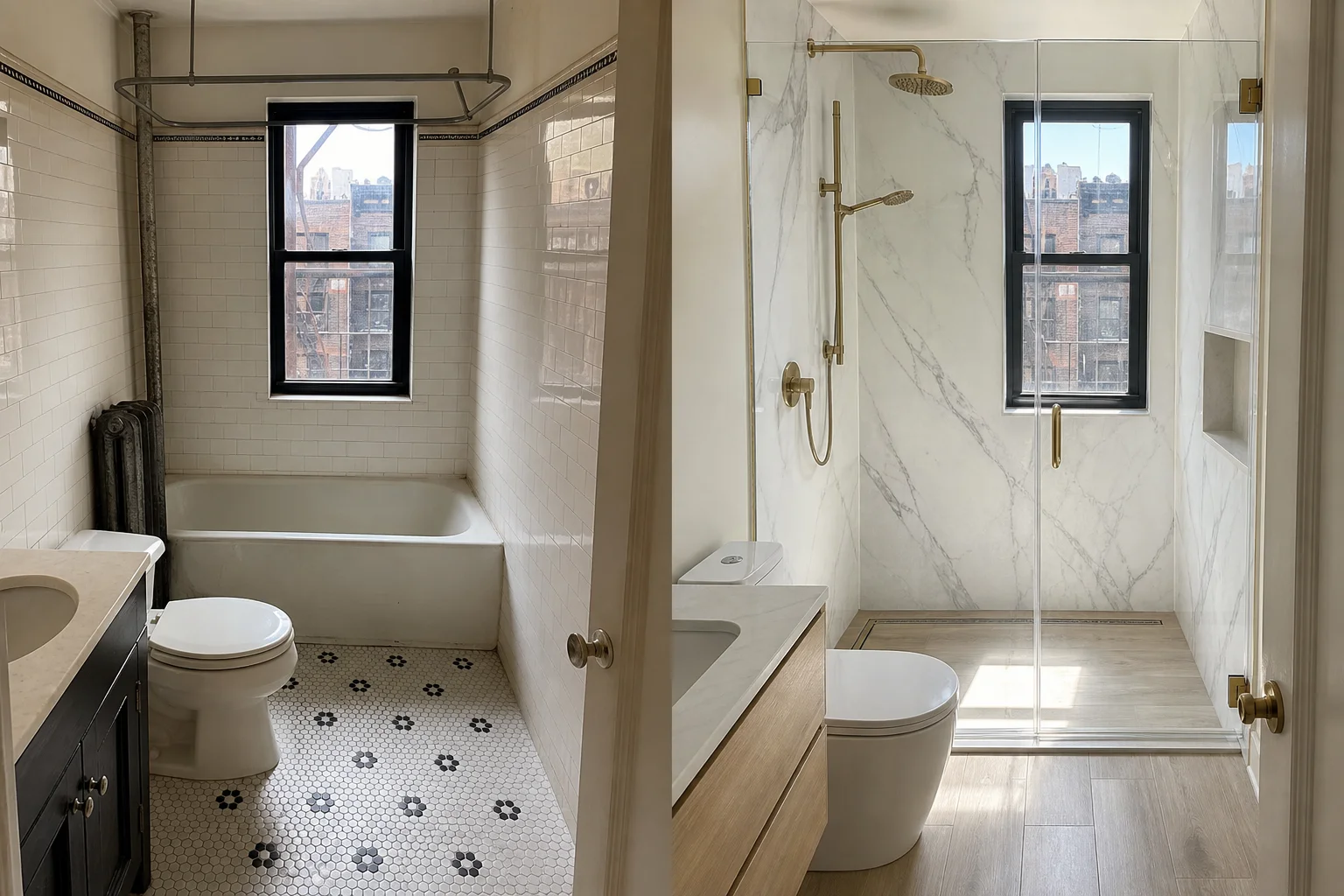
Tub to Walk-In Shower: What the Conversion Involves
Converting a tub to a walk-in shower is one of the most common bathroom remodels: it frees floor are