

Sustainable Sourcing: Finding Eco-Friendly Materials That Don’t Compromise on Style
The conversation around sustainable building materials has shifted considerably over the past decade. What once meant choosing between environmental responsibility and visual quality has become something more nuanced: a growing catalogue of materials that perform well, age beautifully, and carry a significantly lower environmental footprint than their conventional alternatives. For New York City apartment owners navigating renovation decisions, that shift arrives with additional context that makes sustainable sourcing more than an aesthetic preference.
Why NYC Owners Are Paying Closer Attention to Material Choices
NYC Local Law 97, which took effect in 2024, sets carbon emissions caps for buildings over 25,000 square feet, with penalties for owners whose buildings exceed the thresholds. For co-op and condo owners, this means that building-wide sustainability performance has direct financial consequences, and renovation decisions that reduce a unit’s contribution to overall building emissions are increasingly relevant to how boards and managing agents evaluate alteration proposals. Choosing low-embodied-carbon materials, specifying products with low VOC off-gassing, and selecting finishes with long service lives all contribute in measurable ways to a building’s emissions profile over time.
Beyond the regulatory dimension, sustainable materials have simply gotten better. Reclaimed wood, recycled glass surfaces, rapidly renewable flooring options, and low-emission finishes now compete on aesthetic terms with conventional alternatives rather than asking owners to accept a visual trade-off in exchange for environmental credentials.
Reclaimed Wood: Character with a Story
Reclaimed wood brings something manufactured materials cannot produce: the accumulated visual character of actual use. The grain patterns, nail holes, colour variation, and surface texture in a properly sourced reclaimed board reflect decades or centuries of a previous life, and that quality reads differently in a space than any artificial distressing technique.
Sourcing reclaimed wood responsibly requires more diligence in New York City than in most other markets. Materials salvaged from older NYC buildings carry a meaningful risk of lead paint contamination and, in some cases, asbestos-containing compounds in adhesives or finishes. NYC Local Law 31 governs lead paint hazards specifically, and any reclaimed material originating from pre-1978 construction warrants testing and documentation before installation. Reputable architectural salvage suppliers in the metropolitan area are familiar with these requirements and should be able to provide chain-of-custody documentation and relevant test results as a matter of course. Purchasing reclaimed wood through informal channels or without that documentation introduces liability that is particularly acute in a city with active building inspections and strict health code enforcement.
When properly sourced, reclaimed wood delivers environmental benefits that extend well beyond aesthetics. Using salvaged material reduces demand for newly harvested timber, keeps usable wood out of the waste stream, and in many cases provides a material of higher quality than what current production offers, since much reclaimed lumber comes from old-growth forests that are no longer commercially harvested.
Recycled Glass and Innovative Composites
Recycled glass countertops combine crushed post-consumer glass with binding agents to produce surfaces that interact with light in ways solid stone does not. The depth and sparkle that result from embedded glass aggregate give these surfaces a visual complexity that reads as genuinely premium rather than as a sustainable compromise. Colour options range from quiet, neutral palettes to more expressive combinations depending on the glass sources used.
Terrazzo, which has experienced a significant design revival across high-end residential projects in Manhattan and Brooklyn, works on similar principles. Aggregates including recycled glass, marble chips, and other reclaimed materials are set into a cementitious or epoxy base and ground to a smooth finish. The result is a surface that is highly durable, completely customisable in terms of aggregate composition and colour, and supportive of the circular economy in a way that quarried stone is not. For large open-plan apartments where floor continuity matters, terrazzo offers a seamless aesthetic that tile and plank flooring cannot replicate.

Bamboo and Cork: Performance Flooring With an Important Caveat for Co-op Owners
Bamboo flooring has earned its reputation as a genuinely high-performance sustainable material. Certain strand-woven bamboo products exceed many domestic hardwoods in hardness ratings, and the plant’s rapid regrowth cycle makes it one of the more renewable flooring options available at scale. Some bamboo products also carry antimicrobial and moisture-resistant properties that make them functional in areas with higher humidity exposure.
Cork offers a different set of advantages: natural thermal insulation, a softer underfoot feel than hard flooring, and a harvesting process that does not require felling the tree, making it among the more genuinely low-impact flooring materials in commercial production.
For Manhattan co-op and condo owners, both materials come with a qualification that deserves clear attention before specification. Most co-op alteration agreements require installed flooring to meet a minimum Impact Insulation Class rating, typically IIC 50 or higher, to protect neighbouring units from impact noise transmission. Neither bamboo nor cork meets that standard on its own without an appropriate acoustic underlayment system. Before specifying either material, owners should confirm the required IIC rating with their building’s managing agent and work with their contractor and flooring supplier to specify an underlayment combination that achieves compliance. Installing flooring that fails the building’s acoustic requirement is a common trigger for board disputes and, in some cases, a requirement to remove and replace the finished floor at the owner’s expense.
With the correct underlayment, both bamboo and cork can satisfy typical co-op acoustic requirements while delivering their full sustainability and performance benefits.
Low-VOC Finishes and Indoor Air Quality
Paint and finish selection has a direct impact on indoor air quality in ways that are particularly significant in New York City apartments, where units are relatively sealed environments and ventilation is often limited. Conventional solvent-based paints and finishes off-gas volatile organic compounds during and after application, with some products continuing to emit measurable VOC levels for months after the work is complete.
Low-VOC and zero-VOC paints, plasters, and adhesives have improved substantially in terms of coverage, colour range, and finish quality. Current-generation low-emission products from reputable manufacturers are now used routinely in high-end residential projects without any visible performance difference from conventional alternatives. Specifying low-VOC finishes throughout a renovation is one of the lower-cost sustainable choices available, and its impact on the lived-in quality of a space is immediate and tangible.
Certification: What to Look For When Evaluating Materials
The sustainable materials market includes a range of third-party certification programmes that help owners and designers distinguish credible environmental claims from marketing. FSC certification from the Forest Stewardship Council applies to wood products and indicates responsible forest management through the supply chain. GREENGUARD certification focuses on chemical emissions and indoor air quality, identifying products that meet strict VOC thresholds. Cradle to Cradle certification evaluates materials across multiple sustainability dimensions including material health, recyclability, and manufacturing practices.
These certifications are not guarantees of quality, but they provide a verifiable baseline that unverified manufacturer claims do not. For owners working with a design-build firm or general contractor on a full renovation, requesting certified materials as a contract specification is a straightforward way to ensure that sustainability claims are substantiated rather than assumed.
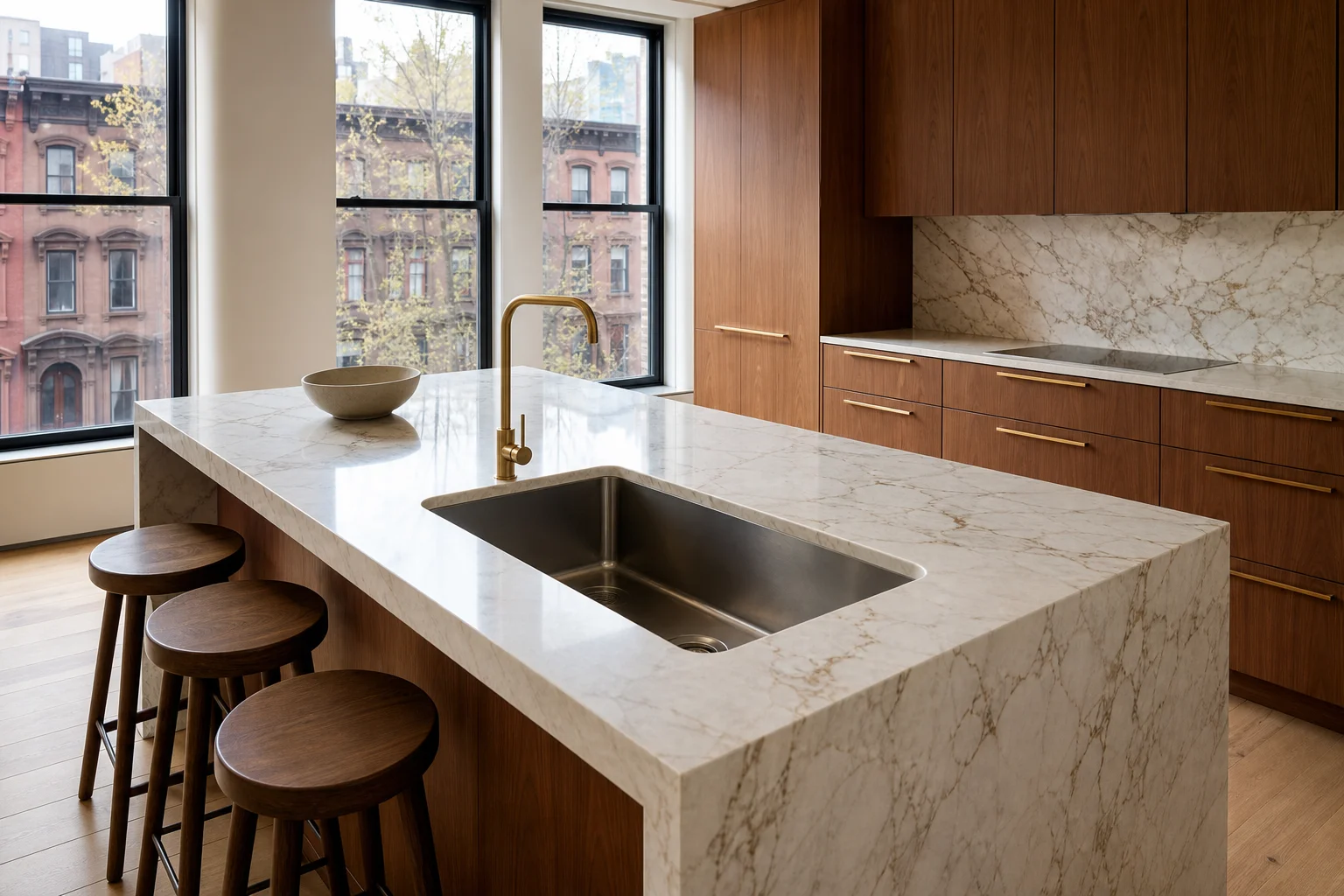
Veneer, Laminate or Wood: Cabinet Refacing Materials Compared
When you reface cabinets, you keep the boxes and replace the doors, drawer fronts, and trim. The sur

Quartz, Granite, or Marble: Choosing the Right Countertop for a New York City Kitchen or Bathroom
Countertop selection generates more genuine disagreement than almost any other decision in a renovat
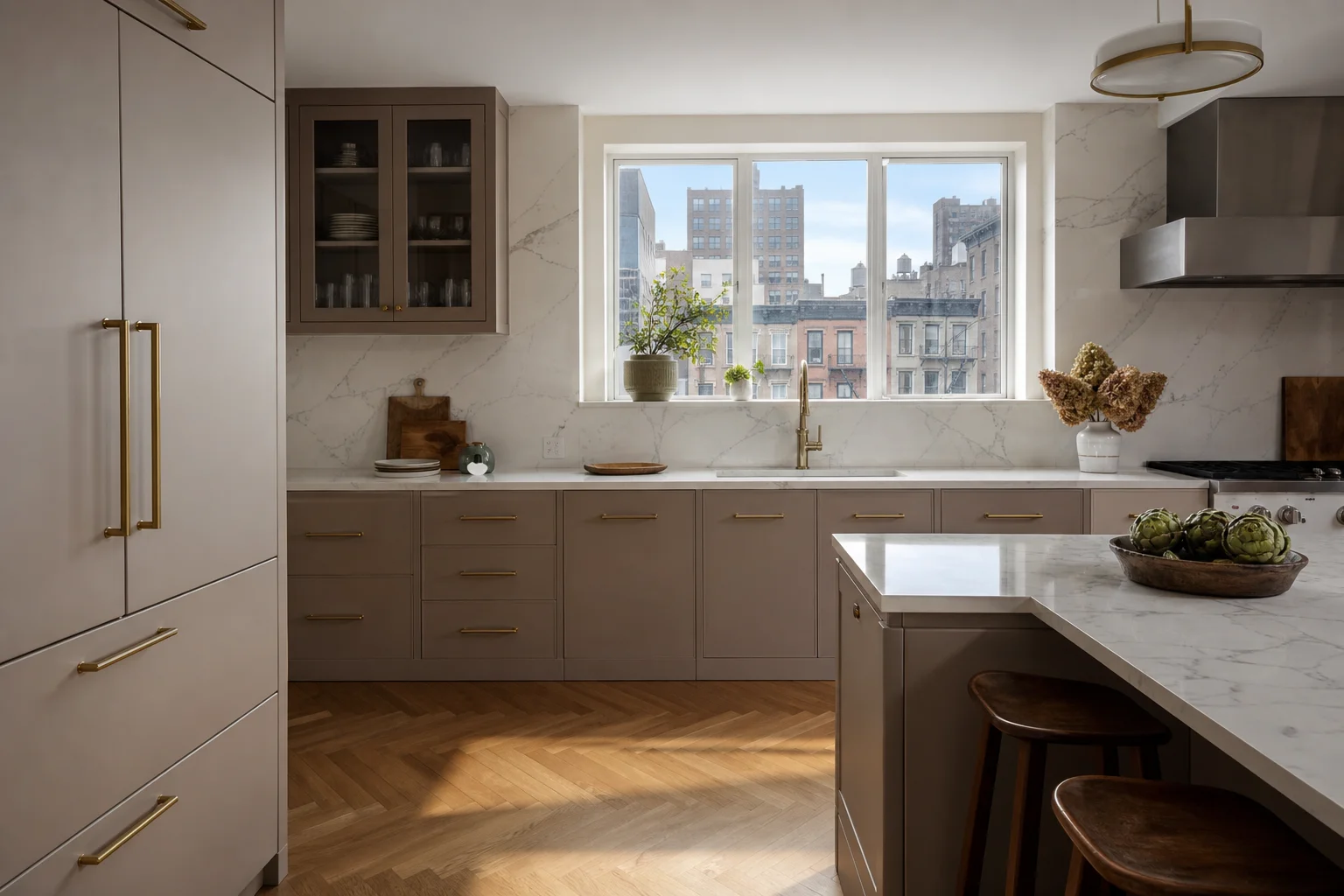
Kitchen Cabinet Refacing: What It Is and How the Process Works
Cabinet refacing keeps the cabinet boxes — the carcasses — and replaces the doors, drawer fronts