

The Anatomy of a Construction Contract: How to Protect Your Project (and Sanity)
There is a specific moment before the hammers swing, before the dust rises like flour in a busy bakery, where the renovation exists only in your mind. It is a vision of morning light hitting a white oak floor, of a kitchen that feels like a sanctuary.
But a vision, no matter how beautiful, is fragile.
A high-end Manhattan renovation is one of the largest and most complex financial investments most people will ever make, second only to buying the apartment itself. To protect that investment, you need more than a handshake. You need a spine. You need a vessel to carry your vision across the stormy seas of construction.
At Hoppled Design & Build, we believe a contract is not a sign of mistrust; it is the invisible architecture of your home. It is the single most important tool for radical transparency.
Here is how we construct a contract that honors the dream while rigorously protecting the reality.
1. The Scope of Work: The Script
Imagine trying to direct a film without a script. Chaos ensues. The “Scope of Work” is our screenplay.
In this industry, a generalized description like “Renovate Kitchen” is legally insufficient and practically dangerous. It guarantees a fight over what was “implied.” We do not deal in implications; we deal in technical specifications.
A professional scope is a technical manual that eliminates assumption. It includes:
- Demolition Protocols: We don’t just say “demo.” We specify: “Remove to studs and subfloor. Remove and cap all plumbing and electrical infrastructure.”
- Framing Precision: We reference specific architectural sets: “Frame new partition walls per plan A-101, dated 10/20/25.”
- Material Specificity: We define the reality: “Furnish and install 3/4″ solid white oak flooring, select grade, with a three-coat matte polyurethane finish.”
- Installation Standards: Methods, adhesives, fasteners, substrate preparation requirements
- Quality Benchmarks: Tolerances, finish levels, testing protocols
If it is not written down, it is not included. This level of detail is the only way to ensure the budget we agree upon is the budget we stick to.

2. Payment Milestones: The Rhythm
A renovation is a dance, a push and pull of energy. We never ask for payments based on calendar dates (e.g., “the 1st of the month”). This incentivizes dragging feet.
To maintain leverage and ensure work-in-place value, our payment schedule is tied to tangible, verifiable milestones. You pay only for the chapter of the story that has been written and verified.
| Payment Stage | Percentage | Trigger Event |
|---|---|---|
| Deposit / Mobilization | 10% | Contract signing and project setup |
| Demolition & Framing | 15% | All demolition and framing work completed |
| Rough-in Systems | 20% | Plumbing, Electrical & HVAC installed and city inspection passed |
| Walls & Surfaces | 20% | Walls closed, tiling and flooring complete |
| Fixtures & Finishes | 20% | Millwork, fixtures and appliances fully installed |
| Final Closeout | 10% | Punch list complete and DOB sign-offs received |
This structure keeps the rhythm honest and keeps you in control of the cash flow.

3. The Change Order: The Plot Twist
Every great story has a twist. In construction, it might be a hidden pipe behind a wall, or your sudden desire to swap quartz for marble. In the industry, this is often where relationships break down. We view it differently.
We call this the Change Order Protocol.
Our contract states that no “twist” happens off-screen. No extra costs are incurred until a written Change Order is priced, presented, and signed by both you and us. It turns a potential point of anxiety (“I thought that was included!”) into a calm, professional business decision.
Every change order includes:
- Detailed description of the requested change
- Exact cost breakdown (labor + materials)
- Timeline impact assessment
- Updated project schedule
- Both parties’ signatures before work begins

4. The Safety Net: Warranties & Liability
Beneath the high-wire act of renovation, there must be a net. This is the section your lawyer will love, and it is non-negotiable for your protection.
- Lien Waivers: At every payment milestone, we provide documentation proving we have paid all subcontractors and suppliers, preventing any “mechanic’s liens” against your property.
- Insurance: We provide verification of General Liability and Workers’ Compensation, listing you and your building as “Additionally Insured.”
- Warranties: Explicit guarantees on labor and craftsmanship, ensuring we stand behind our work long after the dust has settled.
- Building Compliance: All permits, inspections, and certificates of completion handled professionally
- Dispute Resolution: Clear procedures for addressing concerns before they escalate
The Living Document
The problem with a traditional contract is that it gets signed and filed away in a dark drawer.
At Hoppled Design & Build, our contract is a living document. It is the data source for our project management system in ClickUp. Every line item in the Scope becomes a trackable task. Every milestone becomes a deadline.
It creates a single, unbreakable chain of accountability from the first signature to the moment you turn the key in your new door, look around, and realize: It looks exactly like I dreamed it would.
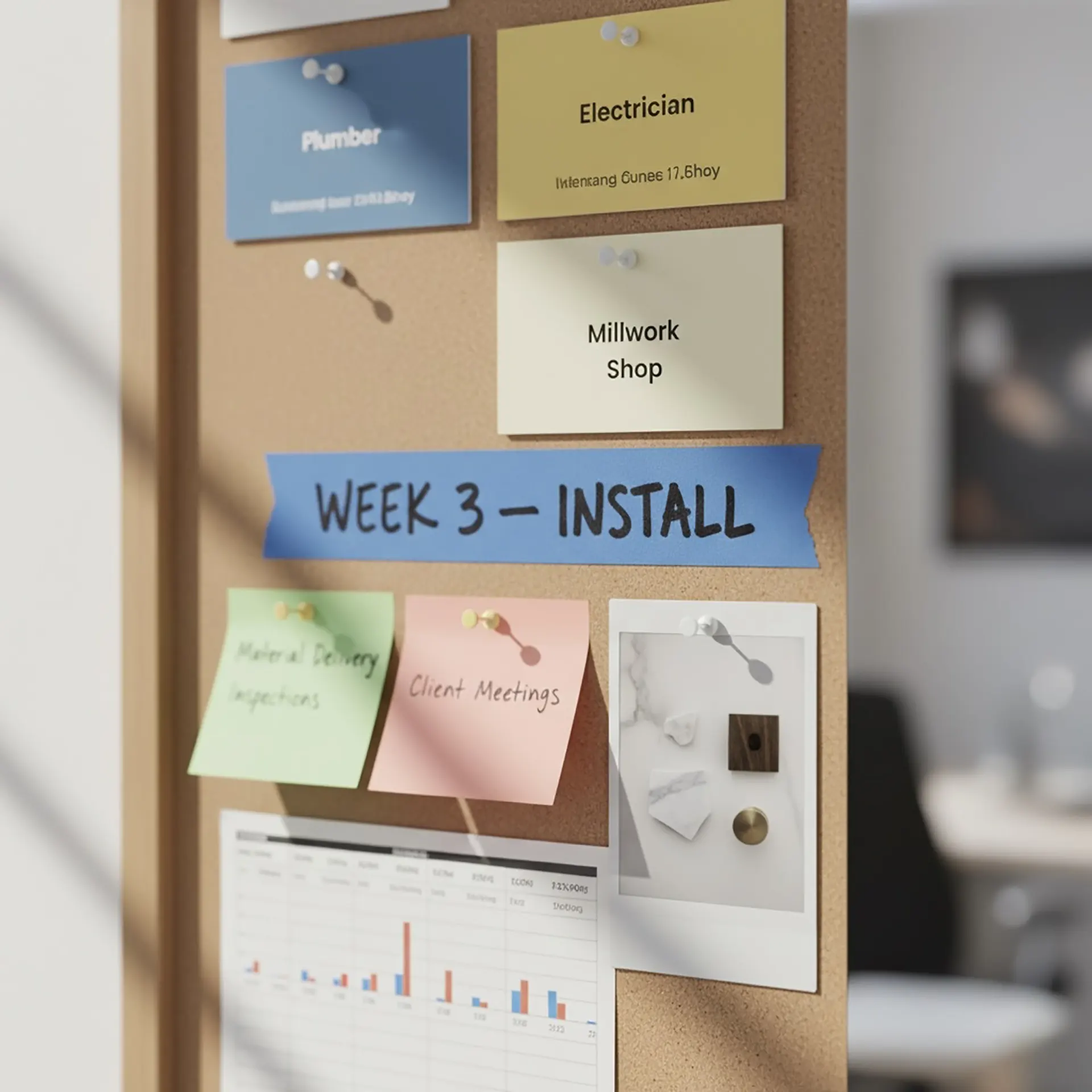
From Permit to Perfection: Why Project Management Defines the Outcome
Here is a question every homeowner should ask before signing a contract: “What’s more ex

The Interview Process: Essential Questions Every Homeowner Should Ask Contractors
Finding the right contractor in NYC can make or break your renovation project. In this exclusive int
Red Flags and Green Lights: Reading Between the Lines of Contractor Proposals
A contractor proposal represents far more than just a list of prices; it’s a window into the p