

How to Interview a Contractor Before You Hand Over the Keys to Your Home
How to Interview a Contractor Before You Hand Over the Keys to Your Home
What separates a reliable contractor from an expensive mistake, and the questions that surface the difference before you sign.
Most New York renovation horror stories trace back to a single meeting that felt perfectly fine at the time. The contractor sounded confident, answered every question fast, and gave a number that seemed reasonable. Then, somewhere between the signed contract and the halfway mark, the project drifted sideways in ways that felt entirely avoidable in hindsight.
The interview is where most of those problems are either caught or missed. To find out what homeowners should actually be asking before a contract gets signed, we sat down with Michael, a senior project manager at Hoppler Design & Build who has spent his career managing residential renovations in Manhattan’s co-ops and condos.

Start with the boring questions. They matter more than people think.
Michael’s first recommendation sounds almost too simple: ask for the contractor’s license number, and tell them you intend to verify it with the Department of Consumer and Worker Protection.
Michael: A contractor who hesitates at that question is telling you something. Any legitimate operator in New York hands that number over without blinking. It’s public information. It should already be on the estimate, the contract, the business card.
In New York City, a Home Improvement Contractor license is legally required for any renovation valued at $200 or more. There’s no exemption for small jobs, and no first-offense grace period for a homeowner who hired an unlicensed contractor. Beyond the license, ask for current certificates of general liability and workers’ compensation insurance, and ask to be named as an additional insured on the policy.
Michael: Without that, if someone gets hurt on your site, the liability question gets complicated fast. In an occupied building, where common areas and neighboring apartments are in play, that isn’t a theoretical risk.
New York experience and construction experience are not the same thing
Twenty years of work in suburban New Jersey is not the same as five years inside Manhattan co-ops. Michael is blunt about it.
Michael: Ask how long they’ve actually worked in New York City, not just construction in general, and push for real examples rather than photos alone. What buildings, what neighborhoods, what kind of scope. You want to know whether they’ve handled something close to your project before.
That distinction is sharpest in pre-war buildings. Apartments on the Upper East and Upper West Sides often hide original plumbing, asbestos-containing materials, and lead paint in older finishes. A contractor who knows these buildings raises those issues before you do, not to alarm you, but because a professional already builds testing and remediation into the timeline and the budget.
Michael: If someone walks through a pre-war apartment and never mentions asbestos or lead paint testing, that’s a gap.
The board-approval question almost everyone forgets
For anyone renovating in a co-op or condo, there’s one question that rarely makes it onto a checklist but can decide whether the project starts on schedule or stalls for weeks: will the contractor prepare the board approval package, and is it included in the fee?
Most Manhattan co-ops and many condos require a formal alteration agreement before any work begins. Assembling that package, which includes insurance certificates, scope of work, contractor credentials, and sometimes architect drawings, takes time and a working knowledge of what each board wants to see. A contractor who has done this dozens of times moves it along quietly. One who hasn’t will either hand it back to you or submit something incomplete that creates delays.
Michael: Board approval isn’t something a homeowner should have to manage. Anyone who’s worked in Manhattan long enough treats it as part of the job, and handles it without being asked.
Have the uncomfortable money conversation early
Ask for a fully itemized estimate that separates materials, labor, and other costs. A single lump-sum number makes it impossible to understand what you’re paying for, or to compare one bid against another in any meaningful way.
Pin down the payment schedule before you’re staring at a contract. A large deposit, anything near half the project cost before work begins, is a warning sign. A sound structure ties payments to completed milestones: work gets done, then payment follows.
Michael: We take a modest deposit to start, then progress payments tied to specific phases. That keeps everyone honest. The client sees what they’re paying for, we’re motivated to keep moving, and nobody’s sitting on money that hasn’t been earned.
Then ask what happens when unexpected conditions turn up once demolition starts, because in old New York buildings, they usually do. A contractor who has worked here long enough treats that as part of the plan, not as a fresh excuse for a change order every time something appears behind a wall.
Ask how the project will actually be run
Find out how the job will be managed day to day, and who your single point of contact will be. Ask how often you’ll get updates, through what channel, and how quickly you can expect a reply when something comes up.
Michael: Poor communication costs real money, not just goodwill. A decision sits unanswered for three days and the whole crew has nothing to do. If a contractor can’t tell you upfront how they’ll keep you posted, that’s usually a sign they won’t.
Ask whether they use project management software that gives you visibility into the schedule and progress. And ask whether the people in your home will be direct employees or subcontractors, and whether every subcontractor carries their own insurance.
What the real warning signs look like
Michael’s list of red flags is worth taking seriously: a contractor who won’t hand over a license number, one who wants a large payment before any work begins, one who can’t produce local references from comparable projects (co-op or condo work specifically, if that’s your situation), one who’ll only give a verbal estimate and resists putting anything in writing, and one who pushes you to sign on the spot.
Michael: An unusually low bid deserves as much scrutiny as no bid at all. Quality work in New York costs what it costs. A number that looks too good to be true usually means something has been cut, left out, or underestimated, and you find out which one later.
Interview three before you commit to one
Every contractor should see the space in person before quoting. Photos won’t reveal the state of the existing plumbing, the quirks of a pre-war layout, or the access constraints of a particular building.
Prepare your questions ahead of each meeting and take notes. Compare the answers, not just the numbers. A contractor who welcomes hard questions and answers them specifically is showing you exactly how they’ll handle the job.
Michael: The interview is the first test. How someone responds to tough questions tells you how they’ll behave when something unexpected comes up on site. And on a renovation, something unexpected always does.
Your Interview Checklist
Bring this to every meeting. The quality of the answers will tell you as much as the answers themselves.
Licensing and Insurance:
- Can you give me your license number so I can verify it with the DCWP?
- Can you provide current general liability and workers’ comp certificates?
- Will you name me as an additional insured?
Experience and References:
- How long have you worked specifically in New York City?
- Can you show me examples of similar projects, with addresses and scope?
- Can you give me three recent references, with contact details, ideally from co-op or condo work?
Building-Specific Risks:
- For a pre-war building, will you test for asbestos and lead paint before any demolition or surface disturbance?
- How do you account for testing and remediation in the timeline and budget?
Project Management:
- What system do you use to track schedule and progress?
- Who will be my primary point of contact?
- How often will we communicate, and what’s your typical response time?
Budget:
- Can you provide a detailed, itemized estimate separating materials and labor?
- What’s the payment schedule, and how is it tied to milestones?
- What conditions could change the budget once work begins?
Timeline and Permits:
- What’s a realistic timeline for this project?
- Who handles permits and DOB filings?
- What’s most likely to cause a delay?
Crew and Quality:
- Will the work be done by employees or subcontractors, and do all subs carry their own insurance?
- Can you tell me about the key people on the team?
- What’s your quality-control process?
Daily Operations:
- What’s your daily cleanup routine?
- How do you protect existing finishes?
- What hours will the crew be working?
Warranty and Follow-up:
- What warranty do you offer on workmanship and materials?
- How do you handle callbacks and punch-list items?
Walk Away If a Contractor:
- Won’t provide a verifiable license number
- Demands a large payment before any work starts
- Can’t supply local references for comparable projects
- Offers only a verbal estimate
- Pressures you to decide on the spot
- Came to you through door-to-door solicitation
- Submits a bid that’s suspiciously low
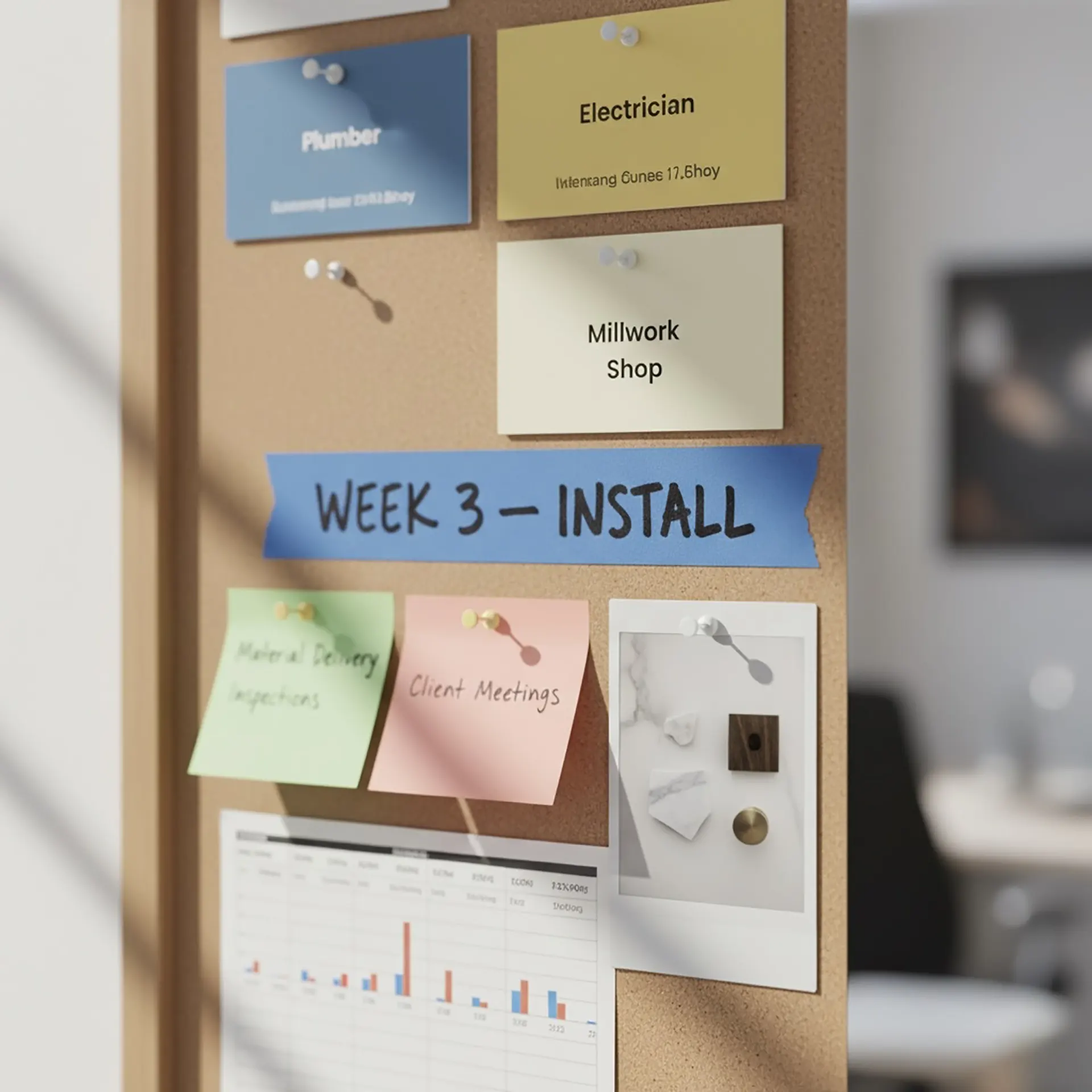
From Permit to Perfection: Why Project Management Defines the Outcome
Here is a question worth asking before you sign a contract: what costs more, a slow builder or a mis

Bathroom Renovation in Manhattan and New York City: What Actually Matters
Bathroom renovation in Manhattan is rarely simple, and it involves far more than choosing tile and s

Building Your Dream Team
Every great renovation starts long before the first wall comes down. It begins with a question: who