

Soundproofing Apartments: Real Technical Solutions That Work
Living in a building with shared slabs and party walls means accepting that sound travels in ways it will not in a detached house. Because of that reality, acoustic privacy is rarely a decorative problem. It is an engineering one. Effective apartment soundproofing begins with a clear diagnosis of how noise gets into your unit and ends with carefully detailed construction. Surface treatments that simply reduce echo inside a room will not stop footsteps on the slab above or bass from a neighboring home. Lasting improvement comes from combining mass, isolation, damping, and airtight detailing into a coordinated assembly.
Understanding how sound moves is the first step. In buildings most complaints fall into two categories: airborne noise and impact noise. Airborne noise travels through the air and then excites partitions. This is the kind of sound you hear when someone talks, plays music, or runs a television. Its performance is commonly measured with the STC metric, which indicates how much speech and general sound a partition attenuates. Impact noise begins when a force strikes a surface and transmits vibration through the structure. Footsteps, furniture drag, and dropped items are examples. The IIC metric measures how a floor assembly reduces structure-borne impact. Each mechanism requires a different set of interventions, and treating one without addressing the other will produce partial, and often disappointing, results.
Because quick fixes commonly fail, it helps to be direct about what does and does not work. Acoustic foam, decorative panels, and white noise machines will reduce reverberation inside a room, making it sound less echoey. They do almost nothing to change how energy transmits through a slab or a wall. If a neighbor’s footsteps are the real problem, superficial surface absorption will not make a meaningful difference. Instead, the work must alter the physical path by which pressure waves and vibrations travel between units.
There are four engineering principles that, when combined correctly, deliver measurable improvement.

 Both methods require mineral wool cavity fill and precise sealing of penetrations. When done well a retrofit can lift a mediocre STC 30s partition into the low 50s or better, but the exact result depends on the starting construction and how well junctions are treated.

Attention to insulation and airtightness is the supporting detail that actually makes high-performance assemblies function. Mineral wool is the common cavity fill because it is dense and remains dimensionally stable. Airtightness is even more important. Sound follows air paths, and small gaps around electrical boxes, recessed lighting, plumbing, and door frames bypass the most carefully constructed assemblies. Acoustic sealant at junctions, gaskets for boxes, and sound-rated doors and seals for rooms requiring privacy are low-cost measures that dramatically improve final performance.
These figures are general; for any meaningful budget you should obtain detailed proposals that include test data and installation guarantees.
- Adding mass. Heavier partitions resist airborne energy more effectively, and adding layers of dense gypsum or other high-mass boards raises STC.
- Decoupling. Creating a break between surfaces prevents vibration from moving directly from one side to the other. Resilient channels, isolation clips, and separate stud lines achieve that decoupling.
- Damping. Viscoelastic compounds convert vibrational energy into heat, lowering resonance between layers; products of this type are commonly used between gypsum layers.
- Absorption. Dense cavity insulation such as mineral wool reduces internal resonance and supports both STC and the subjective quiet of the space.
These four principles must be executed together and with attention to junctions, penetrations, and edge details for the assemblies to work as intended.

Floors and Impact Noise
Floors and impact noise deserve particular attention because they are frequently the dominant annoyance in apartments. When you control the finished floor, a properly designed floating floor is often the single most effective intervention. A floating floor isolates the finish from the structural slab using a resilient underlayment specifically engineered for impact performance. A working system includes a tested underlayment, continuous perimeter isolation, expansion gaps, and careful detailing where cabinets and heavy built-ins are fixed. The performance of an underlayment depends on density and compression resistance, not thickness alone. Thin foams compress under load and lose resilience. For reliable results, choose materials with published IIC ratings and insist on installation that adheres to the manufacturer’s instructions. In dense city buildings the target IIC often lies in the high 50s to 70s depending on the building’s requirements.Walls
Walls used to separate apartments are a different challenge because airborne sound travels through both air and structure. A retrofit that raises STC significantly usually combines added mass, damping, and decoupling. Two practical retrofit approaches dominate.- The first attaches a resilient channel or hat-channel to the existing wall and then installs multiple layers of sound-rated gypsum with a damping compound between layers.
- The second builds a completely independent stud line, sometimes called a double-stud or staggered-stud wall, which provides excellent isolation but consumes additional vertical space.
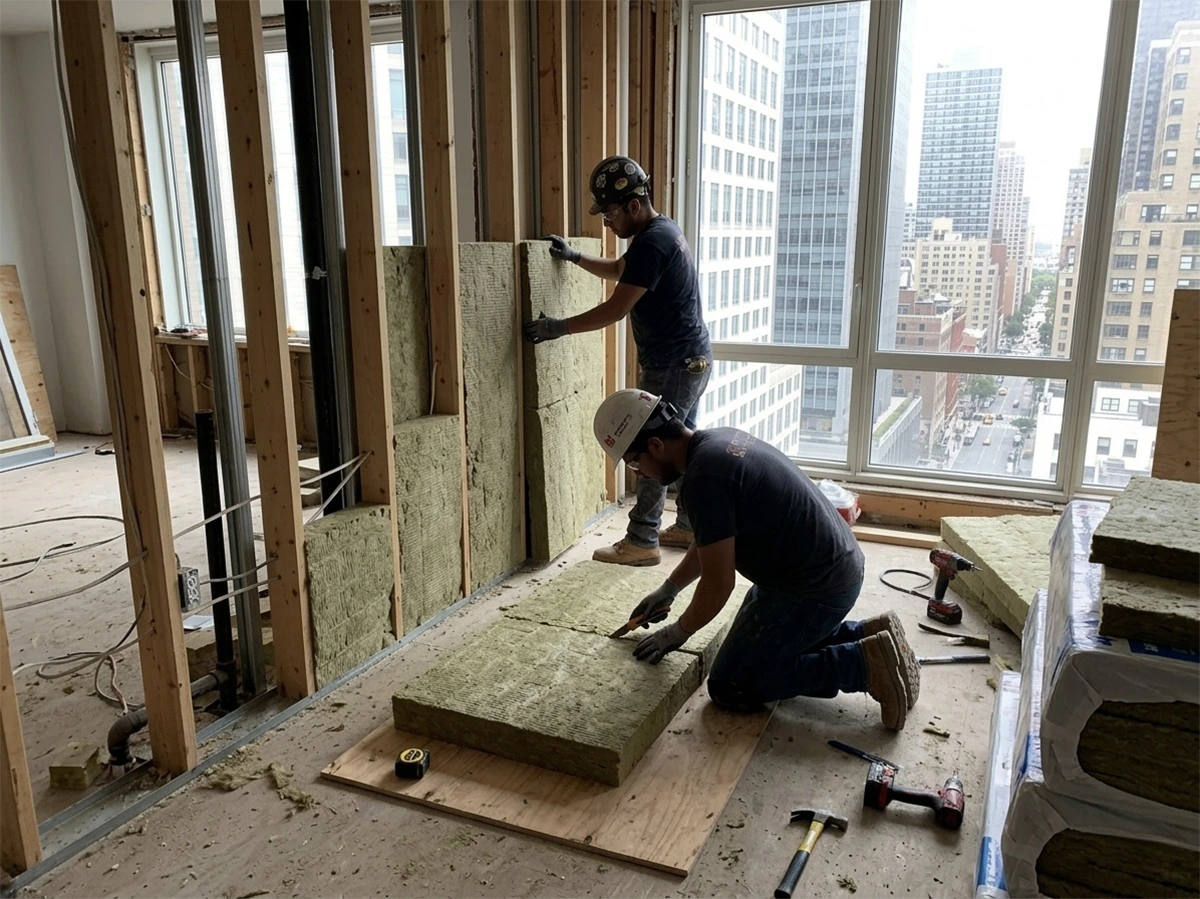 Both methods require mineral wool cavity fill and precise sealing of penetrations. When done well a retrofit can lift a mediocre STC 30s partition into the low 50s or better, but the exact result depends on the starting construction and how well junctions are treated.
Ceilings
Ceilings are often the most constrained surface to improve because headroom is limited and boards may restrict the degree of intervention. Still, significant gains are possible. Isolation hangers and clips allow the ceiling to be decoupled from the structure above so that additional layers of gypsum with damping compounds can be added without rigidly connecting to the slab. For extreme impact issues, a combined strategy works best: floor isolation above paired with an isolated ceiling below. Setting realistic expectations is important here. No ceiling treatment will fully eliminate very heavy structural impacts on its own.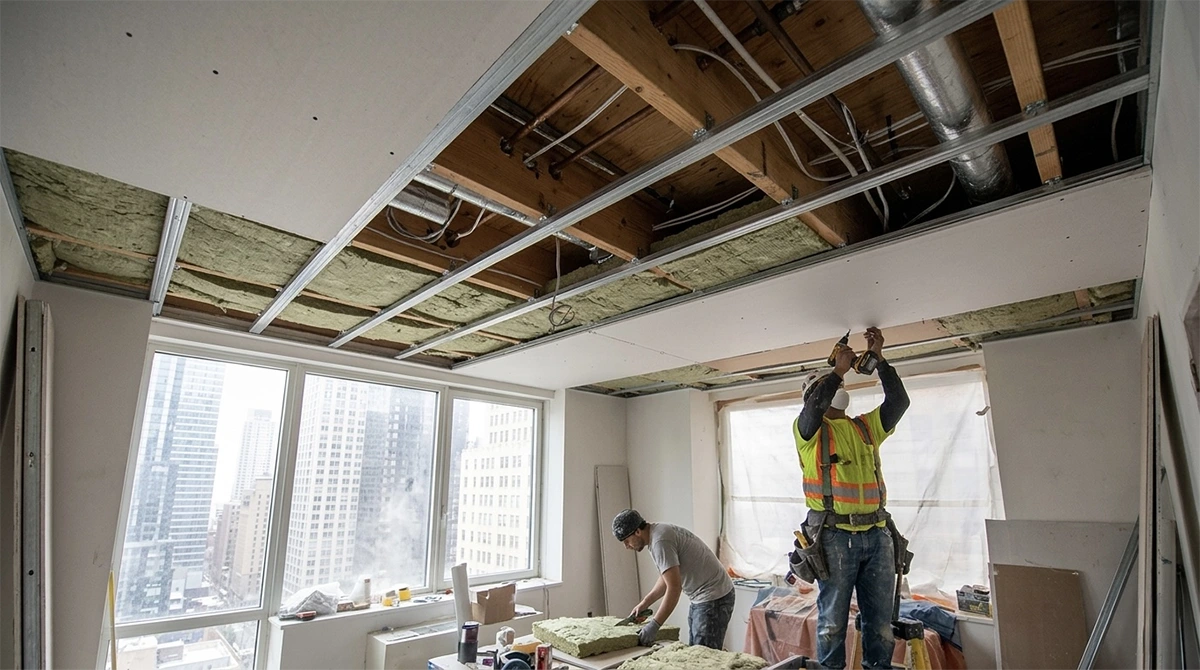
Insulation and Airtightness
Diagnostics and Verification
Diagnostics and verification are essential parts of any professional program. Before spending on retrofit work, have an acoustic consultant perform baseline testing to quantify existing STC and IIC performance and to identify dominant frequencies. If low-frequency bass is the problem, it requires different technical solutions than mid- to high-frequency speech. After the retrofit is complete, follow up with post-construction testing to verify the results. Verified improvement protects your investment and provides documentation that many co-op and condo boards will request.Performance Expectations
Performance expectations should be realistic. No retrofit will make an apartment perfectly silent, but well-executed systems produce substantial perceived quiet. As a practical reference, partitions with STC ratings in the 30s can often be improved into the low- to mid-50s using combined mass, decoupling, and damping strategies. A correctly designed floating floor combined with ceiling work can move IIC into the 60s or 70s, though exact numbers depend on the starting point and installation quality.Cost
Price is always a variable. Rough guidance for Manhattan conditions:| Scope | Typical Cost Range |
|---|---|
| High-performance floating floor (materials + installation) | $15–$30 per square foot |
| Ceiling isolation assembly (per room) | $8,000–$25,000 |
| Wall retrofit, high-performance assembly | $50–$100 per linear foot |
Regulatory and Co-op Constraints
Many buildings require that soundproofing work be submitted to management for approval, and some condos and co-ops mandate minimum IIC values for new flooring or require specific insurance certificates. It is wise to involve the building manager early, present technical documentation, and agree on logistics. Early coordination reduces conflict, accelerates approvals when needed, and avoids costly scope changes once work starts.Installation Sequence and Site Discipline
Installation sequence and site discipline affect outcomes more than most clients realize. Acoustic underlayments should be installed before cabinetry where possible, and perimeter isolation must be continuous so cabinetry or thresholds do not bridge the isolation. For wall and ceiling work, coordinate electrical rough-ins and use acoustic-rated junction boxes. Protect underlayments and membranes during subsequent trades. A single compressed underlayment or an unsealed penetration can erode performance and undo expensive assemblies.
Bathroom Renovation in Manhattan and New York City: What Actually Matters
Bathroom renovation in Manhattan is rarely simple. It is not just a matter of choosing tile and repl

How to Plan an Apartment Renovation in NYC: Inspiring Ideas and Strategic Planning
Planning an apartment renovation in New York City requires more than design inspiration. Between bui

Beyond the Open Concept: Redefining Modern Living Spaces
For decades, the open concept floor plan ruled supreme in American homes, promising seamless flow be