

Manhattan Apartment Renovation Cost: Real Numbers, Hidden Factors, and How to Budget Correctly
Renovating an apartment in Manhattan involves considerably more than construction. It’s a coordinated process shaped by cost per square foot, building rules, permit filings, insurance requirements, labor logistics, and financial planning. Most people searching for a Manhattan renovation cost want a single clear number, and the honest answer is that pricing depends on several structural variables specific to New York City. Understanding those variables early prevents unrealistic expectations and protects the project from financial strain later on.
What renovation costs per square foot in Manhattan
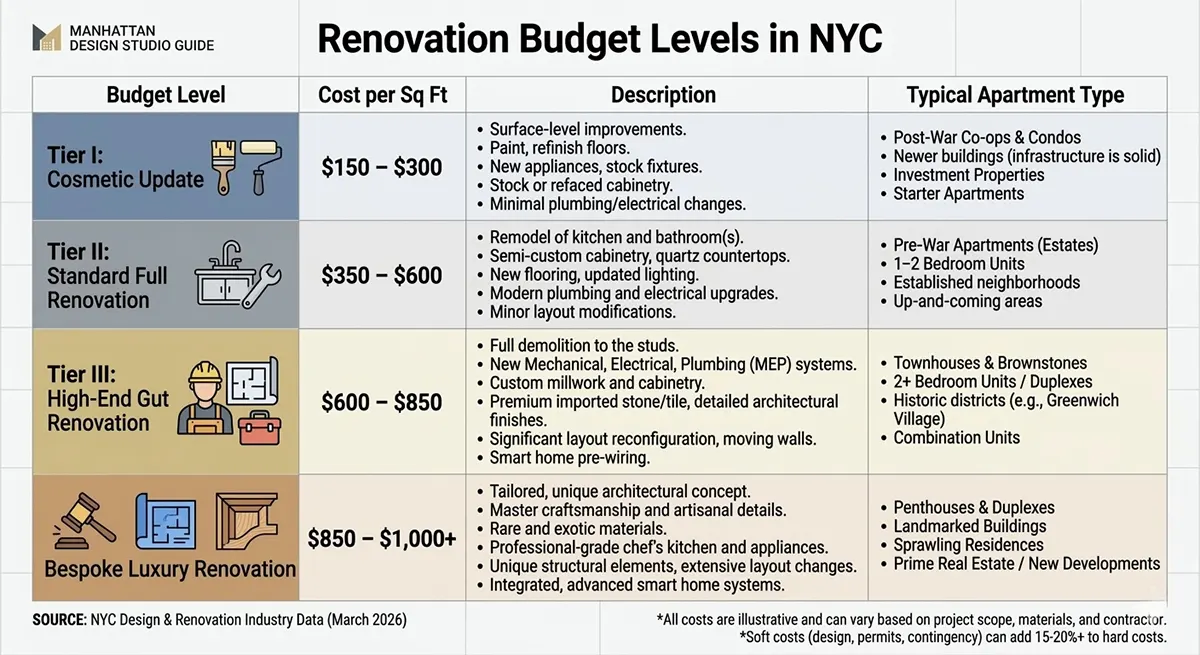
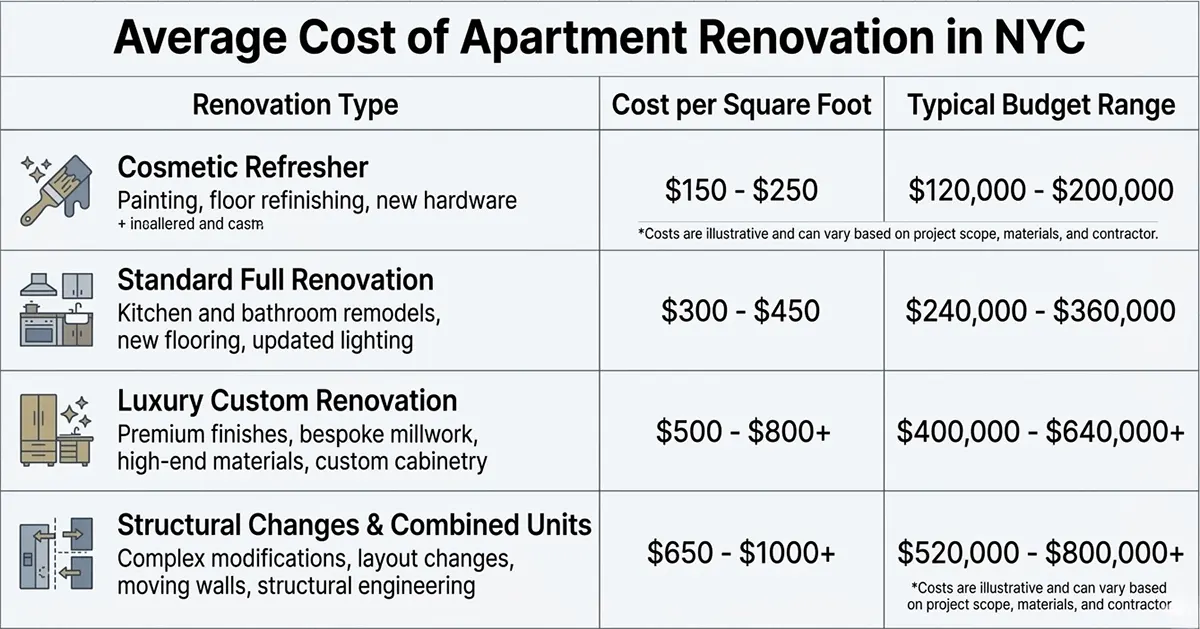
Contractors here commonly use a cost-per-square-foot benchmark at the start of planning. It isn’t a final contract price, but it establishes quickly whether your intended scope and your budget are in the same neighborhood.
One caveat before any of these numbers: published Manhattan renovation figures vary widely between sources, often by a factor of two or more for the same described scope, because there’s no standardized index behind them. Treat everything here as 2026 planning ranges rather than quotes, and get an itemized bid for your specific apartment.
At the lower end, a cosmetic refresh that leaves plumbing and electrical largely alone runs meaningfully less than a full renovation, since there’s simply less work happening behind the walls. For a high-quality standard renovation, meaning licensed trades, proper permits, compliant electrical and plumbing, and mid-range finishes, expect roughly $200 to $300 per square foot. Premium and custom work starts around $350 and climbs from there, covering custom millwork, structural modifications, high-end stone, and complex lighting design. At the bespoke luxury end, the figure can reach $600 or more per square foot.
| Project Level | Cost Per Square Foot | What It Includes |
|---|---|---|
| High-quality standard | $200-$300 | Licensed trades, permits, compliant electrical and plumbing, mid-range finishes |
| Premium / custom | $350+ | Custom millwork, structural modifications, high-end stone, complex lighting |
| Bespoke luxury | $600+ | The top end of custom and bespoke work |
The reason Manhattan sits so far above the national average isn’t only labor pricing. It reflects conditions particular to New York. Co-op and condo boards require alteration agreements and insurance riders. Buildings restrict working hours. Elevators have to be protected and scheduled in advance. Hallways need temporary protective walls. Filings with the Department of Buildings add filing and expediter fees and review time on top of everything else. In some properties, union labor rules apply.
Taken together, these compliance and logistics costs commonly add $10,000 to $40,000 before demolition even starts, depending heavily on the size of the project and whether union labor is involved. This figure is separate from the architect’s design fee, which is covered below. It surprises people more than any other number in the budget, and it’s the one most often left out of an early estimate.
How apartment size affects the total
Square footage drives the headline number, but layout complexity usually matters more. Kitchens and bathrooms are cost-dense because they demand plumbing, waterproofing, electrical upgrades, inspections, and specialty trades, so an apartment with two bathrooms costs more than its square footage alone would suggest.
A full gut renovation of a one-bedroom apartment typically runs between $120,000 and $250,000. Smaller units frequently show a higher cost per square foot, because the fixed costs spread across fewer square feet. A two-bedroom apartment generally falls between $180,000 and $450,000, and once you add custom cabinetry, structural wall changes, or an additional bathroom, projects reaching $500,000 to $700,000 are not unusual.
| Apartment Type | Full Gut Renovation Range | Notes |
|---|---|---|
| 1-bedroom | $120,000-$250,000 | Smaller units often show higher cost per sq ft, since fixed costs spread over fewer square feet |
| 2-bedroom | $180,000-$450,000 | Custom cabinetry, structural wall changes, or an added bathroom can push projects to $500,000-$700,000 |
In a pre-war building, plan on a contingency of at least 15 to 20 percent. Hidden conditions behind old plaster and outdated mechanical systems routinely require adjustment once the walls come open.
Kitchen costs
The kitchen is almost always the most expensive room in an apartment renovation.
A modest kitchen starts around $45,000 with quality stock or semi-custom cabinetry. A mid-range kitchen falls between $60,000 and $120,000, covering custom cabinetry, integrated appliances, stone countertops, upgraded lighting, and plumbing modifications. High-end work begins around $150,000 and covers bespoke millwork, professional-grade appliances, book-matched slabs, and architectural lighting.
| Kitchen Level | Typical Cost Range | What It Covers |
|---|---|---|
| Modest | From $45,000 | Quality stock or semi-custom cabinetry |
| Mid-range | $60,000-$120,000 | Custom cabinetry, integrated appliances, stone countertops, upgraded lighting, plumbing modifications |
| High-end | $150,000+ | Bespoke millwork, professional-grade appliances, book-matched slabs, architectural lighting |
Cabinetry is usually the single largest line item. Beyond that, relocating plumbing or gas lines requires permits and inspections, and upgrading electrical service for an induction range or multiple wall ovens may mean panel work. Integrated ventilation and island plumbing each bring additional trade coordination and cost.
What this adds up to is that a kitchen budget is shaped far more by infrastructure and layout decisions than by the finishes people tend to focus on first.
Bathroom costs
A bathroom in New York typically runs $30,000 to $75,000 for quality work that meets code and includes proper waterproofing. Luxury bathrooms with steam showers, radiant heated floors, custom glass enclosures, premium fixtures, and stone slab walls can exceed $90,000.
Costs climb sharply when you relocate a toilet or change the wet wall configuration, convert a tub to a walk-in shower, or install a linear drain, since all three involve moving plumbing rather than replacing it in place.
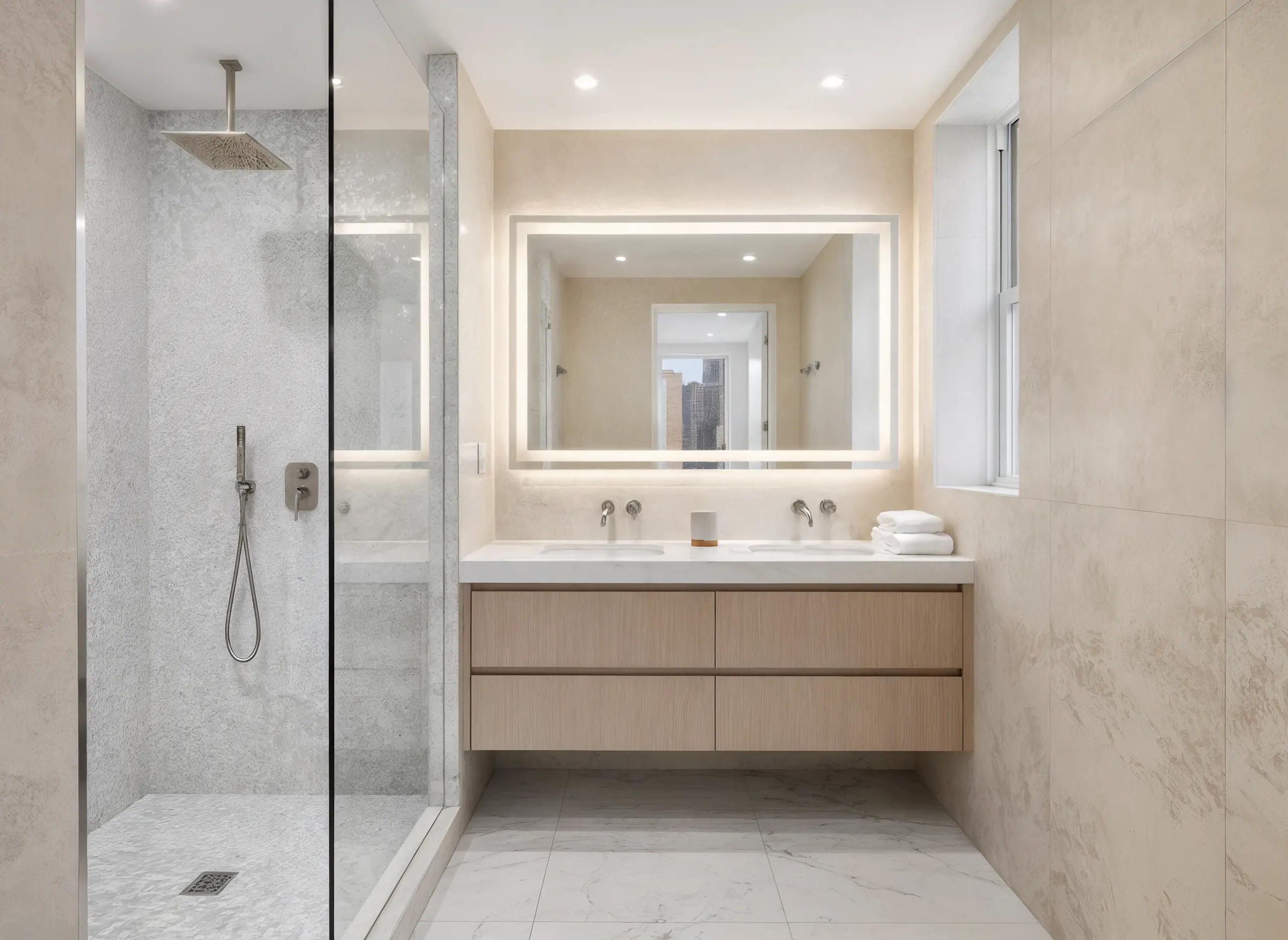
Waterproofing systems, flood testing, and required inspections are not optional upgrades in New York, and cutting costs there reliably produces expensive remediation later, often involving the apartment below yours.
Additional costs specific to Manhattan
Design and architecture fees commonly run around 10 to 15 percent of construction cost, with a larger share on smaller projects where minimum fees dominate. Permit filings, expediter services, and engineering consultations add further to soft costs. Asbestos and lead testing are required in pre-war apartments before work begins. Co-op and condo boards charge application review fees and hold refundable deposits during construction.

Living on site during a renovation also increases the total. The work has to be phased room by room, which slows progress and prevents multiple trades from working at once. Crews lose efficiency to daily setup and cleanup, temporary protections, restricted hours, and the need to keep the apartment safe and habitable throughout. The extended timeline raises labor, supervision, and general conditions costs, which is why the same scope generally costs more in an occupied apartment than in a vacant one.
Why contingencies matter here
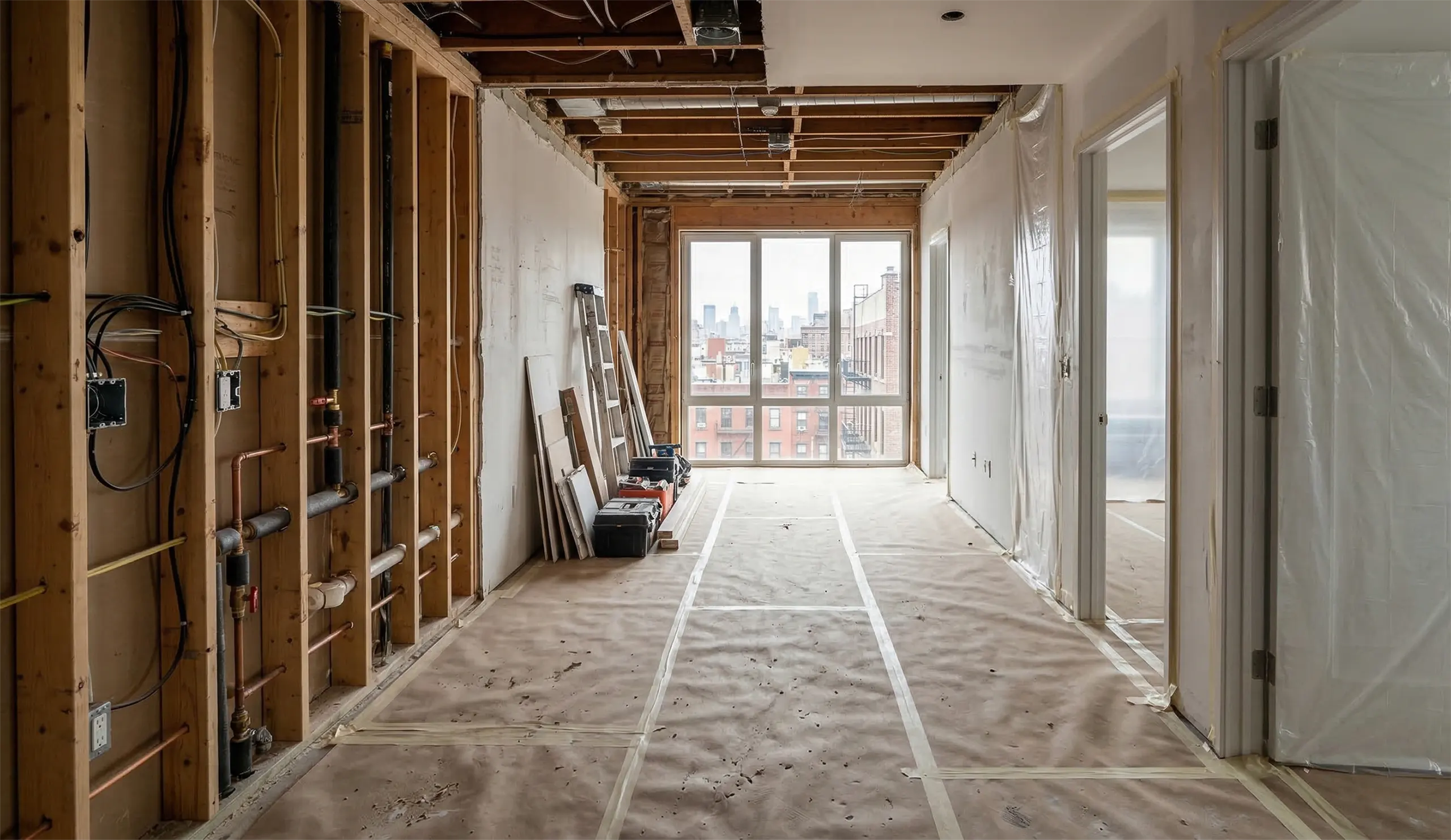
Unexpected conditions are common in older Manhattan buildings. Outdated wiring, corroded plumbing stacks, uneven floors, and hidden structural repairs frequently become visible only after demolition.
A 15 percent contingency is the sensible baseline for most projects, and 20 percent is advisable in a pre-war building. Without one, even a carefully budgeted renovation turns financially stressful the first time something unexpected appears behind a wall.
Financing a Manhattan renovation
Homeowners here typically finance renovations through a home equity line of credit, a cash-out refinance, a renovation-specific loan, or a construction loan on larger projects. Securing financing before work begins matters, because contractor payment schedules move quickly once construction starts, and clear financial planning prevents the mid-project pause that a liquidity gap creates.
Co-op owners face a genuinely different situation, and it’s worth understanding before you count on borrowing.
When you buy into a co-op, you don’t own real property. You own shares in a corporation along with a proprietary lease for your apartment. Because those shares aren’t real estate in the traditional sense, many lenders treat co-op financing as a specialized product, and a number of banks simply don’t offer home equity lines of credit against co-op shares at all. The lenders who do tend to be regional or local institutions with dedicated co-op lending departments, and their terms often differ from what a condo or house owner would be offered. Start those conversations early rather than assuming a HELOC will be available.
There’s a second constraint that catches people entirely by surprise. Many co-op boards restrict how much financing a shareholder may carry against their shares, and some prohibit additional borrowing beyond the original share loan altogether. The board’s rationale is that a heavily leveraged shareholder poses a risk to the building’s finances and can complicate a future sale. In practice this means some buildings expect a renovation to be funded from your own resources rather than through a new loan secured by the apartment, and any new financing typically requires the board’s written consent along with a recognition agreement between the lender, the co-op, and you.
Before you build a budget around borrowed money, read your proprietary lease and house rules, and ask the managing agent directly what the building permits. Discovering this after signing a contract with a builder is a difficult position to be in.
Condo owners have considerably more flexibility here, since a condo is real property and conventional home equity products apply in the normal way.
How to evaluate an estimate
A professional Manhattan estimate should be itemized and transparent, with demolition and framing, plumbing and electrical, finishes and millwork, permits and project management, and insurance all appearing as distinct line items.
A single lump-sum figure with no breakdown makes it effectively impossible to compare bids or understand what you’d be giving up by cutting something. Transparent estimates let you make informed decisions and cut down on disputes once construction is underway.
Controlling cost without sacrificing quality
There are real ways to manage a budget. Keeping plumbing in its existing location avoids expensive reconfiguration and often sidesteps approval complications as well. Choosing durable mid-range materials for large surface areas while concentrating budget on one or two high-impact features produces a strong result without spending everywhere at once.

Some areas shouldn’t be value-engineered aggressively, though. Waterproofing systems, licensed plumbing and electrical work, structural modifications, and ventilation all fall into this category, because a failure in any of them costs far more to remedy than was ever saved by economizing on it.
Budgeting with clarity
Manhattan renovation cost reflects regulation, density, logistics, labor specialization, and the sheer complexity of working inside occupied multi-unit buildings. Budgeting well means accounting for compliance costs, professional fees, contingencies, financing constraints, and temporary living expenses alongside the visible construction work.
A realistic grasp of the cost per square foot, the kitchen and bathroom ranges, and the soft costs behind them is what lets you plan with confidence. Clarity at the start is the most reliable protection for both the investment and the timeline.
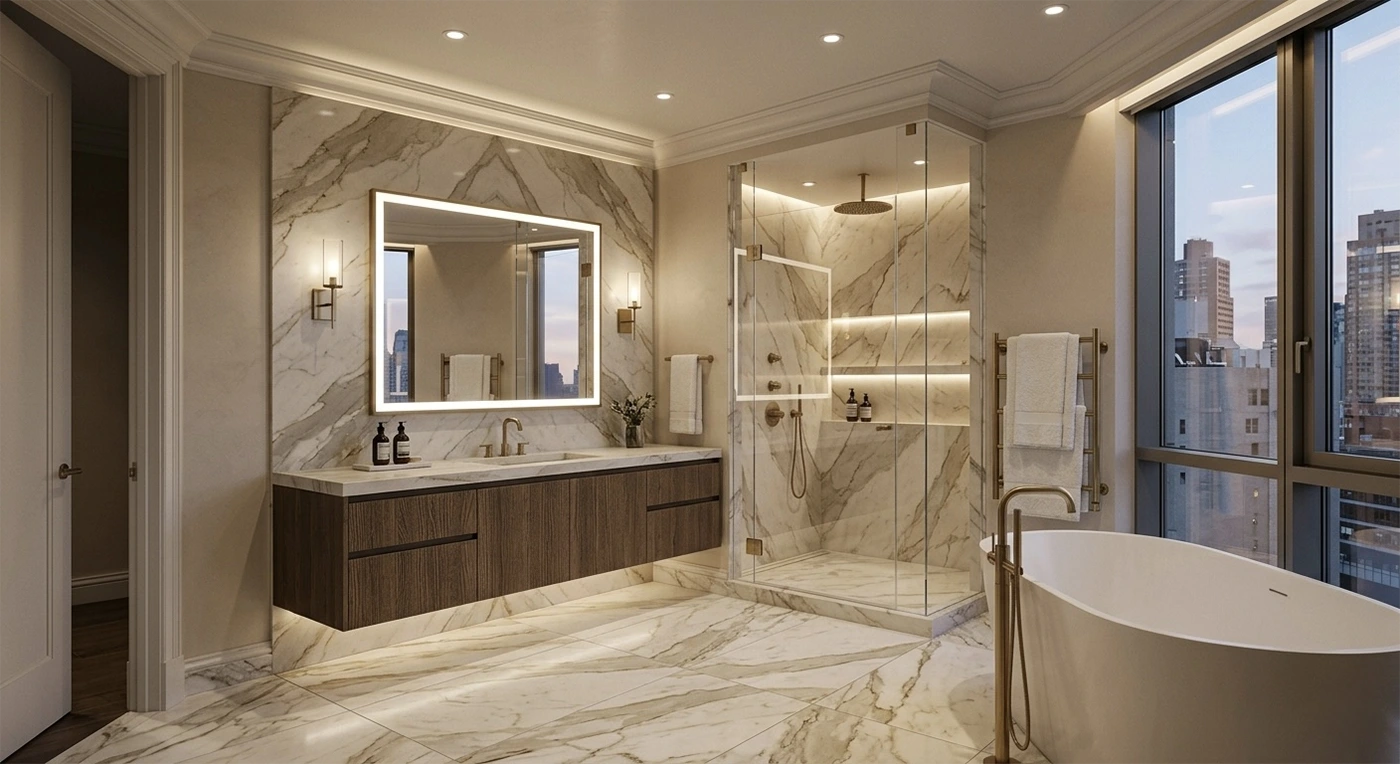
$50K vs $150K Bathroom in NYC: What’s the Real Difference?
The bathroom is the room people most consistently underestimate when budgeting a renovation in New Y

Change Orders Explained: Why Your Final Price Is Always Higher
Almost everyone who has renovated an apartment in New York City has had the same conversation: the c

The Hidden Cost of Beautiful Spaces: What Instagram Doesn’t Show About Home Design
Have you ever scrolled through Instagram, paused at a stunning apartment photo, and thought that it